
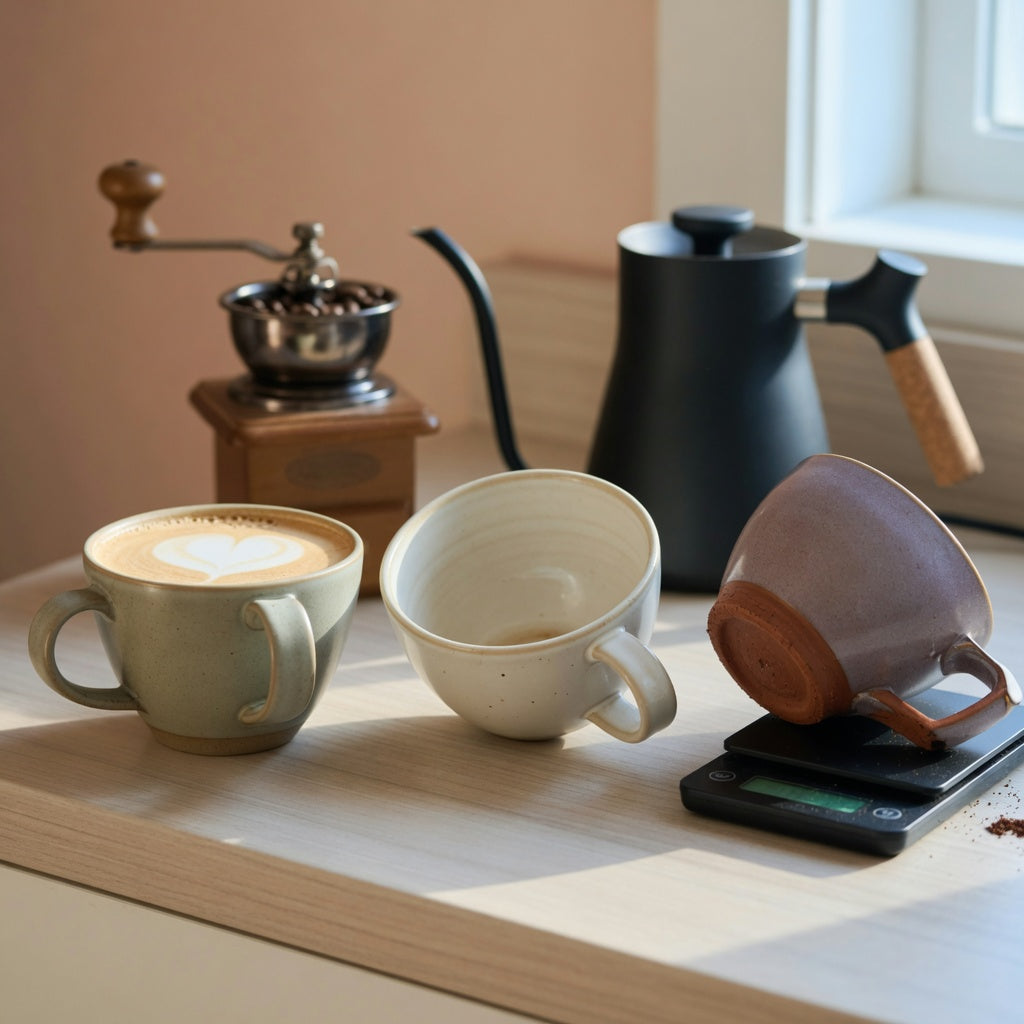
Ceramic Latte Cups Home Coffee Station Practical Purchase Checklist
Reading time: about 12 minutes
The message usually arrives with a photo: a latte cup sitting in a spreading puddle, foam sliding down the outside, and a caption that reads “It says 10 oz — I poured 8 and it overflowed.” We see that photo often enough at CoffeifyMug that it changed how we describe capacity on a product page. The number printed on a ceramic latte cup is almost always measured at the rim. Nobody drinks from the rim.
So this is not another broad buying guide. It is the ceramic latte cups home coffee station practical purchase checklist our team runs when a customer is standing at the counter with two cups in hand, unable to decide. Some of it is arithmetic. Some of it is food-safety paperwork most listings never show you. All of it is checkable before you pay.
Why does a cup labeled 10 oz overflow at 8 oz of latte?
Because three different numbers get printed as capacity, and listings rarely say which one they mean:
- Brim-full volume. The water line at the very top edge. It is the largest number, and it is the one most listings quote.
- Comfortable fill line. Roughly a centimeter below the rim, so you can carry the cup across a kitchen without watching it.
- Usable drink volume with foam. Espresso, steamed milk, and the foam cap, all sitting under the fill line. This is the number that decides whether your counter gets a puddle.
The FDA’s own description of ceramic cups and mugs is a useful anchor here: it treats them as small hollowware that normally holds about 240 mL (8 fl oz), usually with a handle, with curved sides for a cup and cylindrical sides for a mug. Café service has been built around roughly that volume for a long time, which is why a cup stamped 10 oz so often feels smaller than the number promises.
Our rule of thumb: assume the listed figure is brim-full, then subtract one finger’s width of headroom. If you build a thick microfoam cap, subtract a little more.
250 ml, 400 ml, 440 ml — what our three cups actually give you
We keep three shapes on the shelf, and the honest way to compare them is to convert the milliliters and then think about what physically goes in. A double shot of espresso is roughly 50–60 ml; the rest of the volume is milk and air.
- Ball Handle coffee and tea mug — 250 ml (about 8.5 fl oz brim-full). After a double shot, close to 190 ml remains for milk and foam. That is a flat white, a cortado with room, or a small latte — and the drink surface sits near the rim, which is where a pitcher spout likes to work. It is the wrong cup if your usual order is a 12 oz latte; you will be pouring twice.
- The Flow coffee and tea mug — 400 ml (about 13.5 fl oz brim-full). The size most people mean when they say latte. A 12 oz (355 ml) drink leaves roughly 45 ml of headroom — workable for a moderate cap, tight if you like a thick one.
- Morning and Night coffee and tea mug — 440 ml (about 14.9 fl oz brim-full). Best for a long milk drink, an iced latte where ice eats volume, or a station where one cup has to handle tea as well. It behaves like a large latte cup or an everyday mug, not a latte-art vessel.
Cup size quietly sets your espresso-to-milk ratio. The 250 ml pushes you toward a milkier, smaller drink; the 440 ml stretches the same shot across more milk and lands closer to a caffè latte in proportion. You can see all three silhouettes side by side in our unique coffee mugs collection.
Does a rounded interior or a straight wall suit your pour?
No standards body publishes the ideal interior shape for a latte cup, so treat any confident claim about the “correct” bowl with suspicion. What the geometry physically does is easier to stand behind.
A rounded or bowl-like bottom gives the milk somewhere to curl. Pour into the center and let the pitcher rise, and the curve encourages foam to fold instead of slamming flat into a corner. A straight-sided mug gives you taller vertical walls, which means a smaller surface and less room to draw — fine for a heart, frustrating if you are trying to push a rosetta out to the rim.
Rim thickness matters more than buyers expect. A thin rim asks for a tighter pour and can feel sharp by the tenth cup of the morning; a slightly thicker rim gives foam somewhere to land. Neither is a defect.
One honest limitation: if you drink your latte with a spoon and skip the art entirely, a rounded interior is doing nothing for you. Straight walls stack better in a cabinet and scrape clean faster.
Handle clearance and counter footprint: the fit test most buyers skip
A 440 ml cup full of latte weighs noticeably more than the empty cup you lifted in a photo. That is when two things go wrong — the handle digs into your knuckles, or the base is too wide for the strip of counter beside the grinder.
The Ball Handle takes its name from a rounded grip rather than a flat strap; check the listing photos for the actual profile, because a curved handle suits some hands better than others once the cup is full. On the wider two cups the handle stands further from the wall, which buys knuckle clearance at the cost of counter depth.
Three things to do before checkout:
- Measure the counter strip where the cup will live and compare it to the diameter listed on the product page. A cup that will not sit beside the grinder ends up in a cabinet.
- Mime the lift with a full water bottle of similar weight. If your index finger has to jam against the body, a different handle shape will suit you better.
- Check what ships in the box. Our verified details cover the cups themselves; whether a saucer is included should be confirmed on the current listing, not inferred from a styled photo.
Chips most often appear where the handle meets the body — that junction takes the knocks when cups are stacked while still wet.
The ceramic latte cups home coffee station practical purchase checklist
Run these in order. Each line exists because skipping it is a common way to end up with a cup at the back of the cabinet.
- Write down your real pour volume. Espresso plus milk plus foam for the drink you actually make on a Tuesday, not the one you make for guests.
- Convert the listed capacity. Multiply milliliters by 0.034 to get US fluid ounces, then subtract a finger’s width of headroom.
- Match the interior to your goal. Rounded bottom for pouring art; straight wall for stacking and scrubbing.
- Measure the counter. Note the listed diameter against the gap beside your grinder, kettle, or knock box.
- Test the lift. Handle shape only matters when the cup is full and heavy.
- Look for a glaze statement that names a standard and a result, not just a “food safe” badge.
- Read the care line. Microwave, dishwasher, and any metallic decoration should each be addressed. If one is missing, treat it as unconfirmed for that cup.
- Confirm what is in the box. Cup alone, or cup and saucer.
What a “lead-free” glaze claim verifies — and what it does not
This is the part of the checklist that separates a careful buyer from a lucky one. The FDA’s action level for leachable lead in ceramic cups and mugs is 0.5 micrograms per milliliter of leaching solution, applied to any one of six units tested. Cadmium has its own action level for small hollowware, also 0.5 micrograms per milliliter, measured the same way.
The method behind those numbers, ASTM C738, uses an acetic-acid extraction that the FDA itself describes as a severe test unlikely to be matched in ordinary use — so a genuine pass is reassuring. The trouble is that the phrase “lead free” alone is not the pass. The FDA has documented traditional pottery labeled lead free that still released lead at or above its action levels, and it states that ceramicware with extractable lead should not carry that label at all. It also notes that washing or boiling a piece cannot remove lead from a glaze that released it.
What that means at the counter:
- Prefer factory-made commercial ceramicware over handmade, antique, flea-market, or damaged pieces; the FDA describes everyday commercial factory pottery as much less likely to have lead problems.
- Treat bright orange, red, and yellow decorative glazes as higher concern, especially on the surface that touches your drink.
- Retire any cup with a chipped, cracked, or crazed glaze. Once the glassy layer is broken, the safety argument goes with it.
- Remember that ceramicware which looks decorative still falls under food-use rules unless it carries a proper “Not for Food Use” warning on the piece. A pretty cup without that warning is not automatically safe to drink from.
If a listing cites testing, look for the standard and the result rather than the marketing phrase. Where a page does not publish that detail, ask before you buy — or treat the claim as a question you have not yet resolved.
Microwave, dishwasher, and the metallic-trim trap
The FDA explains microwaving plainly: metal reflects microwaves, while glass, paper, ceramic, and plastic let them pass, which is why those containers work at all. That is a fact about materials, not a certification of any individual cup.
The clear rule is the metallic one. If a cup has a gold or platinum luster, a metallic band, or a painted trim that catches the light, keep it out of the microwave. Sparking is the obvious risk; heat concentrating in a thin metallic film is the quieter one. Plain undecorated ceramic is the safer profile — but confirm the care line on the listing before you rely on it for your specific cup.
Dishwashers are a separate question. Detergent is mildly abrasive across hundreds of cycles, and it dulls satin glazes and works at the seam where the glaze meets an unglazed foot ring. Check the manufacturer’s care marks rather than assuming, and hand-wash anything with a decorative surface you want to keep crisp.
Two habits extend the life of any ceramic latte cup. Preheat with hot tap water before you pour, and never take a cup straight from a cold rinse to a boiling fill. Thermal shock shows up as a hairline crack at the base rather than a dramatic break, and you usually discover it when the cup starts weeping onto the counter.
Which of our cups fits which station?
| Cup | Listed capacity | Station it fits |
|---|---|---|
| Ball Handle coffee and tea mug | 250 ml (about 8.5 fl oz) | You pull a double shot, steam a small pitcher, and want the foam close to the rim. Also a sensible tea cup on a narrow counter. |
| The Flow coffee and tea mug | 400 ml (about 13.5 fl oz) | The standard morning latte. Enough room for a 12 oz drink with a moderate foam cap. |
| Morning and Night coffee and tea mug | 440 ml (about 14.9 fl oz) | Long milk drinks, iced lattes where ice displaces volume, or a household drinking both tea and coffee from one shelf. |
Comparing two of them? Put the smaller and larger cup next to each other physically if you can, or scroll the full CoffeifyMug collection and judge the proportions against your usual drink volume.
Where a ceramic latte cup is the wrong buy
We would rather you skip the purchase than return it. These cups are not the answer if:
- You need heat retention through a 45-minute commute. Ceramic is not an insulated vessel. If the drink has to stay hot in a bag, a sealed insulated tumbler is the correct tool.
- You want a 16 oz iced latte with room for ice. None of these three will do it. The 440 ml comes closest and still runs short once ice goes in.
- Your household breaks glassware regularly. Fired ceramic chips when it meets tile. Stack carefully, or buy a shape you are at peace replacing.
- You need care guarantees that are not published. We state capacities plainly because those are the verified figures. Microwave, dishwasher, and material composition should be confirmed against the current product listing before you rely on them.
Frequently asked questions
Is a 400 ml ceramic latte cup the same as a 12 oz cup?
No. 400 ml is about 13.5 US fluid ounces to the rim, while 12 oz is about 355 ml. That leaves roughly 45 ml of headroom for foam — enough for a thin cap, tighter if you build a thick one. If your usual drink is exactly 12 oz with a heavy foam layer, the 440 ml gives you more margin.
Does a rounded-bottom cup actually make latte art easier?
It helps, but it is not magic. A curved interior gives the milk a path to fold into instead of hitting a flat corner, which makes a clean first pour more achievable. Rim width and handle angle matter just as much, and no standards body defines an official latte-cup shape, so weigh geometry claims accordingly.
How do I check whether a ceramic latte cup’s glaze is food-safe?
Look for a testing statement that names a standard and a result, not just a “food safe” badge. The FDA’s action level for leachable lead in ceramic cups and mugs is 0.5 micrograms per milliliter, measured by acetic-acid extraction under ASTM C738. Factory-made ware from a consistent production line carries far less risk than handmade, antique, or damaged pieces, and any cup with a chipped or crazed glaze should be retired.
Can I microwave or dishwasher a ceramic latte cup?
It depends on the individual piece, so confirm it on the listing rather than assuming. Plain ceramic without decoration is the safer profile; anything with metallic trim, a gold luster, or a painted metallic band should stay out of the microwave entirely, since metal reflects microwaves and can spark or concentrate heat. Dishwasher detergent also dulls satin glazes over time, so hand-washing decorative surfaces is the conservative choice.
What is the shortest version of this ceramic latte cups home coffee station practical purchase checklist?
Four steps: convert the listed milliliters to fluid ounces, subtract a finger’s width for foam, measure the counter space you actually have, and confirm the care line and glaze statement on the product page. If all four check out and the handle feels right in a full-cup lift, the cup will work on your station.
Start with the arithmetic and the lift test, because those two decide most of it. Then open the CoffeifyMug collection, put the 250 ml, 400 ml, and 440 ml cups side by side, and run each one through the eight-line checklist above before it goes in the cart.
More from our blog
Read more
Cute Espresso Cups Home Coffee Station Practical Purchase Checklist
A cup-by-cup checklist for buying cute espresso cups that clear your spout, catch both streams, and survive the sink — plus what 170, 200, and 250 ml really mean for a double shot.
Read more
Cute Espresso Cups Replacement Purchase Product Shortlist Guide
Replace the cup, not the habit. A capacity-first shortlist of the three compact ceramic cups we sell — 170 ml, 200 ml and 250 ml — with the exact replacement scenario each one suits and the honest ...
Read more
Leave a comment
This site is protected by hCaptcha and the hCaptcha Privacy Policy and Terms of Service apply.