
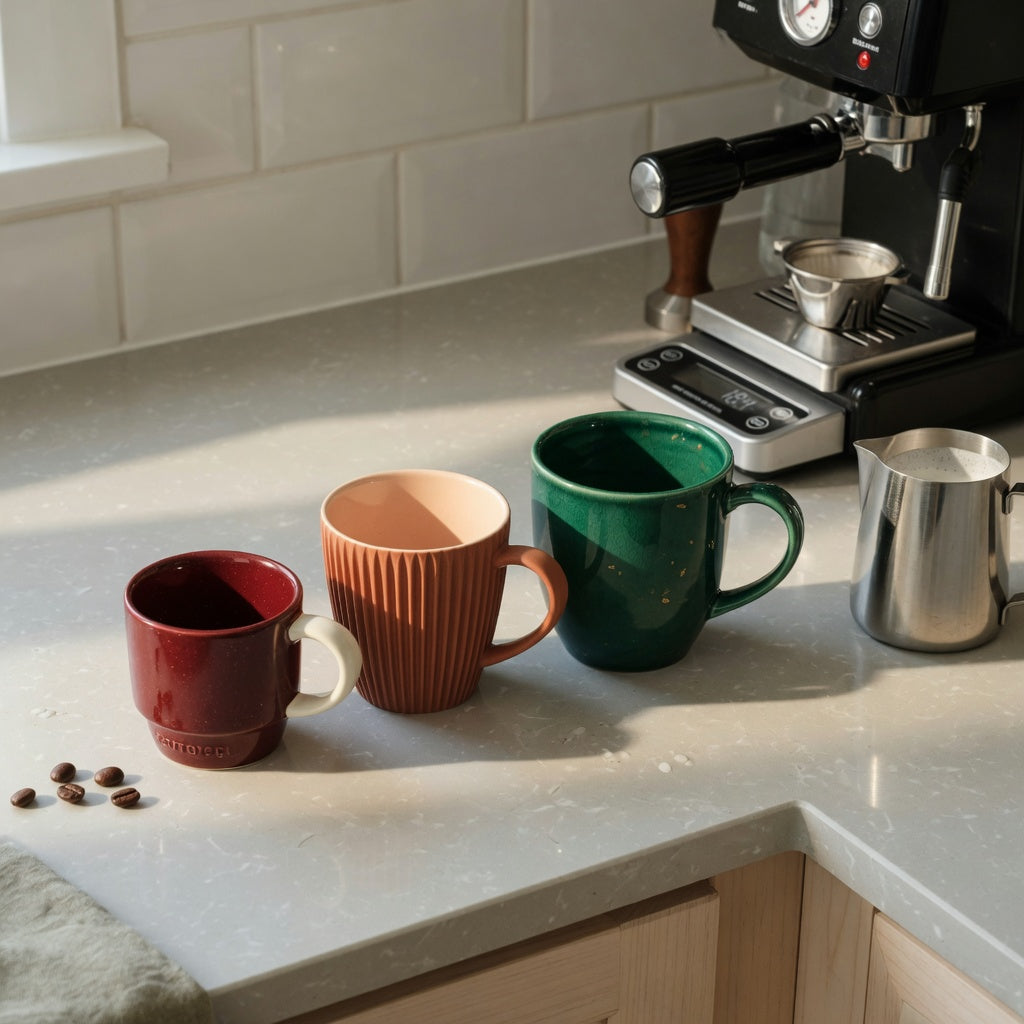
Ceramic Cortado Cup Home Coffee Station Practical Purchase Checklist
Reading time: about 8 minutes
A grinder, scale, milk pitcher, and espresso machine can consume most of a kitchen counter before the cup even enters the workflow. Pick from a styled photo alone and two problems can appear: the drink sits low in more capacity than you wanted, or the cup interferes with the machine, scale, or neighboring tools. That is where a ceramic cortado cup home coffee station practical purchase checklist becomes more useful than a general recommendation for a small mug.
Because we sell and handle ceramic drinkware at CoffeifyMug, we separate verified catalog facts from assumptions. The facts used here are simple: the Retro has a listed capacity of 170 ml, the Pleated 200 ml, and the Emerald 270 ml. We can compare those numbers and calculate potential spare capacity. We cannot use them to promise external dimensions, appliance clearance, heat retention, extraction performance, dishwasher or microwave safety, or suitability for professional cafe service. None of these products is presented here as purpose-built, tested, or certified for cortado.
How much of the cup does your normal drink actually occupy?
The useful starting point is not a textbook cortado recipe. It is the drink you repeatedly make. Milk quantity, foam, and personal preference can shift the finished level, so measure the occupied volume instead of choosing from the drink name.
- Prepare your usual drink in the cup you currently use.
- Mark the finished fill line with a small piece of removable tape on the outside.
- After the cup is empty and cool, refill it with cool water to that line and pour the water into a graduated measuring jug.
- Repeat this on three normal coffee mornings and keep the highest reading for comparison.
This method captures the space your actual drink uses, including the level created by your usual milk texture. Once you have that number, subtract it from each listed capacity. The result is an arithmetic comparison, not a guaranteed comfortable fill margin.
| Verified option | Listed capacity | Difference at a 120 ml fill | Difference at a 150 ml fill | Difference at a 180 ml fill |
|---|---|---|---|---|
| Retro | 170 ml | 50 ml | 20 ml | 10 ml over listed capacity |
| Pleated | 200 ml | 80 ml | 50 ml | 20 ml |
| Emerald | 270 ml | 150 ml | 120 ml | 90 ml |
Those differences show the capacity trade-off clearly. They do not establish the position of a usable fill line because cup geometry and the method used to determine listed capacity are not verified here. If your measured drink nearly equals a cup's full listed capacity, choose more room rather than treating the catalog number as a target fill level.
Ceramic cortado cup home coffee station practical purchase checklist: four station measurements
Liquid capacity does not reveal exterior height, rim width, base diameter, or handle reach. A 170 ml cup is the lowest-capacity option in this comparison, but that fact alone does not prove that it has the smallest footprint or will fit beneath a particular brewer. Before ordering, take four measurements around the equipment you actually own.
- Vertical clearance: Measure from the drip tray, or from the top of your scale if you brew onto one, to the lowest fixed part above the cup position.
- Platform space: Record the usable width and depth of the tray or scale. Leave access to the scale display and controls rather than counting the entire appliance surface.
- Working clearance: Check the space needed to place and remove a cup without striking the outlet, pitcher, grinder, or wall. Include handle reach if the chosen piece has a handle.
- Storage space: Measure shelf height and depth, then account for the number of cups stored together and the room needed to lift one out safely.
Compare those measurements with current product information before buying. If a dimension needed for your setup is not displayed, ask our store rather than inferring it from capacity or photography. This is especially relevant for shallow shelves, machines with limited cup clearance, and compact scales whose display sits close to the vessel.
Which verified capacity matches your coffee routine?
There is no automatic best size. The useful choice is the one that maps your measured fill level and preferred spare capacity to a verified option. The recommendations below rely only on the listed 170 ml, 200 ml, and 270 ml capacities.
| Reader situation | Why the option fits the comparison | Relevant next step |
|---|---|---|
| Your highest measured fill stays comfortably below 170 ml, and you want the least excess listed capacity. | Retro is the lowest-capacity option at 170 ml. | Review the Retro 170 ml coffee and tea cup and confirm its current dimensions and care information. |
| Your drink sits too close to 170 ml, or you want a 30 ml capacity step without moving to 270 ml. | Pleated is the middle option at 200 ml, providing 30 ml more listed capacity than Retro. | Compare your measurements with the Pleated 200 ml coffee and tea cup. |
| Your routine varies, your measured fill exceeds 200 ml, or you deliberately want the largest capacity in this group. | Emerald is listed at 270 ml, which is 70 ml above Pleated and 100 ml above Retro. | Check the Emerald 270 ml coffee and tea mug against your required clearance and storage space. |
| Your drink reaches or exceeds 270 ml, or none of the shapes, dimensions, or documented care details suit your routine. | Forcing one of these three capacities would leave a known mismatch. | Move to the broader unique coffee mug collection and compare a different capacity or style. |
A middle capacity is not automatically the safest purchase, and the largest is not automatically the most versatile. For a tightly controlled short drink, unused capacity may feel unnecessary. For someone still varying milk quantity, a narrow arithmetic margin may be frustrating. Use the measured number and the station dimensions together.
What should be confirmed before the first dishwasher cycle?
Care requirements can decide whether a cup belongs in daily rotation. This article does not claim that the Retro, Pleated, or Emerald is dishwasher safe or microwave safe because those details are not among the verified facts supplied for this comparison. If an evening dishwasher cycle or microwave reheating is part of your routine, confirm the current product instructions or packaging before purchase and use.
We also recommend a basic inspection whenever ceramic drinkware is unpacked:
- Examine the rim, body, base, and any handle attachment under clear light for chips or hairline cracks.
- Place the empty cup on a flat, dry counter and check for unexpected rocking.
- Keep photographs of visible package or product damage before discarding the packing materials.
- Do not use a chipped or cracked piece; contact the seller for the appropriate next step.
These checks are useful after gift unboxings as well as personal purchases. A recipient who relies on a dishwasher, has limited shelf clearance, or needs a specific capacity may prefer a different style if those requirements cannot be confirmed. The word ceramic by itself does not establish care method, resistance to sudden temperature changes, or heat retention.
When is a compact ceramic cup the wrong purchase?
Choose a different vessel if your measured drink regularly exceeds 270 ml, includes enough ice to consume most of that capacity, or needs a lid for travel. Ceramic is also a poor match for someone whose priority is an unbreakable or very lightweight cup. If verified microwave or dishwasher use is essential and cannot be confirmed for the product under consideration, that unknown should stop the purchase rather than become an experiment after delivery.
A cup also cannot correct espresso extraction or milk preparation. Change grind, dose, time, or technique for those issues; select the cup for occupied volume, physical fit, handling preference, care routine, and appearance.
What should you check immediately before ordering?
Use this ceramic cortado cup home coffee station practical purchase checklist as a final filter rather than relying on the product photo alone:
- Measure the highest fill level from three normal drinks.
- Choose how much arithmetic space you want above that measured volume.
- Compare 170 ml, 200 ml, and 270 ml without treating capacity as an exterior dimension.
- Measure machine clearance, tray or scale space, handle room, and storage.
- Confirm any required dimensions and care instructions from current product information or our team.
- Select the linked product that matches, or use the collection when none of the three does.
Frequently asked questions
How do I use the ceramic cortado cup home coffee station practical purchase checklist?
Measure the volume occupied by your usual drink, decide how much spare capacity you want, and compare that result with 170 ml, 200 ml, and 270 ml. Then measure the physical space around your machine, scale, and shelf. Confirm any missing dimensions or care requirements before ordering.
Is a 170 ml ceramic cup large enough for my home cortado?
It can be if your highest measured fill leaves the margin you prefer below 170 ml. For example, a 150 ml fill leaves only a 20 ml arithmetic difference, while a 120 ml fill leaves 50 ml. Those numbers do not guarantee a comfortable pour line, so avoid choosing a capacity that your drink nearly reaches.
Does the Emerald's 270 ml capacity mean it will fit under my espresso machine?
No. Capacity measures liquid volume, not exterior height, width, base diameter, or handle reach. Measure the available clearance and compare it with current product dimensions, or ask us if a required measurement is not listed.
Are the Retro, Pleated, and Emerald dishwasher or microwave safe?
This checklist does not make either claim because dishwasher and microwave safety were not included in the verified facts used here. Check the current product page, packaging, or a direct answer from our store before using any of these cups in a dishwasher or microwave.
Which capacity makes the most practical gift for a home coffee station?
There is no universal gift size. Ask about the recipient's usual drink volume, machine clearance, shelf space, and care routine; then map those answers to 170 ml, 200 ml, or 270 ml. If those details are unavailable, a different mug style with confirmed requirements may be a better gift than guessing.
Tomorrow morning, mark your normal fill line and measure it once the cup is cool. Add the four station measurements, verify the care details you rely on, and compare the resulting numbers with Retro, Pleated, and Emerald. If none clears every check, continue through the unique coffee mug collection instead of accepting a daily mismatch.
More from our blog
Read more
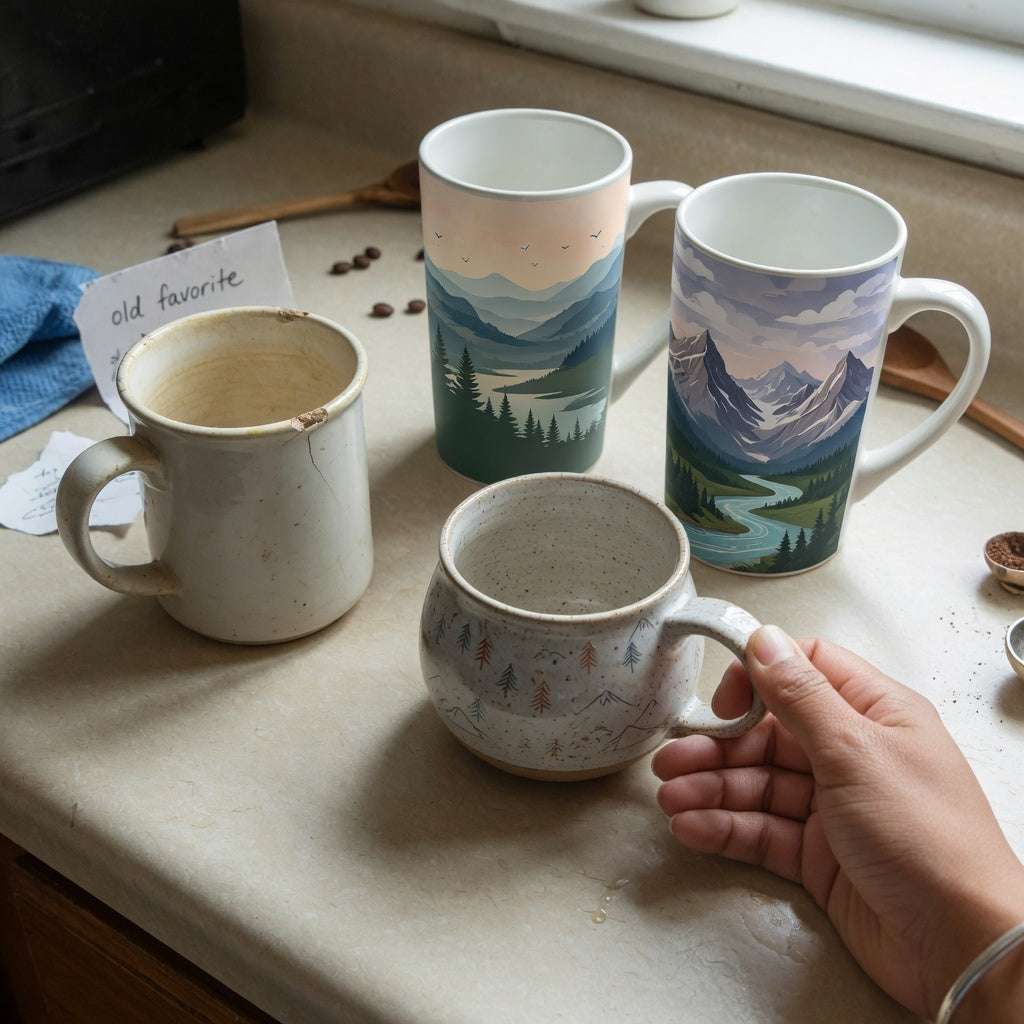
12 oz ceramic coffee mugs replacement purchase product shortlist guide
Use the mug you are retiring as the specification. Compare practical fill, handle and shelf clearance, care requirements, and tall versus round forms before choosing a replacement.
Read more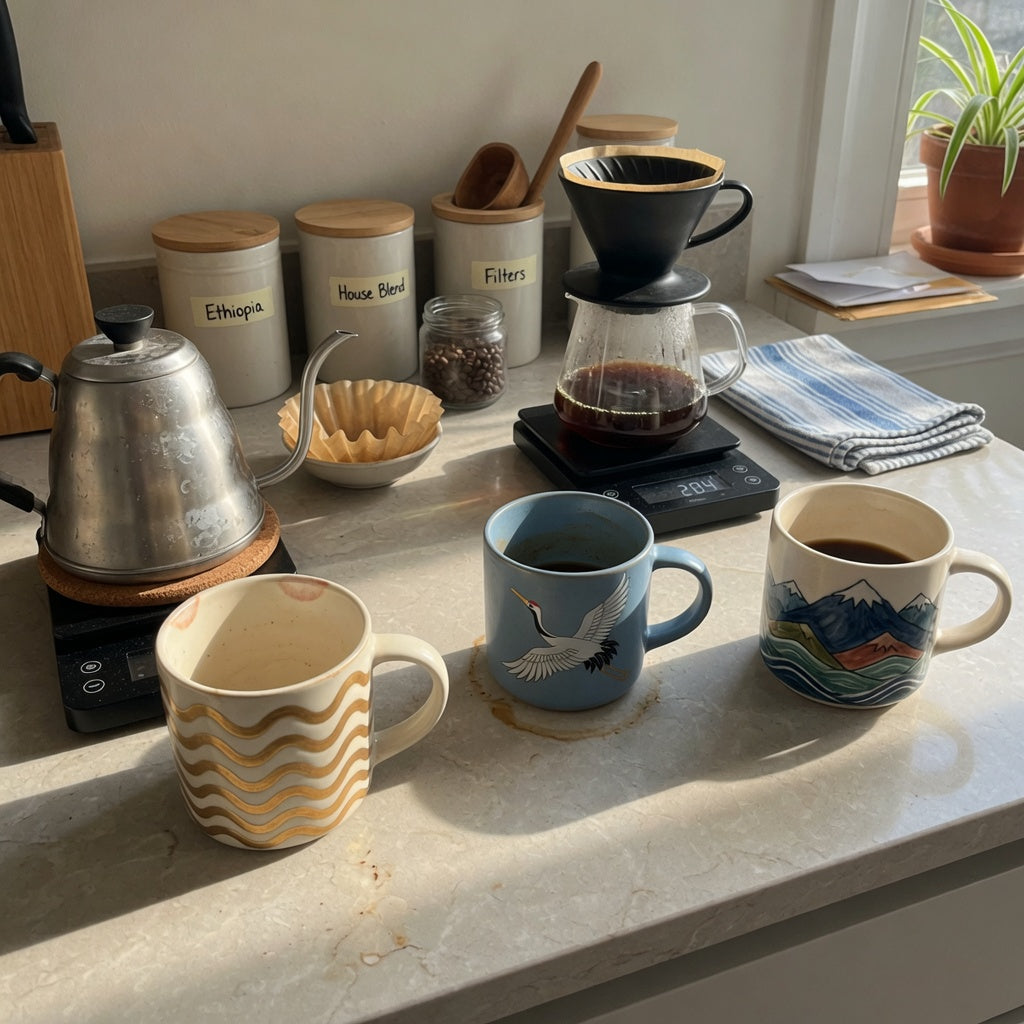
Coffee Mug Gift Idea Home Coffee Station Practical Purchase Checklist
A counter-first checklist for matching a gift mug to available space, drink volume, care habits, and station style. Compare three CoffeifyMug designs without relying on unlisted specifications.
Read more
Leave a comment
This site is protected by hCaptcha and the hCaptcha Privacy Policy and Terms of Service apply.