
Ceramic Coffee Mug With Handle: Home Coffee Station Buying Checklist
Reading time: about 9 minutes
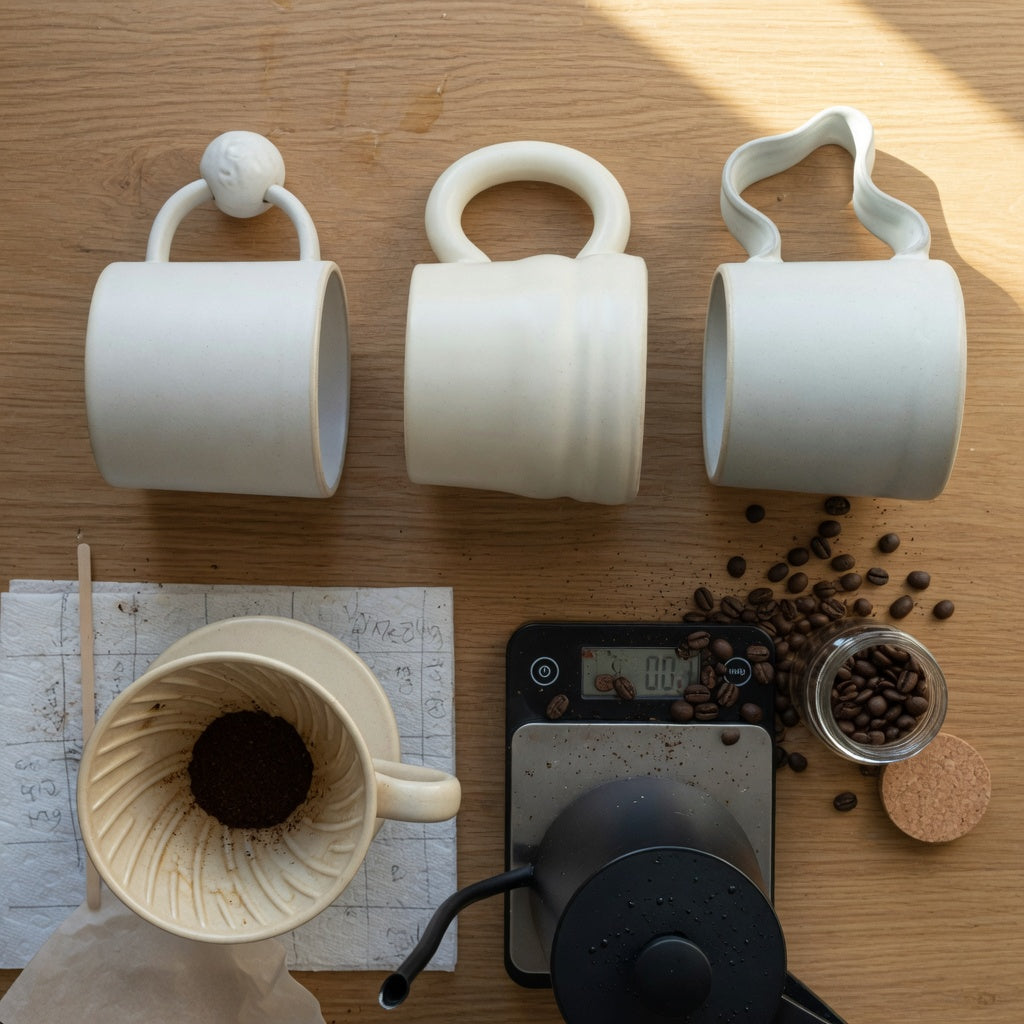
A mug can look compact on a product page and still crowd the counter once it sits between a kettle base, scale, dripper, and bean jar. This ceramic coffee mug with handle home coffee station practical purchase checklist starts with that occupied counter, because the usable footprint matters more than the empty space shown in a styled photograph.
We handle and sell this category in our store, so we separate details shoppers can verify from qualities that cannot be established through a listing. For the mugs covered here, the useful comparison points are the listed ceramic material, listed capacity, visible handle form, and vessel shape. Product photos do not prove ergonomic comfort, fit for a particular hand size, strength, heat retention, or suitability for a dishwasher or microwave.
How much counter space does the mug actually get?
Do not measure the entire coffee station. Measure the space left after every item that normally stays on the counter is in its working position. A mug may have room while the kettle is parked, then lose that room when the kettle turns, the scale moves forward, or a dripper is placed over the cup.
- Place the kettle, grinder, scale, dripper, spoon rest, and storage jars where they sit during a normal brew.
- Use your current mug to trace a rough body-and-handle outline on paper. Cut or fold the paper to create a simple footprint gauge.
- Record the narrowest usable width and depth, including the handle area rather than measuring only the mug base.
- Check vertical clearance below shelves, hanging tools, and low kettle spouts.
- Lift your current mug along the path your dominant hand normally follows. Mark any point where the handle or body approaches another item.
This test gives you a physical envelope for comparison. Keep those measurements beside the product photos while browsing our unique coffee mugs collection. If a listing does not provide every dimension you need, treat the missing measurement as an unknown rather than assuming the mug will fit.
Which handle form clears your kettle, scale, and reach path?
A handle has more than one relevant measurement. Check how far it projects from the vessel, where its widest point sits, how high it rises, and how the visible opening relates to your grip path. A handle that clears the counter may still meet a scale edge during lifting.
Comfort cannot be judged reliably from a photo. Neither can fit for large or small hands. What you can compare is visible geometry. On each product page, identify the point farthest from the mug body and compare that position with the paper footprint from your counter.
- Open side space and a distinctive handle: The Ball-Handled Coffee Tea Mug is the relevant starting point when the visible ball-form handle is part of the station's design. Its shape should still be checked against the available side clearance before purchase.
- A rounded visual profile: The Round Coffee Tea Mug suits shoppers who want the rounded vessel presentation shown in its imagery. Compare the widest part of that body, not just its base, with your tray or scale area.
- A more fluid, sculptural profile: The The Flow Coffee Tea Mug is the logical option when its visible flowing form matches an open display station. Confirm that the handle and vessel silhouette do not enter the working path of nearby equipment.
None of these is automatically the best handle. The correct choice is the form that clears your equipment while meeting your visual preference. A shopper with a wide, uncluttered counter can prioritize shape more freely than someone fitting a mug into a narrow tray.
Does the listed capacity match your normal finished drink?
Use the volume you actually drink, not the amount of water placed in the kettle. Coffee grounds retain water, a server may hold part of the batch, and milk or ice changes the space required in the mug. Those differences make a familiar recipe more useful than a vague preference for a small or large cup.
To create a comparison number, fill your current favorite mug with water to its normal drinking line, then pour that water into a kitchen measuring jug. If you regularly add milk, leave the same headroom you use every morning. For iced coffee, repeat the test with your usual amount of ice in the mug so displacement is represented.
Compare that result with the capacity listed on each product page. If a listing does not say whether its figure is a brimful measurement or a practical serving capacity, use the number to compare products rather than treating it as a guaranteed working fill. A larger listed capacity may provide more headroom, but it can also mean a larger vessel competing for counter space.
What does the ceramic listing confirm, and what remains unknown?
The products in this comparison are listed as ceramic. That identifies the material category, but it does not establish wall thickness, finished weight, impact resistance, heat-retention time, or compatibility with specific appliances. We do not convert the word ceramic into performance promises that are not stated on the product page.
Ceramic can chip or crack after an impact, so a stationary kitchen or office station is a more natural setting than a bag, vehicle cup holder, or uneven outdoor surface. If your mug will be moved between locations every day, a travel vessel designed around a lid and transport may be the better category.
After unboxing any ceramic mug, we recommend checking four practical areas before regular use:
- Rim: Look and feel for an unexpected chip or rough impact point.
- Handle joins: Inspect both attachment points under clear light for a visible hairline crack or separation.
- Foot ring: Set the empty mug on a dry, flat counter and check for noticeable rocking.
- Glaze and body: Compare any unexpected line, pit, or surface variation with the product imagery and description.
Care instructions require the same restraint. Check the product page, packaging, or care label before the first dishwasher cycle or microwave use. If that information is not stated for the exact mug, do not assume compatibility from the ceramic material alone.
Which mug fits your specific coffee-station brief?
We use the station situation first and the product name second. This keeps a visually appealing detail from overriding a practical conflict with the equipment already on the counter.
| Reader situation | Why the option belongs on the shortlist | What to verify before buying |
|---|---|---|
| Open side clearance and a statement handle are priorities | The Ball-Handled Coffee Tea Mug makes its ball-form handle the visible design feature | Handle projection, listed capacity, and the full vessel footprint |
| A rounded mug silhouette suits the jars, tray, or dripper already on display | The Round Coffee Tea Mug provides the relevant rounded visual direction | Widest body point, base placement, and capacity compared with the usual pour |
| The station has display room for a flowing, sculptural vessel | The Flow Coffee Tea Mug provides that specific visual route | Clearance around the complete silhouette and the lifting path |
| No single profile clearly fits the measured space | The collection allows a broader visual comparison instead of forcing one of three forms | Material listing, dimensions if provided, capacity, handle form, and care information for each candidate |
These are scenario-based shortlists, not rankings. For example, the ball-handled option may be a strong style choice on an open shelf but a poor candidate for a narrow gap if its visible form exceeds your measured envelope. The Round or Flow mug may suit a different visual brief, but each still requires the same footprint check.
How should you use a ceramic coffee mug with handle home coffee station practical purchase checklist?
Run the checklist while standing at the station, with the relevant product pages open. It should take only a few minutes once you know your normal serving volume.
- Measure the remaining counter footprint after permanent brewing equipment is positioned.
- Include the mug body's widest point and the entire visible handle form in that footprint.
- Trace the normal lift path toward your dominant hand and note nearby edges or spouts.
- Measure the working volume of your usual coffee, tea, milk drink, or iced drink.
- Confirm that the product is listed as ceramic and record its listed capacity.
- Compare the product photos with your available width, depth, and vertical clearance.
- Check for explicit care statements; leave dishwasher and microwave suitability marked unknown if they are not provided.
- Remove any candidate that depends on an unverified assumption about comfort, strength, appliance compatibility, or hand-size fit.
The last step is easy to skip. A product photo can support a decision about visible form, but it cannot guarantee how the handle will feel in your hand. If grip comfort is the deciding factor and no relevant measurements are provided, buying in person may suit you better.
Who needs a different mug category?
A handled ceramic mug is not the default answer for every coffee setup. Choose another category if the mug needs features that are not established by the product listing.
- A sealed travel vessel is more suitable if leak resistance or bag transport is required.
- A specifically stackable design is better for a shelf where several mugs must nest or stack in limited vertical space.
- A product with explicit care documentation is the safer purchasing route if dishwasher or microwave use is mandatory for your routine.
- A mug with verified dimensions is preferable if a brewer, cup holder, warming surface, or narrow shelf imposes an exact size limit.
- An in-person handle test is more useful if guaranteed finger clearance or hand-size fit matters more than appearance.
Gift buyers should apply the same limits. A sculptural mug can make a strong unboxing impression, but it may be the wrong gift for someone who needs a stackable office cup or uses only dishwasher-approved drinkware. Ask for a photo of the recipient's station and their usual drink size when possible.
Frequently asked questions
What should a ceramic coffee mug with handle home coffee station practical purchase checklist cover?
It should cover available counter width and depth, handle clearance, normal finished-drink volume, listed capacity, ceramic material, vessel shape, and stated care information. It should also identify unknowns such as hand comfort, strength, heat retention, and appliance suitability instead of filling those gaps with assumptions.
Which handle shape is best for a small home coffee station?
There is no universally best handle for a small station. Compare the farthest visible point of each handle with the space beside your scale, kettle, and tray, then reject any form that enters the lifting path.
Can I assume a ceramic coffee mug is dishwasher and microwave safe?
No. Ceramic material alone does not confirm dishwasher or microwave suitability for a specific mug, glaze, or decorative finish. Use only the care information stated on the relevant product page, packaging, or label.
Can I brew pour-over coffee directly into these mugs?
Do not assume compatibility from the mug name. Compare your brewer manufacturer's supported cup or rim requirements with the mug's listed dimensions, rim shape, and capacity where available; if those details are missing, direct-brewing compatibility remains unverified.
Where should I compare the mug options before ordering?
Write down your maximum footprint, normal drink volume, and required care method first. Then open the unique ceramic mug selection, compare each relevant product page against those three facts, and remove any option that relies on an unknown you cannot accept.
More from our blog
Read more

Art Coffee Mugs Replacement Purchase Product Shortlist Guide: 3 Picks
Replace the limitations of your old mug, not just its motif. This shortlist compares three ceramic art mugs by visible imagery, listed capacity, everyday placement, and practical trade-offs.
Read more
Ceramic Tea Mug Home Coffee Station Product Shortlist Guide: 3 Picks
Compare three current CoffeifyMug ceramic tea and coffee mugs by listed capacity, visible body form, and handle shape. Each pick includes the station scenario it suits, why it fits, and a clear rea...
Read more
Leave a comment
This site is protected by hCaptcha and the hCaptcha Privacy Policy and Terms of Service apply.