
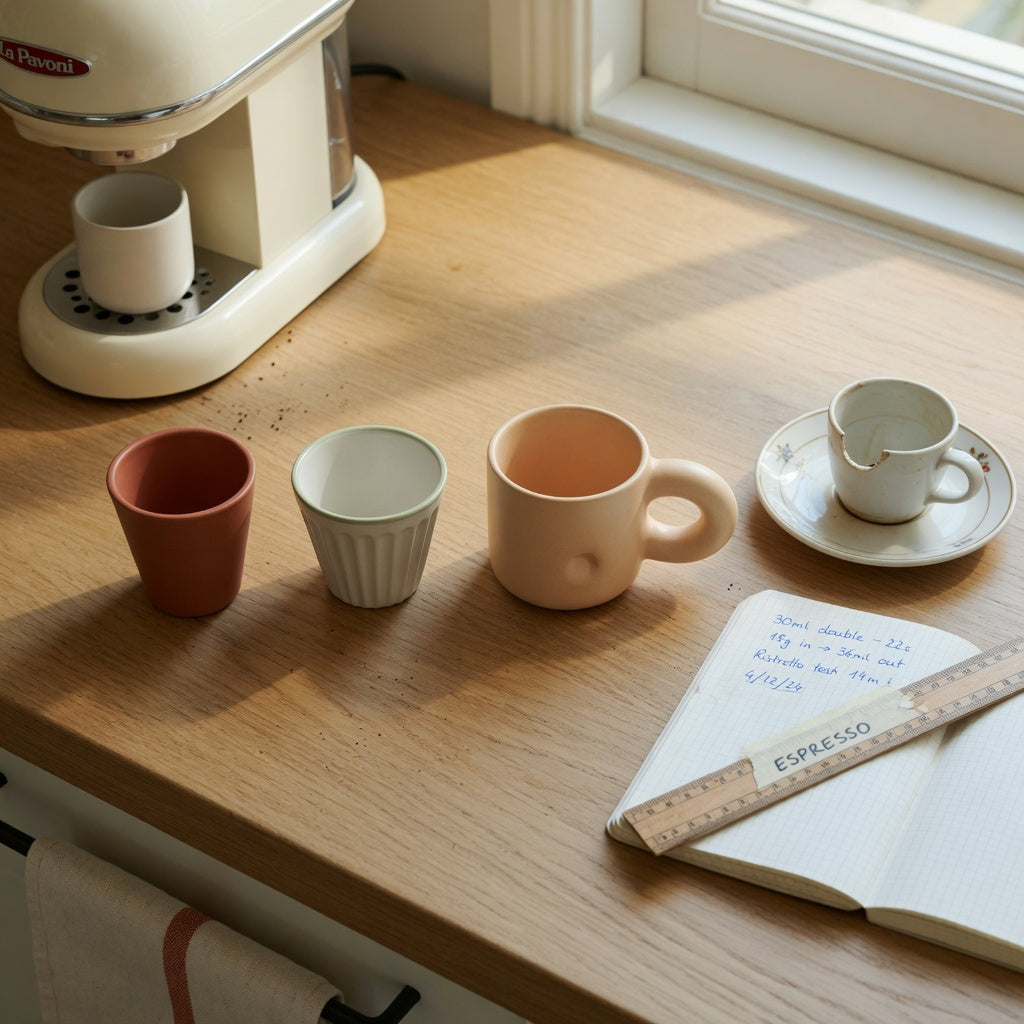
Cute Espresso Cups Replacement Purchase Product Shortlist Guide
Reading time: about 12 minutes
The handle snaps off in the sink. Or the rim chips, or the glaze goes dull and crazed after a winter of hot cycles, and a set of four quietly becomes a set of three. The cup everyone reaches for first is always the one that goes.
Then comes the reflex: buy the same one again. It rarely works. The model is discontinued, the colourway is gone, or — more often — it was never quite right and the break just forced the conversation. So build a cute espresso cups replacement purchase product shortlist guide around function rather than nostalgia: note what the dead cup did well, cross off what it did badly, and let a short list of candidates compete on capacity, machine fit, glaze, and whether the handle is genuinely usable with hot coffee in it.
That is the version we walk customers through at the counter and over email. It is deliberately short. We carry three compact ceramic cups in this shape range, and we would rather tell you which one to skip than sell you the wrong one and process the return a fortnight later.
Why this cute espresso cups replacement purchase product shortlist guide starts with the old cup's faults
Before you open a single product page, answer three questions about the cup you are retiring. Most disappointing replacement purchases come from skipping this step and shopping on looks alone.
- What did it actually hold? Not the capacity printed on the base — the real pour. If you pulled a double into it every morning and it never sloshed, you need at least that much room again.
- What annoyed you? A handle too small for two fingers. A rim too thick to drink from cleanly. A bowl so wide the crema broke apart before you sat down. That annoyance is your filter, not a footnote.
- Where does it live? Open shelf, cupboard stack, desk, or machine tray. Shelf cups can be decorative. Stacked cups have to survive being nested. Desk cups get knocked over, and handle shape decides whether that happens.
Three lines on a notepad will eliminate most of the market before you start comparing anything. It also stops you paying for a pattern you love on a vessel that repeats the fault you were trying to escape.
What 170 ml, 200 ml and 250 ml really mean for an espresso replacement
Espresso itself is small. Traditional Italian service is commonly described as roughly 25 ml of coffee in a cup of about 50 ml, specialty definitions usually place a single shot in the 25–35 ml band, and competition training cups are capped near 90 ml. Modern home practice pushes further still: a double pulled at a 1:2 ratio can land around 36 g of liquid in the cup.
Every cup we point replacement buyers toward sits above that classic range. The three in this shortlist are listed at 170 ml, 200 ml and 250 ml — ceramic bodies, compact profiles, and roughly three to five times the volume of a true demitasse. That gap matters far more than the pattern on the outside, so here is the blunt size map we use in-store:
- Under 90 ml: textbook demitasse territory. Tight crema, hot in the hand, built for singles and ristretti.
- 150–210 ml: a double with headroom, or a shot plus a modest pour of steamed milk.
- 220–260 ml: doubles, small filter coffees, tea, and anything that travels away from the machine.
If the cup you loved was a genuine 60–90 ml china demitasse, be straight with yourself: our cups are the wrong category and another demitasse is the right purchase. We would rather lose that sale than pad a review request with a customer who feels misled. If the chipped thing you are replacing was an everyday mug doing espresso duty, the three below are an upgrade rather than a compromise.
| Cup | Listed capacity | Best fit | Skip it if |
|---|---|---|---|
| Retro Coffee & Tea Cup | 170 ml | Doubles, lungos, a shot with a small milk pour | You want a true 2 oz demitasse, or crema visible at the rim |
| Pleated Coffee & Tea Cup | 200 ml | Cortado and macchiato drinkers, small pour-overs | You want a visually silent cup that matches a plain white set |
| Ball-Handled Coffee & Tea Mug | 250 ml | Desk use, doubles plus tea, one-cup households | You drink straight espresso and want minimum surface area |
Three replacement scenarios, three cups — and the reason to skip each one
None of these is the universal answer. Each solves a different replacement problem, and each has a buyer it will quietly disappoint.
Replacing a cracked demitasse with the smallest option: Retro Coffee & Tea Cup (170 ml)
Your situation: you pull doubles more often than singles, the old cup was small, and you want the least bulky thing that still holds a full shot without threatening the drip tray.
Why it fits: the listed capacity is 170 ml, which gives a modern double real headroom, and it is the most compact of the three. The retro drum profile reads as deliberate on an open shelf — worth thinking about if your cups live out on display rather than in a cupboard, because a pretty cup you resent is still a cup you resent.
Skip it if: you want crema visible right at the rim, or you drink milk-based coffees most mornings. Add textured milk to 170 ml and generous becomes tight fast.
Check the Retro Coffee & Tea Cup listing for the current details before you order, including what ships in the box.
Replacing the cup that also made macchiatos: Pleated Coffee & Tea Cup (200 ml)
Your situation: the old espresso cup was really doing two jobs, and the replacement has to survive a straight shot and a shot with a small milk pour on the same morning.
Why it fits: 200 ml listed capacity, with the fluted, pleated wall as the visible feature — it catches light on a shelf and looks decorative in a way a plain cylinder does not. That extra 30 ml over the Retro gives a milk pour somewhere to go instead of climbing the rim. It is the middle option, which is exactly why it suits the buyer who has not decided yet.
Skip it if: you want a cup that disappears visually, or you are matching an existing plain set. Fluting is the point of this one, and small grooves also collect dust on open shelving, so plan on a quick rinse before the first pour of the day.
Read the Pleated Coffee & Tea Cup listing for care notes and dimensions rather than assuming they match the cup beside it in the photo. If a cortado is your regular drink rather than an occasional one, a narrower vessel is honestly a better tool than anything on this page.
Replacing the mug that never leaves the desk: Ball-Handled Coffee & Tea Mug (250 ml)
Your situation: the cup is going to sit beside a laptop, get refilled twice, and sometimes hold tea instead of coffee.
Why it fits: 250 ml is the largest of the three, so a double plus hot water — or a long black — still leaves room to lift the cup without watching the surface. The listing names it for its ball handle, and that rounded loop is the detail that separates it from the other two on a crowded desk: you can find it with one hand while reading a screen.
Skip it if: you drink espresso exclusively. At 250 ml the coffee spreads across a wide surface and cools noticeably faster than it would in a 90 ml cup. Measure your spout clearance before you commit, too — this is the tallest of the three in practice, and a mug that will not slide under the group head is a mug you will stop using.
Start with a ruler, then look at the Ball-Handled Coffee & Tea Mug. All three sit side by side in our unique coffee mugs collection, which makes comparing shapes in one scroll far easier than juggling browser tabs.
Will the cup fit under your spout? A five-minute measuring routine
There is no published standard for spout-to-tray clearance, so fit is a per-machine question and no product photo can answer it for you. We have had customers return perfectly good cups because nobody told them to check. Do this first:
- Lock the portafilter in with an empty basket and rest a ruler upright on the drip tray.
- Measure from the tray up to the underside of the spout. That is your absolute ceiling, not your working height.
- Leave a few millimetres of daylight between the cup rim and the spout, or the next shot will hit the rim and spray sideways across the counter.
- Check the rim aperture against your double spout. Two streams land apart from each other, and a narrow mouth will send one of them down the outside of the cup.
- Wrap a strip of masking tape on the ruler at your measured height and photograph it. It is faster than re-measuring when you are standing at a checkout screen at 11 pm.
If your clearance is genuinely tight, a demitasse or a handleless cup is the better purchase, and we would rather say so than sell you a 250 ml mug that lives permanently on the shelf.
Crema, wide bowls, and why decoration can hide the shot
Two things change the moment you step up from a demitasse, and both are worth knowing before you choose a finish.
- You see less crema. In a 50 ml cup the crema covers the whole surface. In a 200 ml cup it is a small island in the middle. A plain white interior makes that island easy to read; a dark, speckled, or heavily patterned interior hides the thing many drinkers use to judge a shot. Decoration is lovely — it simply is not neutral.
- You lose heat faster. More surface area means more contact with cool air. Preheating the cup with hot water while you grind closes most of the gap and costs nothing but a kettle boil.
Neither point is a reason to avoid a larger cup. They are reasons to know which job the cup is doing before you pay for it.
Glaze safety and dishwasher claims: what to verify on the listing
Ceramic that touches food deserves a straight answer. The U.S. FDA explains that lead in a ceramic glaze is bound into the finished piece when pottery is fired correctly, but that improperly fired glaze may not fuse and can contaminate food. The agency also notes that some traditional pottery labelled lead-free has still shown extractable lead, and that ceramicware intended only as decoration must be identified so it is not used with food. That last point matters when a cute cup is sold as an ornament — read the label, not the styling.
Practical questions to settle before ordering, because we will not guess on your behalf:
- Dishwasher: painted and hand-finished glazes vary enormously in how they handle repeated hot cycles, and a blanket claim from us would be worth less than the care note on the product page.
- Rim thickness: thin rims chip first. Look closely at the rim edge in photos — a rolled or slightly thicker edge survives a busy sink far better.
- Microwave: never assume, even for a plain-looking ceramic.
- Temperature shock: pouring boiling water into a cold cup is harder on any ceramic than warming it gradually first, and it is the most common way a good cup cracks.
- Accessories: whether a saucer or stand is included can change between batches. Confirm on the current listing instead of trusting an older photo.
Gift shortlist or daily-driver shortlist? They are different shopping trips
These two buyers search the same words and need opposite things.
- Buying as a gift: consistency beats capacity. A matched pair or a small set unwraps better than one odd cup, and a shape that feels pleasant in the hand matters more than whether it fits under a machine the recipient may not own yet. The retro and pleated profiles read as considered presents; the ball-handled mug reads as everyday and personal rather than gift-like.
- Buying as a daily driver: capacity first, then machine fit, then looks. A beautiful cup that mists your countertop every morning stops being beautiful quickly.
If the person you are shopping for genuinely prefers a big mug to a small cup, this shortlist is the wrong page — start from the larger end of the range instead and work backwards.
Frequently asked questions
What should a cute espresso cups replacement purchase product shortlist guide include?
Four things before anything decorative: the capacity of the cup you are replacing, the capacity you actually need for the shots you pull, the measurement from your drip tray to the spout, and the care instructions on the specific listing. Looks come after those four, not before them.
Will a 170 ml cup make my espresso go cold faster than a 60 ml demitasse?
Generally yes. A wider vessel exposes more liquid surface to the air, so heat leaves sooner. Thick ceramic walls slow that a little but do not cancel it out. Preheating the cup with hot water while you grind closes most of the gap.
Can I use these cups for a macchiato or a small cortado?
The 200 ml and 250 ml cups handle a shot with a modest milk pour comfortably. The 170 ml cup is the tightest of the three once milk is involved. If a cortado is your standard order, a narrower vessel is the better tool than any of these.
Are these cups dishwasher safe and microwave safe?
Check the individual listing rather than a general answer here. Decorated and hand-finished glazes are not interchangeable, and care details can change between batches. The product page is the only place we will stand behind.
Do the cups come with matching saucers?
We will not answer that from memory, because included accessories vary. Confirm on the current listing for the cup you want, especially if a saucer matters to how you serve.
Start with the cup in your hand and the space under your spout. If your old cup was a genuine demitasse, buy another demitasse and ignore this page. If it was an everyday mug doing espresso duty, pick from the 170 ml, 200 ml and 250 ml options in our compact ceramic cup range — measure once, choose once, and stop replacing the same mistake.
More from our blog
Read more
Ceramic Latte Cups Home Coffee Station Practical Purchase Checklist
Most latte-cup returns start with the same mistake: trusting the number printed on the box. Here is the checklist our team runs before a cup earns counter space — capacity math, interior shape, han...
Read more
Pottery Tea Cups for Daily Brewing: 170 vs 200 vs 250 ml
Three ceramic pottery tea cups, three capacities, three different jobs. What 170 ml, 200 ml, and 250 ml actually pour like, how to check the glaze before the first brew, and which size you will kee...
Read more
Leave a comment
This site is protected by hCaptcha and the hCaptcha Privacy Policy and Terms of Service apply.