
Cute Espresso Cups Home Coffee Station Practical Purchase Checklist
Reading time: about 10 minutes
Two shots pulled into a 50 ml demitasse fill it to the rim. The same two shots in a 170 ml cup leave a wide band of bare porcelain above the crema — and that second picture is what most shoppers actually mean by cute espresso cups. It is also where the returns start, because a cup that looks right on a shelf still has to clear a portafilter and take a finger through the handle.
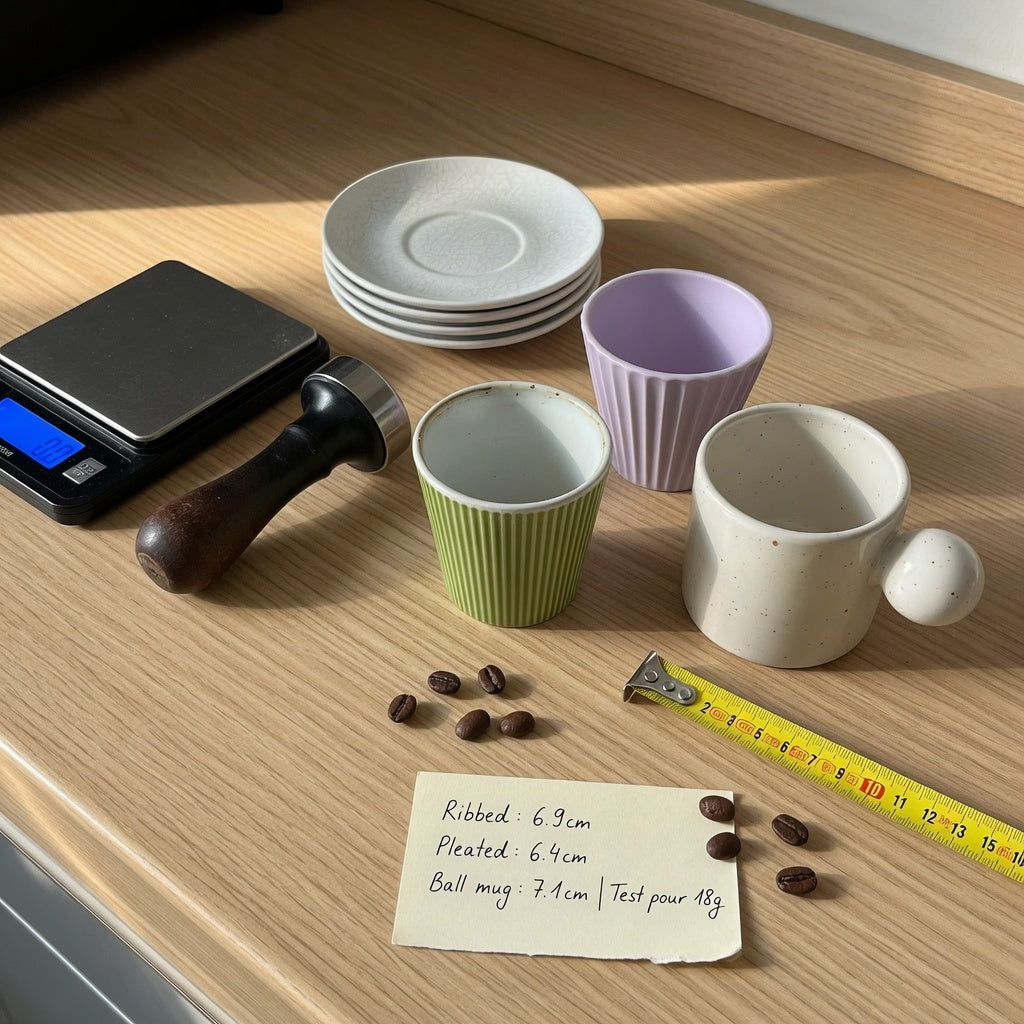
We handle these cups daily in our store, and the same three questions decide most sales: will it fit under the machine, is the handle usable, will the glaze survive the sink. So this cute espresso cups home coffee station practical purchase checklist is built around measurements you can take in your own kitchen, and around the three things we can state with confidence about our own cups — listed capacity, ceramic body, and visible form.
What a 170 ml cup really does to a 36 g double shot
A traditional Italian tazzina holds roughly 50 ml. A modern double pulled near a 1:2 brew ratio lands somewhere around 36 g of liquid, crema included. Those numbers describe a cup and a shot. They do not describe our line, where the smallest cup is listed at 170 ml — more than three times a classic demitasse and, on capacity alone, closer to a cortado cup.
That extra room changes the drink in three ways you can feel:
- Headroom. A double in the 170 ml Retro Coffee & Tea Cup sits low in the cup with a clear band of porcelain above it. Nothing slops on the walk from counter to desk.
- Crema spread. The same volume of foam across a wider surface reads as a thinner layer. If a thick, tiger-flecked crema is the point of the pour for you, a narrower mouth frames it better.
- Heat loss. More coffee touching more ceramic wall means more heat leaving the cup. Rinsing the cup with hot tap water first buys back a couple of minutes — the easiest upgrade in this category.
We would rather say plainly that a 250 ml mug is not a demitasse. It is a small coffee cup with a generous handle, and it earns its place for long blacks, milk drinks, and tea. Judging it as an espresso cup is how people end up disappointed.
The cute espresso cups home coffee station practical purchase checklist
Work down this list before you pay. Each line removes one reason to return the cup.
- Set the cup on the drip tray and look under the spout. No published standard exists for spout-to-tray clearance and machine heights vary too widely to guess, so this is your own measurement, taken with the cup in hand.
- Weigh the shot you actually pull. Eighteen grams in and roughly 36 g out is a common double; if you drink 45–50 g lungos, a genuine 60 ml cup becomes tight and our 170 ml cup becomes comfortable. Guessing here is how people buy a demitasse they never use.
- Measure the inner rim, not the outer diameter. Streams from a spouted portafilter land a few centimetres apart, and a rim wide enough to catch both forgives a basket that sits slightly off-centre.
- Decide whether milk goes in the cup. Black shots and macchiatos want different volumes; buy for the drink you make four mornings out of five.
- Put your own finger through the handle. Handle fit is the most common regret in this category, and a photo cannot tell you how much room a handle leaves. Treat it as something to confirm against published dimensions.
- Add the saucer to your footprint maths. A saucer roughly doubles the counter or shelf space a cup occupies. Four cups with saucers take about as much room as eight bare cups.
- Read the care line before you fall for the colour. If a listing does not state dishwasher or microwave guidance, assume hand wash only and keep it out of the microwave.
- Confirm it is sold as drinkware. The U.S. FDA's guidance on lead-glazed pottery notes that ceramicware intended only for decoration must be identified so it is not used with food — the same rule separates a real cup from a plush novelty.
Will a wide rim save a badly centred basket?
Sometimes, yes. A bottomless portafilter throws its two streams noticeably wider apart than a spouted one, and a narrow demitasse mouth will miss both if the basket sits even slightly off-centre. A wider rim is more forgiving. The trade-off is optical: the wider the mouth, the smaller the shot looks inside it, so the same 36 g pour that looks generous in a narrow cup looks like a puddle in a wide one.
If you switch between baskets, favour the wider mouth and accept the smaller-looking shot. If you pull into a spouted basket with a steady hand, a narrower cup rewards you with a better-looking pour.
Where does the crema go on a patterned or dark interior?
Tasting guidance generally favours a plain white interior because it gives crema maximum contrast — you can read the colour, the flecking, and how quickly it fades. A dark or heavily patterned interior hides all three. That is the honest cost of a decorated cup: you buy it for the shelf, not for the pour.
Double-wall glass shows the layers in a way ceramic cannot and holds heat longer, but the walls consume volume, which usually means a narrower mouth and a more fragile feel in the hand. Our three cups are ceramic, and their interiors are visible in the listing photos — look at those with a shot in mind, not an empty shelf.
Handles, saucers, and fifty centimetres of counter
Most home stations get about half a metre of usable counter, which is where cute cups multiply faster than the space allows. Three practical notes:
- A rough foot ring scratches. Turn the cup over. An unglazed base ring that feels gritty will mark a wooden counter or a painted shelf; a felt pad costs almost nothing.
- Stackability is a form question. Wide, flat rims stack. Flared, ribbed, or heavily decorated bodies usually do not, and stacking painted cups risks chipped rims. Check the silhouette rather than assuming.
- A saucer is storage, not just styling. It catches drips and gives the cup somewhere to land, but it doubles the footprint. Keep one saucer out for daily use and put the rest away.
Matching our three ceramic cups to real stations
These are listed volumes, ceramic body, and visible form — nothing more. Handle comfort, weight, wall thickness, exact dimensions, and dishwasher or microwave guidance are all things to confirm on the current product page rather than infer from a photo.
| Cup | Listed capacity | What that volume suits |
|---|---|---|
| Retro Coffee & Tea Cup | 170 ml | A double with real headroom, or a shot plus a small splash of steamed milk |
| Pleated Coffee & Tea Cup | 200 ml | A double with a proper macchiato-sized pour of milk, or a short tea |
| Ball Handled Coffee & Tea Mug | 250 ml | Long blacks, milk-forward drinks, and tea — the roomiest of the three |
Then match the situation, not the aesthetic:
- You pull doubles, drink them black, and want the pour to look deliberate. The 170 ml Retro cup is the closest fit in our line. A true 50 ml demitasse would frame a single shot better; this one gives you room to work and room for a splash.
- You alternate between espresso and a small milk drink. The 200 ml Pleated cup adds 30 ml — the difference between a splash and a proper macchiato pour.
- One cup has to cover coffee and tea for a guest. The 250 ml Ball Handled mug is the sensible single-cup answer when you do not want two shapes on the shelf.
Glaze, hot cycles, and what to check after a month
Colour and pattern are the whole point here, so care matters more than it does with plain white china. Two things we tell every shopper.
On food safety: the FDA explains that lead in a ceramic glaze is bound into the surface when pottery is fired correctly, but under-firing can leave lead able to migrate into food, and the agency also warns that some traditional pottery labelled lead free has still shown extractable lead (FDA questions and answers on lead-glazed pottery). That is why we tell people to confirm food-contact status on any hand-decorated or imported cup, ours included, instead of assuming it.
On durability: long-term dishwasher wear and chip resistance of hand-painted glazes are largely anecdotal rather than standardised, so we will not quote a cycle count. What we do suggest is a monthly look at the glaze under good light. Crazing — the fine web of cracks that can develop in a glaze after repeated hot washes — is the first sign a decorated cup is ageing. Retire it to display duties when you see it.
When the pretty cup is the wrong purchase
We would rather you skip a cup than store one you never reach for.
- Your daily drink is a 10 oz latte. A 170–250 ml cup will be half empty. Look for a full-size mug instead of forcing a small cup to do the job.
- You need the shot to stay hot for ten minutes. Thin ceramic at these volumes loses heat; a double-wall glass holds it longer, with the fragility and narrow-mouth trade-offs noted above.
- You pull ristretti of 20–25 ml. A 20 ml shot in a 250 ml mug reads as a mistake, not a choice.
- You need guaranteed machine clearance. No listing can promise it. Measure yours.
- You want a decorative object only. Plush and novelty espresso-cup items are not drinkware. Make sure the product is described as a cup for food use.
Start with the cup you reach for at 7 a.m.
Buy one cup in the capacity you drink most, live with it for a week, then add the second size. Most of the two-cup setups we see are a 170 ml for straight shots and a 250 ml for everything else, which covers a whole morning without a shelf full of cups that never get used. Write your spout-clearance measurement on a sticky note, tape it inside the cupboard where you will find it next time, and browse the unique coffee mugs collection to compare the three sizes side by side before you commit.
Frequently asked questions
What size cup do I need for a double shot of espresso?
A double pulled near a 1:2 ratio usually lands around 36 g of liquid including crema, so anything from roughly 60 ml upward holds it. Our 170 ml Retro cup leaves a clear band of headroom above a double, which helps if you add a splash of milk and looks odd if you expect a full cup.
Will these cups fit under my espresso machine?
There is no published standard for spout-to-tray clearance and machine heights vary widely, so measure your own setup: set the cup on the drip tray, slide it under the group head, and confirm visible daylight above the rim. Check the inner rim width too if you use a bottomless portafilter.
Is 170 ml too big for a single shot?
For a 25–30 ml single, yes — the liquid sits in the bottom third of the cup and cools quickly. That does not make the cup useless, it makes it a double-shot cup, a macchiato cup, or a small tea cup. If you mostly pull singles, buy a smaller vessel and preheat it before the shot.
Are coloured or hand-painted espresso cups dishwasher safe?
It depends on the specific glaze and firing, and long-term dishwasher wear on decorated ceramics is not standardised, so we will not generalise. Follow the care line on the individual listing; where none is published, hand wash and keep the cup out of the microwave.
Does this checklist change if the cups are a gift?
One step changes: you may not know the recipient's machine clearance, so shift the emphasis from spout height to capacity, care, and food-contact labelling. A 250 ml cup is the safer gift when you are unsure of someone's coffee habits, and a smaller cup is better when you know they pull doubles. The rest of the cute espresso cups home coffee station practical purchase checklist applies unchanged.
More from our blog
Read more
Ceramic Latte Cups Replacement Purchase Product Shortlist Guide
Replacing a chipped or awkward latte cup is a shortlist problem, not a shopping spree: match capacity to how you actually drink, check handle clearance and desk footprint, then verify glaze and car...
Read more
Ceramic Latte Cups Home Coffee Station Practical Purchase Checklist
Most latte-cup returns start with the same mistake: trusting the number printed on the box. Here is the checklist our team runs before a cup earns counter space — capacity math, interior shape, han...
Read more
Leave a comment
This site is protected by hCaptcha and the hCaptcha Privacy Policy and Terms of Service apply.