
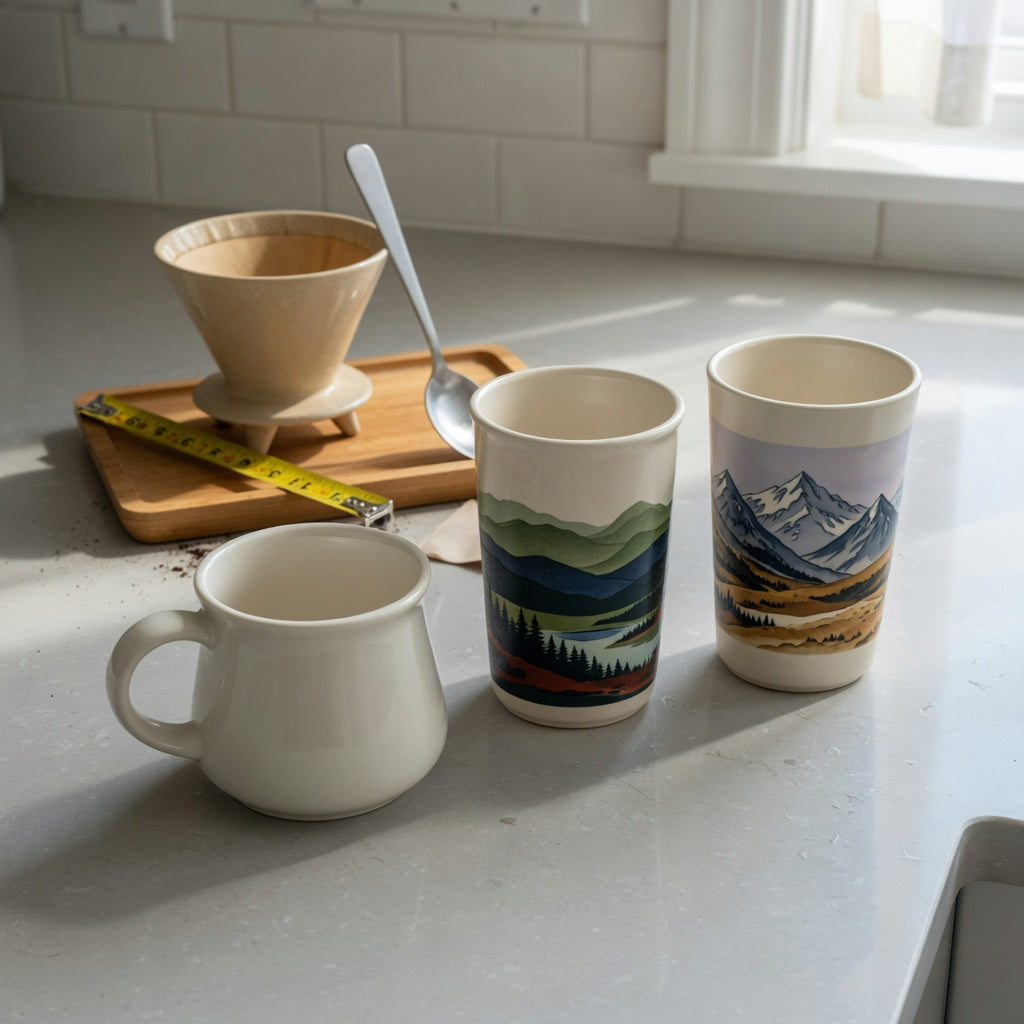
12 Oz Ceramic Coffee Mugs: Home Station Practical Purchase Checklist
Reading time: about 9 minutes
A mug can look perfectly proportioned beside a grinder in a product photo, then turn out to be too tall for the shelf above your counter or awkward once its handle faces forward. The problem usually appears after the coffee station is arranged, not while the mug is still in the cart. In our store, we call the pre-purchase check the 12 oz ceramic coffee mugs home coffee station practical purchase checklist.
The product-specific facts used here are deliberately narrow: the featured CoffeifyMug choices are 12 oz ceramic mugs offered in round, landscape tall, and mountain tall styles. Capacity, material, and visible design help narrow the options, but they do not establish appliance clearance, usable fill level, dishwasher compatibility, or microwave compatibility. Those details must come from the current product page or care instructions for the exact mug.
Does a 12 oz capacity match the drink you actually make?
Twelve US fluid ounces is approximately 355 mL. That conversion is useful for comparing the stated capacity with a measured recipe, but it does not automatically equal the amount you will comfortably drink from the mug. A capacity may be stated close to the rim, while normal use requires space for carrying, stirring, milk, or foam.
Measure the finished drink rather than relying on the setting printed on a brewer. Brew into your usual vessel, add the milk or water you normally use, and pour the result into a measuring cup. For iced coffee, include the ice in the test because it displaces liquid and reduces the amount of coffee that fits.
- Black coffee or tea: compare the full prepared volume with 12 oz and leave the headspace you prefer for carrying.
- Coffee with milk or foam: measure the complete drink, not just the brewed coffee.
- Iced coffee: test your normal ice quantity and liquid together; a 12 oz mug may feel restrictive for ice-heavy recipes.
- Shared brews: check how much each person actually pours instead of dividing a carafe by its labeled capacity.
A 12 oz ceramic mug is not the practical choice for a routine drink that already exceeds that volume before headspace. A larger mug will suit that recipe better. It can also be the wrong format for takeaway coffee, where a lidded and insulated vessel is more useful than open ceramic.
Can the mug clear your brewer, shelf, and neighboring tools?
A 12 oz label describes volume, not outside dimensions. Two ceramic mugs with the same capacity can differ in height, body width, handle projection, and foot-ring diameter. We recommend measuring the completed station, including the tray, dripper, brewer parts, spoon cup, and shelf above it.
- Check vertical clearance. Measure from the surface where the mug will sit to the lowest shelf, brewer component, or dripper. Include the tray thickness.
- Check the full footprint. Use the listed outside dimensions when available. The entire foot should rest on a stable surface without crossing a tray edge or grout line.
- Allow for the handle. Measure the space with the handle turned toward the direction from which you will grab it. A body that fits between tools may still leave no room for your fingers.
- Test the working path. Make sure the mug can be lifted out without striking a shelf, kettle, or hanging utensil.
Product photographs are useful for judging style, but they are not scale drawings. If a current listing does not provide a measurement that controls your setup, do not estimate it from another mug or infer it from the words round or tall.
Compatibility boundary: We cannot promise that a mug fits beneath a specific coffee maker, pour-over dripper, cup shelf, or warming surface unless the required clearance is known and the current product dimensions confirm it.
Which CoffeifyMug profile suits the station you already have?
The three product names provide clear style cues, but those cues should not be treated as performance ratings. A tall name does not prove a smaller footprint, and a round name does not by itself prove greater stability. Use the profile to choose a visual direction, then verify the measurements and care information on the exact listing.
| Reader situation | Why the option fits the brief | Relevant next step |
|---|---|---|
| You prefer a rounded silhouette and do not want a tall visual accent. | The product is presented specifically as a round coffee and tea mug. | Review the 12 oz round coffee tea mug, then compare its current dimensions with your measured space. |
| You want a tall ceramic profile with a landscape-led design. | The named style combines the tall format with landscape artwork. | Check the landscape tall coffee tea mug and confirm vertical and handle clearance. |
| You want a tall mug with a mountain theme. | The mountain design gives the station a distinct nature-focused option without changing the 12 oz shopping brief. | Open the mountain tall coffee tea mug and verify the current product details. |
| You are still comparing silhouettes or building a mixed display. | A broader collection makes it easier to compare visual options before committing to one profile. | Browse our unique ceramic coffee mug collection, checking each individual listing rather than assuming every item shares the same capacity. |
If the station is frequently bumped, do not choose from profile names alone. Base diameter, overall height, weight distribution, tray level, and the placement of nearby tools all affect real-world stability. Those variables need measurements or an in-person test.
What does ceramic require at unboxing and after each brew?
Ceramic is rigid and breakable. From handling this category, our team pays particular attention to the exposed rim, the handle attachment points, the glazed body, and the foot that meets the counter. Those are the areas worth checking before a new mug enters daily rotation or gets wrapped as a gift.
- Run a fingertip carefully around the rim and look for chips or sharp spots.
- Inspect both handle joins under side lighting for a hairline crack.
- Place the mug on a clean, level, dry surface and check that debris or a damaged foot is not causing movement.
- Examine the glazed and decorated surfaces for damage that may have occurred in transit.
Follow the exact listing or care label before using a dishwasher or microwave. Ceramic as a broad material category does not guarantee that every glaze, decoration, or mug construction is suitable for either appliance. For routine hand washing, mild dish soap, a soft sponge, a complete rinse, and thorough drying avoid the abrasion caused by aggressive scouring pads.
If the current instructions confirm dishwasher use, load the mug so its rim and handle cannot knock against neighboring pieces during the cycle. Stop using a mug with a cracked handle or chipped drinking rim. Ceramic is also a poor match for drop-prone outdoor use, commuting without a secure lid, or shoppers who need vacuum-insulated heat retention.
How many mugs belong on a working coffee station?
A matching set can look orderly, but buying the full set before checking fit multiplies the cost of a wrong decision. If dimensions, grip, or usable fill level are uncertain, start with one profile. Wash it according to its instructions, fill it to your normal drinking level, and use it in the actual station for several mornings.
During that trial, notice whether your fingers clear nearby tools, whether the mug lifts cleanly beneath the shelf, and whether the normal drink leaves enough room to carry it. For a gift, inspect the mug before wrapping it and consider the recipient's usual drink size. A 12 oz ceramic mug is a weak gift choice for someone who almost always uses oversized iced drinks or takes coffee on a commute.
The 12 oz ceramic coffee mugs home coffee station practical purchase checklist
Use this list with the current product page open. It separates confirmed listing information from details that only your kitchen and recipe can establish.
- Measure the complete prepared drink, including milk, water, foam, or ice.
- Confirm that 12 oz provides enough room for both the drink and your preferred carrying headspace.
- Measure vertical clearance from the final resting surface, including any tray, to the lowest obstruction.
- Compare the listed mug height and width with the available space. If a controlling dimension is missing, ask before buying.
- Allow room for the handle, your fingers, and the path used to lift the mug.
- Choose round, landscape tall, or mountain tall for its stated profile and design, not an assumed stability or footprint advantage.
- Read the current care instructions for dishwasher and microwave guidance instead of generalizing from other ceramic mugs.
- Inspect the rim, handle joins, glaze, and foot at unboxing, especially before giving the mug as a gift.
- Test one mug first if you are uncertain about hand feel, shelf clearance, or practical fill level.
- Choose a larger, lidded, insulated, or less breakable vessel if your recipe and routine call for it.
Frequently asked questions
What belongs on a 12 oz ceramic coffee mugs home coffee station practical purchase checklist?
Include finished drink volume, carrying headspace, mug dimensions, vertical clearance, handle room, care instructions, and an unboxing inspection. The checklist should also identify when a larger, insulated, lidded, or less breakable vessel would fit the routine better.
Will a 12 oz ceramic mug fit under my coffee maker or pour-over dripper?
Capacity alone cannot answer that. Measure the available height with every tray and brewing component in its normal position, then compare that measurement with the mug height stated on the current product page.
Is a 12 oz mug large enough for a latte or iced coffee?
It depends on the finished recipe. Measure the espresso or coffee, milk, foam, and ice together, then allow headspace; choose a larger mug if the total approaches or exceeds 12 oz.
Is a round ceramic mug more stable than a tall ceramic mug?
Not necessarily. Stability depends on actual base width, height, weight distribution, surface level, and how the mug is used, so the profile name or photograph is not enough to make that claim.
Can CoffeifyMug ceramic mugs go in the dishwasher or microwave?
Check the current product listing and the care information supplied with the exact mug. Do not assume compatibility from the ceramic material alone, because construction, glaze, and decoration can affect the appropriate care method.
Start with four facts written beside your station: prepared drink volume, available height, available footprint, and handle clearance. Then compare the round and tall options in our unique coffee mugs collection. Put a mug in the cart only after its current listing and your measurements agree; if they do not, a different size or material is the more practical purchase.
More from our blog
Read more
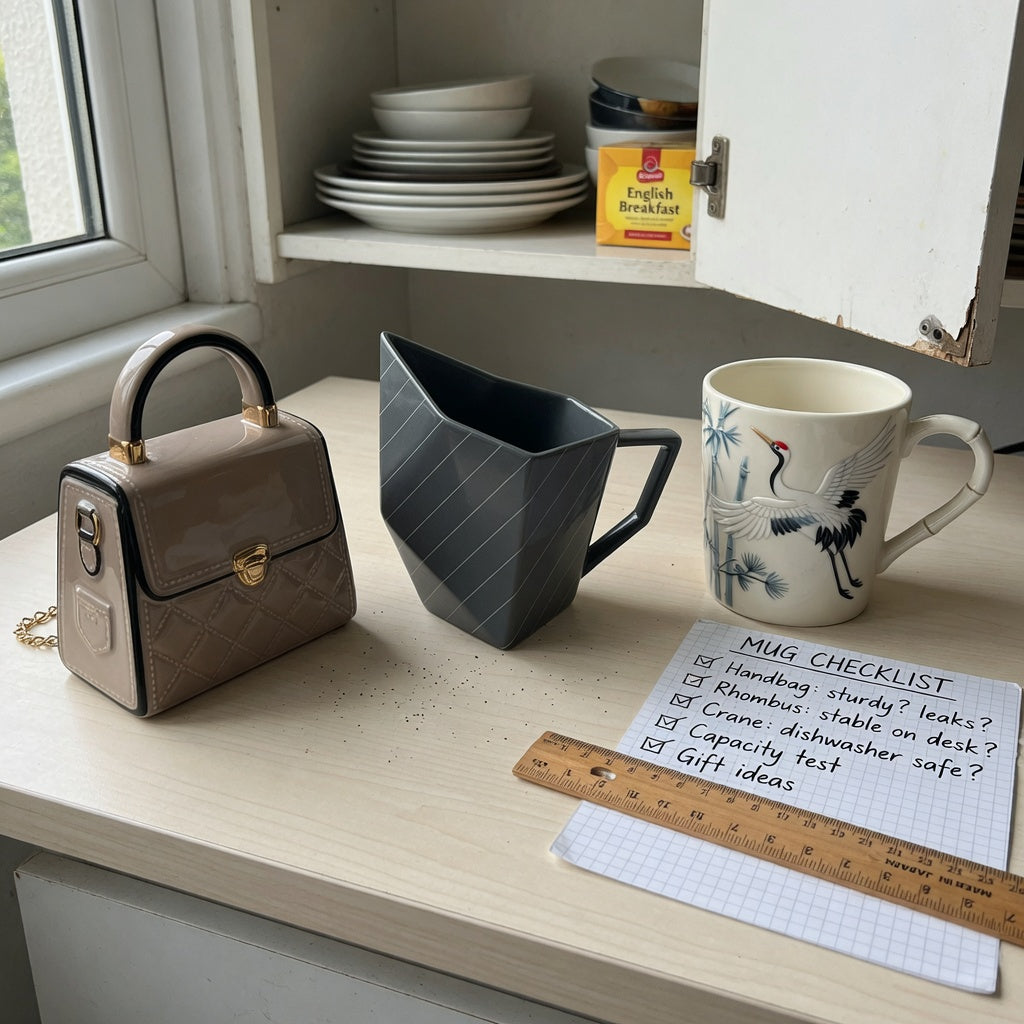
Unique Coffee Mugs for Gifts Gift Choice Practical Purchase Checklist
Match a recipient's coffee or tea routine to the Handbag, Rhombus, or Crane design. This checklist separates listing facts from the size, care, storage, grip, and unboxing details a gift buyer stil...
Read more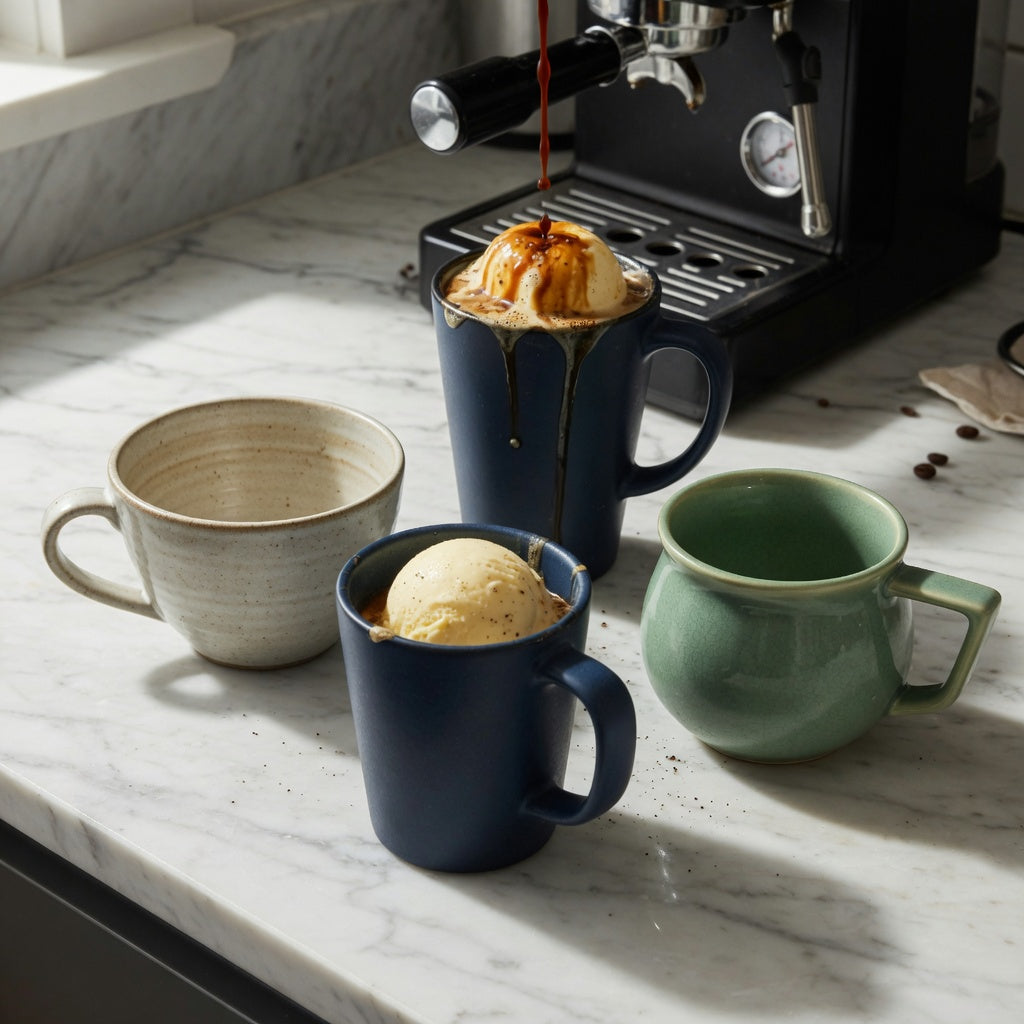
Affogato Cup Home Coffee Station Product Shortlist Guide: 3 Sizes
Compare the verified 170 ml Retro, 200 ml Pleated, and 270 ml Emerald by serving room and visible shape. Each pick includes a clear reason to choose it, skip it, and check station fit before ordering.
Read more
Leave a comment
This site is protected by hCaptcha and the hCaptcha Privacy Policy and Terms of Service apply.