
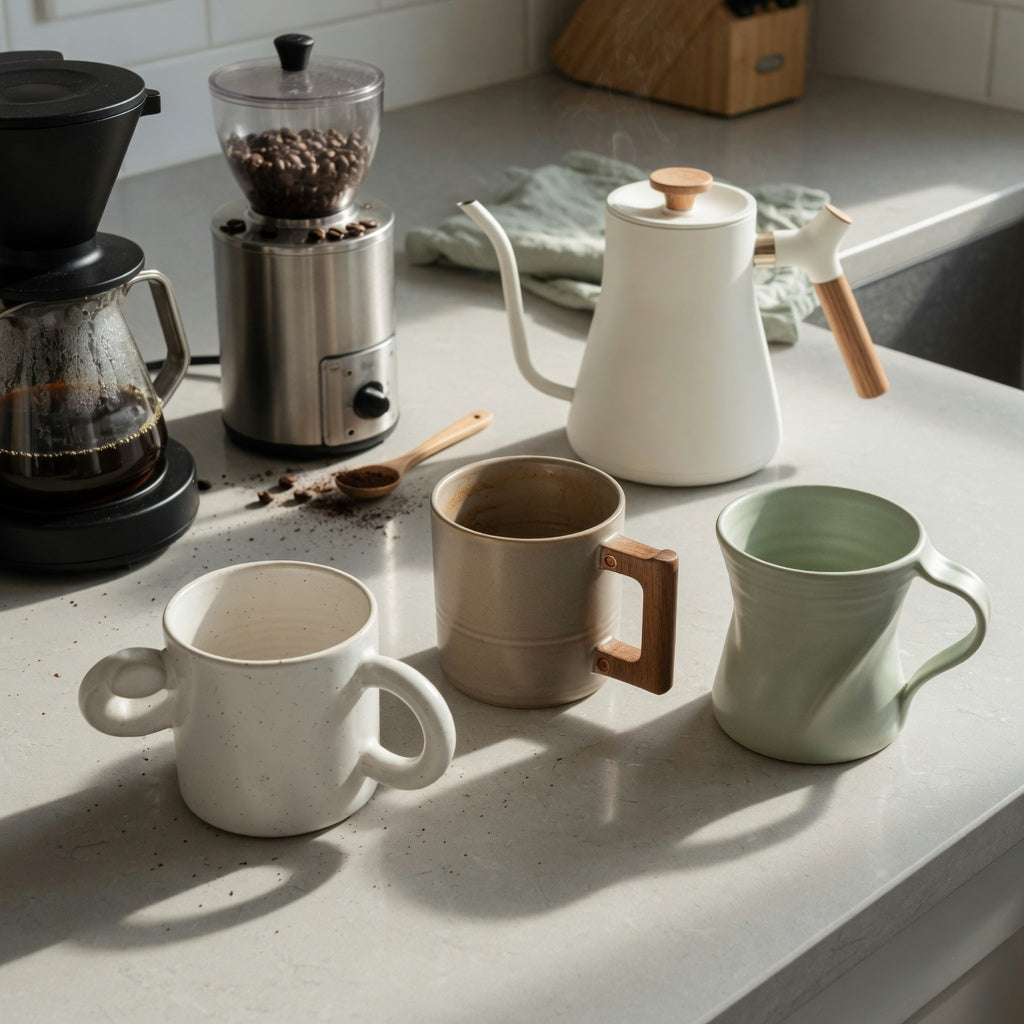
Ceramic Coffee Mugs With Large Handles: Home Coffee Station Checklist
Reading time: about 10 minutes
A mug can clear the brewer and still be wrong for the counter. The problem usually appears after the pour: your knuckles hit the grinder, the handle projects into the kettle path, or the mug will not fit back on its shelf. We built this ceramic coffee mugs with large handles home coffee station practical purchase checklist around those ordinary moments, because handle comfort means little if the whole mug disrupts the station.
From handling and selling this category in our store, we have learned to judge a mug at three contact points: the handle in the hand, the base on the counter, and the foot or handle on the storage shelf. Product photos establish the style, but your measurements and routine determine the fit. We keep general category guidance separate from product-specific facts below, and the current product page should always be your source for dimensions, capacity, materials, and care instructions.
Use this ceramic coffee mugs with large handles home coffee station practical purchase checklist
Start with the station you already have instead of estimating from a product image. A few minutes of checking can expose a mismatch before it reaches your counter.
- Trace the serving route. Fill your current mug with cool water to your normal pour line, then carry it from brewer to milk, sweetener, desk, or table. Note where you change your grip or brush nearby equipment.
- Measure the parking area. Record the available width and depth beside the brewer, including the space occupied by a handle turned toward your dominant hand.
- Check brewing height separately. A large handle does not confirm that a mug will fit below a particular coffee machine. Compare the product dimensions with the actual space beneath your brewer.
- Test the storage route. Measure cabinet depth, shelf height, mug-tree spacing, or hook clearance. Include the handle at its widest point.
- Choose a care routine you will follow. Verify dishwasher, microwave, soaking, and drying instructions on the individual product page rather than applying one rule to every ceramic mug.
- Inspect the whole shape. Handle room, base stability, rim finish, and empty weight all matter once the mug becomes part of a daily setup.
The purpose of this ceramic coffee mugs with large handles home coffee station practical purchase checklist is to eliminate candidates that cannot physically support your routine. Style becomes useful only after those practical checks are settled.
How much counter and storage clearance does a large handle need?
Measure the mug as a complete object. Shoppers often compare body diameter and overlook the handle, even though the handle is usually the first part to collide with a grinder, wall, kettle, or neighboring cup. Rotate your current mug through the positions you actually use: handle forward for pickup, sideways during brewing, and inward for storage.
| Station variable | How to check it | Mismatch it can reveal |
|---|---|---|
| Brewing clearance | Measure from the drip tray or platform to the lowest fixed point above it. | A mug that is comfortable to hold but too tall for the brewing space. |
| Counter footprint | Measure from the far side of the mug body to the outer edge of the handle. | A handle that blocks a control, cord, drawer, or neighboring tool. |
| Pickup path | Reach for a mug without moving the grinder, kettle, or milk pitcher first. | A grip that works only after rearranging the station. |
| Shelf or hook fit | Compare the widest handle point with shelf depth and hook spacing. | A mug that works on the counter but cannot be stored conveniently. |
Leave enough room to place and lift the mug without scraping it along another object. There is no universal clearance number because a wall-mounted shelf, open counter, mug tree, and espresso setup create different constraints. Use the actual route your hand takes.
A projecting handle also has a trade-off: it is easier to catch with a sleeve or towel on a narrow counter. If every available inch is already occupied, a compact mug with a smaller but comfortable loop may be a better purchase than the largest handle you can find.
Which grip and inspection checks matter once the mug is full?
Handle openings should be judged with the mug loaded, not empty. Use your existing mug and note whether you naturally hold it with one, two, or three fingers, whether your fingertips press against the hot body, and whether the lower edge of the handle creates a pressure point. A larger opening can create room, but a thicker ceramic handle and a heavier body can still feel demanding over repeated trips.
Our team also checks the parts shoppers may miss during a quick unboxing:
- Handle joins: inspect both attachment points for hairline lines, chips, gaps in the finish, or visible damage. A decorative seam in the design is different from a crack, so compare both sides under clear light.
- Base contact: place the empty mug on a flat counter and press lightly near the rim from several directions. Rocking can become more noticeable once the mug is full.
- Foot ring: feel for an unexpectedly rough edge that could mark a delicate shelf or desk. A coaster can help, but it should not be used to hide damage.
- Rim and glaze: look for rough spots, chips, or interruptions where your lips and cleaning cloth make repeated contact.
Large handles improve grip room; they do not make ceramic lightweight or prevent tipping. Base shape, mug height, fill level, and where the handle places the load all affect control. Shoppers who experience wrist fatigue should consider the mug's empty weight and expected drink volume rather than relying on handle size alone.
How should care routines change for ceramic and wooden details?
General category guidance: do not infer dishwasher or microwave suitability from the word ceramic. Glazes, decorative finishes, attachments, and mixed-material components can change the approved care method. If a product page does not state compatibility with a particular appliance or cleaning cycle, treat that compatibility as unknown.
For routine station use, clear coffee, tea, milk, or sweetener residue before it dries around the rim and handle joins. Follow the listed washing method, use a nonabrasive cleaning tool where appropriate, and let the mug dry fully before returning it to an enclosed cabinet. If a dishwasher cycle is permitted, inspect the handle joins and rim afterward as part of normal care rather than assuming repeated cycles can never reveal wear.
A wooden handle creates a separate decision. It provides visible material contrast, but it should not automatically receive the same soaking, dishwasher, or microwave treatment as an all-ceramic design. Shoppers who like that mixed-material look should review the current care details on the Mountain Sea II Coffee Tea Mug With Wooden Handle before ordering. If your evening routine depends on putting every mug through one automatic cycle, any design requiring separate care may become frustrating.
Which CoffeifyMug design fits your station priorities?
Choose by situation first. We do not transfer a capacity, measurement, or care claim from one design to another, even when both are sold as coffee and tea mugs. Open each linked page to verify its current specifications and instructions.
- You dislike narrow conventional loops and want the handle to be a defining design feature: compare the Ball Handled Coffee Tea Mug. Its ball-style handle gives the fingers distinct contact points and makes the grip part of the mug's visual identity. Check the page photos against your preferred finger position and measure the resulting overall width before committing counter space.
- Your coffee station is also a display and you want ceramic paired with natural-looking material contrast: examine the Mountain Sea II wooden-handle design. It fits a shopper who values a mixed-material presentation and is willing to follow the specific care directions for that construction. It is less suitable for someone who wants to assume every component can be soaked or placed in an appliance.
- You want a sculptural profile and prefer to judge the mug as part of a modern counter arrangement: review The Flow Coffee Tea Mug. Compare its current photos and listed measurements with the empty space beside your brewing equipment; the product name or silhouette alone cannot confirm machine clearance.
- You are still comparing handle shapes, finishes, and overall silhouettes: use the unique coffee mugs collection to create a short list. Eliminate anything that fails your counter, storage, grip, or care checks before comparing appearance.
Gift buyers should run the same logic for the recipient. A striking wooden handle can make an engaging unboxing, but a dishwasher-dependent household may value simpler care more. Likewise, a dramatic large handle can look excellent on an open shelf while being inconvenient in a shallow cabinet.
When is a large-handle ceramic mug the wrong choice?
This category is not automatically right for every coffee setup. Consider another style if any of these conditions control the purchase:
- You need a sealed commuter vessel, bag-ready cup, or reliable car cup-holder fit. An open ceramic coffee mug is not a substitute for a purpose-built travel mug.
- Your cabinet, hook rack, or desk has very limited side clearance. A large handle can consume more usable space than expected.
- Low empty weight is your highest priority. A generous handle can improve control, but it does not remove the weight of the ceramic body and drink.
- You want every item to share one dishwasher and microwave routine, but the selected product page does not explicitly confirm those uses.
- The mug will sit beside a laptop or at the edge of a narrow office desk. A projecting handle may be easier to bump than a compact profile.
In these situations, a smaller ceramic mug, lightweight cup, or travel-specific vessel may suit the routine better. A practical purchase solves the station's constraint rather than forcing the station to accommodate the mug.
A 60-second comparison before checkout
- Confirm the mug's listed height, width, capacity, materials, and care information on its current product page.
- Compare the height with the actual opening beneath your brewer without assuming appliance compatibility.
- Add the handle to the mug body's width and check the complete counter footprint.
- Rotate a current mug through your usual pickup and brewing positions to expose collision points.
- Match the handle shape to the number of fingers and grip position you naturally use.
- Check the rim, handle joins, base, and foot ring when the mug arrives, before putting it into daily service.
- Choose a different style if storage, cleaning, travel, or weight matters more than a large handle.
That sequence keeps the buying decision grounded in what you can verify. It also prevents an attractive product photo from answering questions about fit or care that only measurements and current product details can settle.
Frequently asked questions
What should I measure before buying a large-handle mug for my coffee station?
Use the ceramic coffee mugs with large handles home coffee station practical purchase checklist by recording brewing height, available counter width and depth, handle swing space, and cabinet or hook clearance. Measure the whole mug footprint, not just the body. Then verify the listed product dimensions against those numbers.
Will a large-handle ceramic mug fit under my espresso machine?
Handle size does not determine brewing clearance. Compare the mug's listed height and base placement with the space between your machine's drip tray and dispensing point. If either measurement is unavailable, treat compatibility as unconfirmed rather than guessing.
Are ceramic coffee mugs with wooden handles dishwasher and microwave safe?
That depends on the specific construction and the care instructions stated on the product page. Do not assume a wooden component can follow the same dishwasher, soaking, or microwave routine as a fully ceramic mug. Check the Mountain Sea II page for its current product-specific guidance.
Is a ball handle more comfortable than a standard mug loop?
Comfort depends on finger position, hand size, mug weight, and how far you carry a full drink. A ball-style handle creates different contact points than a conventional loop, but it also changes the mug's overall width. Compare the product photos with the grip you naturally use and include the handle in your station measurements.
Should I choose a large handle if I have limited cabinet space?
Only if the complete mug fits without forcing other pieces together. Check cabinet depth, shelf height, and spacing between handles before ordering. If storage is the main constraint, a smaller handle profile may be the more useful choice.
Take your station measurements first, then compare the current unique mug lineup. Shortlist only the designs whose product-page details confirm your required footprint and care routine; once those checks pass, choose the handle and finish you will enjoy using every day.
More from our blog
Read more

Small Ceramic Coffee Cup Replacement Purchase Product Shortlist Guide
Replace the cup that failed without repeating the same mismatch. Compare the Pleated, Emerald, and Retro options by damage pattern, measured fit, handling preference, drink volume, and care limits.
Read more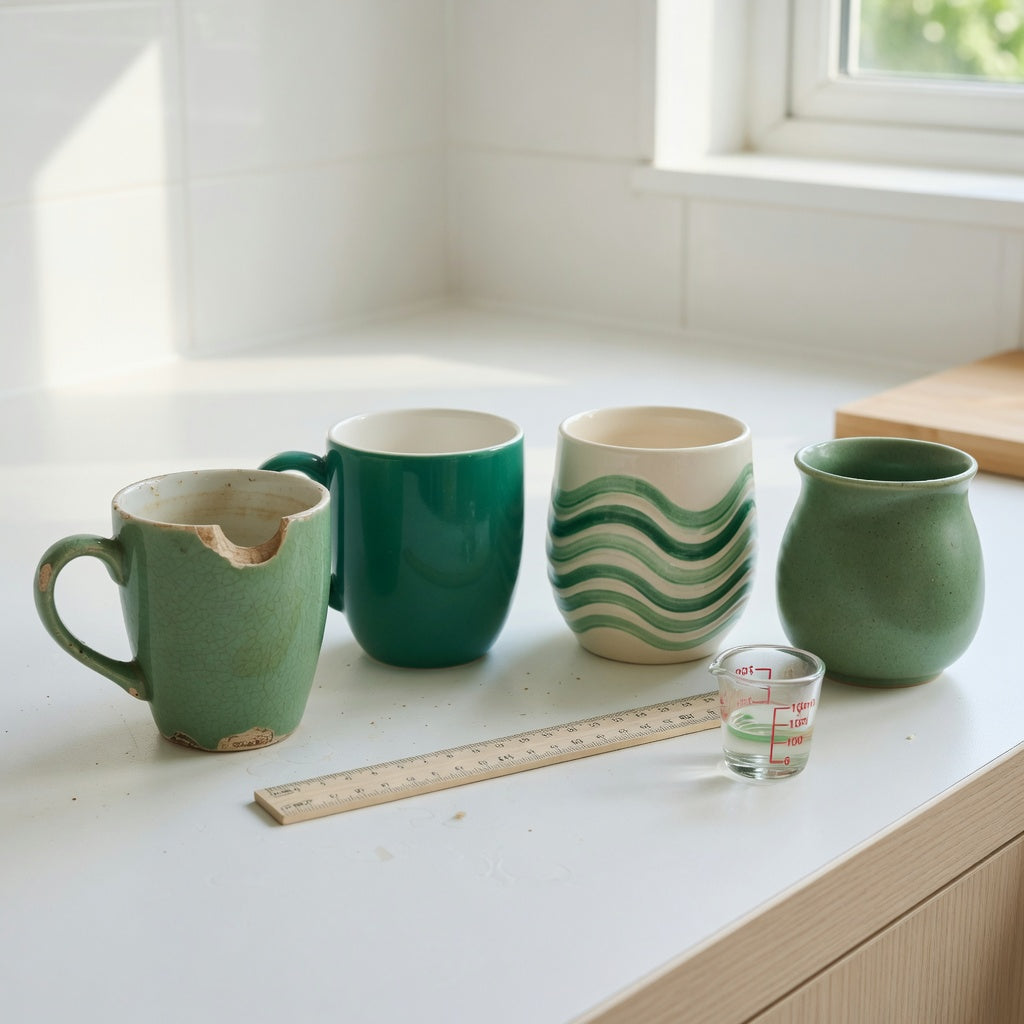
Green Ceramic Coffee Mugs Replacement Purchase Product Shortlist Guide
Replace the mug that failed without repeating its limitations. Compare dimensions, grip, finish, care requirements, and three CoffeifyMug options with clear reasons to choose or skip each.
Read more
Leave a comment
This site is protected by hCaptcha and the hCaptcha Privacy Policy and Terms of Service apply.