



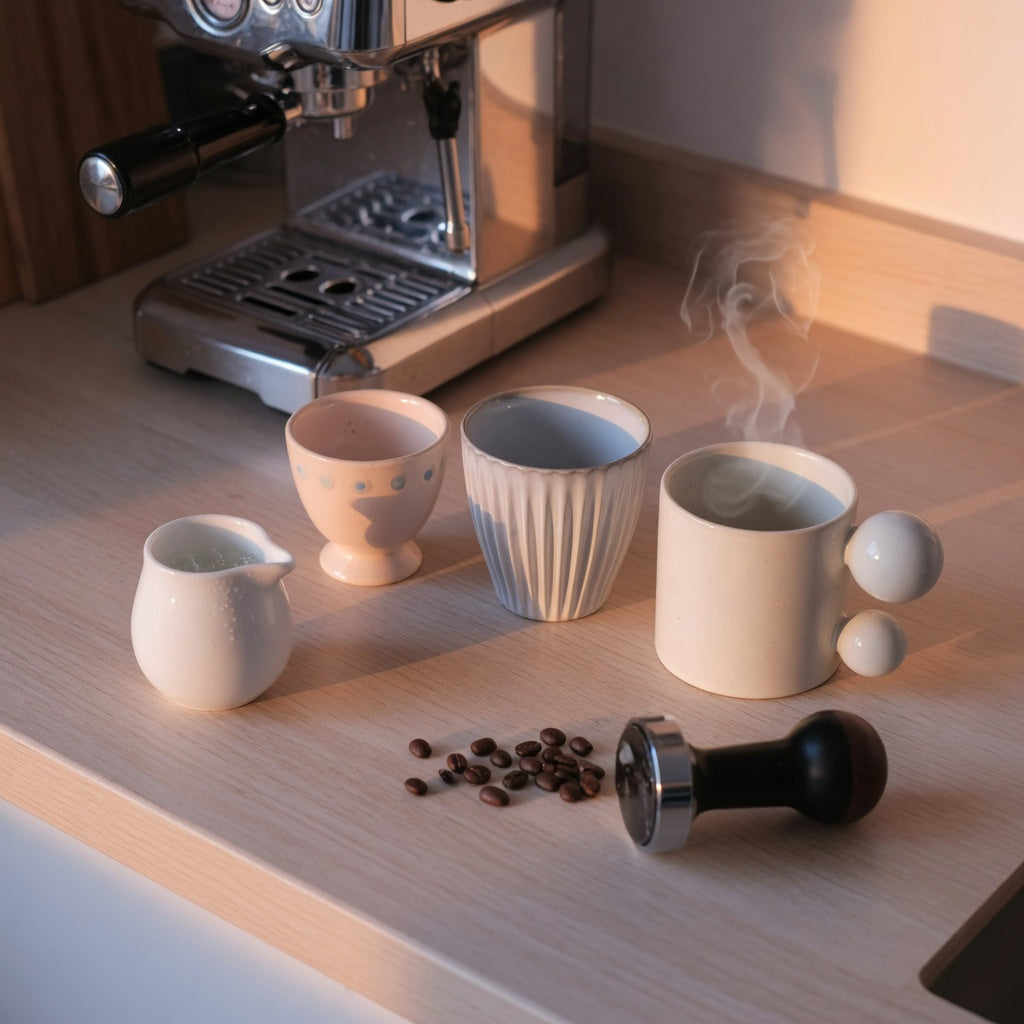
Unique Espresso Cups Morning Routine Product Shortlist Guide
Reading time: about 11 minutes
6:50 a.m. The machine is still coming up to temperature and you are holding a cup you bought because it looked good on a shelf. It holds 250 ml. The shot is 30 ml. By the time you sit down, the crema has collapsed against a cold wall and the coffee is lukewarm. This unique espresso cups morning routine product shortlist guide exists because of that gap — the space between what a cup can hold and what you actually pour — and it is the single most common reason a distinctive cup stops getting used by week three.
We sell three ceramic cups in the CoffeifyMug range, and the questions we get about them are almost never about looks. They are about volume, heat, and whether the thing clears the group head. So here is the shortlist the way we would walk you through it at the counter: your morning first, the cup second.
How much coffee actually lands in the cup before 8 a.m.?
Two numbers get confused constantly: the volume of the drink and the capacity of the cup. They are not the same, and the space between them is where disappointing purchases happen.
A classic Italian certified espresso is a small pour — roughly 25 ml — and the older specialty definition puts a single shot in the 25–35 ml band. The cup is deliberately larger than the liquid. Demitasse capacity commonly runs 50–100 ml so there is room for crema and headspace. That is why an 80 ml or 3 oz listing can sound enormous next to a 30 ml shot and still be correct.
Answer three questions about your own morning before you pick anything:
- How many shots? A single 25 ml pour and a double are different problems. A double is roughly twice the liquid and needs a cup with room to breathe.
- Is there milk? A cortado adds a small, roughly equal pour of steamed milk; a flat white adds considerably more. Either one changes your target size.
- How long does the cup sit? If you sip at a desk for twenty minutes, heat retention matters more than how the rim photographs.
| Morning drink | Rough liquid volume | What the cup needs |
|---|---|---|
| Single espresso | ~25 ml | Small demitasse, 50–90 ml, with an interior you can read crema through |
| Double espresso | ~50 ml | 150–200 ml of capacity plus headspace |
| Cortado | ~100–130 ml | 170–200 ml, a stable rim, room for milk |
| Flat white or small latte | ~150–220 ml | 250 ml, a taller wall |
| Lungo or long black | ~90–150 ml | 200–250 ml |
Note where our cups land: 170 ml, 200 ml, and 250 ml. None of them is a true 60–80 ml demitasse. We say that plainly because it is the limitation of this range — if you drink neat 25 ml shots and want the cup to look proportional, a smaller cup from elsewhere is the honest answer. If your routine is a double, a cortado, or anything with milk in it, keep reading.
Unique espresso cups morning routine product shortlist guide: three real schedules
Same three cups, three different mornings. Match yourself to whichever is closest, and read the skip conditions — they matter as much as the reasons to buy.
| Cup | Listed capacity | Best morning | Skip if |
|---|---|---|---|
| Retro Coffee & Tea Cup | 170 ml | Double shot, cortado, short long black | You want a true 60–80 ml demitasse |
| Pleated Coffee & Tea Cup | 200 ml | Cortado with more milk, 200 ml flat white, tea | You need one cup that also handles big lattes |
| Ball Handled Coffee & Tea Mug | 250 ml | Lungo, flat white, tea, slow desk sipping | You mostly drink neat espresso shots |
Retro Coffee & Tea Cup, 170 ml — the double-shot default
This is the one we hand people first when they pull a double and drink it standing at the counter. At 170 ml, a 50 ml shot plus crema and headspace fills it properly instead of looking stranded, and it is small enough that the last sip is still warm. It stretches to a cortado without strain, because a shot with a roughly equal pour of milk sits comfortably inside 170 ml. Smaller vessels also hold less ceramic mass, so a quick hot-water rinse brings them up to temperature faster than a wide mug will. The Retro Coffee & Tea Cup is the retro-styled option of the three.
- Choose it if your morning is one double, one cortado, or a short long black.
- Skip it if you routinely build 200 ml-plus milk drinks, or you want the shot to look like a shot glass with a handle.
Pleated Coffee & Tea Cup, 200 ml — the in-between that absorbs variation
200 ml is the forgiving size. It covers a double with extra headspace, a cortado where you pour a little more milk than the recipe says, and a mug of tea for the person in the house who does not drink coffee at all. The pleated wall named on the listing is the visual differentiator here — if you want a cup that reads as a piece rather than plain china, this is the one that earns shelf space. In our store, the Pleated Coffee & Tea Cup is the usual recommendation for a two-person kitchen where only one person pulls espresso.
- Choose it if you want one cup that handles coffee and tea, or your milk pour runs generous.
- Skip it if you make large lattes, where 200 ml will feel tight once the milk goes in.
Ball Handled Coffee & Tea Mug, 250 ml — for long mornings and milk-forward drinks
At 250 ml this stops being an espresso cup and starts being a small mug, which is exactly what some mornings need. A flat white, a lungo, or a slow cup you carry to a desk all work here, and the ball handle gives your fingers somewhere to go on a full cup. In our experience it is the one people reach for on a second refill. See the Ball Handled Coffee & Tea Mug if your weekday coffee is long.
- Choose it if your weekday coffee is a longer drink, or you want one cup that also does evening tea.
- Skip it if you drink neat singles — a 25 ml shot looks lost in 250 ml, and the wider exposed surface cools it faster.
Will it clear your group head, and where does it live between uses?
Two measurements decide whether a beautiful cup becomes a daily one: outer height under the spout, and base diameter against the drip tray. Neither is the same as capacity. A tall cup can foul the portafilter spout on a compact machine, and a wide base can overhang a small drip tray and wobble while you pull.
We do not publish a fits-everything answer, because group-head clearance varies machine to machine. What we tell people instead: measure from the drip tray up to the spout with the portafilter locked in, then confirm the cup's outer dimensions on the current product listing or message us before ordering. If a handle collides with the steam wand or the tray lip, the cup quietly becomes a shelf object.
- Handle or handleless: a handle keeps fingers off a hot wall and helps on a full cup; handleless cups pack tighter into a cupboard and suit slower sipping.
- Saucers: a saucer catches drips and protects the counter, but adds footprint — check whether it is included rather than assuming it is.
- Stackability: one-off pottery and double-wall glass usually do not stack. If you have one shelf, plan the vertical space before you buy three.
- Care: dishwasher and microwave tolerance is not universal in this category. Check the individual listing, and hand-wash anything with metallic or hand-applied decoration.
If you are still weighing silhouettes, the unique coffee mugs collection lines the full range up in one place so you can compare shapes side by side rather than one product page at a time.
Preheat, wall thickness, and the dark-interior trap
Thick ceramic has thermal mass. That is good news after thirty seconds of hot water and bad news if you skip it, because the cup pulls heat out of the shot instead of holding it. We keep a small jug beside the machine and fill each cup while the boiler comes up — it takes less time than grinding.
Wall thickness shifts the trade-off. A substantial ceramic wall holds heat and feels steady in the hand, but it is slower to warm and heavier when full. Thin single-wall glass warms in seconds and loses heat just as quickly. Double-wall glass insulates well and stays cool outside, but you cannot judge temperature by touch, and the sealed cavity is a weak point if it gets knocked against a sink edge.
Interior colour is the detail people forget. A white or clear interior lets you read crema colour — the difference between a pale, under-extracted pour and a dark, thin one. A dark or heavily patterned interior looks striking and hides all of it. While you are dialling in a new bean, use a plain cup; save the dramatic one for when you already know the shot is good.
Are decorative glazes safe for hot coffee?
This is where we get cautious, and where you should be too. The FDA states that lead in ceramic glazes or decorative decals can leach into food and drink if a piece is not properly fired, and that washing or boiling will not remove lead from pottery. It flags higher-risk ceramicware as handmade pieces with a crude or irregular look, antiques, damaged or worn ware, items from flea markets or unknown makers, and ware brightly decorated in orange, red, or yellow.
One number is worth carrying into the shop. The FDA's chemical-contaminants listing sets an action level of 0.5 µg/ml leaching solution for lead in ceramicware cups and mugs. Separately, 21 CFR 109.16 requires ornamental ceramicware that could plausibly be used with food to carry a conspicuous Not for Food Use marking or a hole through the food-contact surface.
What that means for a shopper: "lead free" on a marketplace listing is a claim, not a test result, and some traditional pottery labelled that way has still shown extractable lead at or above FDA action levels. If a cup has a bright reactive glaze, ask the seller whether they hold test data. Our own cups are described by their visible ceramic finish and their listed capacity, and that is the limit of what we will state without documentation. If glaze safety is the deciding factor for you, ask us before you order and we will tell you exactly what we have on file.
When none of these three is the right buy
A shortlist is only useful if it excludes things, so here are the mornings where we would point you elsewhere:
- You want a true demitasse. If your shot is 25 ml and you want it to look proportional, look for 60–80 ml. Ours start at 170 ml.
- You want to watch the shot build. A clear cortado glass does that; ceramic does not.
- You want a Turkish coffee cup. Different shape, different ritual, usually smaller and often handleless — not a substitute.
- You want one cup for absolutely everything. Buy the 250 ml and accept that a neat espresso will look thin in it.
- You drink large lattes daily. Skip the 170 ml entirely; 250 ml is the floor for that routine.
Frequently asked questions
Will the 170 ml Retro cup fit under my espresso machine?
It depends on your machine, not on capacity. Measure the clearance from the drip tray to the group spout with the portafilter locked in, then compare that to the cup's outer height on the current product page. If you are unsure, message us with your machine model before ordering — we would rather answer that than process a return.
Is 250 ml too big for a double espresso?
For a neat double, yes. A 50 ml shot in a 250 ml mug looks thin and cools faster because more liquid surface is exposed. The 250 ml size earns its place with lungos, flat whites, and tea — drinks that actually fill it.
Do I need to preheat these ceramic cups?
If you want the shot to stay hot, yes. Fill the cup with hot water while the machine heats, tip it out, then pull the shot. With thick ceramic this step does more for temperature than any other single habit.
Are the cups dishwasher and microwave safe?
That varies by piece and decoration, so check the individual listing rather than assuming. As a rule, hand-wash anything with metallic, gilded, or hand-applied decoration, and keep metal-decorated ceramics out of the microwave entirely.
What is the quickest way to use this unique espresso cups morning routine product shortlist guide?
Count your shots, then count your milk. Volume first, looks second: 170 ml covers doubles and cortados, 200 ml adds headroom for tea and generous milk pours, and 250 ml is for long drinks and slow mornings.
If you are ordering today, run this three-line check before you click: (1) my usual drink volume is under 130 ml, 130–180 ml, or over 180 ml; (2) my machine has at least the cup's outer height in clearance under the spout; (3) I am willing to preheat a ceramic cup, or I want something thinner. Two out of three and you are ready. Start with the full unique coffee mugs collection and pick the size that matches line one.
More from our blog
Ready to pick your mug? Two ways to save on today's order:
Ordering 1–3 mugs? Get an extra 10% off your 1st order with code 10_OFF Apply 10% Off & Shop Wooden-Handle Mugs →
Gifting 4+ mugs? Buy 3, Get the 4th Free applies automatically at checkout (no code needed; offers do not stack) · Free standard shipping (Nov pre-Christmas delivery: 15–20 calendar days US) · Free replacement if chipped in transit.
Popular mug buying guides: Ceramic Mugs with Lids Compared · Wooden-Handle Tea Infuser Mugs Compared · Christmas & Secret Santa Mugs 2026 · Espresso & Cortado Cups Guide · Cup & Saucer Gift Sets · All 25 Mugs Spec Table · Mug Size Guide · Shipping & Promo FAQ
FIRST ORDER 10% OFF (CODE: 10_OFF) · OR BUY 3, GET THE 4TH FREE


Read more
Unique Espresso Cups for Small Coffee Setup: Compare 3 Sizes
Three compact ceramic cups, one narrow counter. Here is how listed capacity, drink choice, handle clearance, interior color, and glaze care decide which unique espresso cups for small coffee setup ...
Read more
14 Oz Ceramic Coffee Mugs Daily Use Guide: Practical Trade-Offs
A working 14 oz ceramic coffee mugs daily use guide: brim capacity versus the pour you actually drink, which drinks fit, how trim and decals change microwave safety, and which of our three sizes ma...
Read more
Leave a comment
This site is protected by hCaptcha and the hCaptcha Privacy Policy and Terms of Service apply.