

Cute Espresso Cups Morning Routine Product Shortlist Guide: 3 Picks
Reading time: about 10 minutes
The cup you reach for at 7:05 a.m. is usually whichever one is dry — not the one you like most. That is the honest test of any drinkware purchase, and it is why this cute espresso cups morning routine product shortlist guide is organized around your clock, your usual pour, and your patience for a second trip to the machine. A cup that cannot survive a weekday rinse-and-go stops being cute somewhere around Thursday.
We sell three compact ceramic cups in this size range: 170 ml, 200 ml, and 250 ml. Each one is larger than a traditional single-shot cup, and we are not going to pretend otherwise. What follows is a short, scenario-based shortlist — one option per morning habit, with a specific reason to skip each one if it does not match yours.
How much coffee is really in a "single" shot?
A traditional Italian espresso is often described at roughly 25 ml, and specialty shops commonly pull a 1:2 ratio double that lands near 36 g of liquid in the cup. A classic china tazzina holds about 50 ml, which leaves just enough headroom for crema and a little slosh. Compare that with 170 ml and the gap is obvious: our cups run three to five times the volume of the drink most people actually pull.
That is not a flaw. It is a design choice with consequences you can predict before you buy:
- Room for crema and a splash of milk. A 170 ml cup takes a double plus a spoon of steamed milk without threatening the rim.
- Faster heat loss at the surface. A wider pool of coffee gives heat more area to escape from than a narrow demitasse does. Preheating with hot tap water while you grind fixes most of that, and it costs ten seconds.
- A small shot looks small. A 25 ml ristretto in a 250 ml mug reads as an underfill, and no amount of nice glaze changes that.
So the first question is not which cup is prettiest. It is: what is in the cup on a normal Tuesday, and how long does it need to stay warm while you drink it?
Cute espresso cups morning routine product shortlist guide: three capacities, three jobs
The short version, in one table. The capacities below are the listed volumes on each product page — nothing more, nothing less.
| Cup | Listed capacity | Morning habit it fits | Choose it if | Skip it if |
|---|---|---|---|---|
| Retro Coffee Tea Cup | 170 ml | One double, drunk standing near the machine | You want the smallest of the three and like a retro profile | You drink 8 oz or more before leaving the kitchen |
| Pleated Coffee Tea Cup | 200 ml | Espresso that usually gets a little steamed milk | You want a bit more room without moving up to a mug | You want to see layers through the side, or want a true demitasse |
| Ball Handled Coffee Tea Mug | 250 ml | A drink that travels from kitchen to desk | You want one pour to last until mid-morning | Your machine clearance is low or your shelf is tight |
We are deliberately limiting claims here to listed capacity, ceramic body, and the visible form of each cup. Exact dimensions, packed weight, dishwasher guidance, and food-contact statements vary by listing, so read the current product page before checkout instead of assuming. If none of the three matches your habit, the unique coffee mugs collection puts the whole range on one screen.
Which of the three fits a five-minute weekday morning?
The 170 ml cup — short drink, fast exit
You pull one double, drink it standing at the counter, and you are out the door. The 170 ml Retro Coffee Tea Cup is the smallest of the three, and that is the entire argument for it: a short drink in a cup that does not dwarf it. The retro silhouette is the visible reason it gets picked off a shelf; the practical reason is that you are not dirtying a 350 ml mug for a 40-second drink.
Choose it if your first pour is a straight double, or a double with a small splash of milk, and you like a cup that reads as a treat without demanding a saucer setup.
Skip it if you drink 8 oz or more before you leave the kitchen — you will refill two or three times. Also skip it if you want a true demitasse for ristretto: at 170 ml it is roughly triple a classic 50 ml cup, and a tiny shot will sit in a wide pool at the bottom.
The 200 ml cup — the shot that usually gets milk
Macchiato, cortado-adjacent, or a short black you sip for ten minutes. The 200 ml pleated cup adds 30 ml over the Retro, which sounds like nothing until steamed milk goes in and the drink still has room to swirl. The pleated wall is what makes it look deliberate on an open shelf rather than like a plain tasting cup.
Choose it if milk lands in your cup more often than not, or if you alternate between espresso and a small filter pour and want one vessel to cover both.
Skip it if you want to watch the layers of a milk drink — ceramic is opaque, so a cortado reads as a flat surface of foam from above. It is also the wrong pick for a matching set of tiny shot cups; the volume is mug territory, not tazzina territory.
The 250 ml ball-handle mug — the no-refill morning
Your first drink is closer to a small latte, or a black coffee you carry to a desk and sip for twenty minutes. The Ball Handled Coffee Tea Mug is the largest of the three at 250 ml, and the ball handle is the detail that changes the carry — a finger hooked through a loop is steadier than a pinch grip on a small cup when your other hand is holding a phone and a bag.
Choose it if one pour needs to last from the kitchen to the desk without a refill, and you want a handled format.
Skip it if your cabinet shelf is tight, your machine has low clearance, or you genuinely want an espresso cup. At 250 ml this is a compact mug, and a 36 g double will look like an inch of coffee sitting at the bottom.
Machine fit, rim width, and what to measure before you order
There is no published standard for spout-to-tray clearance, so fit is a product-by-product measurement. Two cups of the same volume can behave very differently under the same portafilter.
- Measure the gap. Drip tray to the lowest point of the spout, with the machine cold and the portafilter locked in. Compare that number against the cup height on the listing.
- Check the handle, not just the body. A tall loop can foul the spout even when the cup itself slides underneath. This is the most common near-miss customers describe to us.
- Check the opening. A double spout sends two streams, and a bottomless portafilter sends a wider cone. A narrow rim catches one and misses the other.
- Read the care section on that exact page. Decorated and hand-finished glazes vary. When in doubt, hand wash — it costs a minute and protects the finish.
How many trips back to the machine is your limit?
Refill tolerance is the variable people forget to price in. If you drink two 6 oz coffees before 9 a.m., a 170 ml cup means three pours. That is not a defect in the cup; it is a mismatch with your habit.
Our rough rule, based on what customers tell us after a week of real use:
- One short drink, then straight out the door → 170 ml.
- One drink, sometimes with milk, sometimes black → 200 ml.
- One drink carried to a desk, no second trip → 250 ml.
If your honest answer is "I fill a 12 oz mug twice," skip this shortlist entirely. A cute 170 ml cup will not solve a volume problem, and buying one anyway is exactly how pretty cups end up at the back of the cabinet.
Gift cup or daily driver — and the ceramic safety question
Gifting and daily use have different pass/fail criteria. As a gift, visible form does most of the work: the retro silhouette, the pleated wall, the ball handle. As a daily driver, the unglamorous questions decide it — does it fit under the spout, does the rim catch both streams, does the handle take your fingers.
One point we will not soften: food-contact ceramics are not all equal. The U.S. FDA explains that lead in ceramic glaze is bound when pottery is fired correctly, that improperly fired glaze can leave extractable lead, and that ceramicware intended only for decoration must be labeled so it is not used with food. The practical translation — buy drinkware from a seller who states food-contact use, treat decorative-only pieces as display objects, and do not assume something is dinnerware just because it looks like a cup.
Related trap: novelty espresso-cup items that are soft toys or ornaments. They are not drinkware, and no amount of charm makes them hold coffee.
Frequently asked questions
Will a 170 ml cup keep a double espresso hot enough to enjoy?
The ceramic body holds warmth reasonably well, but a wider surface means more heat escapes than in a narrow 50 ml demitasse. Fill the cup with hot tap water while you grind and dose, tip it out, then pull your shot. That single step does more for temperature than any cup design.
Will the 250 ml ball-handle mug fit under my espresso machine?
Only your machine can answer that. Measure from the drip tray to the lowest point of the portafilter spout and compare it with the cup height on the product page — then check the handle too, because a tall loop can hit the spout even when the body clears it.
Are these cups dishwasher safe?
We cannot make one blanket claim across every finish, so check the care section on the exact product page you are buying. For decorated or hand-finished surfaces, hand washing is the safer habit if you want the glaze and color to hold up over months of daily use.
Do I need a smaller cup for a single shot?
If you pull true singles or ristretti and want the drink to look full, yes — a 50 ml tazzina suits that better. This cute espresso cups morning routine product shortlist guide is written for doubles, short milk drinks, and compact coffees, where 170–250 ml leaves useful headroom.
Can the 200 ml cup do double duty for tea?
Physically, yes — it is a ceramic vessel and the product name includes tea. Practically, 200 ml is a small tea serving. If your morning tea is a 350 ml mug, size up or keep a separate mug for it.
Pick one cup, use it for a week, then add a second
Buying three at once is how people end up with two cups they never touch. Start with the one that matches your most common weekday pour, run it through a full week of rinse-and-go mornings, and then decide whether you want a second size for weekends or guests.
If your first drink is short and fast, take the 170 ml compact cup. If milk usually goes in, take the 200 ml pleated option. If the cup travels to a desk, take the 250 ml ball-handle mug. Still torn between shapes? Compare them side by side in the collection of unique coffee mugs — and measure your machine clearance before checkout, because that number decides more mornings than the glaze does.
More from our blog
Read more
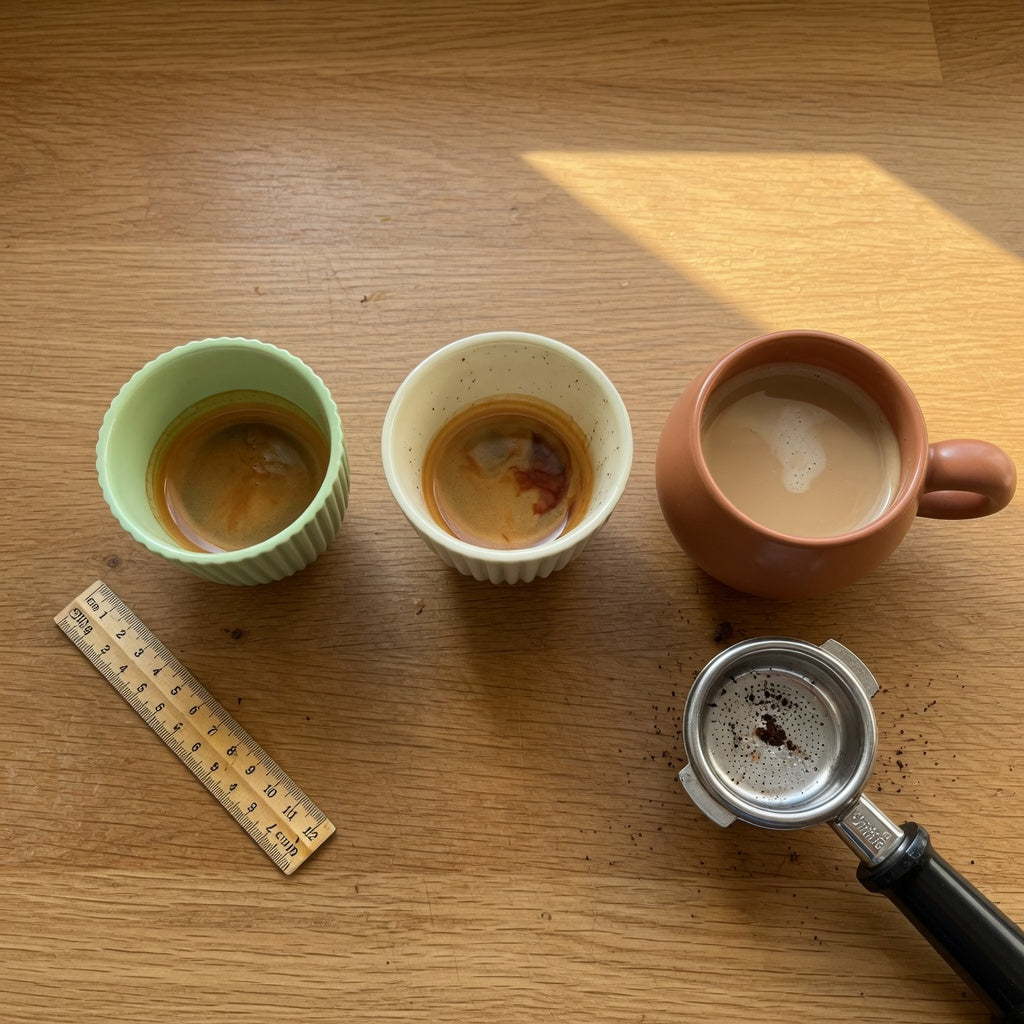
Cute Espresso Cups Capacity Guide: 170 vs 200 vs 250 ml
Three compact ceramic cups, three capacities, three quite different mornings. We compare our 170 ml, 200 ml, and 250 ml cups by pour size, refill pattern, and machine fit so you buy the one that ma...
Read more
Ceramic Latte Cups Home Office Practical Purchase Checklist
A desk-first buying checklist for ceramic latte cups: how to read listed capacity, judge handle and base fit, and what a lead-free glaze claim actually proves — with our 250 ml, 400 ml, and 440 ml ...
Read more
Leave a comment
This site is protected by hCaptcha and the hCaptcha Privacy Policy and Terms of Service apply.