

Ceramic Latte Cups Morning Routine Product Shortlist Guide
Reading time: about 9 minutes
At 6:40 the kettle clicks off, and you have roughly eleven minutes before the door closes behind you. That window — not the product photo, not the café reel you saved last week — is what decides whether a new cup earns its shelf space. We pack and ship this category every week, and the returns we see rarely come from a bad glaze. They come from a cup that was the wrong volume for the drink someone actually makes before work.
So treat this as a ceramic latte cups morning routine product shortlist guide and not another broad buying guide: three cups from our own line, three realistic mornings, and a plain reason to choose or skip each one.
How this ceramic latte cups morning routine product shortlist guide works
Three variables do almost all the sorting, and none of them appear on a product page.
- Minutes. How long between the first pour and walking out the door.
- Pour volume. What you actually put in the cup, not what the bag of beans claims a serving is.
- Refill tolerance. Whether a second round is a pleasure or a chore. This one decides more purchases than people expect.
Answer those honestly and the shortlist usually collapses to one or two cups. If you would rather see every shape in one place first, our unique coffee mugs collection lays out the full current range side by side.
How many minutes do you actually have before the door?
Most buyers overestimate the first variable and underestimate the second. Here is how the three morning types we hear about most often sort out.
- The eleven-minute morning. One drink, made and finished while something toasts. You want a cup you fill once and drain without a second round.
- The two-cup morning. A second pour while you answer email or pack a bag. A larger vessel saves you a wash-up; a small one means the second pour sits in a carafe going cold.
- The slow morning. Weekends, or a work-from-home day with a proper sit-down. Bigger cup, wider surface, and the drink is a ritual rather than a commute step.
Write your answer down before you look at a single product photo. Everything below sorts by it.
What do 250 ml, 400 ml, and 440 ml actually pour?
Capacity labels are the biggest source of morning disappointment. A cup sold as "10 oz" often holds closer to 8 oz once you leave headspace for foam and stop short of the rim. That is not a defect — it is the gap between total volume and a comfortable fill line, and it explains a lot of the "runs small" complaints you see in reviews.
We list millilitres to sidestep the guessing. For scale, the FDA describes a typical ceramic coffee cup as holding about 240 ml (8 fl oz) and being made with a handle. Our three cups run from roughly that classic size up to a mug-sized pour.
| Cup | Listed capacity | Approx. US fl oz | Choose it if | Skip it if |
|---|---|---|---|---|
| Ball Handle | 250 ml | about 8.5 | You drink one small latte, flat white, or cortado-style drink and want it finished, not nursed | You routinely steam 300 ml or more of milk in a single go |
| The Flow | 400 ml | about 13.5 | One generous latte with room for a foam head, drunk over twenty to forty minutes | Your drink is genuinely a cortado or piccolo |
| Morning and Night | 440 ml | about 15 | Two-drink mornings, long weekends, or a latte you top up mid-morning | You want a small cup you refill deliberately, or counter space is tight |
One detail worth internalising: milk foam eats height. A proper foam head costs you roughly a centimetre of usable depth, so a 400 ml cup is the safer pick if your current "one latte" already fills a 12 oz tumbler near the brim.
Which cup matches your pour, your grip, and your counter?
Same material category, three different jobs. Match the cup to the morning you actually have, not the one you keep planning to have.
Ball Handle, 250 ml — the eleven-minute cup
This is the short-window cup. At 250 ml it holds a single modest latte, and because there is less milk in the vessel, the espresso-to-milk ratio stays assertive instead of turning milky. The name points to the handle shape, so use the listing photos for the two things a spec line cannot answer: how much knuckle clearance you get between handle and wall, and whether your hand comfortably wraps it while the cup is full and hot. Skip it if you steam a full pitcher every morning — you will be making two drinks, not one, and you will feel it by day four.
The Flow, 400 ml — the one-latte workhorse
400 ml is the size most people mean when they say "a latte." It leaves genuine headspace for foam and enough room that a simple pour does not hit the rim halfway through. If you drink one latte a day and want it to last through the first half of your morning, this is the default pick in our line. Two things to check on the listing rather than assume: the interior profile (a rounded or bowl-like bottom gives you a friendlier surface for art than a hard-angled one) and the base diameter against whatever coaster or shelf it will live on. Skip it if your drink is genuinely a cortado or piccolo, because 400 ml of milk will drown that ratio.
Morning and Night, 440 ml — the refill and slow-morning cup
The extra 40 ml over The Flow sounds trivial until you are the person who tops up at 9:30. It also suits anyone who makes one large drink on a weekend and carries it to a chair rather than a desk. Be honest about the trade: it is the heaviest full cup of the three and it takes the widest spot on a counter or shelf, so check the base diameter before you commit if your kitchen has shallow worktops. It is the wrong cup for a crowded desk or for anyone who likes a small cup refilled on purpose.
Where does a full cup cost you — handle geometry and desk footprint?
A full cup is heavier than an empty one, and that is when handle design shows up. Three things we tell people to check in the listing photos before they commit:
- Knuckle clearance. Does the handle sit far enough off the wall that your fingers do not scrape hot ceramic when the cup is full?
- Finger count. Some handles take two fingers comfortably; some take four. If you carry a hot drink up a staircase, this matters more than the glaze.
- Base diameter. A wider foot can overhang a small coaster or crowd a shelf; a narrow one can feel tippy on a soft surface. Measure the space you actually have, not the space in the photo.
We deliberately do not rank our cups on heat retention. Comparable independent testing at realistic drink volumes is thin, and the secondary sources we found contradict each other. Use wall thickness and overall mass as buying clues, and treat any blanket "keeps it hotter" line — ours included — with suspicion.
What should you verify on the glaze before you commit?
Ceramic is not a safety guarantee on its own; the glaze and the firing are what matter. The FDA sets an action level of 0.5 micrograms per millilitre of leachable lead for small hollowware such as cups, applied to any one of six tested units, with cadmium limits of 0.5 µg/ml for small hollowware and 0.25 µg/ml for large. Three things buyers get wrong:
- "Lead free" is not self-verifying. The FDA has reported traditional pottery labelled lead free that still released extractable lead at or above its action levels, and it states that washing or boiling cannot remove lead from a poorly fired glaze.
- Decorative pieces are not drinkware. Under 21 CFR 109.16, ornamental ceramicware that looks food-safe is treated as food use unless it carries both a conspicuous "Not for Food Use" warning and a permanent version on the base. If a handmade or flea-market cup has no such mark, ask before you pour.
- Microwave rules are piece-specific. Microwaves reflect off metal, which rules out metallic trim and lustre finishes, while plain ceramic lets them pass through and simply gets hot from the drink. Confirm the care notes on the exact listing you are buying.
Retire any cup with a cracked or crazed glaze. It is the cheapest safety decision you will make all year.
How do you build the shortlist in three passes?
- Cut by volume. Measure what you currently pour — a jug once is enough. Under 300 ml points at the 250 ml Ball Handle; roughly 300–420 ml points at the 400 ml Flow; anything above that, or a habitual second pour, points at the 440 ml Morning and Night.
- Cut by handling. Handle clearance and base size eliminate one option surprisingly often. If you drink standing up or carry the cup between rooms, grip beats capacity.
- Cut by care. Confirm glaze and microwave notes on the specific listing in front of you, not on a similar cup you saw elsewhere.
Frequently asked questions
Is a 250 ml ceramic latte cup big enough for a normal latte?
For a single small latte, a flat white, or a drink built on one shot, yes. It works out to roughly 8.5 US fluid ounces, close to the 240 ml the FDA uses to describe a typical ceramic coffee cup. If you steam a full pitcher of milk every morning, it will feel small within a week.
Why does a cup labeled 10 oz only hold about 8 oz?
Because the label usually describes total volume, while a comfortable fill line sits below the rim and foam takes up additional height. Expect a usable pour noticeably smaller than the number on the box, and size up if you are already filling your current cup close to the edge.
How do I know the glaze is food-safe?
Look for stated lead and cadmium compliance tied to a recognised test method, not just the words "lead free." The FDA action levels are the benchmark: 0.5 µg/ml leachable lead for small hollowware, with cadmium at 0.5 µg/ml for small hollowware and 0.25 µg/ml for large. If a seller cannot tell you anything about glaze testing, that silence is your answer.
Why build a ceramic latte cups morning routine product shortlist guide instead of just buying the cup I like?
Because the failure mode is almost never aesthetic. A shortlist catches the mismatch between the cup and your actual pour, your actual grip, and your actual counter — three things you cannot fix after delivery.
If you are still torn between two, buy the one that matches your smallest common pour rather than your biggest. You can always make a second drink; you cannot shrink a cup that crowds the desk. Start with the unique coffee mugs collection, filter by the capacity you landed on, then confirm glaze and microwave notes on that exact product page before checkout.
More from our blog
Read more
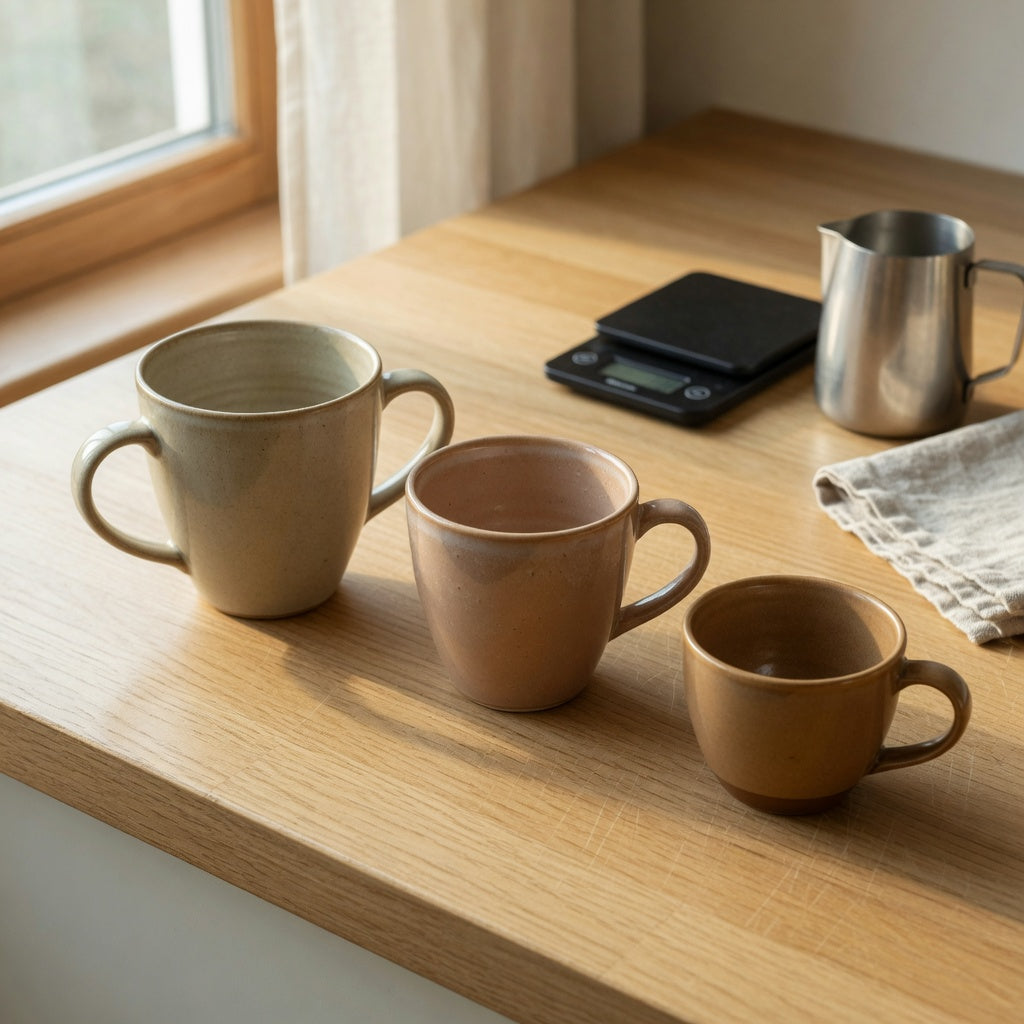
Ceramic Latte Cups: 250, 400, and 440 ml Capacity and Shape Guide
Listed capacity, fill line, and foam headspace are three different numbers. A practical walk-through of 250, 400, and 440 ml ceramic latte cups — interior shape, handle geometry, desk footprint, an...
Read more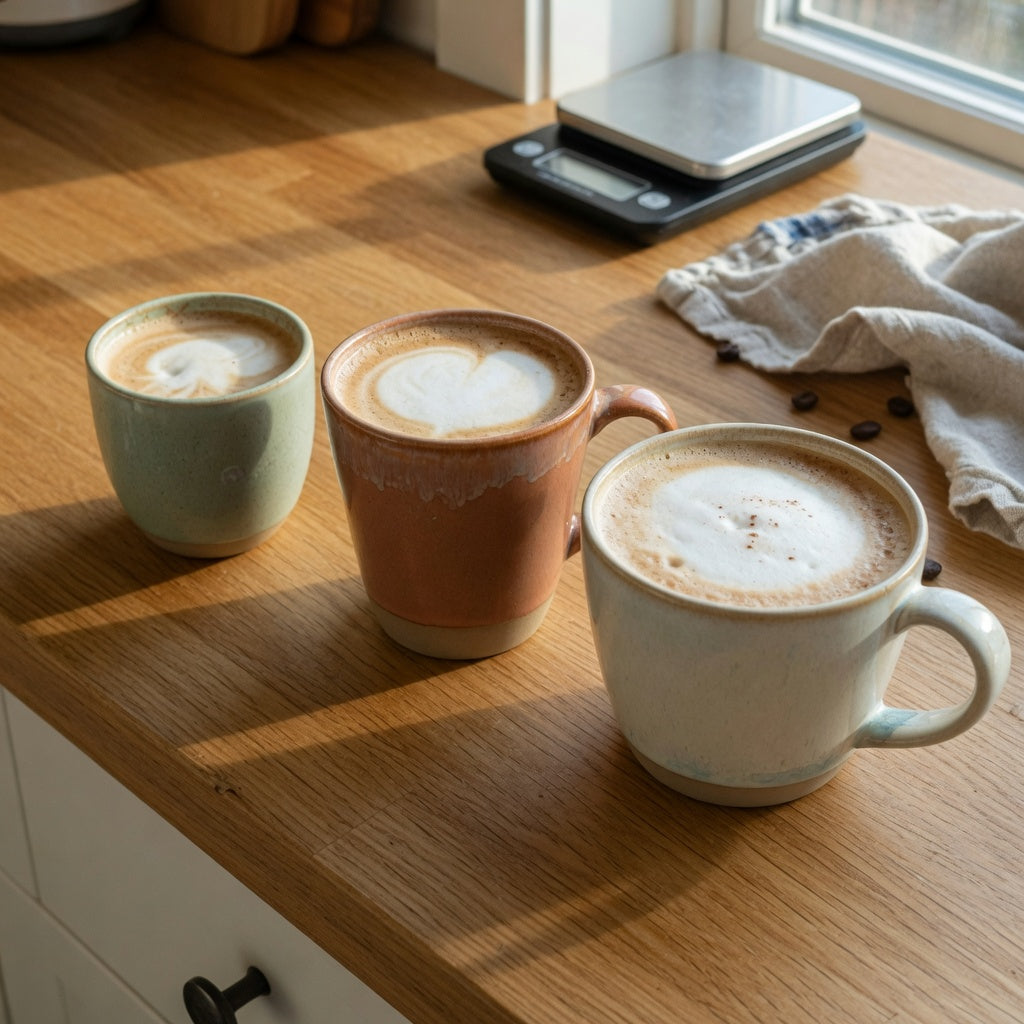
Ceramic Latte Cups Capacity Guide: 250, 400 or 440 ml?
A capacity-first comparison of our 250 ml, 400 ml and 440 ml ceramic latte cups: what each actually pours once foam headspace is counted, how often you will refill, and which desk or counter footpr...
Read more
Leave a comment
This site is protected by hCaptcha and the hCaptcha Privacy Policy and Terms of Service apply.