



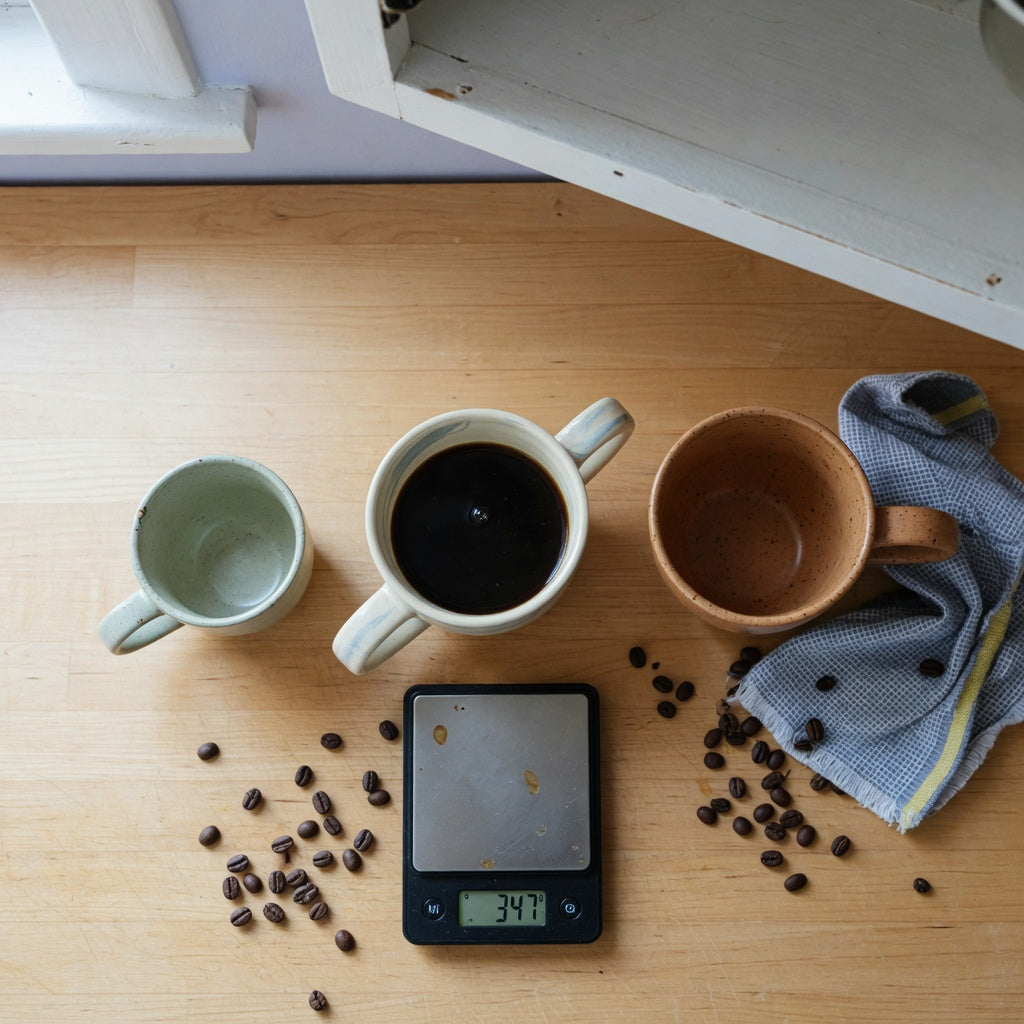
14 Oz Ceramic Coffee Mugs Daily Use Guide: Practical Trade-Offs
Reading time: about 10 minutes
Pour a 14 oz mug to the rim and you get 14 ounces. Pour it the way people actually drink — an inch of headroom so it does not slosh on the walk back to the desk — and you are closer to 12. That gap between brim capacity and usable pour is the most common surprise we hear from customers who size up and then feel shortchanged. This 14 oz ceramic coffee mugs daily use guide is built around that gap: what 414 mL looks like in a real cup, which drinks it suits, and where each of the three sizes we sell stops being the right answer.
We pack and handle these mugs every week, and the sizing emails follow a pattern. Someone measures their old mug, orders by the ounce figure, then writes back about the handle or the cabinet shelf rather than the volume. So here is the working version of that conversation.
What does 14 fl oz actually pour out to?
A U.S. fluid ounce is 29.57353 mL, so 14 fl oz lands at about 414 mL. Two consequences follow from that number.
- It is well above the reference mug in food-safety guidance. The FDA describes cups and mugs as small ceramic hollowware normally about 240 mL (8 fl oz), usually with a handle. A 14 oz mug is more than half again that size, yet it still sits far below the 1.1 L cutoff separating small from large hollowware — so the stricter small-hollowware leachable-lead guidance is the one that applies to it.
- It is usually a brim number. Capacity is easy to quote at the rim and awkward to quote at a comfortable fill. Assume roughly 85–90% usable volume unless the listing says otherwise, and 414 mL becomes something closer to 350–375 mL of drink.
The question worth asking of any listing: is this measured to the rim, and does the lid sit down inside the mug? An inset lid can quietly take a real bite out of usable volume.
Does your usual drink fill a 14 oz mug, or cool in the empty third?
Capacity is only half the decision. Headspace and surface area decide whether the last third of the cup is still hot when you reach it.
- Drip coffee, 10–12 oz: a strong match. Real headroom, and the mug does not look half empty.
- 12 oz latte: fits with room for the foam to settle instead of crowning over the rim.
- 16 oz latte or a full iced coffee: the wrong tool. You will be topping off mid-cup or making two.
- Tea, 8–10 oz: a wide 14 oz body gives a small pour a lot of exposed surface, and it goes lukewarm faster than a narrower cup would.
If your mornings are a short 8–10 oz pour, a smaller mug is genuinely the better buy. Our unique coffee mugs collection shows the full size range, and the 12 oz ceramic coffee mugs daily use guide works through that trade-off properly. Choose 14 oz because your drink is 12 oz or more, not because bigger sounds better on the product page.
Porcelain, stoneware, double-wall ceramic, or ceramic-lined steel?
Four genuinely different products get sold under the same three words, and at 14 oz the differences show up in your hand.
- Porcelain: thinner walls, a denser and lighter body. Easier to lift when full, but thin walls transmit heat — you feel the coffee through the side.
- Stoneware: thicker walls, more mass, better chip resistance. That mass holds heat, and it also means a full mug carries differently one-handed.
- Double-wall ceramic: the outer wall stays cooler, which helps if you carry without using the handle. In exchange you lose the visual fill cue and gain bulk.
- Ceramic-lined steel: a travel format. The ceramic here is a coating over metal, so the metal body rules out microwave use no matter how prominently "ceramic" appears in the title.
Torn between the first two? Our ceramic vs porcelain comparison goes deeper on wall thickness, chipping, and how each feels after months of washing.
14 oz ceramic coffee mugs daily use guide: matching our three sizes to real mornings
Our mugs are stated in milliliters, and none of them is exactly 414 mL. That is worth saying plainly, because a search for 14 oz lands between two of them rather than on one.
| Mug | Stated capacity | Approx. fl oz | Fits well when | Not the best fit when |
|---|---|---|---|---|
| The Flow | 400 ml | ~13.5 | A 12 oz drip or tea with proper headroom; the closest to a cafe-size pour | You routinely pour 16 oz, or want a wide bowl for latte art |
| Morning and Night | 440 ml | ~14.9 | The closest to a true 14 oz feel: 12 oz coffee plus milk, or a single-serve brewer's full output | Cabinet clearance is tight, or you want the mug to double as a soup bowl |
| The Rock | 480 ml | ~16.2 | 16 oz lattes, iced coffee with ice displacement, long desk sessions without a refill | You drink 8–10 oz at a time (the extra airspace cools it), or you want easy one-handed carry |
Practical read: The Flow at 400 ml suits a 12 oz habit that wants breathing room. Morning and Night at 440 ml is the one we point 14 oz shoppers toward when they want that size without going oversized. The Rock at 480 ml holds the most of the three, which makes it the heaviest to carry full and the one to skip if you usually stop at 10 oz.
Handle clearance, full-mug weight, and cabinet height: what to measure first
A mug holding 414 mL of coffee carries roughly 400 grams of liquid on top of its own empty weight. That changes one-handed feel, and it makes handle geometry matter more than the product photo suggests.
Three measurements to check before ordering, in this order:
- Handle opening. Your fingers should clear the mug wall. If knuckles brush the side, a full mug of hot coffee becomes a two-hand job — and that is the complaint we hear most about oversized mugs generally.
- Exterior height and diameter. This decides cabinet shelf clearance, whether the mug fits under a single-serve brewer spout, and whether the base sits in a car cup holder.
- Foot diameter and stackability. Straight-sided mugs stack; tapered or thick-footed shapes usually do not. In a tight cabinet, that alone can decide it.
If grip is your main worry, our guide to ceramic mugs with large handles covers opening width and knuckle clearance in more depth.
Microwave and dishwasher ratings change with trim and decals
This is where buyers get burned. A brand lists a whole shape as microwave and dishwasher safe, then quietly excludes the variant with a metallic handle, metallic rim band, or overglaze decal. Same body, different answer.
- Metal trim of any kind: no microwave. That includes gold- and platinum-look handles and rims.
- Overglaze decals: often labeled dishwasher safe but prone to dulling after hundreds of cycles.
- Oven and broiler: do not assume either. Most drinking mugs are not rated for them, and broiler heat is harsher than oven heat.
- Freezer: thick ceramic going straight from freezer to hot coffee is a thermal-shock risk, not a feature.
Read the care line on the exact product page rather than the collection page. If it is not stated for the specific mug in your cart, treat it as unconfirmed and ask before you buy.
What "lead free" and "food safe" actually cover on a ceramic mug
These two phrases get used as if they are interchangeable. They are not, and the difference is worth five minutes before you commit to a mug you will use every day.
- FDA action levels are leach limits, not content limits. For cups and mugs the guidance is 0.5 micrograms of lead per milliliter of leaching solution, judged on any one of six units, using acetic-acid methods such as ASTM C738. Cadmium for small hollowware sits at the same 0.5 µg/mL.
- "Lead free" is a marketing claim, not a test result. The FDA has found imported traditional pottery labeled lead free that still released extractable lead above those action levels. Ask for a leach-test statement, not just the phrase.
- California draws a separate line. The state's public health department distinguishes lead-free ware (contains no lead) from lead-safe ware (may contain some lead but does not leach above Proposition 65 levels, and may still legally carry a written warning).
- You cannot judge it by eye. Plain white interiors are rarely the concern; damaged or chalky glaze, decoration sitting on top of the glaze, and bright color on the food-contact surface are the higher-risk patterns. Coffee is acidic — exactly the kind of drink that encourages leaching.
One more category worth knowing: decorative ceramicware that looks like a mug but is not intended for drinking must, under 21 CFR 109.16, carry a "Not for Food Use" warning or have a hole bored through the potential food-contact surface. If a handmade mug arrives with unusual surface decoration and no food-use statement, ask before you pour.
A small peer-reviewed pilot study also detected lead in coffee brewed in some ceramic mugs, at levels that varied from mug to mug and in one case exceeded California's daily maximum allowable dose estimate even while staying under the FDA cup-and-mug limit. That is a reason to care about the label, not a reason to distrust ceramic as a category.
One practical note from the same guidance: microwaving and dishwashing can worsen leaching in ware that contains or might contain lead, because heat and detergent attack the glaze. If a mug's food-safety status is unclear, do not reheat coffee in it.
Crazing, coffee staining, and rim chips after a year of daily use
Daily use shows up in three predictable places, and none of them appears in a product photo.
- Staining collects fastest on matte interiors and in the fine texture of unglazed foot rings. A glossy interior glaze wipes clean with noticeably less scrubbing.
- Crazing — the fine web of cracks in the glaze — appears on many glazed ceramics over time. What matters is whether the glaze is still intact at the lip, since that is where you drink from.
- Rim chips come from stacking and from the sink. Rim-against-rim stacking is the main cause; a felt pad between mugs, or simply not stacking, extends life considerably.
Look at the lip separately from the interior. Decoration at the rim deserves its own scrutiny, because that is the part touching your mouth on every sip.
Five checks before you add to cart
- Convert your usual pour to ounces. Under 10 oz, size down rather than up.
- Confirm whether the stated capacity is brim or working volume.
- Measure your cabinet shelf, brewer clearance, and cup holder against the mug's exterior height and base diameter.
- Read the care line for that exact mug — not the collection.
- Look for a lead and cadmium leach statement rather than the words "food safe" on their own.
Still undecided between 400 ml and 480 ml? Put them side by side in our full collection of unique coffee mugs — the difference is far easier to feel in your hand than to picture from a spec line.
Frequently asked questions
Is a 14 oz ceramic mug too big for a regular cup of coffee?
For a 10–12 oz drip coffee, no — you get headroom without the mug looking half empty. For an 8 oz pour, yes: the extra surface area and airspace cool the drink faster than a smaller mug would.
What should a 14 oz ceramic coffee mugs daily use guide tell me that a listing will not?
Mostly the gap between brim capacity and usable volume, plus the fact that handle opening, full-mug weight, and base diameter decide comfort more than capacity does. A listing quotes ounces; it rarely tells you how the mug feels full in one hand.
Can I put a ceramic mug with a gold handle in the microwave or dishwasher?
Not the microwave — metal trim of any kind is a no. Dishwasher safety depends on the specific finish, so check the care line for that exact mug rather than assuming the whole collection shares one rating.
What is the difference between lead-free and lead-safe ceramic mugs?
Lead-free means the ware contains no lead. Lead-safe means it may contain some lead but does not leach above California's Proposition 65 thresholds, and such items can legally carry a written warning. Neither phrase replaces a leach-test statement.
Will a full 14 oz mug fit in a car cup holder or under my brewer?
That depends on exterior height and base diameter, which vary a lot between shapes at the same capacity. Measure the widest part of the base and the total height including the handle, then compare those against your cup holder and brewer clearance before ordering.
Ready to pick your mug? Two ways to save on today's order:
Ordering 1–3 mugs? Get an extra 10% off your 1st order with code 10_OFF Apply 10% Off & Shop Wooden-Handle Mugs →
Gifting 4+ mugs? Buy 3, Get the 4th Free applies automatically at checkout (no code needed; offers do not stack) · Free standard shipping (Nov pre-Christmas delivery: 15–20 calendar days US) · Free replacement if chipped in transit.
Popular mug buying guides: Ceramic Mugs with Lids Compared · Wooden-Handle Tea Infuser Mugs Compared · Christmas & Secret Santa Mugs 2026 · Espresso & Cortado Cups Guide · Cup & Saucer Gift Sets · All 25 Mugs Spec Table · Mug Size Guide · Shipping & Promo FAQ
FIRST ORDER 10% OFF (CODE: 10_OFF) · OR BUY 3, GET THE 4TH FREE




















Read more
Unique Espresso Cups Morning Routine Product Shortlist Guide
A schedule-first shortlist: we match our 170 ml, 200 ml, and 250 ml ceramic cups to real morning volumes, then cover group-head clearance, preheating, crema visibility, glaze safety, and the mornin...
Read more
Big Latte Mug Morning Routine Product Shortlist Guide: 400–480 ml
A scenario-first shortlist for choosing between our 400 ml, 440 ml and 480 ml ceramic mugs, built on your real pour time, drink volume and refill habit — plus the handle, weight and clearance check...
Read more
Leave a comment
This site is protected by hCaptcha and the hCaptcha Privacy Policy and Terms of Service apply.