



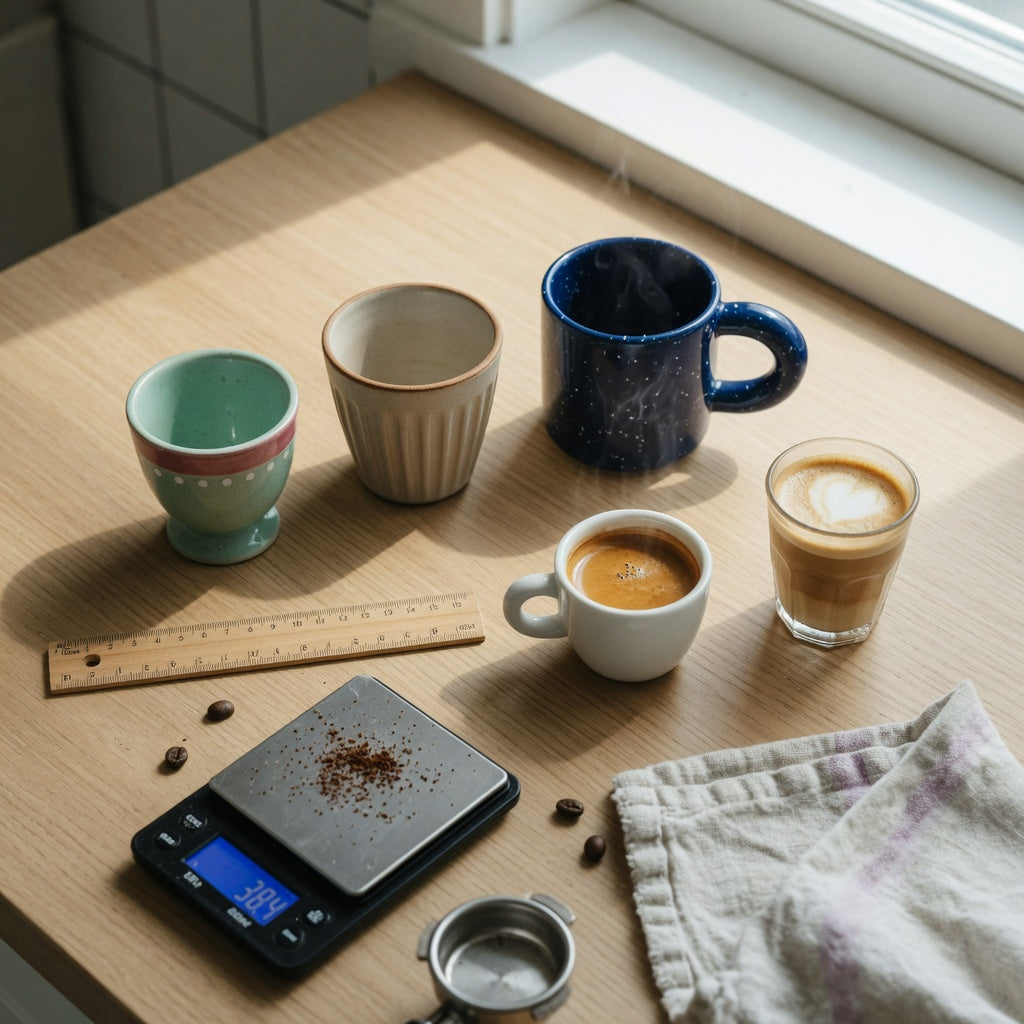
Unique Espresso Cups Morning Routine Practical Purchase Checklist
Reading time: about 9 minutes
6:40 a.m. The machine is up to temperature, the shot is running, and the cup you bought for its glaze is wedged sideways because the handle will not clear the drip tray. That is the moment unique espresso cups stop being decor and start being equipment. A finish can be as expressive as you like — the capacity, rim, and footprint still have to behave.
We sell compact ceramic coffee and tea cups, so most of our pre-purchase conversations are not about color. They are about whether a 170 ml cup makes a double shot look lost, whether a 250 ml mug still counts as an espresso cup, and whether a bright decorative glaze is genuinely safe for hot coffee every morning. Those are the right questions, and this unique espresso cups morning routine practical purchase checklist answers them in the order they actually affect your day.
Unique espresso cups morning routine practical purchase checklist: the three numbers to settle first
Before you scroll the finishes, write down three things about an average weekday — not your weekend, and not the coffee you photograph.
- Usual pour. A certified Italian espresso is about 25 ml; the older specialty definition puts a single shot at 25–35 ml. A double is two of those before crema settles.
- Cup capacity. Demitasse guidance commonly lands in the 50–100 ml range, with roughly 60 ml as a typical demitasse. Cup capacity is deliberately larger than the drink because crema and headspace need somewhere to sit.
- Refill tolerance. One shot and out the door is a different purchase from a double, a splash of milk, and a top-up before the machine cools down.
Those three answers do more work than any style filter. Our ceramic cups are listed at 170 ml for the Retro Coffee & Tea Cup, 200 ml for the Pleated Coffee & Tea Cup, and 250 ml for the Ball Handle Coffee & Tea Mug. Those are capacity facts we can confirm, alongside the visible ceramic finish. What we will not do is call the 250 ml mug a traditional demitasse, because it is not one.
Which listed capacity fits a double shot, a cortado, or a second refill?
| Your weekday morning | Listed capacity to shortlist | Why it fits | Verify before buying |
|---|---|---|---|
| One double shot, drunk standing up | Retro Coffee & Tea Cup, 170 ml | Compact ceramic body leaves room for crema without stretching the shot into a long drink. | Interior color, rim thickness, and outer height under your group head. |
| Double shot plus a splash of milk or a small cortado | Pleated Coffee & Tea Cup, 200 ml | More headspace for milk and crema while staying compact enough for a short morning drink. | Whether the pleated profile sits comfortably on your lip and inside your cabinet. |
| Long double, tea, or a refill without rinsing in between | Ball Handle Coffee & Tea Mug, 250 ml | Largest listed capacity; behaves as a small coffee mug for drinkers who want more volume. | Handle clearance, base diameter, and whether you still want an espresso-cup experience. |
Read that as a fit check, not a ranking. A double shot plus crema typically lands well inside a 170 ml cup, which leaves headroom instead of a brim-full pour you have to carry carefully across the kitchen. The 200 ml cup absorbs a cortado-style splash without turning into a mug. The 250 ml mug is the one you reach for on a cold morning when the second refill matters more than the ritual.
There is an honest trade-off in each direction. If you pull a 25–35 ml single and nothing else, all three of these are oversized — a mismatch, not a defect, and a 50–100 ml demitasse will feel more precise in your hand. If you mostly drink milk drinks, the 250 ml mug is the flexible pick but the least espresso-like, and it is better to admit that before checkout than after.
Will it clear the group head, the drip tray, and the shelf?
In our experience, the two details shoppers most often wish they had checked are handle clearance and interior color. Neither shows up reliably in a hero photo.
- Measure the gap, not the cup. Run a ruler from the drip tray to the underside of the group head, then subtract room for the portafilter and your knuckles.
- Compare outer height, not capacity. A wide 250 ml cup can sit lower than a narrow 170 ml one. Capacity tells you nothing about clearance.
- Look hard at the handle. A generous handle is lovely at a desk and awkward under a machine. Handleless cups save clearance but pass heat to your fingers, so check wall thickness before committing.
- Measure the saucer too. A saucer that overhangs the drip tray becomes a daily annoyance, and a wide one may not fit the shelf where the cup alone would.
- Plan storage. One-off pottery and double-wall glass rarely stack. If your cabinet depends on stacking, check the base and rim profile first.
Preheating belongs in the same routine. Thick ceramic pulls heat out of a small shot quickly, so a hot-water rinse before you pull makes a real difference to the first sip. Do not shortcut that in the microwave if the cup has metallic decoration or a maker's warning against it — a rinse is safer and just as fast.
Do you want to read the crema, or only admire the glaze?
If you judge a shot by color, a white or clear interior is the practical choice. Crema shifts from dark brown to blond as the shot runs, and a dark reactive glaze hides exactly that transition. Metallic lusters look dramatic on a shelf and bounce light in ways that make the surface harder to read at 7 a.m.
Rim geometry is subtler. A thin rim feels hotter and sharper on the lip; a thicker rim feels softer but can mute the first sip. The classic demitasse shape — narrow base, wider rim — concentrates aroma and gives crema somewhere to pool. Square cups, sculptural handles, and heavy art pieces can look better than they drink, especially when a corner traps coffee or the rim sits uneven against your mouth.
Buying a cup as a small design object is a legitimate reason. Just separate the display decision from the drinking decision. An irregular handmade rim may be exactly what you want on open shelving, and exactly the cup you avoid at 6:45 on a Tuesday.
What should a decorative glaze prove before it holds hot coffee?
This is where a charming cup and a risky cup diverge. The FDA guidance on lead-glazed traditional pottery explains that lead in ceramic glazes or decorations can leach into food or drink if the pottery is not properly fired, and that washing or boiling cannot remove lead from pottery. The same guidance flags higher-risk ceramicware as handmade pieces with a crude or irregular look, antiques, damaged or worn ware, flea-market finds and pieces from unknown makers, and ware brightly decorated in orange, red, or yellow.
For cups and mugs specifically, the FDA's chemical-contaminants listing sets an action level of 0.5 µg/ml leaching solution for lead under CPG 545.450. That is a laboratory threshold, not something you can eyeball on a sticker — and the FDA notes that some traditional pottery labeled lead free has still shown extractable lead at or above action levels. Under 21 CFR 109.16, ornamental ceramicware that otherwise looks usable must be conspicuously labeled Not for Food Use or have a hole through the food-contact surface. If the base carries that mark, it is a display piece.
Our rule is simple: ask the seller for food-contact testing or a plain statement that the glaze is intended for food use. A vague answer means treat the cup as decorative. None of this makes handmade ceramics unsafe by default — it means the listing has to answer the question. We can confirm the listed capacities of our cups; we will not turn a glaze photograph into a safety certification.
Will you actually hand-wash it on a workday?
Cleanup is where decorative cups quietly fall out of rotation. Decide before you buy whether you are willing to hand-wash at 6:50 a.m., because a gold rim or a hand-painted band can turn a two-minute routine into a five-minute one.
- Dishwasher: never assume. Heat and detergent can dull metallic lusters, fade hand-painted decoration, and wear glaze over years. Check the care line on the exact listing.
- Microwave: metallic decoration and some glazes are not microwave safe. A cup that handles coffee fine can still be wrong for reheating milk.
- Glass: double-wall glass keeps heat off your fingers but scratches and can trap water in the seam. Single-wall borosilicate is easier to inspect.
- Chips: run a thumb around the rim and the handle junction. A chip on the drinking edge is not a charming imperfection — retire the cup.
- Feet and saucers: unglazed feet trap water and stain. Dry them fully before the cup goes back on the shelf.
A cup that fails your cleanup test can still be a fine gift or a shelf piece. It is a poor daily driver. If you want one cup that does both, pick a simpler glaze and a shape you can wash with a normal sponge.
Frequently asked questions
What is the first thing to check in a unique espresso cups morning routine practical purchase checklist?
Your usual pour and the clearance from your drip tray to the group head. Capacity tells you whether the cup suits a double or a cortado; clearance tells you whether it fits under the machine at all. Style only matters once both of those pass.
Is a 170 ml cup too big for a single espresso?
For a traditional 25–35 ml single, yes — a 170 ml cup leaves a lot of visible headspace. It is a better match for a double shot, a small cortado, or coffee with a splash of milk. If you want a precise single, look for a 50–100 ml demitasse instead.
How do I know a unique espresso cup will fit under my machine?
Measure the gap from the drip tray to the underside of the group head, then measure the cup's outer height plus any saucer you plan to use. Handle position matters as much as height, since a protruding handle can hit the tray even when the rim clears.
Are handmade or brightly glazed cups safe for hot coffee?
They can be, but the listing should answer the food-contact question directly. The FDA sets a 0.5 µg/ml action level for lead leaching from ceramic cups and mugs, and notes that lead cannot be removed by washing or boiling. Ask for test results or a clear food-use statement, and treat vague claims as decorative only.
Can I put a decorative espresso cup in the dishwasher?
Only if that exact product listing says so. Gold rims, metallic lusters, hand-painted patterns, and some glazes degrade in a dishwasher, and glass can scratch. If the care information is missing, hand-wash and dry the cup fully before stacking.
Run a three-line test before checkout: listed capacity against your usual pour, outer height against your measured group-head gap, and care instructions against your tolerance for hand-washing. If capacity is the only open question, compare the Retro 170 ml cup, the Pleated 200 ml cup, and the Ball Handle 250 ml mug side by side, then confirm the interior color and care details on each current listing. The unique coffee mugs collection is where the finishes sit together, so you can pick the one you will still reach for on a Wednesday.
More from our blog
Ready to pick your mug? Two ways to save on today's order:
Ordering 1–3 mugs? Get an extra 10% off your 1st order with code 10_OFF Apply 10% Off & Shop Wooden-Handle Mugs →
Gifting 4+ mugs? Buy 3, Get the 4th Free applies automatically at checkout (no code needed; offers do not stack) · Free standard shipping (Nov pre-Christmas delivery: 15–20 calendar days US) · Free replacement if chipped in transit.
Popular mug buying guides: Ceramic Tea Cups & Infuser Mugs · Ceramic Mugs with Lids Compared · Wooden-Handle Tea Infuser Mugs Compared · Christmas & Secret Santa Mugs 2026 · Espresso & Cortado Cups Guide · Cup & Saucer Gift Sets · All 25 Mugs Spec Table · Mug Size Guide · Shipping & Promo FAQ
FIRST ORDER 10% OFF (CODE: 10_OFF) · OR BUY 3, GET THE 4TH FREE


Read more
Ceramic Mug Shapes Daily Use Guide: Pick by Pour, Grip, Heat
A shape-by-shape look at how listed capacity, rim style, and handle geometry change the way you actually drink — plus which of our three ceramic silhouettes matches your real pour size, and which o...
Read more
14 Oz Ceramic Coffee Mugs Morning Routine Practical Purchase Checklist
A mug labeled 14 oz rarely pours 14 oz of drinkable coffee. Our checklist ties brim versus working capacity to your actual morning pour, handle clearance, glaze safety, and care labels so the next ...
Read more
Leave a comment
This site is protected by hCaptcha and the hCaptcha Privacy Policy and Terms of Service apply.