



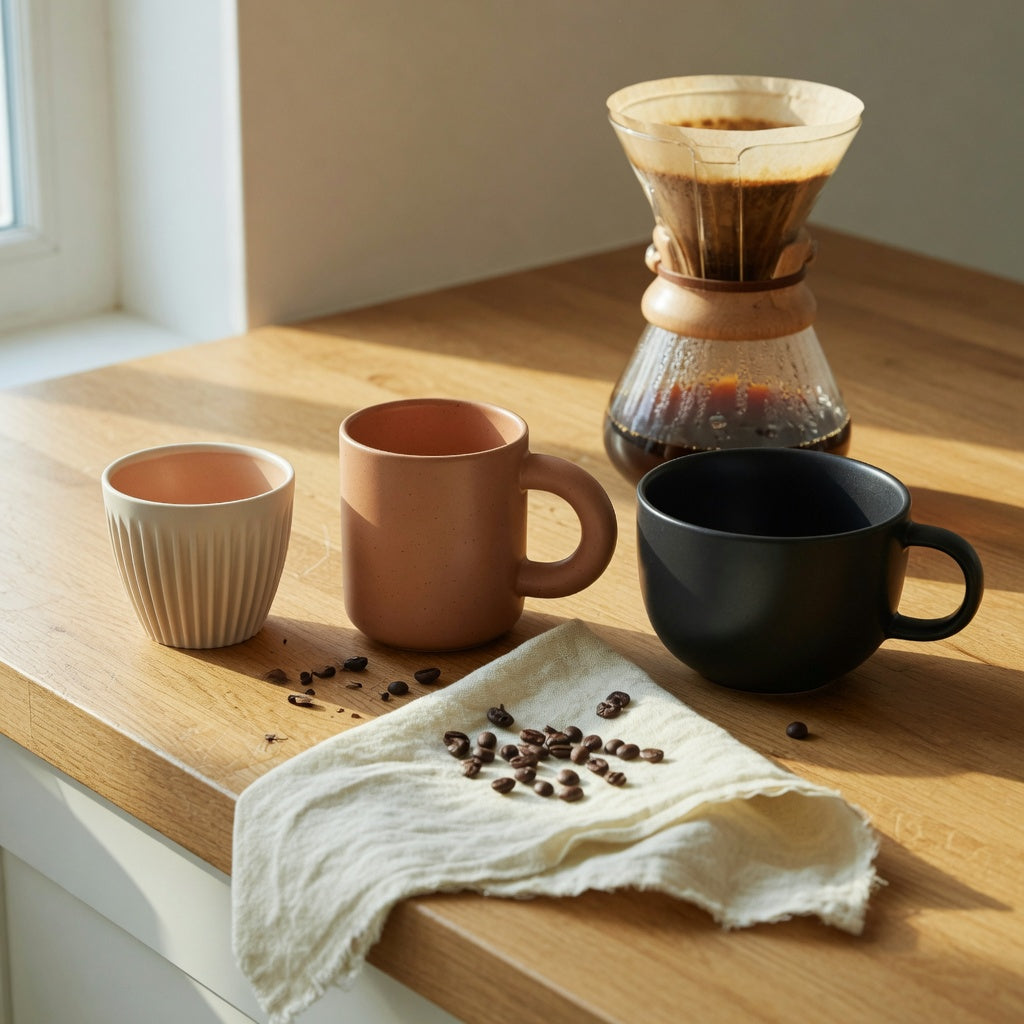
Ceramic Mug Shapes Daily Use Guide: Pick by Pour, Grip, Heat
Reading time: about 10 minutes
There is a mug in most kitchens that never gets used. It is not chipped and it is not ugly. It is the wrong size for the way the household actually drinks — a 400 ml body that feels generous at 7 a.m. and wasteful at 10, when you pour 150 ml into it and watch the heat leave. That is the whole ceramic mug shapes daily use guide in one line: a shape is a container for a habit, and the habit decides whether you love it or resent it.
We pack, photograph, and ship these mugs every week from our store, and the emails we answer are almost never about glaze colour. They are about fill level, finger room in the handle, and whether a shape clears a machine spout or a crowded shelf. Here is how we walk shoppers through it.
What counts as a mug, and why does the 240 ml default mislead shoppers?
U.S. FDA guidance on ceramic hollowware draws a line that surprises most buyers: in that guidance, a cup normally has a base and curved sides, while a mug has cylindrical sides. Both are normally made with a handle and normally hold about 240 ml (8 fl oz) — normally, not always.
That 240 ml figure is a default, not a rule to shop by. Convert the numbers yourself rather than trusting a label: NIST treats 1 fluid ounce as 29.57 ml and 1 cup as 240 ml. So a mug listed at 200 ml holds roughly 6.8 fl oz, a 250 ml mug holds about 8.5 fl oz, and a 400 ml mug holds roughly 13.5 fl oz.
Drink sizes then sit on top of those numbers:
- Espresso and ristretto: small cups, commonly up to about 90 ml.
- Cappuccino, flat white, latte: often in the 150–240 ml band, with different milk-to-foam ratios rather than dramatically different volumes.
- Filter coffee, tea, iced drinks: wherever your own pour lands, which is usually bigger than anything above.
Specialty-coffee training uses those bands as a starting point, not a law. The practical takeaway: a mug label tells you almost nothing about whether it suits your morning. The listed capacity and the opening do.
Ceramic mug shapes daily use guide: does the silhouette actually keep coffee hot?
Partly, and less than sellers claim. Heat leaves a mug three ways: through the walls, off the exposed liquid surface, and out of the open top as evaporation. More surface area and thinner walls increase conductive heat flow; an open top adds evaporative loss that a lid removes.
So a fat-bellied mug with a narrower mouth exposes less liquid at the top than a straight cylinder of the same volume. That is a reasonable argument. It is not the same as proof. We have not seen a controlled side-by-side that holds clay body, wall thickness, and volume constant and then ranks named silhouettes — and neither, as far as we can tell, has anyone else publishing the claim. Treat belly-mug heat retention as plausible physics, not a measured result.
What you can do without any of that: preheat the mug with hot water for 30 seconds before pouring. In our experience with 200 ml and 250 ml cups, that single step changes the drinking experience more than swapping silhouettes ever will. It also takes the shock out of a cold cabinet mug hitting a hot pour, which is one of the small stresses that eventually shows up as a hairline crack in cheap earthenware.
Pleated 200 ml: the small cup that either fits your ritual or fights it
Our pleated coffee and tea cup is listed at 200 ml. The pleated body is the visual signature, and it also gives your fingers a defined place to sit — which matters more than it sounds when the drink is hot.
Where a 200 ml cup earns its counter space:
- A single flat white or cortado in the morning, drunk while it is still at temperature.
- Loose-leaf tea in small, repeated pours instead of one giant mug that goes cold.
- A doppio or lungo you want to taste rather than sip through a meeting.
- Hot chocolate for a child, where a 400 ml pour is simply too much.
Where it does not fit, and we say this to shoppers directly: if your default is a 12 oz drip coffee, or you build iced drinks with a full scoop of ice, 200 ml will feel like a sample. If you like to fill once and sip for an hour, this is not the shape to buy. For more on matching a smaller vessel to a tea routine, our ceramic tea mug daily use guide walks through the same capacity logic.
Ball handle at 250 ml: finger room, balance, and cabinet clearance
The ball-handled coffee and tea mug comes in at a listed 250 ml, which sits right around that 240 ml norm — the band most people picture when they hear coffee mug.
Handle geometry is where this one lives or dies. A ball handle is a rounded knob-style grip rather than a flat strap, and the questions to ask are physical, not aesthetic:
- How much room is inside the loop for two or three fingers?
- Does your knuckle clear the body when the handle sits against your palm?
- Does the handle sit high enough that a full mug does not feel like it is tipping forward?
- Does it protrude far enough to block stacking or catch on a shelf edge?
There is no published ergonomic range for handle openings by hand size — anyone who quotes one is guessing. Test with your own grip, or check the listing photos for the loop profile before ordering. If you have large hands, or you drink with your non-dominant hand at a desk, a protruding handle costs you cabinet depth and stacking height, and that is a daily annoyance rather than a minor one. Our comparison of handled shapes goes deeper on exactly this trade-off.
The Flow at 400 ml: generous at 7 a.m., lukewarm at 10
The Flow coffee and tea mug is listed at 400 ml — roughly 13.5 fl oz, or a large filter coffee with room for milk. It is the shape for people who treat a mug as a desk companion rather than a tasting vessel.
Two things buyers underestimate about a mug this size:
- Full weight. 400 ml of liquid is about 400 g before you count the ceramic. If you carry it upstairs or drink one-handed at a keyboard, check where the balance point sits in your grip.
- Open area. A larger mouth means more exposed liquid and faster cooling. That is a fair trade for aroma and for adding milk without a spoon fight, but it is why a 400 ml mug of coffee can be cold at the halfway mark.
It is the wrong mug for a single espresso, for a small latte you intend to pour art into, and for anyone with limited shelf height. If you fill it to the top every time, you already know you want it. If you usually pour 150 ml, you will spend the year looking at a lot of empty ceramic.
Faceted, square, and handleless: where decorative shapes break down
We love a sculptural mug. We also tell people which ones we would not use every day. Interior corners on faceted and square bodies give residue somewhere to sit, and outside edges and feet are the spots that chip first when a mug meets a stone counter. A round interior and a smooth foot are boring for a reason.
Handleless cups are a separate conversation. A yunomi-style cup is pleasant for tea at a drinkable temperature, but with a freshly boiled pour the wall becomes the handle and the rim can be too hot to meet your lip. If you want handleless, decide whether you drink tea that has rested a minute or coffee straight off the brew — the answer changes the shape you should buy.
Our unique coffee mugs collection is where those sculptural forms live, and the sculptural mug daily use guide covers how far a novelty body can go before it stops being practical.
Our three silhouettes at a glance, by listed capacity
| Model | Listed capacity | Best daily scenario | Where it falls short |
|---|---|---|---|
| Pleated coffee and tea cup | 200 ml (about 6.8 fl oz) | Flat white, cortado, small repeated tea pours | 12 oz drip drinkers; iced drinks with a full scoop of ice |
| Ball-handled coffee and tea mug | 250 ml (about 8.5 fl oz) | The familiar standard band; kitchen counter and desk | Protruding handle costs cabinet depth and stacking height |
| The Flow coffee and tea mug | 400 ml (about 13.5 fl oz) | Large filter coffee, milk-heavy drinks, long desk sessions | Espresso; latte art; low shelves; slow drinkers |
Capacities above are the listed figures. We deliberately are not quoting wall thickness or clay body for these three, because those details belong on the current product pages, not in a comparison table where they can drift out of date.
Six checks before you commit to a shape
- Pour what you actually pour. Measure your normal pour once with a jug. It settles the size question faster than any chart, including ours.
- Rim thickness and lip. A thick rolled rim feels soft on the lip; a thin one feels more precise. A slight outward flare helps direct the liquid and reduces the drip that runs down the outside.
- Handle finger room. Two to three fingers inside the loop is the working range for most adults; then check knuckle clearance against the body.
- Balance when full. An empty mug tells you nothing. Fill it with water and carry it across the room.
- Clearance. Measure shelf height, cabinet depth, and the space under your machine spout before buying — especially with a protruding handle or a 400 ml body.
- Food-contact documentation. FDA Compliance Policy Guide Sec. 545.450 sets a lead guideline of 0.5 micrograms per millilitre of leaching solution in any one of six units, tested along the lines of ASTM C738 — an acetic-acid extraction that the standard itself describes as severe and unlikely to match ordinary use. Decorative-only pieces are a different category from food-use ware. If a listing does not state food-use status or test results, ask before you buy.
Shape does not change how much lead a glaze releases; firing and formulation do. Keeping those two questions separate is how you shop safely without blaming the silhouette.
Frequently asked questions
Is a wide, bowl-shaped ceramic cup better for latte art than a straight-sided mug?
A wide, shallower cup gives the milk more room to spread and settle as you pour, which is why baristas favour it. A tall 400 ml mug with a narrow mouth makes a clean pour harder, not impossible. If latte art is the goal, choose the wide form; if you mostly drink black coffee, that same wide form just cools faster.
How many fingers should fit through a mug handle?
There is no published ergonomic standard, so test it with your own grip. Two fingers inside the loop with the knuckle clear of the body is comfortable for most adults, and three is generous. The failure mode is a handle that forces your knuckle into the ceramic once the mug is full.
Does a fat-bellied mug keep coffee hotter than a cylinder?
A narrower mouth exposes less liquid surface and reduces evaporative loss, so it should help. We have not seen a controlled test that isolates silhouette from wall thickness and volume. Preheat the mug and match your pour to the capacity; those two steps matter more than the outline.
Can I use a handleless ceramic cup for very hot coffee?
It is a poor fit for a fresh boil. The wall becomes your only grip and the rim can be too hot to drink from. Handleless forms work best for tea or coffee that has rested a minute, or for smaller volumes that cool quickly.
What should I measure first before picking any of these shapes?
Your pour, your shelf, and your grip — in that order. The short version of this ceramic mug shapes daily use guide is that a mug which holds the wrong volume for your habit will lose to one that holds the right volume, no matter how good it looks on the shelf.
Start with the pour, not the photo. Measure what you drink, check the rim and the handle against your own hand, and pick the shape whose listed capacity matches the cup you already reach for. If that is a small single-serve ritual, the 200 ml pleated cup is the honest answer; if it is a standard handled mug, the 250 ml ball handle sits in the most familiar band; if it is a desk-sized brew, go straight to the 400 ml Flow. Browse the full unique coffee mugs collection with those three numbers in hand, and skip anything whose size you would have to talk yourself into.
Ready to pick your mug? Two ways to save on today's order:
Ordering 1–3 mugs? Get an extra 10% off your 1st order with code 10_OFF Apply 10% Off & Shop Wooden-Handle Mugs →
Gifting 4+ mugs? Buy 3, Get the 4th Free applies automatically at checkout (no code needed; offers do not stack) · Free standard shipping (Nov pre-Christmas delivery: 15–20 calendar days US) · Free replacement if chipped in transit.
Popular mug buying guides: Ceramic Tea Cups & Infuser Mugs · Ceramic Mugs with Lids Compared · Wooden-Handle Tea Infuser Mugs Compared · Christmas & Secret Santa Mugs 2026 · Espresso & Cortado Cups Guide · Cup & Saucer Gift Sets · All 25 Mugs Spec Table · Mug Size Guide · Shipping & Promo FAQ
FIRST ORDER 10% OFF (CODE: 10_OFF) · OR BUY 3, GET THE 4TH FREE


Read more
Big Latte Mug Morning Routine Practical Purchase Checklist
There is no standard size for a latte mug, so we built the checklist we run through with buyers at the counter: your measured pour, brim versus usable capacity, handle room, filled weight, and the ...
Read more
Unique Espresso Cups Morning Routine Practical Purchase Checklist
A decision-ready checklist for buying unique espresso cups that actually fit your morning: match listed capacity to your real pour, check group-head clearance, read the interior for crema, and conf...
Read more
Leave a comment
This site is protected by hCaptcha and the hCaptcha Privacy Policy and Terms of Service apply.