

Ceramic Latte Cups Morning Routine Practical Purchase Checklist
Reading time: about 11 minutes
At 6:45 a.m., the difference between a good latte and a frustrating one is often about 50 ml of headroom. We watch it happen in our store: someone buys a cup they love the look of, pulls a double shot, steams milk to their usual line, and the foam crests the rim before the first sip. The cup is not defective. The number on the listing and the millilitres you can actually drink are two different figures, and that gap is the most common reason a mug gets demoted to the back of the cabinet.
This ceramic latte cups morning routine practical purchase checklist runs on three variables that decide whether a cup earns permanent counter space: when you drink, how much you genuinely pour, and whether you will walk back to the machine for a refill. Glaze, handle, and footprint are filters you apply afterward. Work through them out of order and you will spend twenty minutes comparing rim widths on a cup that was the wrong size from the start.
The ceramic latte cups morning routine practical purchase checklist, step by step
Take these in sequence. Most buyers who stall are arguing about step four before they have answered step one.
- Time the drink. Ten minutes standing at the counter and a forty-minute carry to a desk are two different purchases. Long carries favor a larger listed capacity; a quick flat white does not.
- Measure your real pour. Steam your usual milk into a jug once and read the level. That number beats any cafe menu size, because your pitcher, your milk, and your foam are the ones that have to fit.
- Budget headroom for foam. Foam, a spoon, and a cautious fill line all sit above the liquid. A cup shown filled to the brim in a photo was not filled to the brim with hot coffee.
- Look at the interior transition. How the base meets the wall changes how milk moves as you pour, so check interior photos rather than the front-facing hero shot.
- Judge the handle loaded, not empty. A grip that feels generous on a shelf sample can pinch when the cup is full and your hand is cold from the milk jug.
- Confirm the glaze and care statements. Ask those questions before checkout, not after the first dishwasher cycle.
Why a cup listed at 10 oz can pour like an 8 oz cup
Listed ounces and millilitres are usually brim-full figures unless the listing says otherwise. Foam, a spoon, and a sensible fill line all take room, which is why reviews so often report that a cup labelled 10 oz feels closer to 8 oz in daily use. Nothing shady is happening. It is an unstated measuring convention, and most listings never clarify which number they are quoting.
For scale, FDA describes a cup or mug as small ceramic hollowware normally holding about 240 mL (8 fl oz) and made with a handle, with cups tending to have a base and curved sides while mugs have cylindrical sides. That puts a 250 ml cup close to a conventional single serving. Not a large latte, and not automatically too small either.
| Cup | Listed capacity | What to verify on the listing |
|---|---|---|
| Ball Handle | 250 ml | Handle opening, base footprint, and whether the listing quotes brim capacity or a comfortable fill line. |
| The Flow | 400 ml | Vessel shape in interior photos, mouth width, and desk footprint. |
| Morning and Night | 440 ml | Handle balance when the cup is full, and how much counter it occupies. |
Those three capacities are the ones we publish for this line-up. Anything beyond that, from wall thickness to exact interior profile to microwave or dishwasher approval for a specific piece, should come off the product page or from us directly before you order, because those answers are piece-specific and we would rather you check than assume. The full range sits in our unique coffee mugs collection.
Which listed capacity matches your refill tolerance before 9 a.m.?
Refill tolerance is not appetite. It is the number of times you walk back to the machine before your morning settles into work, a school run, or email.
- Ball Handle 250 ml — one small latte, flat white, or cappuccino, and then you switch to water.
- The Flow 400 ml — one generous latte with room for foam, no second trip.
- Morning and Night 440 ml — the largest listed capacity in this comparison, sized for a single fill you carry to a desk.
If your usual pour is 6–8 oz and you rarely finish it, start with the Ball Handle 250 ml. If you want foam headroom and a drink that still feels generous at 10–13 oz, The Flow 400 ml is the middle option. If you fill once and walk the cup to a desk, compare Morning and Night 440 ml against your actual route, because footprint matters more than capacity once a cup lives next to a keyboard.
Two refills of a 250 ml cup will still feel like fuss if you sip slowly and like a warm mug in hand at 10 a.m. A single 440 ml fill is the more honest answer for that habit. Be realistic here — this is the step people skip and then blame on the cup.
Rounded bottom or straight wall — which interior helps your pour?
A rounded transition from base to wall gives steamed milk a smoother path as you pour, which is why bowl-shaped latte cups keep appearing in latte-art discussions. A hard interior corner can stall the flow and make a clean rosetta harder to start. That does not make every straight-sided mug bad for art. It means your margin for error is smaller, so confirm the interior from photos before assuming any ceramic cup is a latte-art tool.
Rim width does its own work. A narrow rim leaves you less room once the foam reaches the edge, while a wide mouth gives you a slower, more forgiving pour. Capacity and mouth width are not the same measurement, so read the dimensions rather than the volume. If you are practising pours, the 400 ml Flow cup is the middle of our three sizes and the one most people compare first for a 10–13 oz latte.
One boundary we hold: we will not tell you that one wall material keeps a latte hotter than another. Published comparisons of stoneware, porcelain, and double-wall ceramics disagree with each other, and we have no test data of our own to add. If temperature matters to you, preheat the cup with hot water while the shot pulls. That works whichever capacity you choose.
Handle opening and counter footprint when the cup is full
A full 440 ml cup carries noticeably more liquid mass than a 250 ml cup, so the handle has to do more than look proportional. Three details are worth checking on any ceramic latte cup listing: the opening between handle and body, the thickness of the grip, and where the handle attaches to the wall.
Look for a side-view photo rather than a front-on hero image. If you use a thumb-over grip, or your hands are on the larger side, a small cup can still have a tight opening. In our experience this is the defect buyers mention most after delivery. Not breakage, but a handle that turns uncomfortable once the cup is full.
Then measure the destination. A 440 ml cup needs a clear spot on the counter, the desk, or the shelf, plus clearance under your espresso machine's group head if you pull straight into the cup. A 250 ml cup slots into tight apartment kitchens and fits under most cabinets with room to spare. Thirty seconds with a tape measure beats a return.
What a glaze label should answer before the first dishwasher cycle
Food safety is the one place a pretty glaze deserves a boring question. FDA's action level for leachable lead in ceramic cups and mugs is 0.5 micrograms per millilitre of leaching solution, applied to any one of six units tested. Cadmium limits are separate: 0.5 micrograms per millilitre for small hollowware such as a cup, and 0.25 micrograms per millilitre for large hollowware.
A lead-free label is not self-verifying. FDA has reported traditional pottery labelled lead free that still contained extractable lead at or above its action levels, and it states that washing, boiling, or other household processes cannot remove lead from pottery. The agency names handmade, antique, damaged, flea-market, and brightly orange-, red-, or yellow-decorated pieces as higher-concern types, while describing everyday commercial factory pottery as much less likely to have lead problems.
Decorative ware is the other trap. Under 21 CFR 109.16, ornamental ceramicware that appears suitable for food use is treated as food use unless it carries both a conspicuous Not for Food Use warning and a permanent version of that warning on its base, or has a hole bored through the food-contact surface. A painted cup sold as decor does not become your morning latte cup because it looks the part.
Care rules follow the same piece-specific logic, not a category-wide promise:
- Microwave: FDA notes that microwaves are reflected by metal and pass through ceramic, which is why plain ceramic is usable and foil is not. Treat gold rims, metallic lusters, and metallic handles as not microwavable unless that exact piece says otherwise. The cup still gets hot from the drink, so lift it with a towel.
- Dishwasher: check the maker's mark or product page. A general statement about ceramic tells you nothing about a specific glaze, luster, or handle.
- Retire cracked or crazed cups. A fine web of cracks in the glaze is a food-contact surface you cannot clean reliably, and there is no consumer fix for it.
- Preheat, do not overfill. Warming the cup with hot water is safe and reversible. Filling to the rim with a hot drink is neither comfortable nor necessary.
Which of these three cups is the wrong tool for your morning?
We would rather say this now than process a return later.
- The Ball Handle 250 ml is the wrong purchase if you routinely pour 12–14 oz, or if you want one fill to survive a meeting without a top-up.
- The Morning and Night 440 ml is the wrong purchase if your drink is a 6 oz cappuccino. The liquid sits low in a large vessel and feels lost, even though the cup itself is fine.
- The Flow 400 ml is still too much cup for a single espresso, a macchiato, or a child's hot chocolate.
- None of the three is a travel mug. If you need a sealed lid for a commute or a bag, an open ceramic cup is the wrong category entirely.
If you mostly drink 6–8 oz and want something compact, size down instead of compromising on capacity. If tea is your second drink of the day, a larger listed capacity is easier to live with, but confirm the glaze and care guidance for that specific piece first.
Your next step takes one morning. Steam a latte into a measuring jug and write the number down. Then open the current coffee mug range, match that number to the 250 ml, 400 ml, and 440 ml listings, and check the handle photo and care notes on the one that fits. One cup that matches your actual pour beats three that look good on a shelf.
Frequently asked questions
Is a 250 ml ceramic latte cup big enough for a standard latte?
It can be, but it will be tight if you build a full foam head. FDA's description of a typical cup is around 240 mL (8 fl oz), so a 250 ml cup is close to a conventional serving, and a double shot plus roughly 6 oz of steamed milk fills it near the top. Check whether the listing quotes brim capacity or a comfortable fill line.
Do I need the 400 ml cup if I only make one latte a day?
Only if that one latte is large. The Flow 400 ml is the middle listed capacity here and suits a 10–13 oz drink with foam headroom better than a 250 ml cup, but it takes more counter space. If your usual pour is 6–8 oz, the smaller cup is easier to handle and easier to store.
How can I tell whether a ceramic latte cup is food-safe?
Ask for a plain statement about the food-contact glaze and the limits it is held to. FDA's action level for leachable lead in cups and mugs is 0.5 micrograms per millilitre of leaching solution, with separate cadmium limits for small and large hollowware. A seller who cannot answer basic glaze questions is a reason to keep looking.
Can I microwave a ceramic latte cup that has a metallic handle or trim?
Treat metallic trim as not microwavable unless that exact piece's instructions say otherwise. FDA explains that metal reflects microwaves while ceramic lets them pass through, which is why plain ceramic is used in microwaves and foil is not. Even then the cup gets hot from the drink, so handle it with a towel.
What can this ceramic latte cups morning routine practical purchase checklist not tell me?
It cannot tell you your own pour volume, which is the one number only you can measure and the number that decides everything else. It also cannot verify a specific piece's glaze test results or microwave approval, because those are stated per product rather than per category. Measure your drink, then read the listing you are actually considering.
More from our blog
Read more

Ceramic Latte Cups Home Office Practical Purchase Checklist
A desk-first buying checklist for ceramic latte cups: how to read listed capacity, judge handle and base fit, and what a lead-free glaze claim actually proves — with our 250 ml, 400 ml, and 440 ml ...
Read more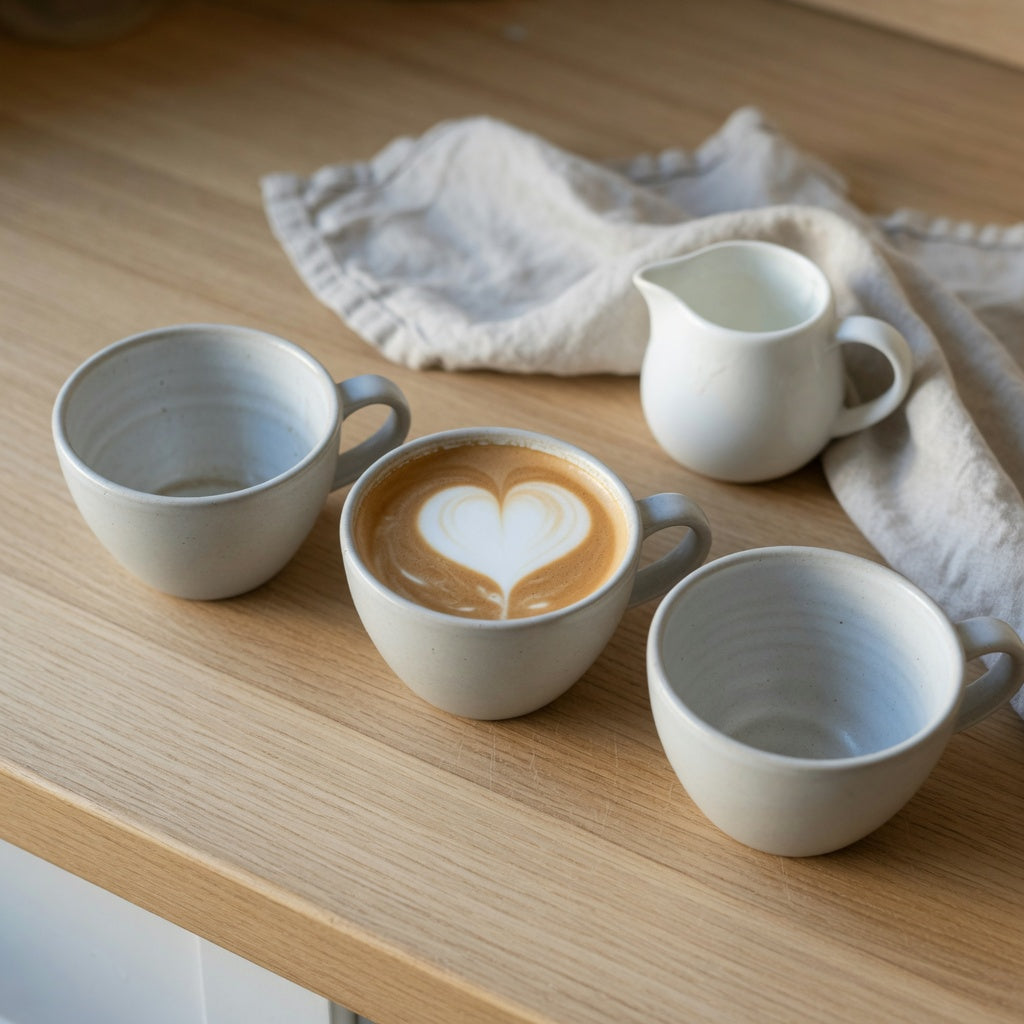
Ceramic Latte Cups Shape and Handle Guide: 250, 400, 440 ml
A close look at our three current ceramic latte cups — 250 ml, 400 ml, and 440 ml — covering what a listed capacity really measures, how rounded and straight interiors pour differently, handle fit ...
Read more
Leave a comment
This site is protected by hCaptcha and the hCaptcha Privacy Policy and Terms of Service apply.