
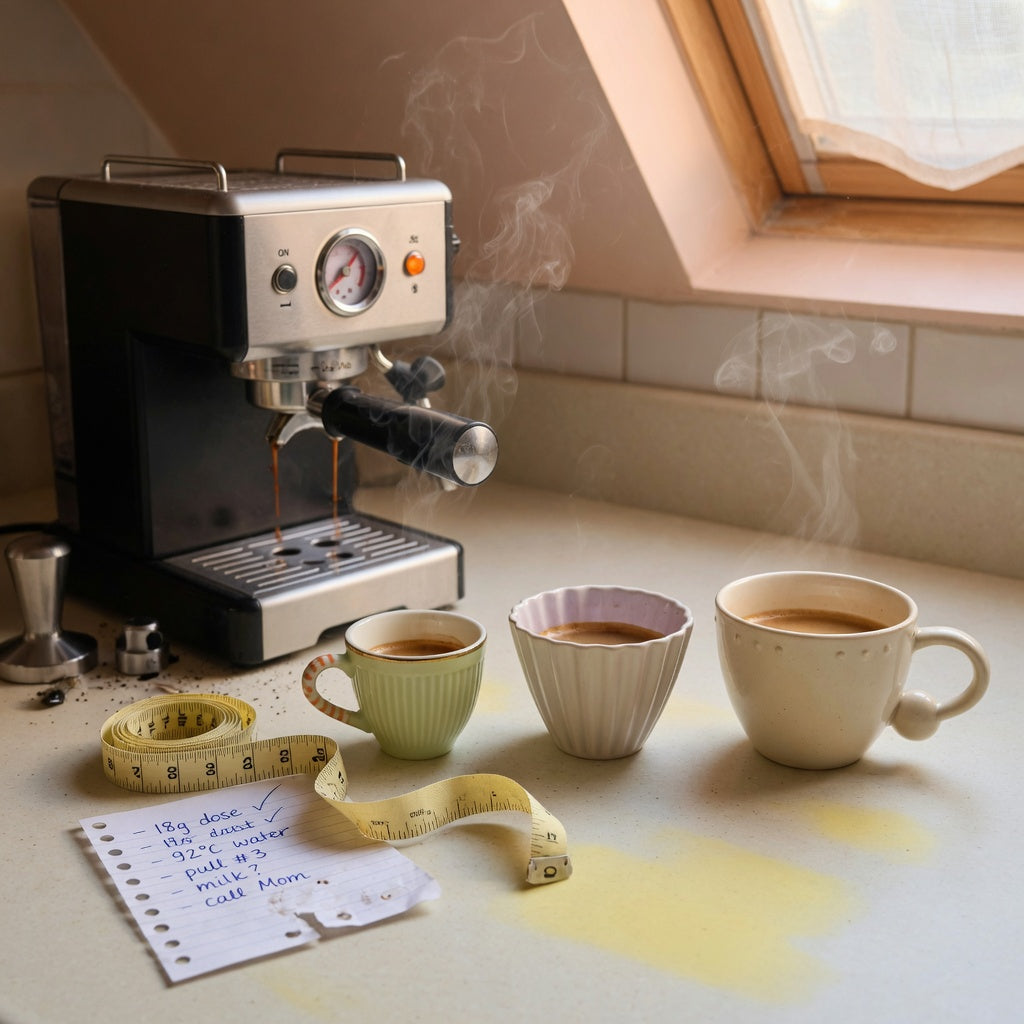
Cute Espresso Cups Morning Routine Practical Purchase Checklist
Reading time: about 10 minutes
At 6:45 on a Tuesday, nobody is thinking about glaze chemistry. They are holding a cold cup pulled straight off the drying rack, watching two espresso streams split around a rim that looked wider in the product photo. We hear the aftermath of that moment in our store all week: the cup was lovely, the shot was fine, and the routine still felt like a small negotiation. So the cute espresso cups morning routine practical purchase checklist below is deliberately short — it is the version our team runs before handing anyone a cup, ordered by what actually causes returns.
Six checks. Most shoppers fail at number three, not number six.
Cute espresso cups morning routine practical purchase checklist: six checks, in order
Work down the list before you fall for a pattern or a colour. Nothing here requires equipment beyond a tape measure and one honest answer about how you actually drink coffee on a workday.
- Usual pour volume. How many millilitres land in the cup on a weekday — not on the Sunday when you have time to experiment?
- Refill tolerance. One drink and out the door, or a second pour before you leave the kitchen?
- Spout-to-tray clearance. The distance from the drip tray surface to the portafilter spout, measured with the portafilter locked in.
- Rim opening. Two streams need to land inside the wall, even when the basket sits slightly off-centre.
- Handle and foot. Can you hold a full cup steady with one hand while the other finishes the milk? Does the base sit flat, or rock on the counter?
- Interior colour and glaze. What your crema looks like against the inside wall, and whether the finish is sold as drinkware rather than ornament.
How much coffee actually leaves your machine before 8 a.m.?
Cute espresso cups get misunderstood here, because the word "espresso" covers a wider range of volumes than most shoppers expect. Commonly cited references put a traditional Italian espresso at roughly 25 ml, modern specialty definitions at about 25–35 ml, and a classic demitasse at around 50 ml. Pull a double at a 1:2 ratio from an 18 g basket and you are near 36 g of beverage. Competition-style training cups are sometimes described as going up to about 90 ml.
Now set a 170 ml cup beside those numbers. A 200 ml cup. A 250 ml cup. We would rather say it plainly than sell around it: the compact ceramic vessels we stock are larger than a traditional single-shot cup. The Retro Coffee & Tea Cup is 170 ml, the Pleated Coffee & Tea Cup is 200 ml, and the Ball-Handled Coffee & Tea Mug is 250 ml — all listed capacity, ceramic body, and visible form, nothing more. They suit a double, a macchiato, a double with a splash, or a short morning coffee. They are a poor match for someone chasing a true 25 ml ristretto, where a wide, roomy cup lets the shot flatten before the first sip. If that narrow lane is what you want, a genuine demitasse is the right purchase, not a scaled-up decorative cup.
Which of our three capacities matches your usual pour?
We keep three sizes because three covers almost every weekday routine customers describe to us. Match your pour to the row — not to the photo you like best.
| Cup | Listed capacity | Morning job it suits | Trade-off to accept |
|---|---|---|---|
| Retro Coffee & Tea Cup | 170 ml | One double, a macchiato, a single-cup routine | Least headroom — a long pour or a generous milk top will crowd it |
| Pleated Coffee & Tea Cup | 200 ml | Double plus a proper splash of steamed milk; tea later in the same cup | Slightly airier than the Retro for a straight shot, so preheat it |
| Ball-Handled Coffee & Tea Mug | 250 ml | Two refills, or one longer drink you nurse through email | Most empty wall above the liquid, so the last third cools fastest |
The 170 ml Retro is what we hand to people who describe their routine as "one good shot, then out the door." The 250 ml ball-handle goes to the shopper who admits they will pour a second cup before the first is finished — refill tolerance is a real specification even though nobody prints it on a box. If you are still comparing silhouettes, the unique coffee mugs collection keeps the odd shapes and colours in one place.
Will the cup fit under your spout? Two measurements and one gotcha
There is no published standard for spout-to-tray clearance, and manufacturers do not agree on where usable height is measured. That leaves you a tape measure and thirty seconds of work.
- Drop height: with the portafilter locked in, measure from the drip tray surface to the underside of the spout. Leave an extra inch so the stream breaks cleanly instead of splashing.
- Rim opening: measure the inside diameter across the top. A double spout needs both streams inside that circle even if the basket is off-centre.
- The gotcha — widest point: a handle that juts sideways can foul the machine body or a milk pitcher even when the cup body itself clears.
Our listings lead with capacity. We do not publish exact height and rim diameter for every cup, so treat those as details to confirm on the current product page — or ask us before ordering — especially if your machine sits under a low cabinet or inside a hutch.
Handle, foot, and saucer: what decides whether you reach for it daily
Small-format handles get called decorative in reviews, and for some cups that criticism is fair. A handle you cannot get two fingers through turns a pleasant ritual into a balancing act, particularly when you tilt the cup to catch a stream. If you drink standing up, prioritise the handle. If you drink sitting at a desk, prioritise the foot: a wider base is far less likely to tip when a laptop cable catches it, and a base that rocks on the counter will annoy you by Thursday.
Saucers are the other quiet decision. A saucer roughly doubles the storage footprint, so a stackable cup in a small kitchen often beats a matched set that lives on a shelf. Whether a saucer is included with any of our three cups is something to confirm on the current listing — we would rather you check than assume. If you want the look of a cute espresso cup set with saucers, buy that as a set rather than trying to match a saucer afterwards.
Crema, glaze, and the case for a pale interior
Patterned cups are lovely empty. With espresso in them, the interior is the surface you look at forty times a week. A pale, plain interior shows the crema's colour and thickness clearly, which genuinely helps when you are dialling in a new bag of beans and want to see whether the shot is running thin. A dark or busy interior hides that feedback — a real cost if you are still learning your grinder.
On safety, the U.S. FDA explains that lead in a ceramic glaze is normally bound into a correctly fired surface, but that improperly fired pottery can leave lead available to leach, and that ware sold as lead-free has still shown extractable lead in some cases. Ceramicware intended only for decoration must be identified so it is not used with food. That is why we tell shoppers to buy drinkware from listings that describe it as drinkware, and to skip the purely ornamental novelty objects that surface in the same search results. If a product page does not state food-contact status, ask before you buy.
On care, the parts that fail first in our experience are hand-painted rims and metallic accents, not the body. If a glaze detail matters to you, wash that cup by hand and let sturdier pieces take the machine — and confirm dishwasher guidance on the current listing rather than assuming it, since "dishwasher safe espresso cups" means different things to different makers.
Refill tolerance and heat: the preheat habit that saves a 170 ml cup
A 170 ml cup holding 36 g of espresso has a lot of empty ceramic above the liquid line. That headspace is exactly what makes the cup photogenic and exactly what makes the drink cool. Three steps fix most of it:
- Fill the cup with hot water while the machine heats, then empty it just before you pull the shot.
- Pull into a warm cup, never one straight off the drying rack.
- If you take milk, steam first and pour within a minute — a splash of hot milk does more for temperature than wall thickness alone.
Thick ceramic walls hold heat well, but they absorb it on contact unless preheated. Double-wall glass insulates better at true espresso volumes; the trade is fragility and a narrower opening that can be fussy about a wide spout. For a cup that lives near a sink and gets knocked about, ceramic is the safer daily driver.
When a cute espresso cup is the wrong purchase
We talk people out of these cups regularly, and it is usually one of four situations:
- You want a true ristretto experience. These cups are too wide and too deep for 25 ml. Buy a proper demitasse or a 2 oz cup.
- You drink one large mug all morning. The 250 ml is closer, but a mug with a working handle will serve you better — our note on cute ceramic coffee mugs for morning routines is the better read.
- You need it for a commute. These are open, unlidded vessels. Not the job.
- It is a gift for someone with a capsule machine and a tight counter. Measure their clearance first, or choose the smallest of the three.
What these cups are genuinely good at: making a small pour feel deliberate, sitting comfortably in a kitchen palette, and surviving daily use as a ceramic object on an open shelf. If you want something a little more generous for everyday coffee, our breakdown of the small ceramic coffee cup covers that middle ground.
Frequently asked questions
What size cute espresso cup fits a double shot?
A modern double is roughly 36 g of beverage, so anything from about 90 ml upward holds it without spilling. Our 170 ml Retro Coffee & Tea Cup is the default recommendation because it leaves headroom for crema and a splash of milk without becoming a mug.
Is a 250 ml cup too big for espresso?
It is too big for a single shot and noticeably airy for a double. It earns its place when you routinely pour two drinks or want one longer morning coffee. Preheat it or the last third will be lukewarm.
Can I use these ceramic cups for tea or hot chocolate instead?
Yes. Capacities between 170 ml and 250 ml suit a small tea or a modest hot chocolate better than they suit a ristretto. Remember there is no lid and no insulation, so a quick preheat helps here too.
What extra items belong on the cute espresso cups morning routine practical purchase checklist for gifting?
Add three gift-only checks to the six above: the recipient's machine clearance, whether they have cabinet space for saucers, and whether they will actually use a decorative cup daily or display it. A gift that gets stored is not a gift.
Are decorated glazes safe to drink from?
Buy ceramic drinkware that is sold and labelled for food use. The FDA notes that correctly fired glazes bind lead into the surface, while improperly fired or purely decorative pieces can leach, and ornamental ware must be marked as not for food. If a listing does not say, ask the seller.
Do I need a saucer and a stand, or can I stack these?
Depends on your cabinet. A saucer roughly doubles the footprint of each cup; a stackable handle-forward shape usually wins in a small kitchen. Check the current listing for what ships with each cup before you plan storage.
If you already know your pour volume and your clearance, skip the rest of the research: start with the unique coffee mugs collection, match capacity first, then choose the shape that makes you want to get up.
More from our blog
Read more

Ceramic Latte Cups for Desk Use: Capacity, Handle, Footprint
A desk-side look at ceramic latte cups: what 250 ml, 400 ml, and 440 ml change about refill rhythm, how handle geometry quietly eats keyboard space, and how to measure your own setup before ordering.
Read more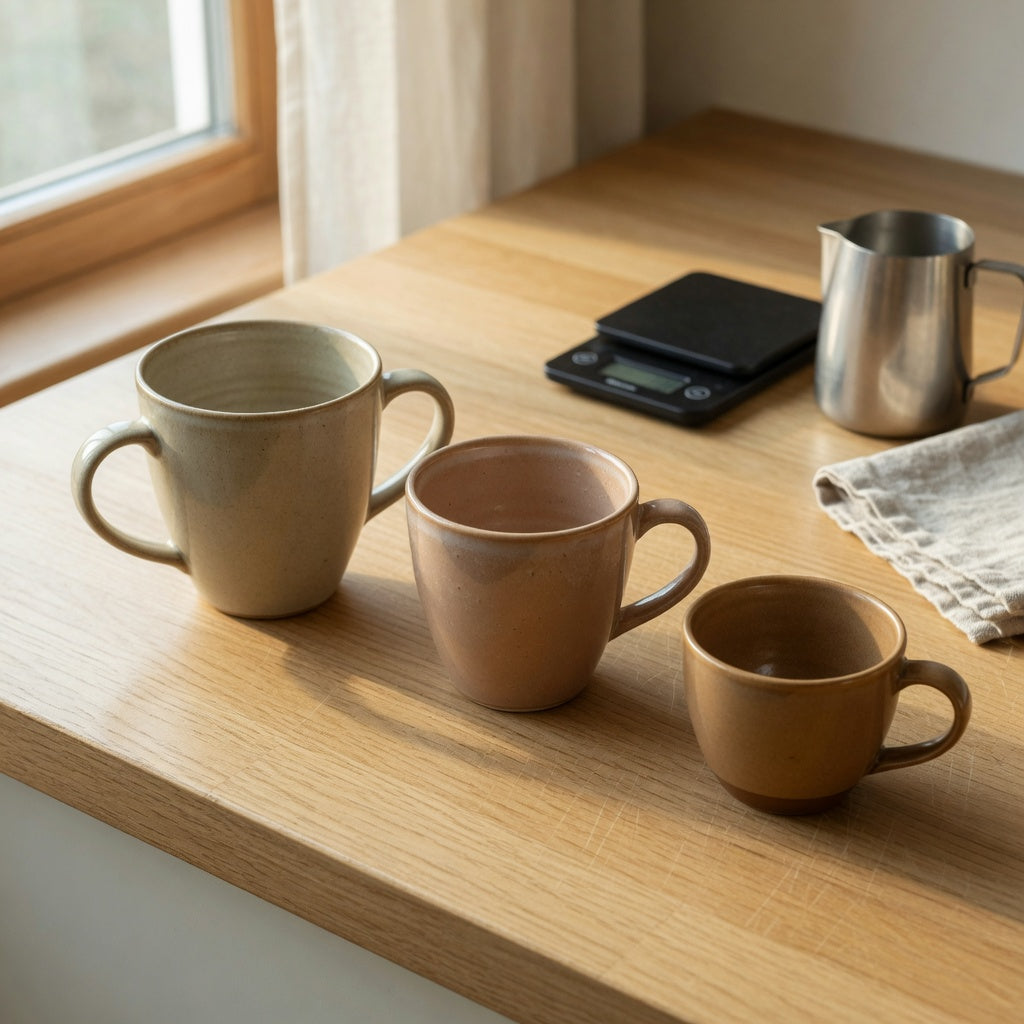
Ceramic Latte Cups: 250, 400, and 440 ml Capacity and Shape Guide
Listed capacity, fill line, and foam headspace are three different numbers. A practical walk-through of 250, 400, and 440 ml ceramic latte cups — interior shape, handle geometry, desk footprint, an...
Read more
Leave a comment
This site is protected by hCaptcha and the hCaptcha Privacy Policy and Terms of Service apply.