



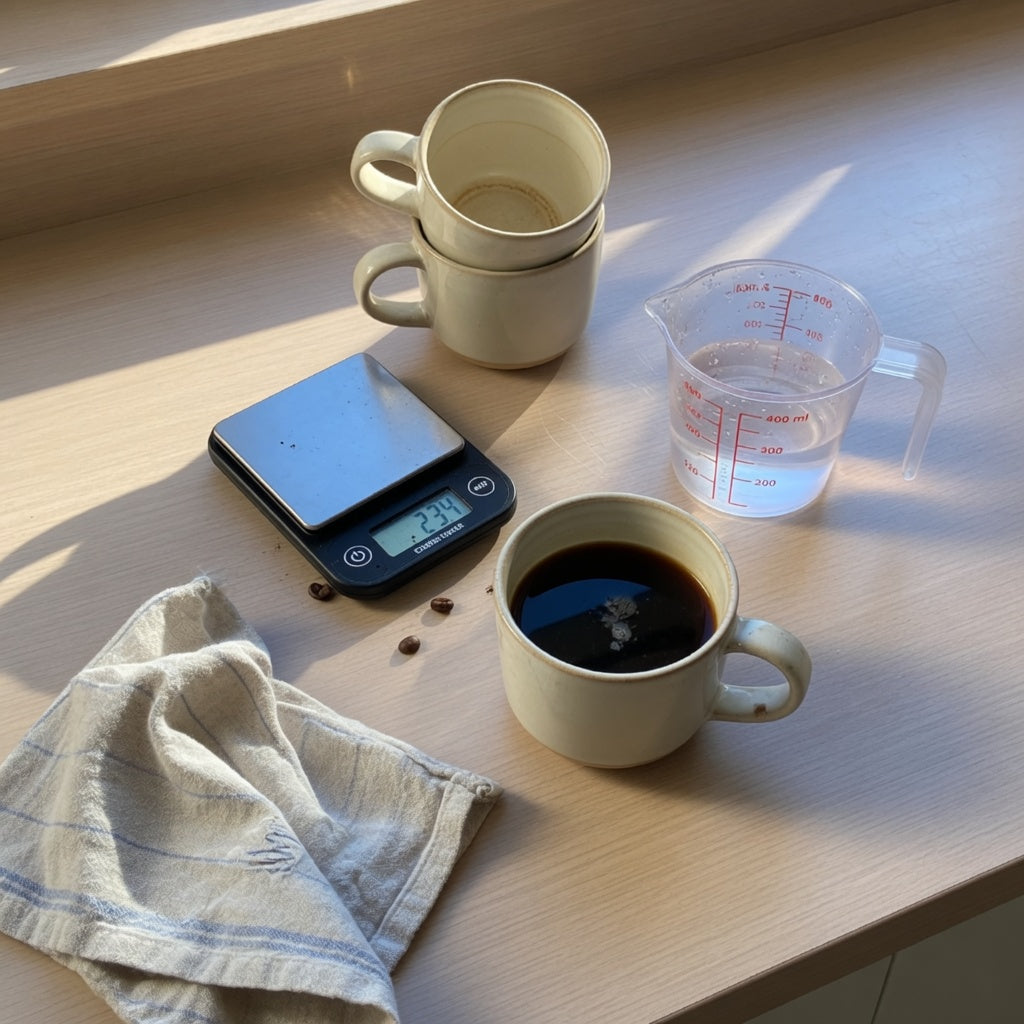
14 Oz Ceramic Coffee Mugs Morning Routine Practical Purchase Checklist
Reading time: about 11 minutes
A question we hear often: why does a mug that holds 14 ounces to the brim leave someone with a lukewarm half-cup by 8:40? Nothing is wrong with the mug. The number on the box describes the vessel, not the drink. That gap is why our 14 oz ceramic coffee mugs morning routine practical purchase checklist starts with what you actually pour, then works backward to capacity, handle fit, glaze safety, and care.
We sell this category, so we see the same pre-purchase questions repeat. Is the stated 14 oz a brim measurement or a working fill? Will a full mug clear your knuckles? Does the care line apply to the exact finish you chose, or only to the plain body? The checklist below is the order we would answer those questions at the counter.
How much is 14 oz, and how much of it can you actually drink?
One U.S. fluid ounce is 29.57353 milliliters, so 14 U.S. fl oz comes to roughly 414 mL. That is a big cup by federal reckoning. The FDA describes cups and mugs as small ceramic hollowware normally, though not exclusively, around 240 mL (about 8 fl oz) and usually made with a handle. A 14 oz mug is closer to two standard cups than one.
The catch is what the number measures. Three different quantities all get called capacity in listings:
- Brim capacity — the volume if you fill it to the very edge. Spills guaranteed.
- Working capacity — what you can carry one-handed with roughly half an inch of headroom left. A practical rule of thumb is 30 to 60 mL below brim.
- Capacity with a lid inset — measured with the lid seated, which can take another few ounces off the top.
When you compare a 14 oz mug with a 12 oz cafe drink, ask which of those three the seller means. A brim-full 14 oz mug and a cafe 12 oz cup can end up close in working volume once headroom is accounted for.
Does your morning drink really need 14 ounces?
Match the mug to what goes in it. An oversized mug is a heat problem, not a generosity problem. More exposed surface and more air above the liquid mean faster cooling. Fill a 14 oz mug halfway with a small drip pour and it will be tepid before you finish your first email.
- Black drip coffee, 8 to 10 oz: a 12 oz mug usually feels better in the hand than a 14 oz one. If that is your usual pour, the honest answer is that 14 oz may be too big.
- Drip with a splash of milk, around 12 oz: a 14 oz body gives headroom without a long cool-down.
- Milk-heavy latte, 14 to 16 oz: this is where a 14 oz mug earns its place; many cafe lattes are sized in that range.
- Tea: a handled 14 oz mug works if you decant from a pot, but a full steep goes cold quickly without a lid or a cozy.
- Iced coffee: you need more volume than your pour because ice displaces liquid. A 14 oz mug can work for a small iced drink; a 16 oz body leaves more room.
If your usual cup is 8 to 10 oz, size down rather than up. A smaller body keeps a small pour hotter and feels less like a bucket in the hand.
Our three capacities: 400 ml, 440 ml, 480 ml
None of our mugs is stamped 14 oz, and we would rather give you the exact numbers than round up and hope. Here is how the three sit against a 414 mL reference pour.
| Mug | Stated capacity | In U.S. fluid ounces | The morning it suits |
|---|---|---|---|
| The Flow | 400 ml | about 13.5 fl oz | A 12 oz coffee with real headroom, or a small latte |
| Morning and Night | 440 ml | about 14.9 fl oz | The closest thing to a true 14 oz pour, with room to spare |
| The Rock | 480 ml | about 16.2 fl oz | Long drip sessions, iced coffee, or a 16 oz latte |
The Flow sits just under a strict 14 oz fill at 400 ml. That is useful if your usual pour is 12 oz and you want headroom without a long cool-down. Morning and Night clears 14 oz at 440 ml, with roughly 26 mL to spare, so it suits a 14 oz pour or a latte. The Rock at 480 ml is the one to choose if you already know you refill a smaller mug halfway through the morning, or if you add ice and do not want the drink diluted to a half-cup. The Flow is not the right pick if you routinely pour 16 oz or load a mug with ice.
You can see all three side by side, including the shapes we currently stock, in our unique coffee mugs collection.
If your usual pour is closer to 8 to 10 oz, read our 12 oz ceramic coffee mugs checklist before sizing up. The right mug for a 12 oz drip is not automatically the biggest one on the page.
Porcelain, stoneware, double-wall ceramic, or ceramic-lined steel?
Four constructions get sold under the same phrase, and they behave differently at 6:45 a.m.:
- Porcelain — thinner walls and lighter in the hand, so a full 414 mL pour stays manageable. It also gives up heat to the room faster than thick stoneware. Our ceramic vs porcelain comparison goes deeper on that trade.
- Stoneware — thicker walls and more mass, which holds heat in the body of the mug but makes a full one noticeably heavier one-handed. If weight is the deciding factor, read the heavy ceramic mugs checklist before ordering.
- Double-wall ceramic — an air gap between two walls. The outside often looks larger than the interior volume delivers, and the interior is what you drink from.
- Ceramic-lined steel — a steel shell with a ceramic interior coating. It insulates better than solid ceramic, but the ceramic contact surface is a lining, not the whole body, and the care instructions that come with steel usually differ from a solid ceramic mug.
If you are switching from a bare steel travel mug, the contact surface is the part that matters for taste and odor. Ask what the interior actually is before you assume a steel mug behaves like a ceramic one.
Whichever you choose, the numbers that decide comfort are empty weight, wall thickness, and handle opening — not the marketing photo.
What handle clearance and cabinet height should you measure first?
This is where many returns start, and none of it is visible in a product photo. Before you commit, get these five numbers from the listing or ask us directly:
- Exterior height and rim diameter — for shelf clearance and for fitting under a single-serve brewer spout.
- Handle opening height and width — the real test is whether your knuckles clear the hot wall when the mug is full, not whether the handle looks big.
- Foot diameter — a wide base is stable on a desk but may not drop into a car cup holder.
- Empty weight, plus the pour — 414 mL of coffee weighs roughly 414 g, so a 350 g mug becomes close to 770 g full.
- Stackability — whether the handle of one mug sits inside the rim of the one below it determines how much cabinet space a set of four really takes.
In our store, the fit questions above are the ones we field most often. A mug can be beautiful and still be wrong for your brewer, shelf, or car.
Lead, cadmium, and what 'food safe' on a glaze actually proves
Under FDA compliance guidance, cups and mugs are judged at an action level of 0.5 micrograms of lead per milliliter of leaching solution, assessed on any one of six units using ASTM C738 chemistry. Cadmium carries a 0.5 microgram per milliliter action level for small hollowware. Those are leach limits, not ingredient bans. A glaze can contain lead and still pass, which is why 'lead free' and 'passes the test' are not the same claim. The FDA has itself found imported pottery labeled Lead Free that still released extractable lead above the action level.
California's public health department draws the distinction we find clearest. Lead-free ware contains no lead; lead-safe ware may contain some but does not leach above Proposition 65 thresholds. The same agency notes you cannot tell by looking. Plain white interiors are rarely the concern; decoration applied on top of the glaze, bright color on the food-contact surface, and damaged or chalky glaze raise it. Coffee is acidic, which is precisely the condition that pulls metals out of a weak glaze.
One small peer-reviewed pilot study measured lead in coffee from ceramic mugs at 0.2 to 8.6 micrograms per liter, with the mug mattering more than the drink. One of the five mugs produced an estimated daily dose above California's 0.5 microgram-per-day maximum allowable dose level even though its leaching stayed inside the FDA cup-and-mug limit. That is a pilot study, not a verdict on all ceramic mugs. It is a reason to ask for a glaze test statement instead of trusting a photo.
Two more boundaries are worth knowing. Federal rule 21 CFR 109.16 treats ceramicware that looks food-suitable as food use unless it carries a required 'Not for Food Use' warning or has a hole bored through the food-contact surface, so decorative pieces are legally not mugs no matter how they look. And a 14 oz mug sits far below the FDA's 1.1 liter large-hollowware threshold, so it is judged as small hollowware.
When you inspect a mug, look at the lip band separately from the interior glaze. A decorated rim is a different thing from a plain interior, and it is worth asking about before you make that mug your daily driver.
Are microwave and dishwasher claims true for every mug in a collection?
Rarely, and this is the most common care mistake we see. Two mugs from the same range can carry different care lines because one has a gold handle or metallic rim band. Read the care line per piece, not per collection.
- Microwave: metal trim or a metallic decal is the classic reason a ceramic mug is excluded, even when the body itself is fine.
- Dishwasher: an overglaze decal may fade or dull in a hot cycle while the glaze beneath it survives.
- Oven and broiler: do not assume a mug that is microwave-safe is also oven-safe. Check the label for both, and keep the broiler out of it unless the maker explicitly rates the piece for that heat.
- Suspect ware: California public health guidance advises against microwaving dishes that contain or might contain lead, since heat speeds leaching, and notes repeated dishwashing can damage a glaze and make later leaching more likely. That applies to suspect pieces, not to every ceramic mug.
Our practical habit: run one mug from any new set through ten dishwasher cycles before you commit the whole set, and check the rim for dulling or fine crazing lines. A matte interior can hide coffee residue differently than a glossy glaze, so look at it in raking light before you decide the mug is clean.
Your 14 oz ceramic coffee mugs morning routine practical purchase checklist, condensed
- Convert the stated capacity: 14 U.S. fl oz is about 414 mL, and 400 ml is about 13.5 fl oz.
- Ask whether the number is brim or working capacity, and subtract 30 to 60 mL of headroom.
- Measure your largest usual pour — that is the size you should buy, not the biggest mug on the page.
- Note the empty weight, then add about 414 g for a full pour.
- Check the handle opening for knuckle clearance against the hot wall.
- Measure shelf height, brewer clearance, and your car cup holder before ordering a set.
- Read the microwave and dishwasher line for the exact piece and finish you selected.
- Ask for any available glaze or leach test statement before you buy decorated ware.
If you are choosing between our three sizes, start with the pour you make most mornings. The Flow at 400 ml suits a 12 oz coffee with headroom. Morning and Night at 440 ml is the closest to a true 14 oz pour. The Rock at 480 ml is for refills, iced coffee, or a 16 oz latte. Browse the unique coffee mugs collection to compare shapes, and keep the checklist above beside your measuring cup.
Frequently asked questions
Can I trust the ounce rating on a ceramic mug listing?
Treat it as a brim measurement until the seller says otherwise. Subtract 30 to 60 mL for a realistic pour, and ask directly whether a lid was inset when the capacity was measured. On our own mugs we publish milliliters so there is nothing to decode.
Are 14 oz ceramic mugs microwave and dishwasher safe?
Often, but not automatically, and not uniformly across a collection. Metal handles, metallic rim bands, and some overglaze decals change the answer for that specific piece. Check the care line for the exact finish you are buying, then test one mug before trusting a set.
Will a handled 14 oz mug fit under a single-serve brewer or in a car cup holder?
Only a tape measure can answer that. Exterior height matters for the brewer spout, and foot diameter matters for the cup holder. A wide, stable base that is lovely on a desk is often too wide for a console. Ask for both numbers before ordering.
What does 'lead free' mean on a ceramic coffee mug?
Strictly, it should mean no lead was used, which is different from lead-safe ware that may contain some lead but does not leach above California Proposition 65 thresholds. You cannot verify either by looking at the glaze. Ask the seller for a leach test statement referencing the FDA cup-and-mug action level.
Is 14 oz too big for a single coffee?
For an 8 to 10 oz drip pour, yes. The extra surface area cools it fast and the mug feels half empty. The short version of our 14 oz ceramic coffee mugs morning routine practical purchase checklist is simple: buy the mug that fits your pour, not the number on the box. If your usual cup is 12 oz, start with The Flow at 400 ml and size up only if you genuinely refill.
Ready to pick your mug? Two ways to save on today's order:
Ordering 1–3 mugs? Get an extra 10% off your 1st order with code 10_OFF Apply 10% Off & Shop Wooden-Handle Mugs →
Gifting 4+ mugs? Buy 3, Get the 4th Free applies automatically at checkout (no code needed; offers do not stack) · Free standard shipping (Nov pre-Christmas delivery: 15–20 calendar days US) · Free replacement if chipped in transit.
Popular mug buying guides: Ceramic Tea Cups & Infuser Mugs · Ceramic Mugs with Lids Compared · Wooden-Handle Tea Infuser Mugs Compared · Christmas & Secret Santa Mugs 2026 · Espresso & Cortado Cups Guide · Cup & Saucer Gift Sets · All 25 Mugs Spec Table · Mug Size Guide · Shipping & Promo FAQ
FIRST ORDER 10% OFF (CODE: 10_OFF) · OR BUY 3, GET THE 4TH FREE


Read more
Unique Espresso Cups Morning Routine Practical Purchase Checklist
A decision-ready checklist for buying unique espresso cups that actually fit your morning: match listed capacity to your real pour, check group-head clearance, read the interior for crema, and conf...
Read more
Big Latte Mug Daily Use Guide: 400 vs 440 vs 480 ml
A practical daily-use comparison of 400 ml, 440 ml, and 480 ml big latte mugs, with real pour scenarios, handle and desk-footprint trade-offs, fit checks, and when a smaller cup is the better buy.
Read more
Leave a comment
This site is protected by hCaptcha and the hCaptcha Privacy Policy and Terms of Service apply.