



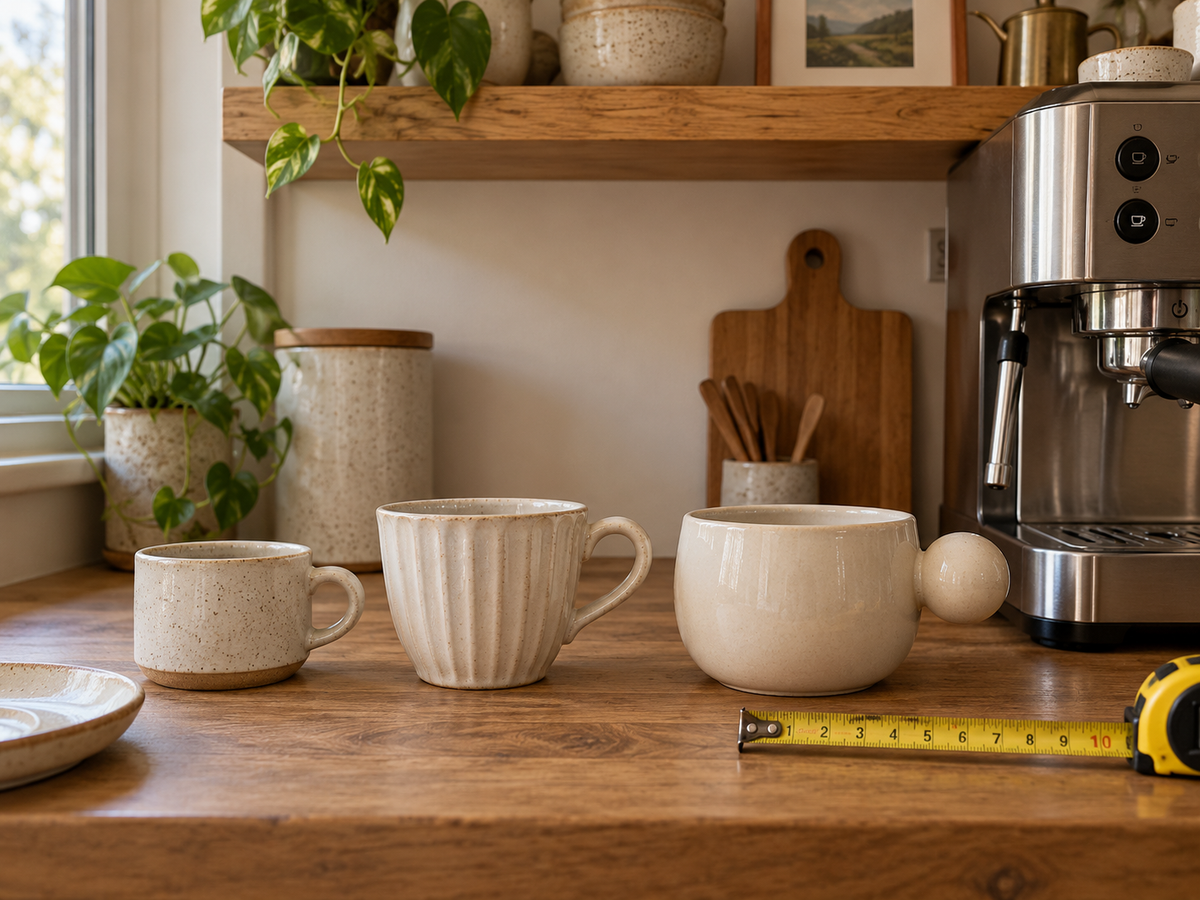
Unique Espresso Cups Compact Kitchen Practical Purchase Checklist
Reading time: about 11 minutes
A 30 cm strip of counter between the kettle and the bread bin will not hold a full cappuccino setup. It will hold a machine, a tamper and two small cups — if you buy the right two. Most of that decision gets made from a product photo, which is exactly the wrong place to make it.
So here is the unique espresso cups compact kitchen practical purchase checklist we walk buyers through when they have one free shelf and no room for a mistake: five measurements first, then a listed capacity, then the glaze and care questions. This is not a broad buying guide. It is a fit test built around the three capacities we actually list — 170 ml, 200 ml and 250 ml — and the space a real counter gives you.
How much counter and shelf space does one espresso cup really take?
Measure before you fall for a glaze. In a small kitchen the cup is never the only object in the equation — it sits on a saucer, next to a machine, under a cabinet that has to close.
Take five numbers with a tape measure:
- Depth of the free counter strip, from the front edge to the backsplash.
- Clearance from the drip tray up to the group head or spout, with the tray in place.
- Height between the shelf you plan to use and the shelf above it.
- Width of that shelf run, so you know whether two cups or four fit side by side.
- Whether the cabinet door still shuts with a cup standing at the front of the shelf.
Two cups with saucers eat roughly four times the footprint of two cups alone. On a shallow shelf, saucers are the first thing to cut, not the cups. In our experience packing and shipping ceramic drinkware, small cups come back for two reasons: a handle that fouls the drip tray, or a cup that will not stand under the shelf above. Neither shows up in a hero photo.
What do 170 ml, 200 ml and 250 ml actually mean in the cup?
Shot volume and cup capacity are different numbers, and this is where most shoppers get lost. A certified Italian espresso is about 25 ml; the older specialty-coffee definition runs 25–35 ml. The cup that holds it is much larger — commonly cited guidance puts an espresso cup at 50–100 ml, and Nescafé's own cup guide describes a demitasse of roughly 60 ml. The extra room is headspace for crema, not extra coffee.
All three cups we list sit above that strict demitasse range, deliberately:
- 170 ml (Retro) — a double shot of roughly 50–60 ml plus crema and a splash of steamed milk fits with room to spare.
- 200 ml (Pleated) — the same double shot, or a cortado, or a tea bag with hot water. The most flexible single-cup option of the three.
- 250 ml (Ball Handle) — cortado through small latte, or a proper tea. Treat it as a small mug, not an espresso cup.
Here is the trade-off nobody prints on the box: the more ceramic mass and the more air above the liquid, the faster a small shot cools. A 60 ml demitasse holds heat around a 25 ml shot better than any 250 ml mug will. If you drink espresso within two minutes, this barely matters. If you set the cup down and come back to it, it does — and that is the honest argument for keeping one genuinely small cup in the cabinet alongside your larger ones.
Which of our three ceramic cups matches your counter and your routine?
Match the cup to what you actually drink on a Tuesday, not to what you drank on holiday.
| Your routine | Cup and listed capacity | Why it works in a small kitchen |
|---|---|---|
| Double shot, drunk standing at the counter | Retro Coffee & Tea Cup — 170 ml | The lowest fill of the three, so it leaves crema headspace without a tall silhouette on a shallow shelf. Confirm overall height on the listing if your cabinet gap is tight. |
| One cup for coffee and for tea | Pleated Coffee & Tea Cup — 200 ml | Enough volume for a double shot with milk or a tea bag, so one set covers two habits and you store half as much. |
| Cortado, small latte, or a large tea | Ball Handle Coffee & Tea Mug — 250 ml | Walks the line between espresso cup and mug — the pick if you want one vessel covering milk drinks without buying a second set. |
What these are not: none of the three is a 60 ml demitasse for tasting a single ristretto, and none replaces a proper cappuccino cup if you drink 180 ml milk drinks every morning. If that is your habit, buy one 250 ml cup and one smaller cup rather than two mid-size cups that do neither job well.
The wider range of shapes, finishes and capacities lives in our unique coffee mugs collection — worth a browse if you are still deciding between an espresso-sized cup and something with more presence on an open shelf.
Will the cup clear the group head and the cabinet door?
We publish capacity, not height, so treat vertical clearance as a question to answer on the current product page before you order. Ask for:
- Overall height, measured with the handle at its highest point.
- Outer base diameter, which decides whether the cup sits flat on a drip tray grate instead of rocking on it.
- How far the handle projects — enough to catch the machine body or the tray lip is enough to ruin your morning.
- Whether the cup sits level on its saucer without a wobble.
Handleless cups buy back roughly a finger's width of clearance, which is real in a galley kitchen. They also mean lifting a hot 200 ml ceramic body with a paper towel, or waiting for it to cool. That is a trade-off, not a styling choice.
Stackability follows the same logic. A straight-sided cup stacks; a flared rim, a ball handle, or a saucer with a raised foot does not. If you store on an open shelf, count how many you can stack before you count how many you want.
Do dark glazes and unusual shapes cost you anything at the sip?
Two things change when a cup is decorative rather than plain white china: how you read the shot, and how the rim meets your lip.
- Crema reading. A white or clear interior lets you judge colour and thickness at a glance. A dark reactive glaze hides both — fine if you drink for taste alone, less useful while you are dialling in a new bag of beans.
- Rim thickness. Thin rims deliver liquid faster and feel sharper; thick, rounded rims feel softer and slow the flow. Irregular handmade rims can also put one high point against your lip, which some people notice on the first sip and nobody notices afterwards.
- Body shape. A narrower base with a wider rim concentrates aroma. Square or novelty bodies look superb on the shelf and force you to tilt further to reach the last mouthful.
- Surface detail. A pleated body earns its place visually, but those grooves hold dried coffee film. A soft brush every few days beats scrubbing dried rings out later.
None of this is a reason to buy plain. It is a reason to know which trade you are taking, and to keep one light-interior cup around if you also roast or dial in.
What should you ask about glaze safety before a bright handmade cup joins your cabinet?
Decorative ceramics and drinkable ceramics are not the same category, and the FDA is explicit about it. Lead in glaze or decoration can leach into food or drink if a piece is not properly fired, and washing or boiling will not remove lead from pottery. The FDA's action level for lead leaching from ceramic cups and mugs is 0.5 µg/ml of leaching solution, and under 21 CFR 109.16 ornamental ware that looks usable must carry a conspicuous "Not for Food Use" label or a hole through the food-contact surface.
The FDA also names the higher-risk pieces: handmade ware with a crude or irregular look, antiques, damaged or worn ware, flea-market finds from unknown makers, and ware brightly decorated in orange, red or yellow. That list overlaps uncomfortably with the phrase "unique espresso cups."
So ask any seller, including us, four questions before you buy:
- Is there a written statement that the glaze is food-safe, rather than just the words "lead free" on a tag?
- Is there a "Not for Food Use" mark anywhere on the base? If yes, it is decor. Stop there.
- Is the interior glaze intact, with no crazing, chips or worn patches near the rim?
- Is the decoration sealed under a fired glaze or sitting on top of it?
We describe the ceramic finish you can see in the listing photos and keep our claims inside that. None of this argues for a beige kitchen. It argues for buying from a seller who answers the question in writing.
Care on a tight counter: what we tell buyers to check
Our listings only carry care claims we can back, so check the current product page or ask us before the first wash rather than assuming. No seller should claim dishwasher or microwave safety without having tested that exact piece.
- Metallic lustre, gold rims and hand-applied decoration are usually hand-wash only.
- Ceramic that survived the kiln can still chip against a granite sink or another cup — a folded tea towel in the basin costs nothing.
- Separate stacked glossy cups with a paper napkin; gloss on gloss scratches.
- Do not store a damp cup lip-down on a sealed shelf. Trapped moisture smells, and you will notice it in the coffee.
One more small-kitchen rule from our side of the counter: buy the number of cups that fits your storage, not the number that fits your wishlist. A two-cup set you can actually stack beats a six-cup set living in a box under the sink.
Your unique espresso cups compact kitchen practical purchase checklist
- Measure the counter strip, the shelf gap, and the clearance under the group head.
- Decide whether you are buying for a 25–35 ml shot, a double shot, or a cortado. Capacity follows the drink, not the label.
- Pick a listed capacity: 170 ml for a double shot with headspace, 200 ml for coffee-or-tea flexibility, 250 ml for milk drinks.
- Confirm height, base diameter and handle projection on the product page before checkout.
- Choose a light interior if you want to read crema; accept that a dark glaze hides it.
- Ask for written food-safety information on any bright or handmade glaze, and refuse anything marked "Not for Food Use."
- Check dishwasher and microwave guidance — do not assume either.
- Count how many cups actually stack or nest on your shelf, and buy that number.
Frequently asked questions
Is a 170 ml cup too big for a double espresso?
No. A double shot is roughly 50–60 ml of liquid plus crema, so a 170 ml cup leaves comfortable headspace without drowning the shot. It will cool faster than a 60 ml demitasse, which matters only if you set the cup down and walk away.
Will these cups fit under my espresso machine?
We list capacity, not height, so treat vertical clearance as the second half of the unique espresso cups compact kitchen practical purchase checklist: measure from the drip tray to the group head, then compare with the cup height on the product page. Check handle projection too — a handle that catches the tray lip is the most common fit failure we hear about.
Do I need saucers in a small kitchen?
Only if you want them. A saucer catches drips and protects a wooden counter, but it roughly doubles the footprint and adds a wobble point. On a shallow shelf or a narrow counter, skip saucers and store cups directly.
Are brightly glazed handmade cups safe for hot coffee?
They can be, but the glaze has to be formulated and fired for food use, and "lead free" on a tag is not proof. The FDA sets a 0.5 µg/ml lead leaching action level for ceramic cups and mugs and flags brightly decorated orange, red and yellow ware as higher-risk. Ask the seller for written food-safety information and walk away from anything marked for decorative use only.
Can I put ceramic espresso cups in the dishwasher?
Not automatically. Unless the current listing states dishwasher safety, hand wash — and always hand wash gold rims, metallic lustre and hand-painted decoration. If a machine-safe set is non-negotiable, confirm it in writing before you order rather than assuming.
Start with your three measurements, then open the unique coffee mugs collection and compare the 170 ml, 200 ml and 250 ml options side by side. If two cups land within a centimetre of your shelf limit, buy the shorter one — you will thank yourself every morning.
More from our blog
Ready to pick your mug? Two ways to save on today's order:
Ordering 1–3 mugs? Get an extra 10% off your 1st order with code 10_OFF Apply 10% Off & Shop Wooden-Handle Mugs →
Gifting 4+ mugs? Buy 3, Get the 4th Free applies automatically at checkout (no code needed; offers do not stack) · Free standard shipping (Nov pre-Christmas delivery: 15–20 calendar days US) · Free replacement if chipped in transit.
Popular mug buying guides: Ceramic Tea Cups & Infuser Mugs · Ceramic Mugs with Lids Compared · Wooden-Handle Tea Infuser Mugs Compared · Christmas & Secret Santa Mugs 2026 · Espresso & Cortado Cups Guide · Cup & Saucer Gift Sets · All 25 Mugs Spec Table · Mug Size Guide · Shipping & Promo FAQ
FIRST ORDER 10% OFF (CODE: 10_OFF) · OR BUY 3, GET THE 4TH FREE


Read more
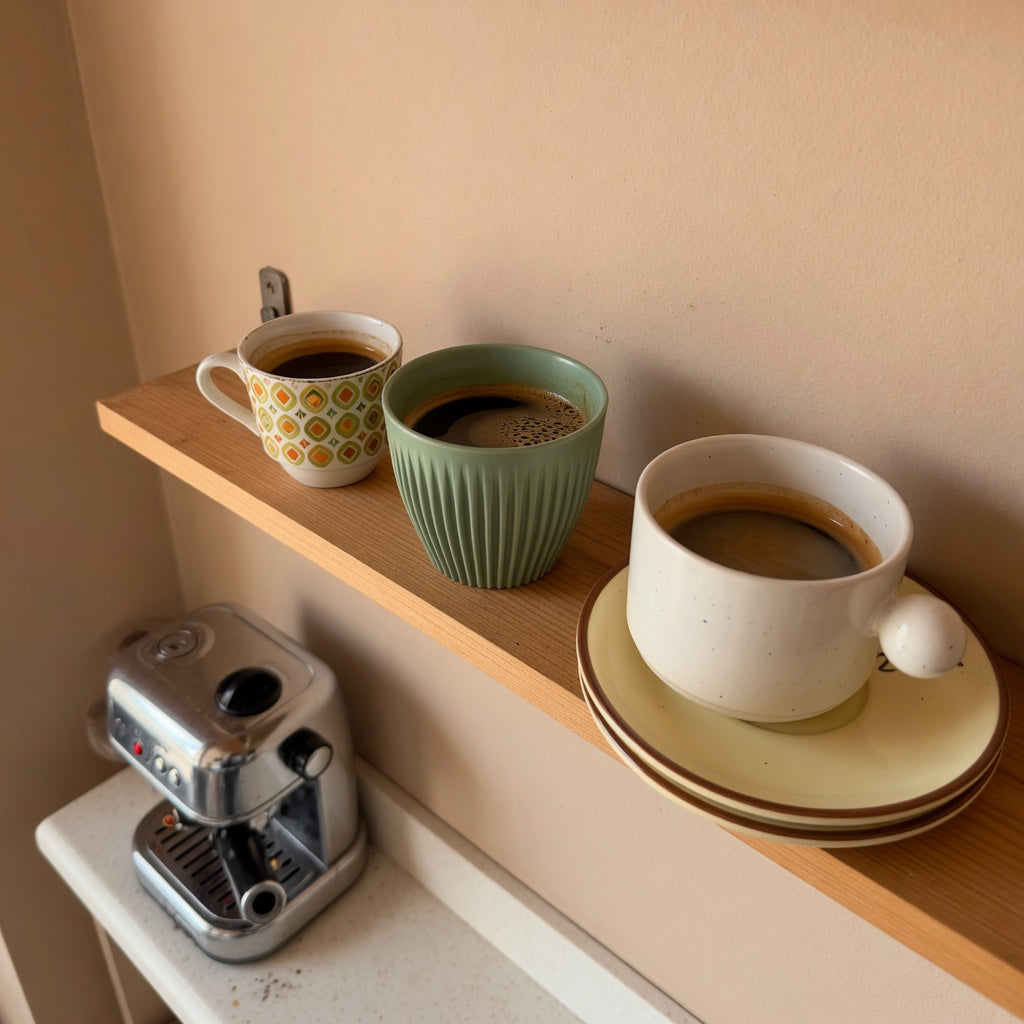
Unique Espresso Cups Compact Kitchen Product Shortlist Guide: 3 Picks
A three-cup shortlist for small kitchens: how our 170 ml, 200 ml and 250 ml ceramic cups map to doubles, cortados and tight shelves, plus the routines where each one is the wrong buy.
Read more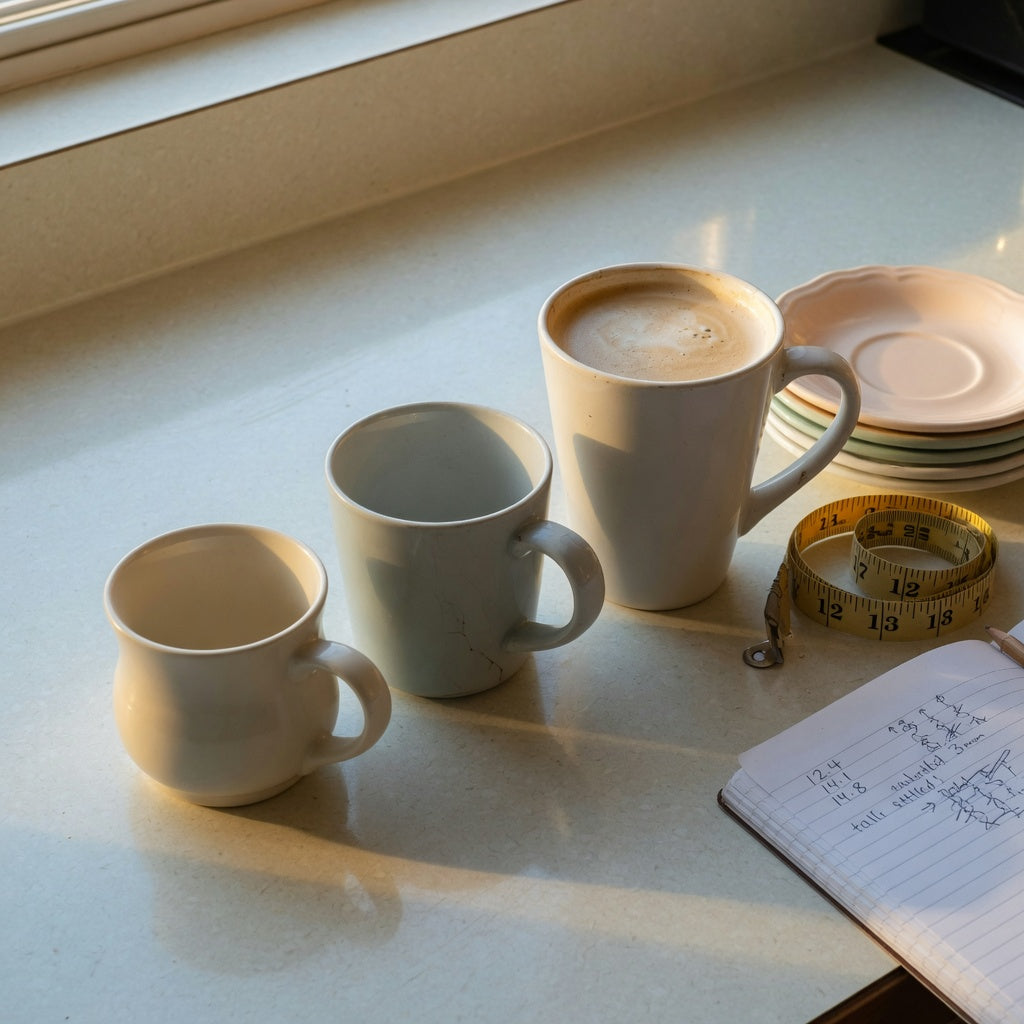
Big Latte Mug for Shared Households: Practical Purchase Checklist
A decision-first checklist for homes where one person wants a café-sized latte and another wants a mug they can hold with both hands. Compare 400 ml, 440 ml and 480 ml, plus the handle, footprint a...
Read more
Leave a comment
This site is protected by hCaptcha and the hCaptcha Privacy Policy and Terms of Service apply.