



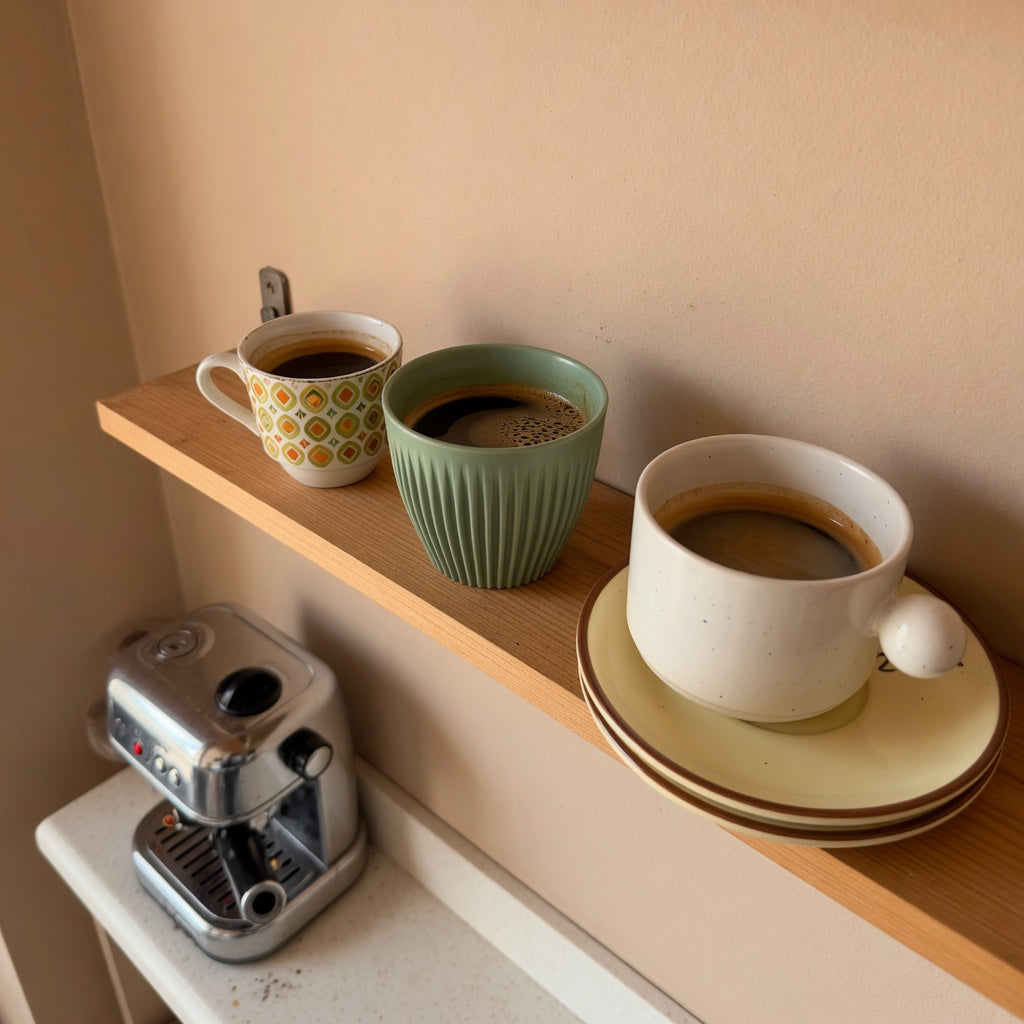
Unique Espresso Cups Compact Kitchen Product Shortlist Guide: 3 Picks
Reading time: about 9 minutes
There is a specific kind of regret that only turns up in a 60 cm galley kitchen. You buy four cups you love, get them home, and find that the handle fouls the drip tray, the bases will not sit two-abreast on the shelf, and the dark glaze hides whether the shot ran thin. The cups were not the mistake. The shortlist was. We sell these cups and we answer the follow-up emails, so this unique espresso cups compact kitchen product shortlist guide stays deliberately short: three ceramic cups with capacities we can state plainly, and honest reasons to take or leave each one.
Why does a cup that holds 170 ml still crowd a compact kitchen?
Three things go wrong, and none of them are the ones shoppers worry about.
- Capacity gets confused with drink volume. A certified Italian espresso is about 25 ml, and the older specialty definition ran 25–35 ml. Nobody serves that in a 25 ml cup, because crema and headspace need room, which is why demitasse listings cluster nearer 60–100 ml. A 170 ml cup is a double-shot or cortado vessel, not an oversized mug, and it should be bought as one.
- Footprint is guessed, not measured. Height under the group head and outer base diameter decide whether a cup survives your counter, and most listings never publish either number. Capacity is not a proxy: a 170 ml cup can be wider than a 200 ml cup depending on wall thickness and shape.
- The finish can hide the coffee. A dark interior photographs beautifully and makes it harder to read crema colour, spot a channelled shot, or judge how much milk actually went in.
Fix those three and the decision collapses to capacity plus one honest look at your shelf.
The unique espresso cups compact kitchen product shortlist guide: three capacities, three routines
Capacity is the one number worth leaning on hard, because it maps to what you actually drink. Our ceramic range splits cleanly.
| Cup | Listed capacity | The routine it suits | What to confirm on the listing |
|---|---|---|---|
| Retro Coffee & Tea Cup | 170 ml | Double shots, ristretto-and-a-bit, cortados with headspace | Outer base diameter and height, if your machine sits under a wall cabinet |
| Pleated Coffee & Tea Cup | 200 ml | Cortados, small flat whites, tea alongside the espresso machine | How deep the pleated texture runs and how easily it wipes clean |
| Ball Handled Coffee & Tea Mug | 250 ml | Longer milk drinks, guests, anyone who wants a handle | Handle clearance under the group head and total width on the shelf |
All three are compact ceramic vessels, so the crema sits against an opaque wall. You judge the shot from above, not through the side.
Routine one: doubles at 6 a.m. on a shared counter — the 170 ml Retro
The Retro is the smallest of the three and the one that behaves most like a proper espresso cup once the crema settles. Pull a double, let it rest ten seconds, and 170 ml gives you room to swirl without turning the drink into a soup bowl. It is also the cup we hand to someone who wants a distinctive piece without parking a large object on a 30 cm shelf.
Skip it if you mostly drink ristrettos, because a 25–35 ml pour will look stranded in it, or if your morning routine includes a 200 ml latte. Stretch this cup into milk-drink territory and you get a thin, cooling drink instead of a generous one.
One note from handling these every week: ceramic pulls heat out of a small pour quickly. Fill the cup with hot water while the machine comes up to temperature, tip it out, then pull. Cafés do the same thing by parking cups on the machine top.
Routine two: cortados on open shelving — the 200 ml Pleated
The pleated exterior earns its place on an open shelf, where texture reads as made-by-hand from across the room in a way a smooth wall never will. At 200 ml it lands in cortado territory with room to spare, so you get glassware-style proportions with the heat retention of an opaque ceramic wall.
Skip it if you want a surface you can wipe in one pass. Pleats and ridges hold dust and dried coffee rings, and if you are the person who rinses a cup and puts it straight back, that texture will annoy you by week two. It is also worth asking whether the cups nest: textured walls usually do not stack inside one another, so measure the shelf gap instead of assuming you can double up.
Routine three: milk drinks and carrying one-handed — the 250 ml Ball Handle
250 ml is the most forgiving capacity here. A cortado, a small flat white, or an espresso lengthened with hot water all fit without you measuring anything. The ball handle is the practical argument: on a narrow counter where you are carrying a hot drink one-handed past a kettle, a handle you can hook two fingers through matters more than any glaze.
Skip it if space is genuinely tight. The handle adds width, and width is what decides whether a cup slides under the group head or has to be angled in. It is also the wrong cup for singles — 250 ml of empty wall around a 30 ml shot looks exactly as odd as it sounds.
Which of the three is the wrong buy, and when should you leave ceramic alone?
Explicit reasons beat vague guidance, so here they are.
- Skip the 170 ml if your default drink is a 6–8 oz milk drink. You will be refilling, not enjoying.
- Skip the 200 ml if you stack cups or rinse-and-return them. Texture fights both habits.
- Skip the 250 ml if your machine sits in a cabinet gap with less than a hand's width of headroom, or if you only ever pull singles.
- Skip all three if you want to watch the layers separate. Ceramic is opaque; a double-wall glass shows the shot and the milk meeting, and that is a different purchase, not a lesser one.
If your idea of a small cup leans decorative rather than classic, the unique coffee mugs collection is the honest place to compare silhouettes side by side, and it is also where to look if 250 ml turns out to be your floor.
How do you check glaze safety on a distinctive cup before you pay?
Decorated ceramics deserve a stricter eye than plain white china, because the decoration is usually the point. The FDA warns that lead in ceramic glazes and decorative decals can leach into food or drink if the ware is not properly fired, and that washing or boiling will not remove lead from pottery. It flags higher-risk ceramicware as glazed pieces with a crude or irregular look, antiques, damaged or worn ware, items from flea markets or unknown makers, and pieces brightly decorated in orange, red or yellow.
Two anchors worth carrying into any checkout. The FDA action level for lead leaching from ceramicware cups and mugs is 0.5 µg/ml, and under 21 CFR 109.16 ornamental ware that could plausibly hold food must be marked 'Not for Food Use' or have a hole through the food-contact surface. If a listing says nothing either way, ask for current lead and cadmium test documentation covering that specific glaze — from any seller, including us. A generic 'food safe' badge is not the same document.
The cheaper check is the interior. A light interior tells you instantly whether a shot is pale, blonding early, or pouring with good tiger-striped crema. Dark reactive glazes are gorgeous and they hide all of it.
The two-minute fit check we run before recommending a cup
This takes a tape measure and about two minutes, and it has saved more returns than any glaze decision.
- Measure group-head clearance from the counter to the underside of the group, then subtract a centimetre for lifting the cup in and out.
- Measure shelf depth and decide whether saucers live under the cups or in a stack behind them.
- Check handle direction. A wide handle collides with a drip tray or a side wall on a narrow counter.
- Confirm care instructions on the product page. Hand-washing is the conservative default for decorated ceramic, and metallic or gold detailing should stay out of the microwave.
- Decide stackable or not. One-off shapes and textured walls generally do not nest, so buy the number that fits on the shelf, not the number that fits in a cupboard.
Then buy one before you buy four. A single cup tested against your own machine tells you more than a shelf of reviews, and it is the only reliable way to find out whether a handle clears your drip tray.
If shape is the variable you are chasing rather than capacity, our unique-shape mug shortlist for compact kitchens covers where curves and handles start costing you shelf space. For milk-heavy routines, the ceramic latte cup shortlist picks up at the point this one stops.
Frequently asked questions
Do unique espresso cups have to be tiny to count as espresso cups?
No. The drink is small — about 25 ml for a certified Italian espresso — but the cup has to hold crema and headspace, which is why demitasse cups commonly run 60–100 ml. This unique espresso cups compact kitchen product shortlist guide starts at 170 ml and says so plainly, because a 170 ml cup is a double-shot or cortado vessel, not a thimble.
Is 170 ml too big for a single shot?
Visually, yes. A 25–35 ml pour in a 170 ml cup leaves a lot of empty wall, and the liquid cools faster because more of the cup is air. Use it for doubles and cortados; if you drink singles, look for something nearer 60–90 ml.
Will the 250 ml Ball Handled mug fit under my espresso machine?
Capacity does not tell you that. Height and handle width are separate measurements and most listings do not publish them, so measure your group-head clearance first and check the current product listing for dimensions before ordering. A handle is the most common reason a cup will not slide in.
Can these ceramic cups go in the dishwasher?
Check the care section on each product page rather than assuming — decoration type drives the answer. Hand-washing is gentler on glazes and printed patterns, and anything with metallic or gold detailing should stay out of both the dishwasher and the microwave.
How do I know a distinctive glaze is safe for hot coffee?
Ask the seller for lead and cadmium test documentation covering that exact glaze. The FDA sets a 0.5 µg/ml action level for lead leaching from cups and mugs, treats irregular glazed-looking ware and brightly decorated orange, red or yellow pieces as higher risk, and notes that washing or boiling cannot remove lead from improperly fired pottery.
Ready to pick your mug? Two ways to save on today's order:
Ordering 1–3 mugs? Get an extra 10% off your 1st order with code 10_OFF Apply 10% Off & Shop Wooden-Handle Mugs →
Gifting 4+ mugs? Buy 3, Get the 4th Free applies automatically at checkout (no code needed; offers do not stack) · Free standard shipping (Nov pre-Christmas delivery: 15–20 calendar days US) · Free replacement if chipped in transit.
Popular mug buying guides: Ceramic Tea Cups & Infuser Mugs · Ceramic Mugs with Lids Compared · Wooden-Handle Tea Infuser Mugs Compared · Christmas & Secret Santa Mugs 2026 · Espresso & Cortado Cups Guide · Cup & Saucer Gift Sets · All 25 Mugs Spec Table · Mug Size Guide · Shipping & Promo FAQ
FIRST ORDER 10% OFF (CODE: 10_OFF) · OR BUY 3, GET THE 4TH FREE


Read more

Ceramic Mug Shapes Home Office Product Shortlist Guide
A scenario-based shortlist for desk, meeting, and break routines: compare a 200 ml pleated cup, a 250 ml ball-handle mug, and a 400 ml mug by capacity, handle geometry, and explicit reasons to skip...
Read more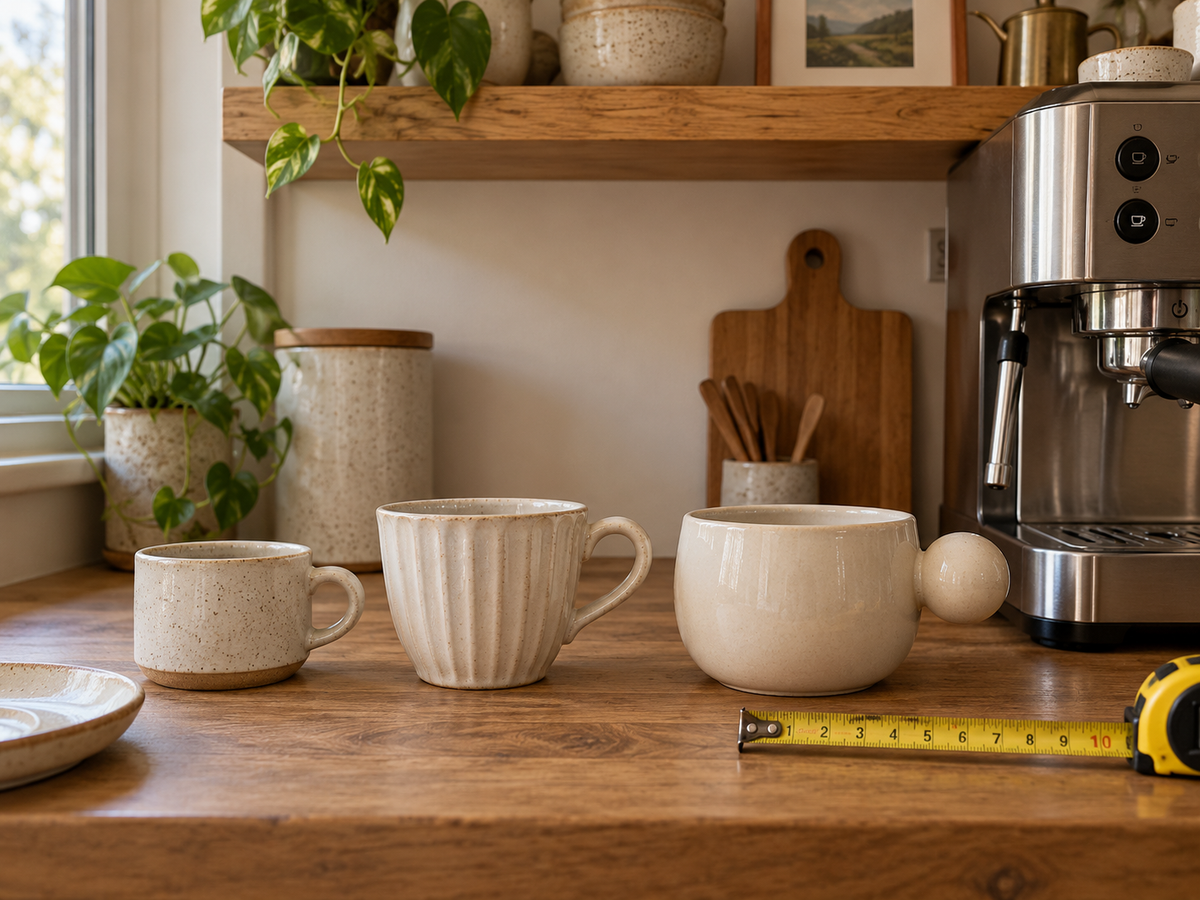
Unique Espresso Cups Compact Kitchen Practical Purchase Checklist
A fit-first checklist for buying unique espresso cups when counter and shelf space is tight: the five measurements to take, how 170–250 ml actually pours, and the glaze questions to ask before chec...
Read more
Leave a comment
This site is protected by hCaptcha and the hCaptcha Privacy Policy and Terms of Service apply.