



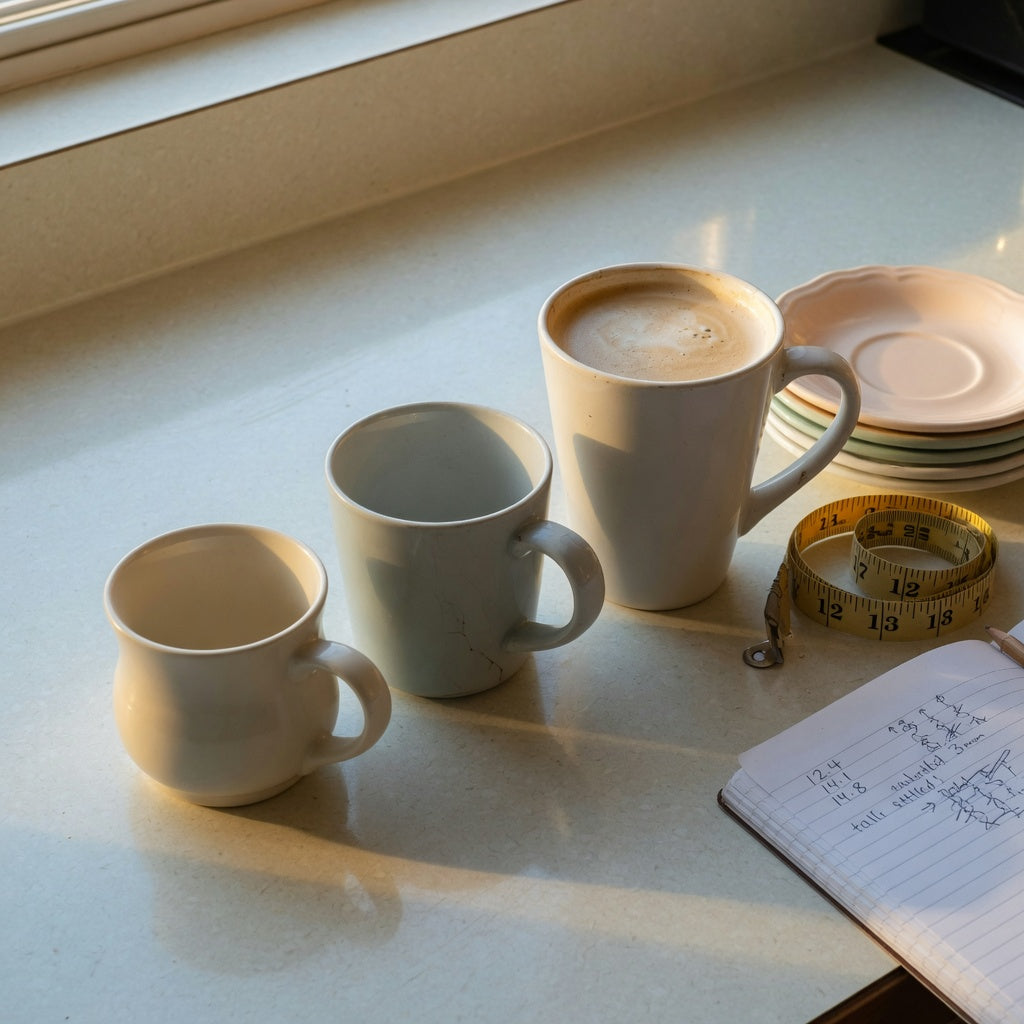
Big Latte Mug for Shared Households: Practical Purchase Checklist
Reading time: about 11 minutes
Two mugs sit on the same shelf, and only one gets picked up on a weekday morning. That is the whole problem behind the big latte mug shared household practical purchase checklist we walk shoppers through: the person who wants a 300 ml café latte and the person who wants a mug they can wrap both hands around are not shopping for the same object, even though both type the same words into a search box.
We run CoffeifyMug, so our team's view of this category comes from order notes, follow-up emails and the occasional return rather than a lab bench. What follows is the list we would hand a housemate before they add anything to a cart — capacity math, handle comfort, desk footprint, and the care questions that decide whether a mug survives its first dishwasher cycle.
What actually separates a café latte cup from a big latte mug?
Start with the uncomfortable fact: there is no legal definition of a latte mug. What exists are reference points that sit surprisingly far apart.
- The official mug. FDA Compliance Policy Guide 545.450 describes cups and mugs as small ceramic hollowware that normally, though not exclusively, holds about 240 ml (8 fl oz) and is made with a handle. In that guide, small hollowware means anything under 1.1 litres.
- The café latte cup. Specialty coffee shops commonly list latte cups around 300 to 355 ml, which is roughly 10 to 12 US fluid ounces.
- The retail big latte mug. Mugs sold under the latte name in general retail climb well past that, into the 400 to 600 ml range.
A 400 ml mug is already about 1.7 times the FDA's 240 ml reference mug. That gap explains why the phrase produces such different pictures in two people's heads, and why glaze colour should not be the first item on anyone's list.
Do the unit conversion before you trust a label. NIST's handbook conversion is fluid ounces multiplied by 29.5735 for millilitres, with 8 fl oz equal to 236.588 ml and 16 fl oz equal to 473.176 ml. Run it on our own sizes:
- 400 ml ÷ 29.5735 is about 13.5 US fl oz
- 440 ml ÷ 29.5735 is about 14.9 US fl oz
- 480 ml ÷ 29.5735 is about 16.2 US fl oz
Notice the last one. A true 16 oz measure is 473.176 ml, so a 480 ml mug holds slightly more than 16 oz rather than a rounded version of it. Small difference, but it matters if a recipe, a milk pitcher or a machine dose is built around 16 oz.
The big latte mug shared household practical purchase checklist: seven questions before checkout
- Whose hands are holding it? A 480 ml mug that suits a two-hand iced-latte drinker can feel like a mixing bowl to someone with smaller hands or a lighter grip. Pick the drinker first, the mug second.
- Is the listed capacity brim-full or pour-full? Every number on a product page is a maximum, not a working volume. A latte needs headroom for steamed milk and a foam cap, so expect usable fill to sit meaningfully below the listed figure.
- What espresso dose is going in? A 30 to 45 ml shot in a 480 ml mug reads as coffee-flavoured milk. If you pull singles, stay nearer 400 ml. If doubles are your default, 440 to 480 ml keeps the ratio sane.
- Will the handle take two fingers and a thumb? Handle opening, not handle length, is the comfort variable. A narrow opening on an otherwise generous handle is the most common grip complaint we hear about tall latte mugs.
- What does it weigh once full? 480 ml of liquid is roughly half a kilogram before the ceramic is counted, which puts a one-handed carry close to a kilo. For anyone with wrist or grip issues, that is the deciding number, not capacity.
- Where does it live between uses? Cabinet shelf spacing, group-head clearance under an espresso machine, and car cup-holder diameter each rule out more mugs than buyers expect.
- Who washes it? A dishwasher label is an instruction, not a promise. Metallic or hand-applied decoration and thermal shock do more damage than detergent ever will.
400 ml, 440 ml or 480 ml: which of our mugs fits which drinker?
Our three sizes sit deliberately close together, and you can see them side by side in our unique coffee mugs collection. The table maps each to a drinker type. The last column lists the details we would confirm on the live listing before ordering, because handle geometry and base diameter decide fit in ways capacity never will.
| Mug | Listed capacity | Approx. US fl oz | Best fit | Confirm on the listing |
|---|---|---|---|---|
| The Flow | 400 ml | ~13.5 | Single-shot latte, smaller hands, tighter cabinets | Handle opening, base diameter |
| Morning and Night | 440 ml | ~14.9 | Compromise mug for two drinkers with different habits | Handle opening, base diameter |
| The Rock | 480 ml | ~16.2 | Double shots, iced lattes, two-hand carry | Empty weight, base diameter |
Capacity figures above are the listed specifications for each mug. The fluid-ounce column is our own conversion using the NIST factor, not a manufacturer claim.
If you order a 12 oz latte at a café and want that volume at home, The Flow, at 400 ml, is the closest match. It is still larger than the 300 ml cup a specialty shop would use, but it will not turn one shot into milk soup. If two people in the house drink different volumes and you want a single shape that satisfies both, Morning and Night at 440 ml sits in the sensible middle. And if the mug belongs to someone who builds a 16 oz iced latte, drinks slowly, or genuinely likes holding a mug with both hands, The Rock at 480 ml is the one we point to first.
Each mug has its own listing, which means you can match sizes to drinkers instead of buying a matching pair — useful when one person wants 400 ml and the other wants 480 ml. Nothing here assumes both mugs arrive together, so order one per drinker.
Will it clear the group head, the cabinet shelf and the desk?
Four measurements cause more returns in this category than any glaze defect.
- Group-head clearance. A mug that fits under an espresso machine without a scale may not fit with one sitting on the drip tray. Measure from the tray to the group head, subtract your scale height, and compare against the mug's listed height plus room for the portafilter spout.
- Cabinet height. Tight shelf spacing clears almost nothing once a mug is taller than a standard coffee cup, and stacking makes it worse.
- Cup-holder diameter. A 480 ml mug with a wide base is usually a passenger-seat mug. Ceramic has no lid and no seal, so treat car use as a bonus rather than a requirement.
- Desk footprint. If the mug lives beside a keyboard, base diameter matters more than capacity, because a broad foot eats mouse room every single day.
We publish capacity on every product page because that is the number buyers ask about first. Base diameter, handle opening and empty weight vary enough between shapes that we would rather you check the current listing than judge from a photo, where a 480 ml mug shot head-on can look identical to a 400 ml one. If you are weighing shapes rather than sizes, our guide to oversized ceramic coffee mug capacity and daily fit covers the wider comparison.
Wide bowl or tall wall: what shape changes about the drink
A latte is espresso plus steamed milk plus a thin cap of foam. Change the vessel and you change three things at once.
- Pour control. A wide mouth gives the pitcher room to draw through the foam, which is why latte art advice keeps pointing toward bowl-shaped cups. A tall, narrow mug limits how much of the surface you can reach with the spout.
- Surface area and cooling. A wide bowl exposes more liquid to air per millilitre. A tall mug exposes less, but a partly full tall mug can still cool quickly because the wetted wall above the drink line keeps conducting heat away. We do not publish heat-retention figures, and a ceramic mug is not a thermos.
- Iced drinks. Ice occupies volume. If the plan is a 16 oz iced latte, start from a 480 ml mug and accept that a real share of the listed capacity is ice and foam, not coffee.
Milk ratio is the part people taste first, and it is worth checking our note on how many ounces a mug of coffee actually holds before you assume a bigger mug means a stronger drink. It usually means the opposite.
What do dishwasher, microwave and lead-free labels actually promise?
Treat care and safety labels as instructions rather than guarantees.
- Thermal shock cracks more ceramic than dishwashing does. Pouring boiling water into a cold mug, or moving one straight from the freezer to the microwave, is the classic failure.
- Metallic and hand-applied decoration is usually the first thing to fade in a dishwasher. If the finish matters to you, hand-wash.
- Microwave-safe wording refers to the fired body and glaze, not to a metal trim, a decal or an unglazed foot.
Lead deserves plain language, because the phrase lead-free ceramic latte mug appears on many listings that never explain what it means. FDA guidance sets the lead action level for ceramic cups and mugs at 0.5 micrograms per millilitre of leaching solution, applied to any one of six units tested. The same guidance notes that some ceramic foodware can leach lead from food-contact surfaces and that continued food use can cause the effects of chronic lead poisoning. Lead-free is a marketing claim, not a test result. If it is a deciding factor, ask the seller for documentation that names the standard.
For our own mugs, we would rather you read the current product page than take a general statement from an article, ours included — and that applies to dishwasher and microwave wording exactly as much as to capacity.
When a big latte mug is the wrong purchase
Plenty of households should skip this category entirely, and we would rather say so than sell a mug that ends up at the back of a cabinet.
- You drink flat whites, cortados or espresso. A 400 ml mug with a 30 ml shot is roughly ninety percent milk, and no amount of good ceramic fixes that ratio.
- You sip slowly. A large volume of milk coffee over twenty minutes will not stay hot, whatever the mug is made of.
- Your cabinets are shallow or your counter is narrow. A mug that does not fit gets used once.
- You want something for the commute. Buy a travel mug with a seal; ceramic belongs on the desk, the sofa and the kitchen table.
None of that makes the category bad. It makes it specific. A 480 ml mug earns its shelf space for soup, cereal and a long black on a cold morning. The same mug used for a single-shot latte mostly earns a complaint.
Frequently asked questions
Is a 16 oz big latte mug the same as a 480 ml mug?
Close, but not identical. NIST's conversion puts 16 US fluid ounces at 473.176 ml, so a 480 ml mug holds slightly more than a true 16 oz measure. Both figures are usually brim capacity, so the amount you can pour without spilling is smaller than either number.
How do I check whether a big latte mug will fit under my espresso machine?
Measure from the drip tray to the group head, then subtract the height of the scale you use. Compare that gap with the mug's listed height and leave a little room for the portafilter spout. If the listing gives no height, ask before ordering; group-head clearance is one of the most common fit misses with tall latte mugs.
Why does my latte taste thin in a big latte mug?
Because the milk scaled up and the coffee did not. A single 30 to 45 ml shot in a 480 ml mug is mostly milk. Either pull a double, step down to a 400 ml mug, or accept a longer, milder drink for what it is.
Is a ceramic big latte mug dishwasher and microwave safe?
Only if that individual listing says so, and even then treat it as a care instruction rather than a guarantee. Hand-painted or metallic decoration and thermal shock are the usual failure points, so check the current product page for the exact wording instead of assuming from the category.
Should a shared household buy one big latte mug or one per person?
One per drinker, in most cases. Capacity preference is personal, and the person who wants a 480 ml two-hand mug will rarely reach for the 400 ml single-shot mug beside it.
One last pass before checkout: name the drinker, name the dose, confirm handle opening and base diameter on the live listing, and measure the group-head gap and the shelf. Then browse all of our oversized ceramic mugs with those numbers written down, and the mug you order is the one that actually gets used tomorrow morning.
More from our blog
Ready to pick your mug? Two ways to save on today's order:
Ordering 1–3 mugs? Get an extra 10% off your 1st order with code 10_OFF Apply 10% Off & Shop Wooden-Handle Mugs →
Gifting 4+ mugs? Buy 3, Get the 4th Free applies automatically at checkout (no code needed; offers do not stack) · Free standard shipping (Nov pre-Christmas delivery: 15–20 calendar days US) · Free replacement if chipped in transit.
Popular mug buying guides: Ceramic Mugs with Lids Compared · Wooden-Handle Tea Infuser Mugs Compared · Christmas & Secret Santa Mugs 2026 · Espresso & Cortado Cups Guide · Cup & Saucer Gift Sets · All 25 Mugs Spec Table · Mug Size Guide · Shipping & Promo FAQ
FIRST ORDER 10% OFF (CODE: 10_OFF) · OR BUY 3, GET THE 4TH FREE


Read more
Unique Espresso Cups Compact Kitchen Practical Purchase Checklist
A fit-first checklist for buying unique espresso cups when counter and shelf space is tight: the five measurements to take, how 170–250 ml actually pours, and the glaze questions to ask before chec...
Read more
Big Latte Mug Compact Kitchen Practical Purchase Checklist: 400–480 ml
A checklist built around the measurements that actually decide the purchase: shelf gap, group-head clearance, handle opening, brim versus usable fill, and what 400, 440 and 480 ml pour in fluid oun...
Read more
Leave a comment
This site is protected by hCaptcha and the hCaptcha Privacy Policy and Terms of Service apply.