
Ceramic Latte Cups Compact Kitchen Practical Purchase Checklist
Reading time: about 12 minutes
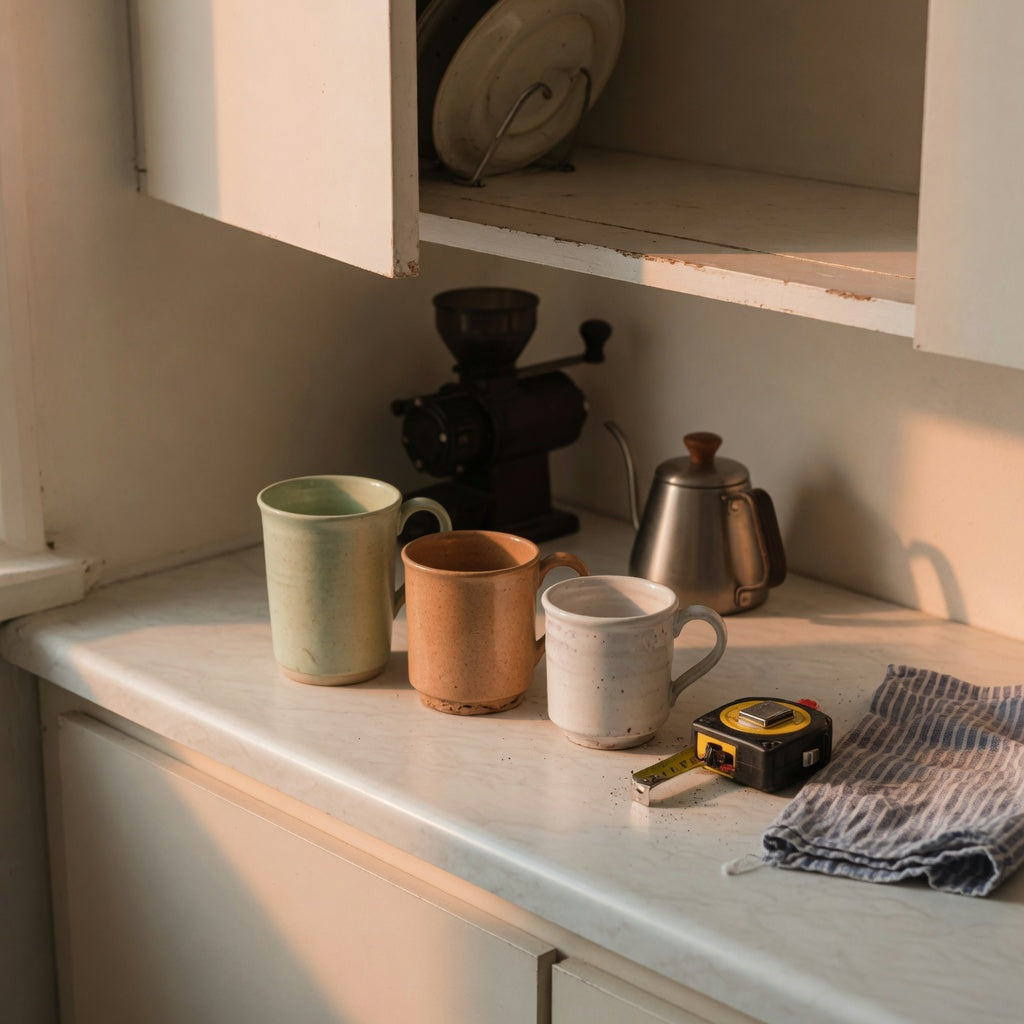
The tape measure comes out at a predictable moment in our store inbox: a shopper has a 40 cm counter run, a kettle that never moves, and a cart holding a 440 ml cup that looked smaller in the product photo than it will on the shelf. Before we answer, we ask for three numbers — the shelf gap, the cup base diameter plus handle swing, and the volume of the drink they actually pour. That sequence is the spine of this ceramic latte cups compact kitchen practical purchase checklist, and it is the same order we use when a customer sends a photo of a mug already sitting on their counter. If you want to compare vessel shapes before reading further, our unique coffee mugs collection puts handle styles and body heights in one view.
Why does a 440 ml cup behave like furniture on a narrow counter?
Most buyers measure the cup. In a compact kitchen, the binding constraint is usually the shelf gap or the counter depth, and both are measured before the cup leaves the cabinet. A cup occupies its base diameter plus the projection of its handle, not the tidy rectangle the listing photo suggests. In our experience, that extra two or three centimetres is what decides whether the cup sits beside the grinder or lives on top of it.
- Shelf gap, top down. Measure from the shelf surface to the underside of the shelf above it. A hand slid underneath is not a measurement, and 2 cm of clearance is not enough once a handle rises above the rim.
- Footprint equals base diameter plus handle projection. A wide handle eats counter depth even when the body is slim. This is the number that decides whether a cup crowds a laptop or a mouse hand at a desk.
- Front-to-back depth matters more than width on a narrow run, because that is where the grinder, kettle and scale already live.
- Stacking is a shape question, not a size question. Straight-sided cups usually stack rim to rim. Bowl-shaped cups frequently refuse to stack at all, which turns a set of four into four separate footprints.
Worth knowing: the FDA describes cups and mugs as small ceramic hollowware with a handle, normally holding about 240 ml (8 fl oz), where a cup has a base and curved sides and a mug has cylindrical sides. Those are shape words as much as size words, and shape is what decides whether your cups stack or sprawl.
Which listed capacity matches the drink you actually pour?
Listed capacity and usable capacity are different numbers. Filled to the rim, a cup cannot be carried. Filled to a comfortable line with headroom for foam, it holds noticeably less than the figure on the box. Run the arithmetic once: a double shot is roughly 60 ml, and everything above that is milk and foam. That is why a 10 oz ceramic latte cup can feel small when you pour a standard latte, and why a 12 oz cappuccino cup can feel generous with the same shot. The FDA's 240 ml reference point is close to an 8 oz ceramic latte cup, but the listing is the only reliable guide to what a specific cup actually holds.
- 250 ml is a cortado, flat white or small latte. A double shot plus milk lands close to the rim, which is why it is a poor fit for a mug of filter coffee. That is the Ball Handle coffee and tea mug, listed at 250 ml, and the one we suggest first when shelf clearance is the tightest constraint.
- 400 ml is the comfortable middle. There is enough room above a standard latte to pour and still carry the cup without watching the rim the whole way to the table. That is The Flow coffee and tea mug, listed at 400 ml.
- 440 ml is the largest capacity we list, sized for a long morning drink or tea rather than a precise espresso-to-milk ratio. That is the Morning and Night coffee and tea mug, listed at 440 ml.
Two failure modes are worth calling out. If your usual drink already fills a 350 ml mug to the brim, a 250 ml cup means topping up twice. If you have been pouring flat whites into a large mug and wondering why they taste thin, the cup is not the problem — the drink is oversized. And when a listing quotes ounces without saying whether that figure is brim-full, filled to a line, or includes foam headspace, ask before ordering. That ambiguity is a recurring complaint in cup reviews, and it is why we quote our capacities in millilitres.
Rim shape and handle geometry: what changes when the cup is full?
A full cup is a lever, and the handle is the fulcrum. Interior shape decides how easy the pour is; handle geometry decides whether you enjoy carrying it. If you are shopping for a bowl shaped ceramic latte cup or a rounded bottom latte cup, you are usually chasing more surface for latte art and a gentler transition from the milk pitcher. The trade-off is footprint and an unwillingness to stack.
- Rounded or bowl-like interior with a wide rim. More surface to pour into, which is why many barista-style vessels use it. A straight-sided interior is easier to store and stack, but the walls can squeeze the milk stream and make a clean rosetta harder.
- Handle loop size. You want one finger comfortably through the loop and your thumb resting on top. A loop that only accepts two fingers pushes your wrist up toward the shelf above.
- A thick wall ceramic latte cup adds mass, and mass shows up as weight at the handle. That is a handling observation only. We do not publish heat-retention claims for any of our listings, because comparable cup-to-cup testing at realistic drink volumes is thin on the ground.
- Stackable ceramic latte cups are usually straight-sided. If stacking matters in your cabinet, ask whether the specific cup is designed for it rather than assuming from a photo.
For latte art, volume matters as much as shape: a cup poured to the rim leaves nowhere for a pattern to sit. That is why we point art-focused buyers at The Flow's listed 400 ml first, then ask them to confirm rim width and interior shape on the current listing. Handle feel is personal, so read the handle description and care markings before you order. We would rather you check than assume, and the same applies to material and wall thickness — those are details of a specific listing, not of the category.
Double-wall ceramic latte cups are a different animal: the air gap changes the weight and the feel in the hand, and the care instructions belong to that specific build. Ask before buying if the listing does not spell them out. Material labels — stoneware, porcelain, bone china, earthenware — are not a shortcut to performance either. We do not publish heat-retention claims for our cups, and the useful checks are the care markings, the glaze finish, and the weight in the hand. If a listing does not state the body material, ask.
The ceramic latte cups compact kitchen practical purchase checklist: three cups, three counters
Once the measurements are in hand, the decision usually collapses into one row of this table. Capacities below are exactly as listed. Everything in the last column is a detail to confirm on the product page before you commit, because we do not want to imply a specification the listing does not state.
| Cup | Listed capacity | Choose it when | Confirm on the listing |
|---|---|---|---|
| Ball Handle | 250 ml | Shelf clearance is tight, or the cup shares a desk with a laptop | Handle projection, base diameter, care markings |
| The Flow | 400 ml | You want the middle capacity for a standard latte and will confirm rim width on the listing | Rim and base diameter, microwave and dishwasher markings |
| Morning and Night | 440 ml | One large morning drink or tea, and the shelf depth to take it | Total height including handle, footprint, care markings |
Where this goes wrong most often: buying the 440 ml because it is the best value per millilitre, then discovering the cabinet gap is snug. Volume plus a handle needs vertical room, and we would rather say that plainly than let you find out at the shelf. If your cabinet is genuinely tight and the size of the drink is secondary, the 250 ml option is the honest recommendation, even though it is the smallest thing we list. If this is a gift, check the recipient's cabinet before choosing the largest cup. And if none of the three suits the space you have, browse the full ceramic mug range rather than bending a measurement to fit a favourite.
What does a 'lead free' glaze label actually prove?
This is the part of the checklist that has nothing to do with fit, and it is the part worth reading twice. If you are specifically searching for a lead free ceramic coffee cup, the label is a starting point, not the whole file.
- The FDA action level for leachable lead in small hollowware such as cups and mugs is 0.5 micrograms per millilitre of leaching solution, applied to any one of six units tested. Cadmium has a separate action level of 0.5 micrograms per millilitre for small hollowware.
- The test is harsher than daily life. FDA compliance guides cite ASTM C738, an acetic-acid extraction method the standard itself describes as a severe test unlikely to be matched in ordinary use. Useful context when a brand waves a pass result around.
- 'Lead free' is a restricted claim. The FDA has found traditional pottery labelled lead free that still released extractable lead at or above action levels, and states that ware failing the test should not carry that label.
- Decorative pieces are a separate category. Under 21 CFR 109.16, ornamental ceramicware that looks food-safe is treated as food-use unless it carries a conspicuous 'Not for Food Use' warning plus a permanent version on the base, or a hole through the food-contact surface.
- You cannot wash lead out. The FDA is explicit that washing or boiling does not remove lead from pottery, and flags handmade, antique, damaged, flea-market and brightly orange-, red- or yellow-decorated pieces as higher concern. Everyday factory-made commercial ware is described as much less likely to have lead problems — context, not a guarantee for any specific cup.
Practical takeaway: if leachable lead and cadmium documentation matters to you — and for a cup you drink from daily, it reasonably might — ask before you buy. Most product pages, ours included, do not publish batch test results, and the phrase on the box is not a substitute for that paperwork.
How should you wash, stack and retire cups in a small cabinet?
- Stack only what the shape allows. Rim-to-rim stacking on straight-sided cups is fine. Forcing a bowl-shaped cup under another puts load on the rim, which is the part that chips first.
- Keep handles facing out. Handles knocked against neighbouring cups in a crowded cabinet are a common source of hairline cracks at the join.
- Check care markings before the first wash. Microwave and dishwasher suitability is piece-specific. A listing may call a cup a microwave safe ceramic latte cup; that claim applies to that exact piece, not to every ceramic cup in the category. If you are comparing dishwasher safe ceramic latte cups, confirm the marking rather than assuming.
- Keep metal out of the microwave. The FDA notes that microwaves are reflected by metal, which is why metallic trim, lusters and gold detailing should never go in. A general statement that ceramic is microwave safe does not cover those.
- Avoid thermal shock. Do not move a cup straight from a cold fridge to a boiling rinse.
- Retire crazed or cracked cups. A web of fine cracks in the glaze, or any visible crack, means the surface is no longer the surface that was tested. Stop using it for hot drinks.
Before you order, run the checklist in this order: shelf gap, then base diameter plus handle swing, then listed capacity, then care markings, then glaze documentation if you want it. That sequence is boring and it works, and it is the same order we use when a customer sends us a photo of their counter with a mug already sitting on it.
Frequently asked questions
Is a 250 ml ceramic latte cup big enough for a normal latte?
It is enough for a small latte, flat white or cortado, not for a large milk drink. A double shot takes roughly 60 ml, leaving about 190 ml for milk and foam before you reach the rim — which leaves very little headroom once the foam settles. If your usual drink fills a 350 ml mug, step up rather than down; if you are working through the ceramic latte cups compact kitchen practical purchase checklist, test this size against your usual pour first.
Why does a cup labelled 10 oz hold less than 10 oz when I fill it?
Because the ounce figure is often brim-full capacity, not a comfortable fill line. Foam headspace, a rounded bottom and the space you leave to carry the cup all reduce usable volume. When a listing does not say which number it means, ask before ordering — this is one of the most common sources of returns in drinkware.
Do I need a bowl-shaped or rounded-bottom cup to pour latte art?
It helps, but it is not the only variable. A rounded interior with a wide rim gives the milk stream more surface to work with, while straight sides narrow the pour. Volume matters just as much — a cup filled to the rim leaves nowhere for the pattern to sit.
Can I microwave a ceramic latte cup with metallic trim or a gold handle?
No. Microwaves are reflected by metal, and the FDA advises against metal in a microwave because it heats unevenly and can damage the oven. Plain glazed ceramic with no metallic decoration is a different question, and even then you should check the care markings on that specific product.
Will thick walls keep my latte hot longer?
Thicker walls add mass, and mass shows up as weight at the handle — that much is predictable. As for heat retention, we do not publish claims either way, because independent comparisons of commercial cups at realistic drink volumes are scarce and secondary tests disagree. Treat wall thickness as a handling and durability consideration rather than a temperature guarantee.
More from our blog
Read more
Cute Espresso Cups Compact Kitchen Practical Purchase Checklist
A measurement-first checklist for buying cute espresso cups when spout clearance, shelf gaps, and counter space are tight. We map our 170 ml, 200 ml, and 250 ml ceramic cups to real drinking habits...
Read more
Cute Espresso Cups Shared Household Product Shortlist Guide
A shared kitchen rarely needs four identical cups. Here is how we shortlist 170 ml, 200 ml and 250 ml ceramic cups against each person's real pour, plus the plain reasons to skip each one.
Read more
Leave a comment
This site is protected by hCaptcha and the hCaptcha Privacy Policy and Terms of Service apply.