
Macchiato Cup Replacement Purchase Product Shortlist Guide: 170-250 ml
Reading time: about 9 minutes
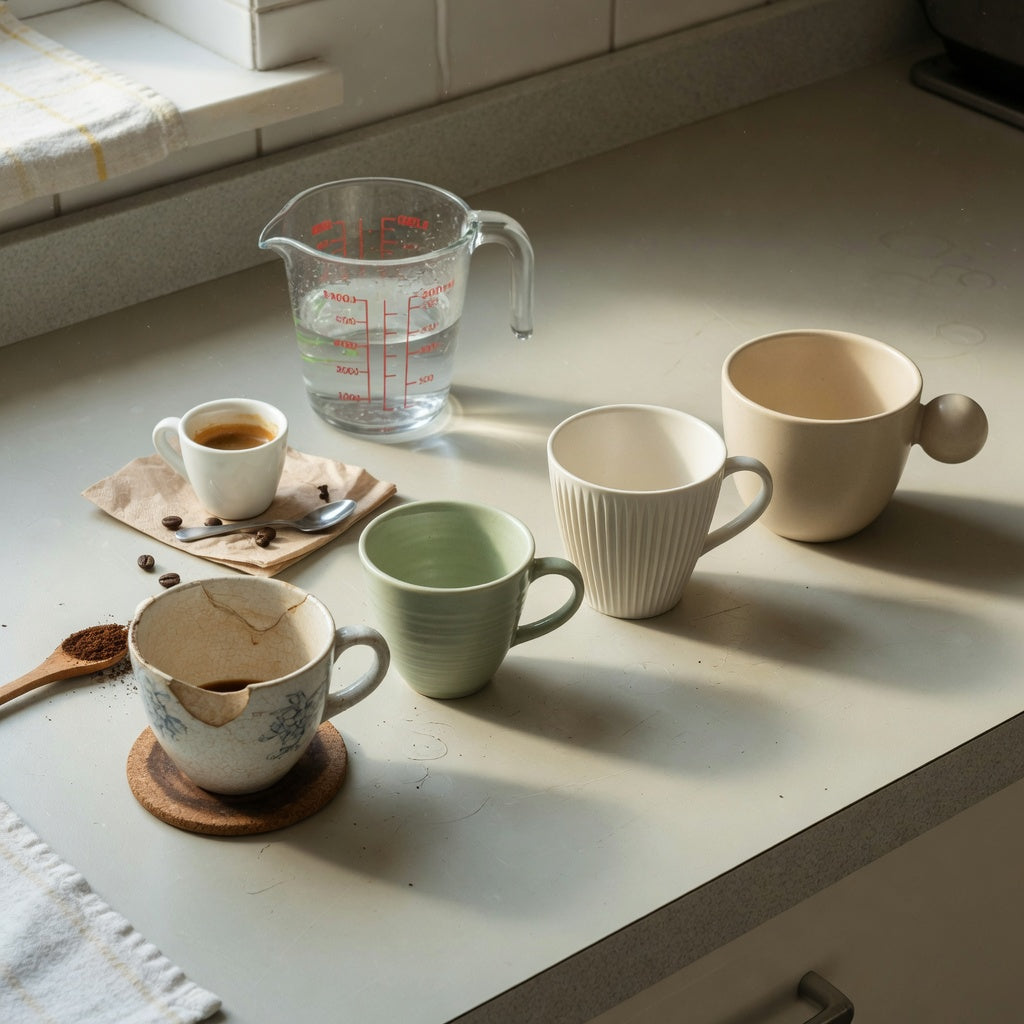
A chipped rim beside the sink is a specific problem. A cup that overflows every time you add milk is a different one. Replacing either with the first small cup that looks familiar can repeat the same frustration, so this macchiato cup replacement purchase product shortlist guide begins with the limitation of the cup leaving your cabinet. We then compare only three current ceramic options in our compact range: Retro at 170 ml, Pleated at 200 ml, and Ball Handle at 250 ml.
In our store, we find that replacement shoppers make better decisions when they measure the drink they actually prepare instead of relying on the name macchiato alone. Espresso, milk, and foam proportions vary by recipe and personal habit. The useful comparison is therefore listed capacity, practical headroom, visible form, care compatibility, and fit in the place where the cup will be used.
Which limitation of the old ceramic cup should lead the replacement?
Inspect the old cup before comparing new ones. We are not looking for a reason to buy the largest option. We are identifying the one problem the replacement must solve.
- Rim damage: A chip or rough edge means the cup should leave drinking service. Also check whether rims have been knocking together in a crowded dishwasher rack or cabinet, because a replacement cup cannot correct the way ceramic pieces are stored.
- Insufficient capacity: Milk or foam reaching the rim points to inadequate headroom. Measure the usual filled level rather than guessing from the old cup's exterior size.
- Handle mismatch: A handle can be undamaged yet still feel awkward for the person using it. Decide whether you want a familiar cup form, a textured exterior, or the distinctive ball-shaped handle shown on the largest option.
- Care mismatch: If the cup must go through a dishwasher, confirm that the current care instructions support that routine. Ceramic material alone is not a dishwasher-safe claim.
Separate accidental damage from design mismatch. A handle broken by an impact does not prove that every handle of the same form is weak. Likewise, a 170 ml cup that felt too tight did not fail structurally; its capacity simply stopped matching the drink being poured.
Macchiato cup replacement purchase product shortlist guide: 170, 200, or 250 ml?
The three candidates stay within a compact capacity band, but the 80 ml difference between the smallest and largest is meaningful around espresso-based drinks. Use the table for a first cut, then read the choose and skip cases below.
| Option | Listed capacity | Material and visible form | Best shortlist reason |
|---|---|---|---|
| Retro | 170 ml | Ceramic, retro form | Your old small serving size worked and you want the lowest-capacity option |
| Pleated | 200 ml | Ceramic, pleated exterior | You need 30 ml more listed capacity than the Retro without moving to 250 ml |
| Ball Handle | 250 ml | Ceramic, ball-shaped handle | Your pour varies or you want the most headroom in this shortlist |
Retro 170 ml: the old serving size was already right
Reader situation: Your previous compact cup held the drink comfortably, and the replacement is about damage or wear rather than volume. Why it fits: The Retro is the smallest listed option at 170 ml, so it avoids adding unnecessary capacity. Its visible retro form also suits shoppers who do not want the pleated exterior or ball handle. Why to skip it: If milk regularly approached the old rim, 170 ml leaves the least margin of these three. Review the current form on the Retro 170 ml coffee and tea cup page before matching it to your shelf and hand.
Pleated 200 ml: the old cup needed a modest step up
Reader situation: A 170 ml serving feels tight, but 250 ml would leave more unused space than you want. Why it fits: The Pleated option sits directly between them at 200 ml, adding 30 ml over the Retro while retaining a compact listed capacity. Its pleated exterior is also a clear visual and tactile design choice. Why to skip it: Do not choose it if you prefer a plain exterior or need the greatest available headroom. Check the visible contours on the Pleated 200 ml coffee and tea cup listing.
Ball Handle 250 ml: variable pours need more margin
Reader situation: Your milk amount changes, you sometimes add hot water, or you dislike carrying a cup close to the rim. Why it fits: At 250 ml, the Ball Handle has 50 ml more listed capacity than the Pleated and 80 ml more than the Retro. The visible ball-shaped handle may also suit someone who prefers that grip form. Why to skip it: The handle style is not proof of extra strength, and the largest capacity is unnecessary for a consistently small pour. Confirm the form on the Ball Handle 250 ml coffee and tea mug page.
How much headroom does your real macchiato pour need?
There is no single fill volume that covers every macchiato routine. Some people add only a small amount of milk or foam, while others use the name for a noticeably longer drink. We use a simple counter test that takes the recipe label out of the decision.
- Fill the old cup with cool water to the level where your finished drink normally sits.
- Pour that water into a graduated kitchen measuring jug and record the milliliters.
- Subtract the result from 170, 200, and 250 ml to compare nominal headroom.
- Allow additional room below the rim for carrying, foam, and day-to-day variation.
For example, if the usual level measures 130 ml, the arithmetic difference is 40 ml in the Retro, 70 ml in the Pleated, and 120 ml in the Ball Handle. Those numbers are comparison points, not promises of comfortable usable space. Listed capacity, cup geometry, foam height, and the level at which you stop pouring all affect the real margin.
That is also why a replacement should not be selected from drink terminology alone. A personally prepared macchiato may fit 170 ml easily, while another shopper's version needs 200 ml or more. Your measured pour is stronger evidence than a universal recipe claim.
How do ceramic care, dishwasher use, and cabinet clearance affect the shortlist?
Capacity does not reveal outside width, height, handle projection, or dishwasher-rack fit. Before ordering, measure the old cup at its widest point, including the handle, and record its height. Compare those measurements with the current product information and photos. If a required dimension is not shown, ask our store rather than assuming that the lower-capacity cup has the smallest external footprint.
We also treat care requirements as a purchase filter, not an afterthought. These are useful checks for any ceramic replacement:
- Confirm the current washing instructions if dishwasher use is essential. Do not infer compatibility from ceramic material.
- Leave enough rack or cabinet clearance to keep the rim from striking neighboring ceramic pieces during loading, unloading, or stacking.
- At unboxing, inspect the full rim, exterior surface, base, and handle attachment points under direct light. Set aside a cup with a chip, rough edge, or visible crack and contact the seller before use.
- Follow the listed temperature and care guidance. Avoid assuming that a new ceramic cup tolerates abrupt temperature changes simply because the old one did.
The pleated exterior also has more visible contours than the Retro form, while the Ball Handle has a more pronounced handle shape. Those are preferences, not performance guarantees. A shopper who hand-washes may welcome the visual texture; another may prefer the simpler-looking Retro form for quick inspection and wiping.
Which cup fits a small kitchen, office desk, or gift recipient?
For a kitchen with limited storage: Start with the capacity that matches the measured pour, then verify the actual external dimensions. The Retro 170 ml is the logical capacity candidate for a consistently short drink, but listed milliliters alone do not guarantee shelf clearance.
For an office desk: The Pleated 200 ml offers middle-ground headroom, while the Ball Handle 250 ml suits a more variable pour. Check the cup against the coaster and the clear area beside the keyboard. None of the listed facts establishes a lid, insulation, or travel function, so these should not be treated as commuter cups or spill-resistant deskware.
For a gift: Match the recipient's habits before selecting the most distinctive form. Choose Retro for the lowest listed capacity, Pleated for the visible textured exterior, or Ball Handle for the ball-shaped handle and highest capacity. If you do not know the recipient's normal serving volume or form preference, browse the broader unique coffee mug collection instead of forcing one of these three into the shortlist.
Skip this compact range if the recipient mainly prepares large Americanos, tea servings, or iced drinks that need substantial room for ice. A 250 ml listed capacity is the ceiling here. It is also the wrong category for anyone who needs a sealed lid or an insulated travel vessel.
What should you check before placing the replacement order?
Treat the macchiato cup replacement purchase product shortlist guide as a decision record. Five answers should identify the sensible next step:
- What failed: rim condition, handle preference, capacity, care fit, or storage fit?
- How many milliliters reach your normal serving line?
- How much carrying and foam headroom do you want above that line?
- Does the visible Retro, pleated, or ball-handle form suit the user?
- Have you confirmed dimensions and care details that are essential to your routine?
Choose the Retro at 170 ml when the existing serving volume was right. Choose the Pleated at 200 ml for a measured, modest increase. Choose the Ball Handle at 250 ml for the most capacity headroom and that specific handle preference. If none solves the old cup's actual limitation, move to a different capacity or form rather than making a compromise replacement.
Frequently asked questions
How do I use the macchiato cup replacement purchase product shortlist guide without knowing my old cup's size?
Fill the old cup with cool water to your normal drink level, then transfer the water to a graduated measuring jug. Compare that result with 170, 200, and 250 ml, remembering that you still need space below the rim. If the old cup is broken, measure the finished drink directly in a suitable kitchen measuring vessel.
Is 170 ml or 200 ml better for a macchiato with extra milk?
Use your measured finished volume rather than assuming that extra milk always requires one size. The 200 ml Pleated provides 30 ml more listed capacity than the 170 ml Retro, so it is the more forgiving of those two when the old cup felt tight. Choose 170 ml if your actual pour already fits with comfortable room below the rim.
Are the Retro, Pleated, and Ball Handle cups dishwasher safe?
Do not assume dishwasher compatibility from ceramic material. Check the current product page or care guidance for the exact cup before ordering, especially if daily dishwasher use is non-negotiable. The facts used in this comparison support the ceramic material, listed capacities, and visible forms, not an additional dishwasher claim.
Does the Ball Handle make the 250 ml cup stronger than a loop-handle cup?
The visible ball-shaped handle identifies a different form, but it does not by itself prove greater strength or durability. Choose it if that shape suits the user's grip preference and the 250 ml capacity suits the drink. If the old handle broke from impact or crowded storage, address that handling issue as well.
What should I buy if 250 ml is still too small?
Skip all three compact options. A drink that already approaches 250 ml before carrying space, foam, or ice needs a different capacity band. Measure the finished pour, note the required care routine and cabinet clearance, then compare larger forms in the CoffeifyMug unique coffee mug collection.
More from our blog
Read more

Green Tea Mug Gift Choice Practical Purchase Checklist: 3 Sizes
Compare the Retro 170 ml, Pleated 200 ml, and Emerald 270 ml using the recipient's pour size, refill routine, and preferred visible shape. The checklist also identifies product details that should ...
Read more
Ceramic vs Porcelain Coffee Mugs: Replacement Purchase Checklist
Replace a chipped, awkward, or poorly sized mug without repeating the same problem. Compare material wording, usable capacity, handle fit, care claims, and current CoffeifyMug options.
Read more
Leave a comment
This site is protected by hCaptcha and the hCaptcha Privacy Policy and Terms of Service apply.