
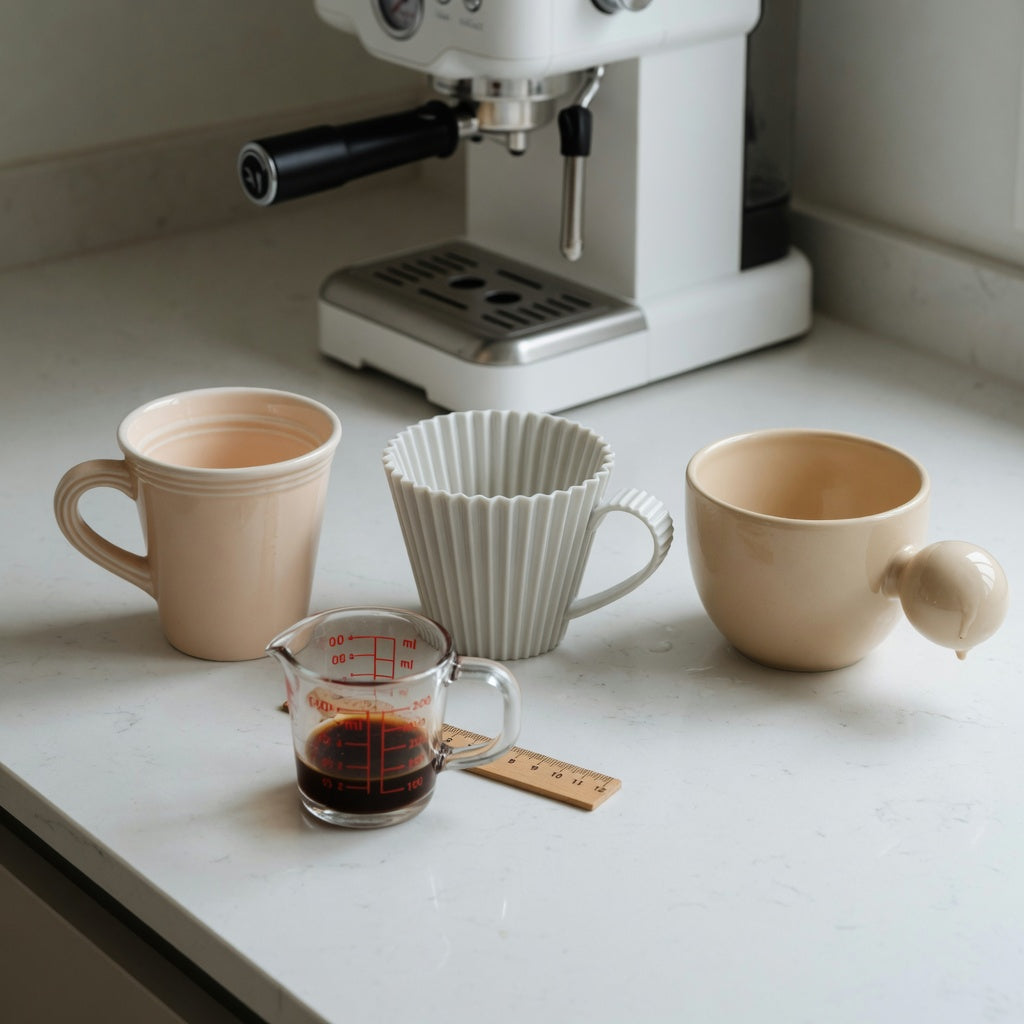
Ceramic Espresso Cup First Time Buyer Product Shortlist Guide: 3 Picks
Reading time: about 9 minutes
Set a small espresso pour inside a 170 ml vessel and the unused space can be the first surprise. In our store, we answer that size question by reading the milliliter line before judging the product photo. This ceramic espresso cup first time buyer product shortlist guide starts with the finished drink you actually make, then narrows the choice using only facts the listings support.
For this shortlist, the verified catalog facts are limited but useful: the Retro is 170 ml, the Pleated is 200 ml, and the Ball Handle is 250 ml. All three are ceramic vessels with the visible forms shown on their product pages. These capacities may be larger than a traditional single-shot demitasse, and they do not confirm exterior dimensions, equipment fit, included accessories, care compatibility, weight, insulation, or tested drink performance.
Why can 170-250 ml feel roomy beside a single espresso?
A traditional single-shot demitasse is generally smaller than the three options in this group, although exact demitasse capacities vary. The published capacity is a vessel comparison point, not a recommended recipe or usable fill line. Most people also need some headspace so the drink is less likely to reach the rim during the walk from the kitchen counter to a desk.
- 170 ml: the lowest listed capacity in this group, but still potentially roomy for a small straight espresso.
- 200 ml: 30 ml above the Retro and 50 ml below the Ball Handle.
- 250 ml: the highest listed capacity and the least similar to a small single-shot demitasse by volume.
Measure your usual finished drink once before ordering. Use a marked measuring cup and include everything that normally goes into the cup, such as espresso, milk, or added water. Drink names alone are unreliable comparison tools because a double espresso, cortado-style drink, or short coffee can be prepared at different volumes in different kitchens.
Which listing facts deserve a yes, no, or unknown?
We separate verified facts from visual impressions when we compare cups in our store. A product photo can establish the visible form, but it cannot reliably establish scale, weight, wall thickness, handle clearance, or how the cup will feel in a particular hand.
| Option | Verified catalog facts | Details that remain unconfirmed |
|---|---|---|
| Retro | Ceramic vessel, 170 ml, visible retro form | Exterior dimensions, empty weight, handle measurements, care compatibility, accessories, and machine fit |
| Pleated | Ceramic vessel, 200 ml, visible pleated form | Grip comfort, insulation, wall thickness, care compatibility, accessories, and machine fit |
| Ball Handle | Ceramic vessel, 250 ml, visible ball-handle form | Handle opening, grip comfort, total width, weight, care compatibility, accessories, and machine fit |
Ceramic material alone does not prove dishwasher or microwave compatibility. A pleated exterior describes the visible surface form; it does not establish insulation or chip resistance. A ball handle may appeal to you visually, but the photo cannot guarantee comfort for every hand. If a detail affects daily use and the page does not state it, mark that detail as unknown and ask before ordering.
Three use cases in a ceramic espresso cup first time buyer product shortlist guide
Each option below has a defined buyer situation, a fact-based reason to choose it, and a clear reason to skip it. The aim is not to name one universal winner. It is to remove options that do not match your measured drink or practical requirements.
Small finished pour: Retro 170 ml
Reader situation: Your usual drink is small, and you want the least unused capacity among these three options. Why it fits: The Retro 170 ml ceramic cup has the lowest listed capacity, sitting 30 ml below the Pleated and 80 ml below the Ball Handle. Skip it if: You want a true single-shot demitasse, expect the espresso to fill most of the vessel, or need exact exterior dimensions to confirm shelf or machine fit. Lowest capacity does not automatically mean smallest exterior footprint.
Middle capacity and visible texture: Pleated 200 ml
Reader situation: You want more listed capacity than 170 ml but do not need the full 250 ml, and you prefer a visibly pleated exterior. Why it fits: The Pleated 200 ml ceramic cup is the middle-capacity option and has a distinct visible form without requiring you to jump to the largest vessel. Skip it if: You prefer a smooth exterior or need confirmed grip, weight, wall thickness, or care details before buying.
Larger finished drink and ball-handle form: Ball Handle 250 ml
Reader situation: Your measured drink needs the most capacity in this group, or you want one coffee cup for espresso and other larger pours. Why it fits: The Ball Handle 250 ml ceramic mug has the highest listed capacity and the visible ball-handle form. Skip it if: Your priority is a small espresso cup, you want a close demitasse proportion, or limited desk and cabinet space makes exact exterior measurements essential.
What should you measure at the espresso machine, shelf, and desk?
In our experience, capacity, usable fill, and exterior dimensions answer three different questions. A cup can hold the right amount yet still be too tall for a machine, too wide for a shelf, or awkward beside a keyboard. None of those fit questions can be settled from milliliters alone.
- At the machine: Measure vertically from the drip tray to the lowest point of the spout. Compare that number with the cup's external height if the page provides it; otherwise, fit remains unknown.
- In the cabinet: Measure shelf height, depth, and available width. Include room for the handle rather than comparing the vessel body alone.
- On the desk: Mark the usable area beside your keyboard, notebook, or monitor stand. Capacity does not reveal base diameter, total width, or stability.
- For a gift: Check the recipient's current cup capacity, care routine, and expectation of a saucer or lid. A gift photo cannot communicate those practical details.
What should you inspect before the first wash or dishwasher cycle?
Ceramic is breakable tableware, so we recommend a basic inspection after unboxing and before first use. These are standard checks for any ceramic delivery, not a suggestion that the three shortlisted products have a known defect.
- Examine the rim under direct light for chips or rough damage that could contact the lips.
- Look at the handle-to-body junction for a visible hairline crack, especially after shipping.
- Set the empty, dry cup on a flat counter and check for unexpected rocking.
- Read the listed care instructions before using a dishwasher or microwave. If compatibility is not stated, ask us rather than treating ceramic material as automatic approval.
- For conservative care while a compatibility detail is unresolved, use mild dish soap and a non-abrasive sponge, and avoid knocking the cup against metal cutlery or other ceramic pieces.
Do not assume thermal-shock resistance, commercial dishwasher durability, or microwave suitability without a specific product statement. For a gift, complete the inspection before wrapping and do not promise a saucer, lid, spoon, or other accessory that the listing does not confirm.
Who should skip all three ceramic options?
A different cup style or a listing with more complete specifications will be a better purchase if any of these requirements apply:
- You want a traditional single-shot demitasse that is smaller than 170 ml.
- You require confirmed exterior dimensions to fit a specific espresso machine or narrow cabinet.
- You need an included saucer, lid, spoon, sleeve, or coordinated place setting.
- You need a sealed travel vessel, double-wall insulation, or documented heat-retention performance.
- You require stated dishwasher, microwave, thermal-shock, or commercial-service compatibility before ordering.
Those are not minor preferences. They change the type of product you should buy. We would rather call an unlisted detail unknown than turn it into an unsupported feature claim.
A practical two-minute shortlist before checkout
- Measure the total volume of the drink you make most often.
- Decide how much visible headspace you prefer above that drink.
- Compare your result with 170 ml, 200 ml, and 250 ml.
- Choose the visible form you prefer: Retro, Pleated, or Ball Handle.
- Confirm machine, shelf, and desk dimensions where exact fit matters.
- Verify care instructions and included pieces instead of assuming them.
- Write one reason to choose and one reason to skip each remaining option.
If an unresolved detail affects daily use, remove that option from the shortlist until the detail is confirmed. A clear unknown is more useful than a guess made from a styled photo.
Frequently asked questions
Is a 170 ml ceramic cup too large for a single espresso?
It may be larger than a traditional single-shot demitasse and can leave substantial visible space around a small pour. The Retro 170 ml is still the lowest-capacity option in this group. If you want the drink to occupy most of the cup, look for a smaller demitasse instead.
Which CoffeifyMug option is closest to a small espresso cup?
The Retro is closest by listed capacity because it is 170 ml, compared with 200 ml for the Pleated and 250 ml for the Ball Handle. That comparison does not prove it has the smallest exterior dimensions. Verify height, width, and handle projection separately if physical fit matters.
Will these ceramic cups fit under my espresso machine?
Capacity does not establish under-spout clearance, so fit cannot be confirmed from 170 ml, 200 ml, or 250 ml alone. Measure from your drip tray to the lowest spout and compare that clearance with the cup's stated external height. Ask us if the required dimension is not listed.
Can I put the Retro, Pleated, or Ball Handle cup in the dishwasher?
Check the individual product page for a stated care instruction. Ceramic material by itself does not confirm dishwasher or microwave compatibility. If the information is absent, contact us before the first machine cycle or use conservative hand washing while the detail remains unresolved.
What should I verify before ordering my first ceramic espresso cup?
Use this ceramic espresso cup first time buyer product shortlist guide to verify your measured drink volume, preferred headspace, listed capacity, visible form, exterior dimensions, care instructions, and included pieces. Choose only after the option has a clear daily-use fit and no unresolved requirement that could change the purchase.
Open the three product pages in separate tabs and place 170 ml, 200 ml, and 250 ml beside your measured drink volume. Remove any option with an unresolved fit or care requirement. If none earns a clear yes, compare the verified capacities and visible forms in our unique coffee mugs collection before building a new shortlist.
More from our blog
Read more

Cafe Au Lait Mug Shared Household Practical Purchase Checklist
Compare The Flow 400 ml, Morning and Night 440 ml, and The Rock 480 ml by measured pour volume, handle comfort, shape, cabinet fit, and unboxing checks. This checklist also identifies product detai...
Read more
Herbal Tea Mug Shared Household Practical Purchase Checklist: 3 Sizes
Use measured pour volume and a loaded-grip check to compare The Flow 400 ml, Morning and Night 440 ml, and The Rock 480 ml for different household members. This checklist also identifies product de...
Read more
Leave a comment
This site is protected by hCaptcha and the hCaptcha Privacy Policy and Terms of Service apply.