
Herbal Tea Mug Shared Household Practical Purchase Checklist: 3 Sizes
Reading time: about 9 minutes
A shared kitchen cabinet can hold plenty of mugs and still leave two people reaching for the same one. One person wants a modest evening pour. Another wants the largest-capacity option available, and both care about how the handle feels once the mug is full. This herbal tea mug shared household practical purchase checklist turns that ordinary conflict into two decisions supported by the verified catalog information: capacity and handle comfort.
In our store, we have learned that a capacity label becomes useful only after it is connected to the person who will carry the mug from the kitchen counter to a desk, sofa, or dining table. The three relevant CoffeifyMug listings support tea use: The Flow at 400 ml, Morning and Night at 440 ml, and The Rock at 480 ml. We do not treat one as universally best, and we do not assume everyone in a household should choose the same size. You can first scan the unique coffee mugs collection, then use the comparisons below to narrow the choice for each person.
Start with the pour each person actually uses
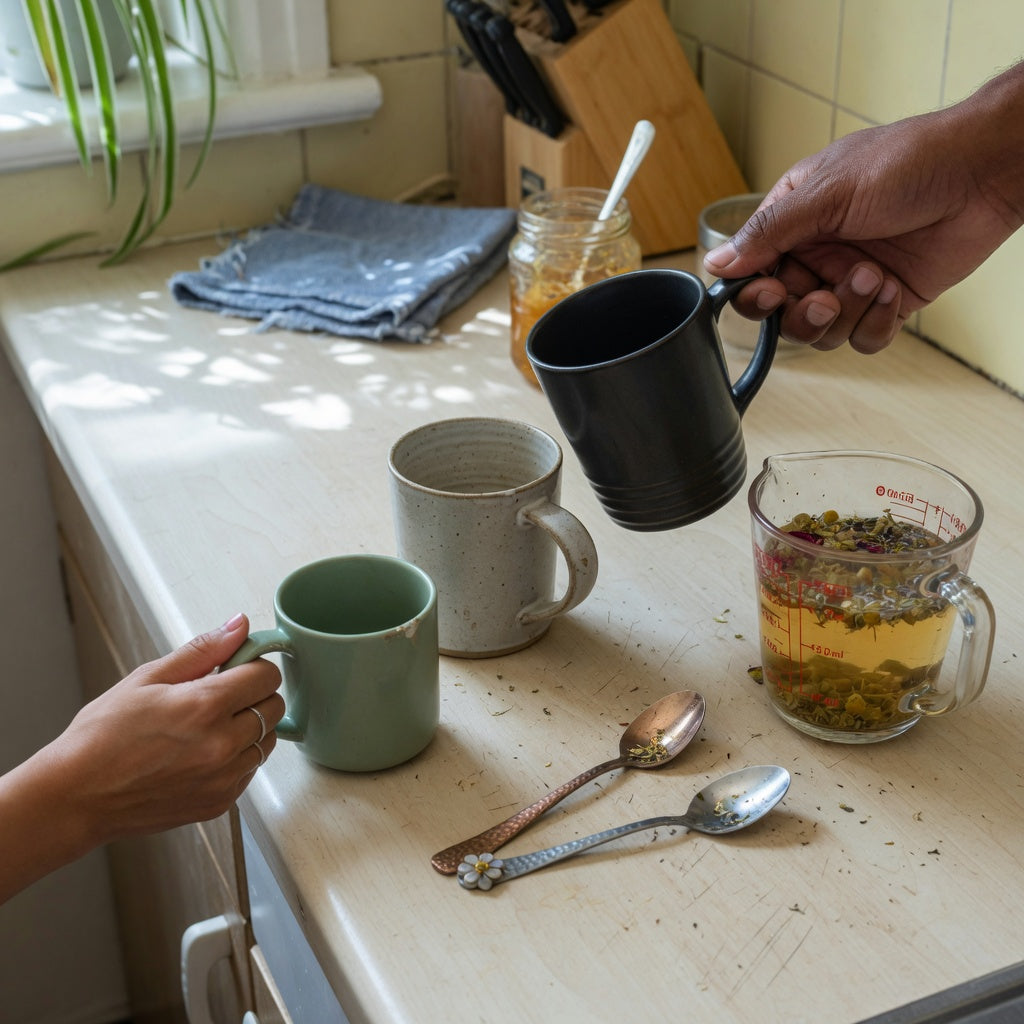
Before comparing product pages, measure one normal serving for every regular herbal tea drinker in the home. Fill the current favorite mug with cool water to the level that person normally uses, then transfer the water to a measuring jug. The result does not need laboratory precision. It only needs to show whether the person is closer to the lower, middle, or upper end of the 400 ml to 480 ml range.
Do not treat listed capacity as a target fill line. Most people leave some headspace, and the amount varies by person. If a normal serving comes close to a mug's listed capacity, moving to the next size may be more practical than filling near the top. The comparison has two 40 ml steps: 400 ml to 440 ml, then 440 ml to 480 ml. The full difference between The Flow and The Rock is 80 ml.
Typical shared-household results look like this:
- A light-pour drinker wants the smallest listed capacity and dislikes carrying more liquid than needed.
- A middle-range drinker wants more room than 400 ml but does not need the largest option.
- A larger-pour drinker regularly finds a 440 ml capacity too close to the amount they want to serve.
- Two people prefer a similar volume but use different grips, so handle comfort becomes the deciding factor.
Write down each person's result separately. A matching shelf may look orderly, but matching capacities can force one household member to compromise every day.
How do 400 ml, 440 ml, and 480 ml divide household roles?
The capacity figures provide a clear starting order. They do not prove exterior dimensions, mug weight, or handle-opening size, so keep those questions separate from the volume comparison.
| Mug | Verified capacity | Reader situation | Why it is the logical next page |
|---|---|---|---|
| The Flow | 400 ml | The person wants the smallest capacity in this three-mug comparison, and their usual serving leaves suitable headspace within that figure. | It establishes the lower end of the range without making the shopper move directly to 440 ml or 480 ml. |
| Morning and Night | 440 ml | The person's preferred volume sits between the two ends, or 400 ml feels too close to their normal pour. | It is the exact midpoint by listed capacity: 40 ml above The Flow and 40 ml below The Rock. |
| The Rock | 480 ml | The person wants the largest capacity of these three, or their normal serving leaves too little headspace in a 440 ml option. | It provides 80 ml more listed capacity than The Flow and 40 ml more than Morning and Night. |
Each row is an individual purchase path, not a recommendation to buy the mugs as a set. A two-person home might compare The Flow for one person and The Rock for another. Another household may find that both people prefer 440 ml, then make separate decisions based on handle comfort.
How can different hand sizes judge handle comfort online?
Handle comfort cannot be ranked honestly from capacity alone. A larger-capacity mug does not automatically have a larger handle opening, and a smaller-capacity mug is not automatically easier for every small hand. Finger length, preferred grip, knuckle clearance, and wrist position all affect the result.
When we help shoppers think through this choice, we separate the weight of the liquid from the shape of the handle. You can reproduce that process with a mug already in your cabinet:
- Preferred finger count: Note whether the person normally places one, two, or more fingers through the handle.
- Knuckle clearance: Check whether the current favorite handle leaves space around the fingers or presses against the knuckles.
- Loaded wrist position: Add cool water up to a safe level near the candidate volume and notice whether the wrist remains neutral or rotates inward.
- Thumb position: Record whether the thumb naturally rests on top of the handle, against the mug, or around the outside.
- Normal carry route: Walk from the preparation area to the usual seat or desk. A grip that feels acceptable for two seconds may feel less secure across a room.
This home test can approximate the effect of carrying different liquid volumes, but it cannot reproduce the exact handle geometry of a mug you have not held. Use current product images and any explicitly listed measurements as screening evidence. Do not estimate exact finger clearance from a photograph if handle dimensions are essential to the buyer.
Which details need a product-page check before checkout?
The verified facts used here are deliberately narrow: the catalog descriptions support tea use, and the listed capacities are 400 ml, 440 ml, and 480 ml. This article does not fill gaps with assumptions. Before ordering, check the current product page for any requirement beyond capacity and your visual assessment of handle comfort.
- Exterior dimensions: Capacity alone does not prove height, width, cabinet clearance, or the amount of counter space a mug uses.
- Handle measurements: Do not assume the 480 ml option has a wider opening than the 400 ml option unless the current listing confirms it.
- Material and construction: Use the current product description rather than treating all mugs in a category as identical.
- Care instructions: If dishwasher or microwave compatibility is required, buy only after the current listing provides the information you need.
- Accessories and storage: Do not assume a lid, infuser, stacking feature, or other unlisted element is included.
This verification step matters in a shared home because one unconfirmed requirement can affect several people. For example, a capacity may suit the drinker while an unverified exterior measurement may not suit the available shelf. Keep unresolved details marked on the checklist until the product page or direct store confirmation answers them.
How to use this herbal tea mug shared household practical purchase checklist
The value of a herbal tea mug shared household practical purchase checklist is that it records one decision per person instead of asking the household to agree on a single mug. Complete these steps at the kitchen counter before choosing a product.
- Write down the name of every person who regularly uses the shared mug shelf.
- Measure each person's usual serving with cool water and a measuring jug.
- Record how much headspace that person normally leaves in a favorite mug.
- Compare the result with 400 ml, 440 ml, and 480 ml. If the measured serving is close to one listed capacity, flag the next size for comparison rather than assuming a near-rim fill will be comfortable.
- Have each person describe their normal grip: preferred finger count, knuckle clearance, thumb position, and any wrist rotation under load.
- Choose the first product page by capacity: The Flow for the lowest listed option, Morning and Night for the midpoint, or The Rock for the highest.
- Review the candidate's current images and specifications for handle information. Keep capacity fit and handle fit as two separate checks.
- Verify any non-negotiable dimensions, material details, care instructions, or accessories directly on the current listing.
- Let each person make an independent choice. Do not reject a mixed-capacity shelf simply because identical mugs would look more uniform.
A useful household note can be as short as this: preferred serving, desired capacity band, usual finger count, loaded-grip result, and unresolved product details. That record is more dependable than choosing by appearance alone.
When is a different mug style the better purchase?
These three CoffeifyMug options are sensible candidates when the buyer's decision can be narrowed by tea-compatible catalog use, a 400 ml to 480 ml capacity range, and personal handle comfort. They are not automatically the right fit for every household.
- Look for a smaller or larger capacity if a person's normal serving falls clearly outside this range.
- Choose a different form factor if a lid, built-in infuser, transparent body, insulation, or verified stacking design is mandatory and the selected product page does not confirm it.
- Do not rely on capacity if the mug must fit a tightly measured cabinet, shelf, or holder. Exact exterior dimensions should drive that decision.
- For anyone who finds a loaded mug tiring to carry, seek verified mug weight and handle measurements rather than assuming the lowest capacity solves every grip issue.
This does not mean the three products lack any particular feature. It means those features are outside the verified comparison used here. If none of the three capacity positions resolves the household's needs, return to the collection and compare another style against the same person-by-person notes.
Frequently asked questions
What should a herbal tea mug shared household practical purchase checklist include?
Include each person's normal measured serving, preferred headspace, candidate capacity, finger position, and loaded-grip notes. It should also list any unverified requirements, such as exact dimensions or care instructions, that must be confirmed on the current product page.
Which mug size is best for two people who drink different amounts?
There is no single best shared size. If one person wants the lowest capacity and another wants the highest, The Flow 400 ml and The Rock 480 ml are the logical pages to compare; Morning and Night 440 ml covers the middle position. These are separate product choices rather than a claim that the mugs are sold as a set.
Does a larger mug capacity mean the handle will be more comfortable?
No. Larger capacity tells you how the listed volume compares, not how many fingers fit through the handle or how the grip feels in a particular hand. It can also mean more liquid is being carried when filled, so evaluate volume load and handle geometry separately.
Can The Flow, Morning and Night, and The Rock be used for herbal tea?
The catalog descriptions for all three support tea use. This comparison does not make claims about ingredients, wellness effects, or brewing performance; it focuses only on capacity and the shopper's handle-comfort assessment.
How do I choose if exact handle dimensions are not listed?
Compare the product images with a current favorite mug and record the grip characteristics you need, but do not treat a photograph as an exact measurement. If finger clearance is non-negotiable, wait until the measurement can be verified through current product information or direct confirmation.
Your next step: measure one normal pour for each person, assign a 400 ml, 440 ml, or 480 ml starting point, then open the linked product page and verify the remaining details. If all three miss a requirement, use the CoffeifyMug collection to find a different candidate while keeping the same person-by-person checklist.
More from our blog
Read more
Ceramic Espresso Cup First Time Buyer Product Shortlist Guide: 3 Picks
Compare the verified facts for CoffeifyMug's Retro 170 ml, Pleated 200 ml, and Ball Handle 250 ml ceramic cups. This shortlist explains who each option fits, why to skip it, and which dimensions, c...
Read more
Americano Coffee Cup First Time Buyer Practical Purchase Checklist
Compare CoffeifyMug's verified 200 ml, 270 ml, and 350 ml capacities using your measured pour and preferred headroom. This checklist also identifies dimensions, materials, care, and compatibility d...
Read more
Leave a comment
This site is protected by hCaptcha and the hCaptcha Privacy Policy and Terms of Service apply.