

Big Latte Mug Storage Fit Guide: 400, 440 and 480 ml
Reading time: about 10 minutes
Last week a customer set two of our mugs side by side on the counter and asked which one would survive her cabinet. The capacities were close. The difference was not volume — it was the air above the handle. One cleared the shelf by a finger's width. The other bumped the underside of the shelf before the rim got anywhere near it. Capacity is the number shoppers compare; clearance is the number that decides whether a mug gets used every morning or ends up beside the kettle.
So this is the big latte mug storage fit guide we actually talk through at the counter: three listed capacities stated plainly, the shape trade-offs those numbers hide, and four measurements you can take at home in about three minutes.
Why a big latte mug and a café latte cup are different purchases
The FDA compliance guide for ceramic cups and mugs describes the category as small hollowware used for hot drinks, normally holding about 240 ml (8 fl oz) and made with a handle. Small hollowware, in that same guide, means anything under 1.1 liters. That definition covers a very wide range, which is why the phrase latte mug has no fixed size attached to it.
Specialty café latte cups are usually listed around 300–355 ml. All three of our mugs sit above that band. Anyone searching for a big latte mug is shopping in the gap between a café cup and something closer to a bowl, and that gap is exactly where shelf fit gets decided — not in the millilitre figure, but in the height, base width and handle the figure says nothing about.
What 400 ml, 440 ml and 480 ml work out to in ounces
US fluid ounces and printed millilitres get rounded by different rules, so the two numbers on a listing rarely line up neatly. Using the NIST conversion of 29.5735 ml per US fluid ounce, here is where our current capacities land:
| Mug | Listed capacity | Approx. US fluid ounces | What it usually suits |
|---|---|---|---|
| The Flow | 400 ml | about 13.5 fl oz | A hot latte or cappuccino with a moderate milk pour |
| Morning and Night | 440 ml | about 14.9 fl oz | A larger hot latte, or the same mug for an evening tea |
| The Rock | 480 ml | about 16.2 fl oz | Iced lattes, long drinks and generous single-serve pours |
For scale, NIST's packaging conversions put 8.0 fl oz at 236.588 ml and 16.0 fl oz at 473.176 ml. Our largest mug therefore sits just past the 16 oz line — slightly over a US pint if you filled it to the rim, which nobody should with a milk drink.
Those figures are brim capacity. Leave headroom for a foam cap and the usable pour drops below the printed number — and the drop is bigger on a wide mug, where the top centimetre holds a surprising amount of liquid. If one listing says 14 oz and another says 440 ml, they may well be the same vessel. If one says 16 oz and another says 400 ml, they are not. Our practical guide to ounces in a mug covers the conversion side in more depth.
The big latte mug storage fit guide: four numbers to take first
Before you choose between 400 ml and 480 ml, measure these. None takes more than a minute, and all four sit behind most of the oversized-mug returns we see.
- Shelf headroom. Measure from the shelf surface to the underside of the shelf above. Compare that to the mug height on the listing, then add the handle rise if the handle arcs above the rim. The handle is usually what hits first.
- Cabinet depth and door swing. A wide body with a long handle can foul the door, or leave no room for a second mug behind it. In a shallow cupboard, depth matters as much as height.
- Group-head clearance. If the mug is going under an espresso machine, measure from the drip tray up to the group head — with your scale on the tray, not without it. That total is your real ceiling, and in most kitchens it is the tightest constraint you own.
- Base width against your holder or caddy. For iced lattes and commutes, base diameter decides whether the mug sits properly in a car cup holder or rattles around in it.
Write those four numbers on your phone before you open a product page.
Matching each of our mugs to a real shelf and a real drink
The capacities below are the listed figures, and they are the only size facts we can state here with confidence. Height, base width and handle projection belong to the individual product page — read them off the live listing for the exact mug rather than from a photograph or from this article.
- The Flow coffee and tea mug — 400 ml (about 13.5 fl oz). The smallest listed capacity we carry, which makes it the sensible starting point when headroom or cabinet depth is your binding constraint. It suits a morning latte with room to build foam without committing to a large pour. It is not the right pick if you routinely drink 16 oz iced lattes — you will be refilling.
- Morning and Night coffee and tea mug — 440 ml (about 14.9 fl oz). The middle listed capacity, and the one we see bought for two jobs: a full milk drink in the morning, a large tea in the evening. Do not assume it is automatically shorter or narrower than the other two — shape varies independently of volume, so compare its listed height and base width directly against whichever mug you are also considering.
- The Rock coffee and tea mug — 480 ml (about 16.2 fl oz). The biggest pour in the current lineup. Good for iced lattes, long drinks, soup, or anyone who resents refilling mid-morning. It also has the least margin for error on a tight shelf, so measure before you give it cabinet space.
If you want the capacity question examined from a different angle, our oversized ceramic mug capacity comparison works through daily fit rather than storage.
Handle projection and the one-hand carry test
Handle opening width and how far the handle projects from the body are the two specs listings almost never print, and they cause more returns than capacity ever does.
- A thicker palm or wider fingers needs a wider opening. A narrow loop is uncomfortable no matter how light the mug is when empty.
- Projection adds to depth as well as height. It is also what stops stacked mugs sitting flat, which matters in a cupboard where you nest them.
- Look for a straight side-on photo rather than the three-quarter hero shot. A side view shows whether the handle rises above the rim or stops below it — that single detail can swing your headroom calculation by centimetres.
Then run the carry test. Fill a mug you already own with water to 400, 440 or 480 ml and walk it one-handed from the kitchen to your desk. Milk is denser than water, so if water already feels precarious, the real drink will feel worse. Two minutes now saves a return later, and it is the quickest way to rule out the largest capacity in a range.
Wide bowl or tall cylinder — what each shape does to a low shelf
Two mugs can both be listed at 440 ml and behave completely differently once they are on a shelf.
- Wide, bowl-like shapes spend their volume sideways. They sit lower, which helps under a low shelf, but they use more depth and take a bigger base footprint on a crowded desk. A wide mouth also gives you more room to pour into, which is why latte-art regulars lean that way.
- Tall, straighter shapes keep a smaller footprint but demand more headroom. A tall mug that is only partly filled also exposes a larger liquid surface, and a big exposed surface loses heat faster than a small one — one reason a generous mug can taste cooler near the bottom than a small cup poured at the same moment.
We deliberately do not print a height figure in this article as though it settled the question, because shelf fit depends on the exact shape that arrives at your door.
Where a big latte mug is the wrong mug
We sell large mugs, so it would be easy to pretend they suit everybody. They do not.
- Single espressos and cortados. A 480 ml mug swallows a small drink and leaves it cooling in a wide, half-empty vessel. Use a small cup.
- Shallow cabinets and small kitchens. If your upper shelves are tight, a 300–355 ml café latte cup is the better category — shorter, narrower and easier to stack.
- Latte art on a small pitcher. Wide bowls need more milk volume to pour into properly. If your pitcher is sized for a 10 oz drink, a 480 ml mug will feel like pouring into a mixing bowl.
- Fast drinkers. Big mugs reward slow sipping. Finish a latte in three minutes and you are mostly left with cooling milk.
In our experience, the buyers who end up happiest with an oversized mug measured first and then chose a capacity, instead of choosing the largest option and hoping it fitted.
Dishwasher, microwave and what a lead-free label actually proves
Care guidance is set per product and per glaze, so read the notes on the exact listing rather than assuming every mug in a size range behaves the same way. A dishwasher-safe or microwave-safe label describes what the maker expects the item to tolerate; it is not a guarantee, and repeated cycles plus rapid temperature change are where things usually go wrong.
On lead, the FDA sets an action level of 0.5 micrograms per millilitre of leaching solution for ceramic cups and mugs, applied to any one of six units tested under its cup-and-mug compliance guide, and it notes that some ceramic foodware can leach lead from food-contact surfaces. A lead-free line on a product page is a marketing statement. A leach test result is evidence. Those are different things, and it is fair to ask which one you are being shown.
Frequently asked questions
How many ounces is a 440 ml big latte mug?
About 14.9 US fluid ounces to the brim, using the NIST conversion of 29.5735 ml per fluid ounce. Your actual drink will be less once you leave headroom for a foam cap. Morning and Night is the 440 ml option in our current lineup.
What should I measure before buying a big latte mug?
Start with shelf headroom from the surface to the shelf above, plus the mug height and handle rise from the listing. Then check cabinet depth against the door swing, and if the mug is going under an espresso machine, add the distance from drip tray to group head with your scale in place. This big latte mug storage fit guide boils down to those three numbers plus your car cup holder diameter.
Is 480 ml too big for a hot latte?
It changes the drink rather than just holding more of it. At about 16.2 fl oz you get more milk per shot unless you pull extra espresso, so the ratio shifts. It is an excellent iced latte size. If you drink small, strong lattes, a smaller cup serves you better.
Will The Rock fit in a car cup holder?
Base width is the deciding number, not capacity, and it is printed on the product page rather than here. Check that measurement against your holder before you buy. If it does not fit, the mug still works perfectly as a desk or kitchen mug.
Does a lead-free label mean a ceramic mug was tested?
Not necessarily. The FDA action level for ceramic cups and mugs is 0.5 micrograms per millilitre of leaching solution across six tested units, and some ceramic foodware can leach lead from food-contact surfaces. A label is a claim; a test result is proof. Ask which one you are looking at.
Ready to match a capacity to your shelf? Note your four clearance numbers, then browse the full unique coffee mugs collection and compare The Flow, Morning and Night and The Rock against them — listed capacity, listed height, base width and handle projection, in that order.
More from our blog
Read more
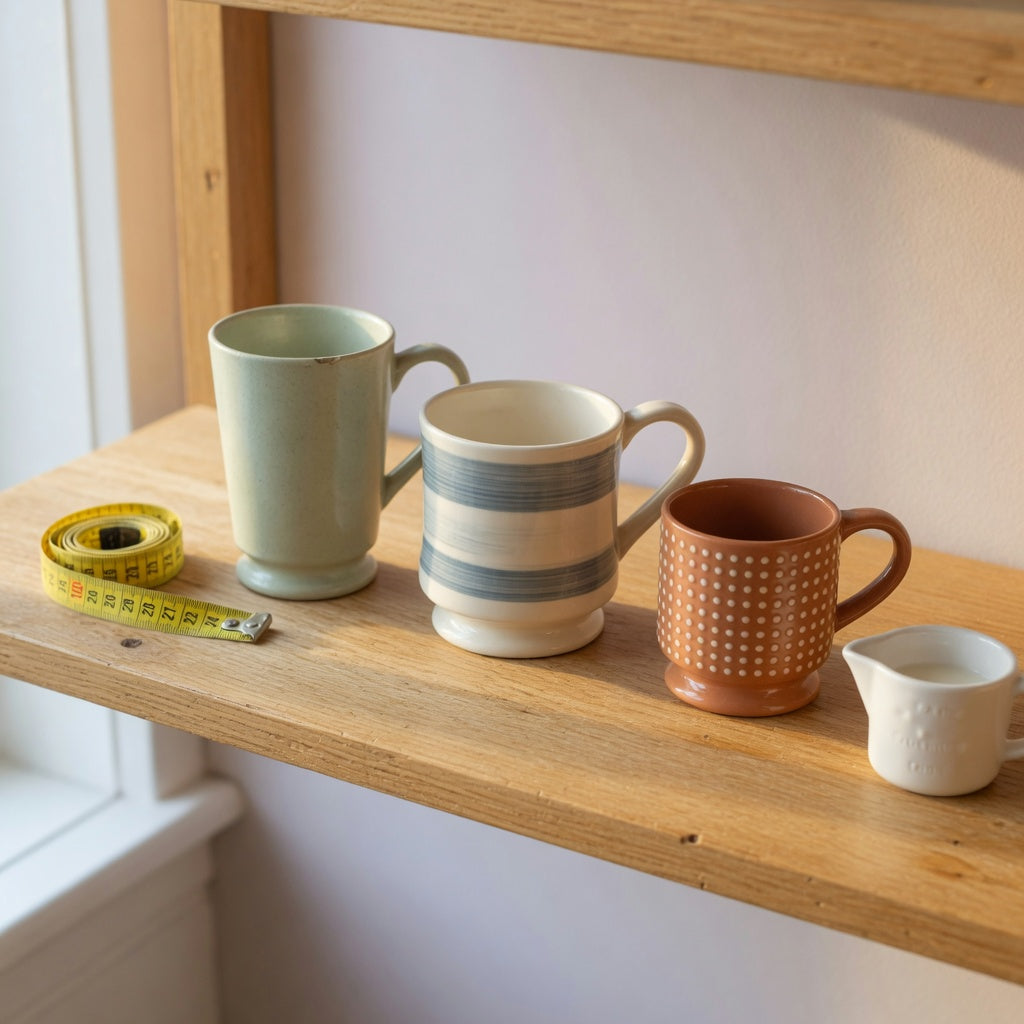
14 Oz Ceramic Coffee Mugs Storage Fit Guide: Shape vs Shelf
A 14 oz mug can still fail your cabinet, because handle projection and exterior height decide fit, not capacity. Here is how our 400 ml, 440 ml, and 480 ml shapes compare on real shelves and in rea...
Read more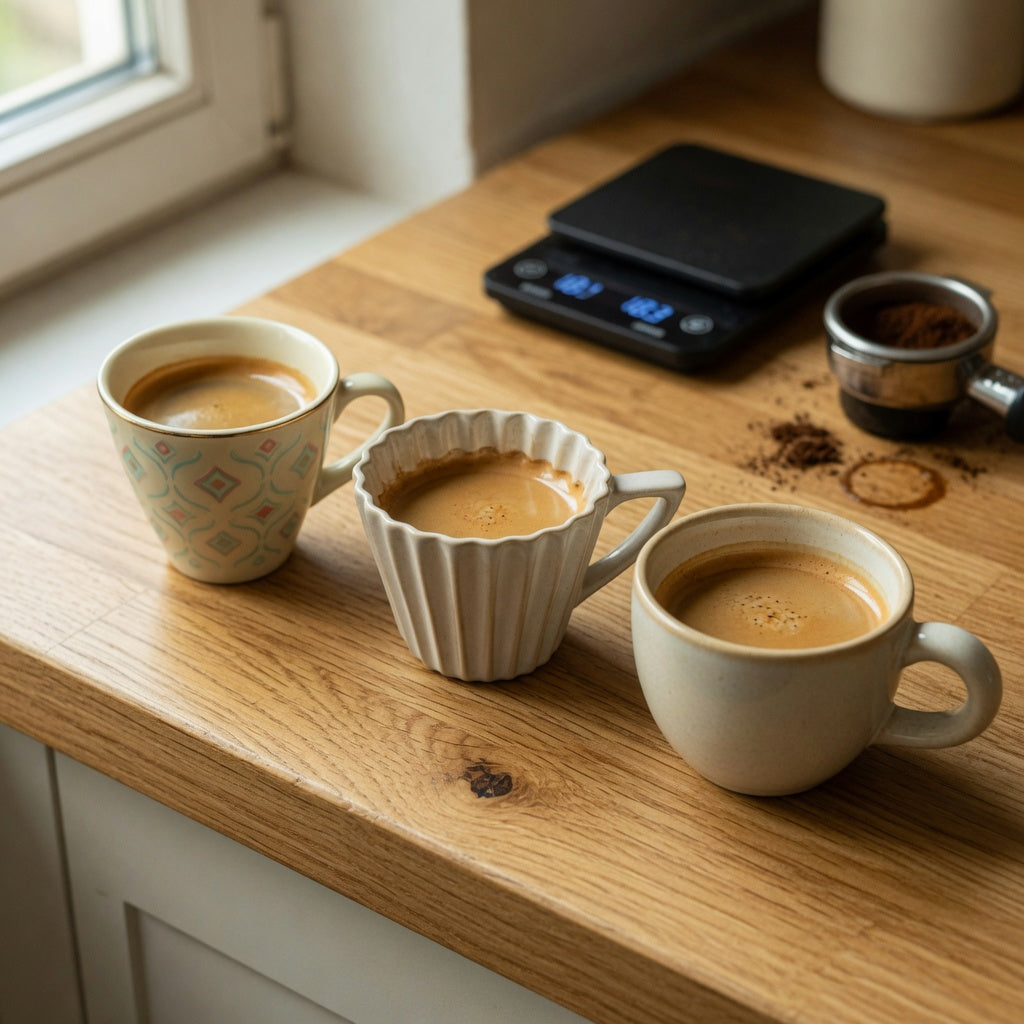
Unique Espresso Cups Size Decision Guide: 170, 200 or 250 ml
Same double shot, three capacities, three very different results. A practical breakdown of our 170 ml, 200 ml and 250 ml ceramic cups — which pour each one suits, and where each size stops being th...
Read more
Leave a comment
This site is protected by hCaptcha and the hCaptcha Privacy Policy and Terms of Service apply.