
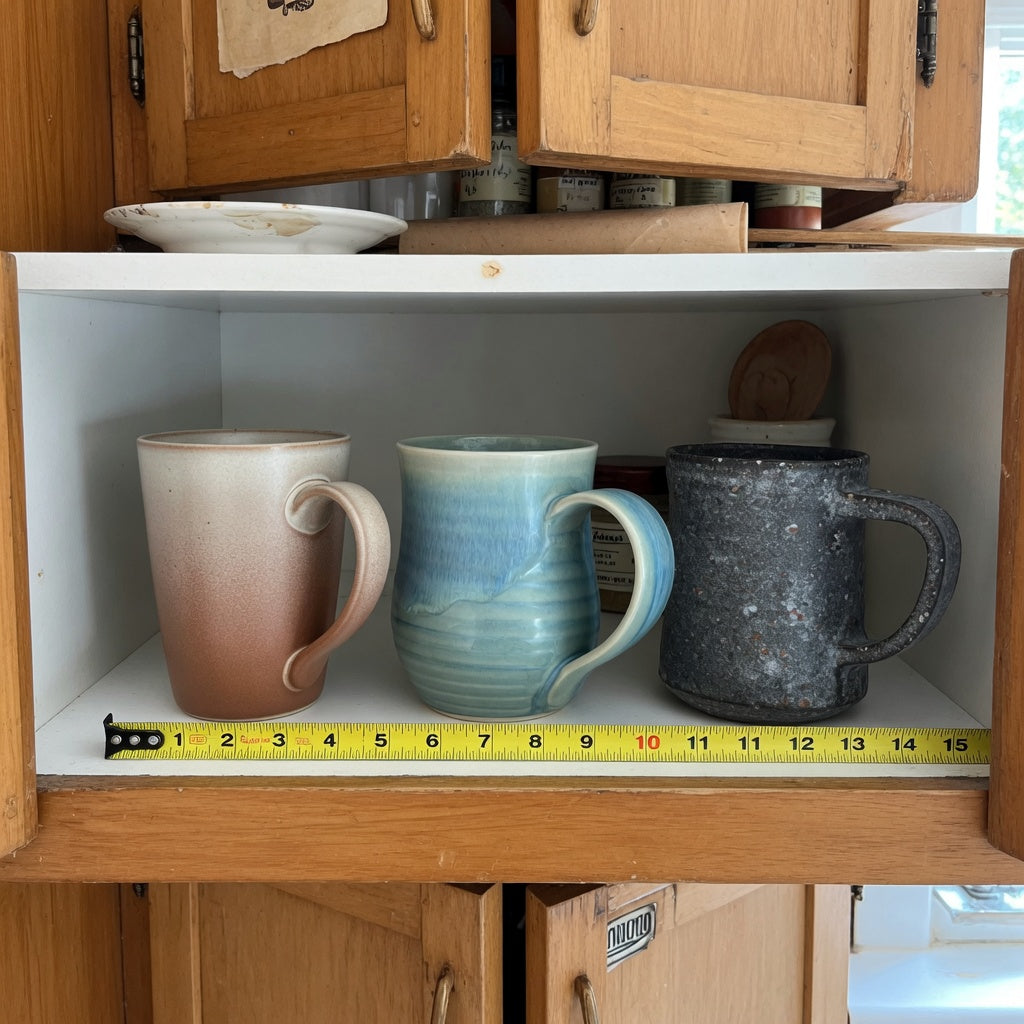
Apple Cider Mug Storage Fit Guide: 400 ml vs 480 ml
Reading time: about 10 minutes
A mug can sit flat on a shelf and still keep the cabinet door from closing because its handle reaches beyond the body. That storage envelope is difficult to judge from a front-facing product photo. This apple cider mug storage fit guide separates what we can verify from what needs to be measured: listed capacity, visible body form, handle projection, shelf depth, and the clearance required around everyday ceramic mugs.
The current comparison covers The Gradient at 400 ml, The Flow at 400 ml, and The Rock at 480 ml. Those capacities are verified catalog facts. The supplied product information does not give us verified exterior measurements for this comparison, so we will not turn liquid volume or product photography into invented millimeter dimensions. These are everyday ceramic mugs, with no claim here that ingredients, organizers, special insulation, or other accessories are included.
Apple cider mug storage fit guide: what should you measure?
Start with the usable interior of the cabinet, not the advertised size of the cabinet box. Hinges, door frames, shelf lips, and items stored behind the mug can all reduce the space that matters. In our store, we use three exterior variables to discuss mug fit: total height, widest body diameter, and overall width from the far side of the body to the outer edge of the handle.
- Measure usable shelf height. Measure from the shelf surface to the shelf or cabinet structure above it. Leave enough room to lift the mug over a shelf lip rather than planning a zero-clearance fit.
- Measure usable depth. Measure from the back obstruction to the plane where the door closes. A mug body may fit while a forward-facing handle still catches the door.
- Set a width allowance per mug. Include the handle, not just the circular body. Also account for the neighboring mug's handle if both will face the same direction.
- Check turning room. A mug may fit after it is placed but still be awkward to rotate, grip, or remove without knocking another handle.
- Confirm what a listed width includes. If a product page provides dimensions, check whether the width covers the body alone or the full mug including its handle.
If an exterior measurement you need is not listed, use the product images to make a shortlist, not a final fit decision. Compare them with a mug already in your cabinet and ask us about the missing measurement before ordering several pieces.
How do Gradient, Flow, and Rock compare on capacity and form?
Capacity gives you one confirmed comparison point. Visible form supplies useful clues, but it cannot establish exact shelf fit. The shape notes below describe what the current listing imagery appears to show and identify the measurement each shopper should verify.
| Mug | Verified capacity | Visible form to inspect | Practical storage decision |
|---|---|---|---|
| The Gradient | 400 ml | The current imagery presents a defined, tapered-looking body with an open loop handle. | Shortlist it if you want a 400 ml mug and value visible finger room. Confirm the full width including the outer handle edge before placing it in a tight row. |
| The Flow | 400 ml | The current imagery presents a softer, continuous body profile, with a handle that appears to sit relatively close to the mug. | It is a sensible first option when handle projection is your main concern, such as in an upper cabinet or office hutch. Treat that as a visual shortlist reason, not a measured fit guarantee. |
| The Rock | 480 ml | The current imagery presents a more substantial, sculpted form than the two 400 ml options. | Choose it when the larger listed capacity matters and you can reserve more shelf or counter space. Verify its exterior envelope rather than assuming the 80 ml capacity difference predicts a specific width. |
The Gradient and The Flow hold the same listed volume, yet their bodies and handles need not occupy identical exterior space. The Rock has the largest listed capacity, but that alone does not prove it will exceed every 400 ml mug in every exterior dimension. Product shape still controls the result.
Why can a 400 ml mug need as much shelf room as a 480 ml mug?
Liquid capacity describes interior volume. Cabinet fit depends on the exterior envelope. Ceramic wall thickness, body taper, rim flare, foot ring, handle thickness, and handle projection can change that envelope without producing the same change in capacity.
A shorter mug may be wider. A tall mug may use less shelf width but fail under a low shelf. A handle with generous finger clearance may be comfortable on a kitchen counter while forcing adjacent mugs farther apart. This is why our apple cider mug storage fit guide does not label every 400 ml option compact or treat 480 ml as an exterior measurement.
The listed capacity also should not be treated as a recommended fill line. You will normally leave room below the rim for carrying and sipping. Choose between 400 ml and 480 ml according to the amount you prefer to pour, then make a separate decision about storage dimensions.
Which shape suits an upper cabinet, open shelf, or office hutch?
- Narrow upper cabinet with a closing door: Begin with the 400 ml Flow or Gradient. The Flow is the first visual shortlist when handle projection appears to be the limiting variable; the Gradient is relevant if its handle shape better suits your grip. For either one, confirm overall depth and width before ordering.
- Wide shelf with limited vertical clearance: Do not choose by capacity. Check total exterior height and the lifting room above the rim. A mug that technically fits under the next shelf can still be frustrating if it must be tilted around the shelf edge.
- Deep open kitchen shelf: The 480 ml Rock becomes more practical because a closing door is not controlling the depth. Make sure the full base remains supported and the handle does not project into a walkway or busy preparation area.
- Office hutch or shared cupboard: The two 400 ml mugs are reasonable starting points because they meet the lower capacity target, but neither is guaranteed to be narrower. Leave enough side clearance to remove one mug without striking a coworker's cup.
- Gift for someone whose cabinet size is unknown: A 400 ml option reduces the capacity commitment, but it does not guarantee a smaller exterior. Use the visible silhouettes in our unique coffee mugs collection to shortlist a style, then verify dimensions rather than relying on the gift box or product photo for scale.
For a small closed cabinet, The Rock is not the lowest-risk first choice because it combines the largest verified capacity with a visibly substantial form. It makes more sense for a shopper who values the 480 ml capacity and already has a deep shelf, open shelving, or a dedicated counter position.
Can these ceramic mugs be stacked, hung, or stored after washing?
The supplied facts do not identify The Gradient, The Flow, or The Rock as purpose-built stacking mugs. Do not assume one will nest securely inside another. Stacking ordinary ceramic shapes can concentrate weight on a rim or create hard contact between glazed surfaces, increasing the chance of chips, scratches, or an unstable pile.
- For shelf rows: Store each mug upright on its base. Alternating handles left and right may recover some width, but test removal before filling the entire row.
- For a second shelf level: A separately purchased shelf riser is usually more predictable than placing one ceramic mug inside another. Check the riser's load rating and height before use.
- For hooks: Verify the handle opening, handle thickness, hook diameter, clearance from the wall, and rated load. A handle that fits over a hook can still leave the mug body resting at an unstable angle.
- After washing: Follow the care instructions on the product page. If a dishwasher cycle is permitted, let any water around the foot ring or recessed base drain and dry before placing the mug in a closed cabinet.
- During daily handling: Leave enough space that handles do not strike neighboring rims as mugs are removed. Handle-to-rim contact is a common storage stress point for ceramic pieces.
These options are not the best category for a buyer who needs true nesting, collapsible travel storage, or guaranteed compatibility with a fixed commercial mug rack. A purpose-built stackable cup or travel vessel would suit those requirements better.
Which current mug should each type of shopper shortlist?
Choose The Flow as your first comparison if the mug will live in a shallow cabinet and the visible distance between the handle and body is your main concern. Its 400 ml capacity also suits shoppers who do not need the largest pour. The trade-off is that imagery alone cannot confirm the clearance.
Choose The Gradient as your first comparison if you want a 400 ml capacity and its open-looking handle appears better suited to your hand. That visible handle room may require more lateral shelf allowance, so measure the overall width rather than focusing on the body.
Choose The Rock as your first comparison if 480 ml is the priority and you have a known storage position with more room. It is better suited to a dedicated open shelf or counter spot than to an unmeasured, crowded cabinet.
Compare the full collection first if your cabinet contains mixed mug shapes or you are buying a gift. A mixed shelf often benefits from one mug filling a specific gap rather than several mugs sharing identical dimensions.
What should you check before placing the order?
- Write down the cabinet's usable height, usable depth to the closed door, and width available per mug.
- Decide whether 400 ml or 480 ml better matches your normal pour before comparing exterior form.
- Check the widest point of the body and confirm whether any listed width includes the handle.
- Allow room to grip, rotate, and lift the mug without contacting the shelf above or the mug beside it.
- Use Flow or Gradient as the first shortlist for tighter spaces; consider Rock where larger capacity has priority and storage is already confirmed.
- Do not plan to nest or hang the mug unless the relevant dimensions and support requirements have been verified.
Frequently asked questions
How do I use an apple cider mug storage fit guide if exterior dimensions are not shown?
Measure a mug you already own at its widest point, including the handle, and compare its visible proportions with the product images. Capacity cannot replace exterior dimensions. If the required measurement is missing, ask for it before ordering multiple mugs.
Is a 400 ml mug always narrower than a 480 ml mug?
No. Capacity measures interior volume, while exterior width depends on the body profile, ceramic walls, rim, and handle projection. The 400 ml Gradient and Flow should therefore be evaluated separately from the 480 ml Rock rather than being declared smaller in every dimension.
Can The Gradient, The Flow, and The Rock be stacked?
The supplied catalog facts do not claim that these mugs are stackable. Unless the base and interior are specifically designed to nest securely, upright single-level storage or a separate shelf riser is the more dependable choice. Avoid balancing ceramic weight on another mug's rim.
Which current mug is the best starting point for a small cabinet?
The 400 ml Flow is the first visual shortlist if handle projection is the main concern, while the 400 ml Gradient provides another lower-capacity option. Neither is guaranteed to fit without exterior measurements. Check usable depth, total height, and full width including the handle.
Can I keep these ceramic mugs on wall hooks?
Only after confirming that the handle opening fits the hook and that the hook is rated for the mug's loaded weight. The mug should hang without pressing its body against the wall or cabinet. A shelf is the better option if any of those points cannot be verified.
Before checkout, take the three cabinet measurements that settle most fit questions: usable height, depth to the closed door, and width including handle clearance. Then compare The Gradient, The Flow, and The Rock on their product pages or in the collection. If a measurement your shelf depends on is unavailable, pause and confirm it rather than guessing from the 400 ml or 480 ml capacity.
More from our blog
Read more
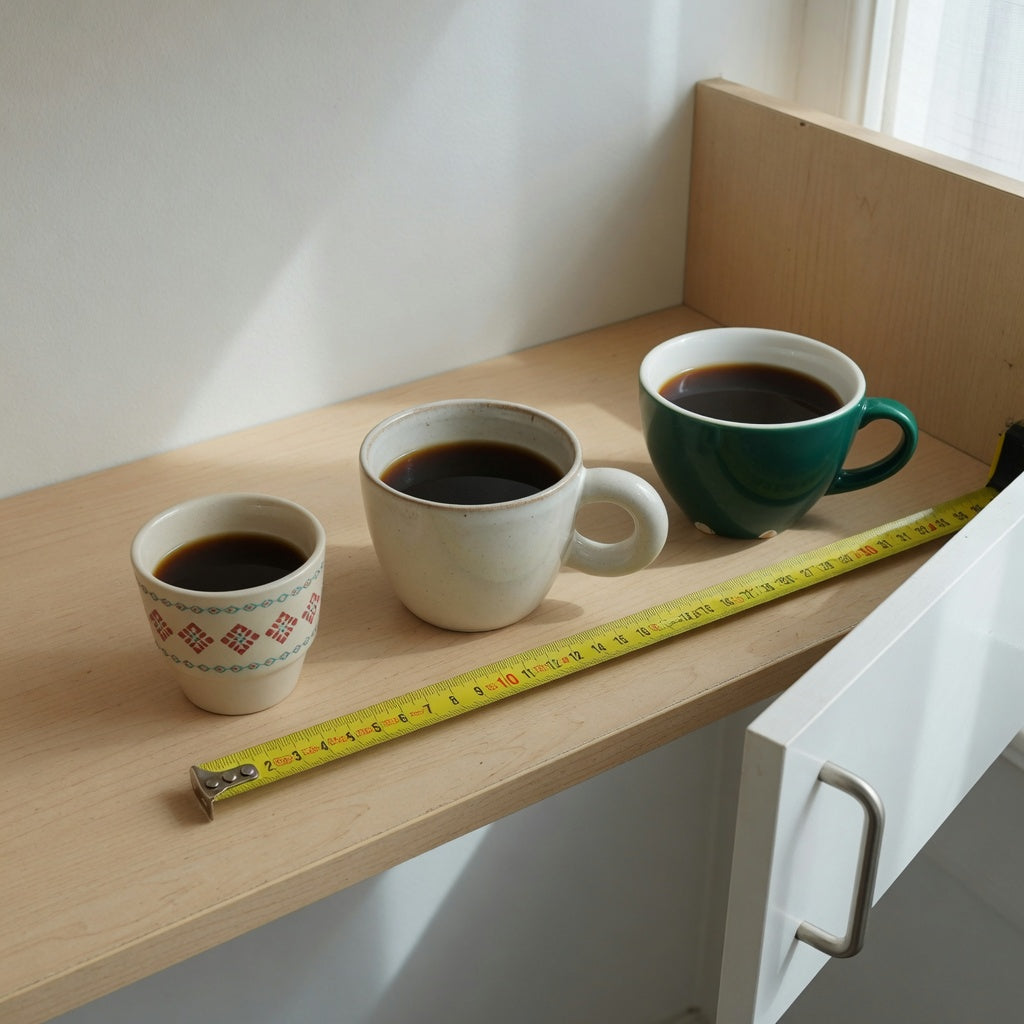
Piccolo Cup Storage Fit Guide: 170, 250 and 270 ml Compared
Compare the verified 170 ml, 250 ml and 270 ml capacities against handle projection, cabinet depth, door clearance and stacking plans. See where each current CoffeifyMug shape makes practical sense...
Read more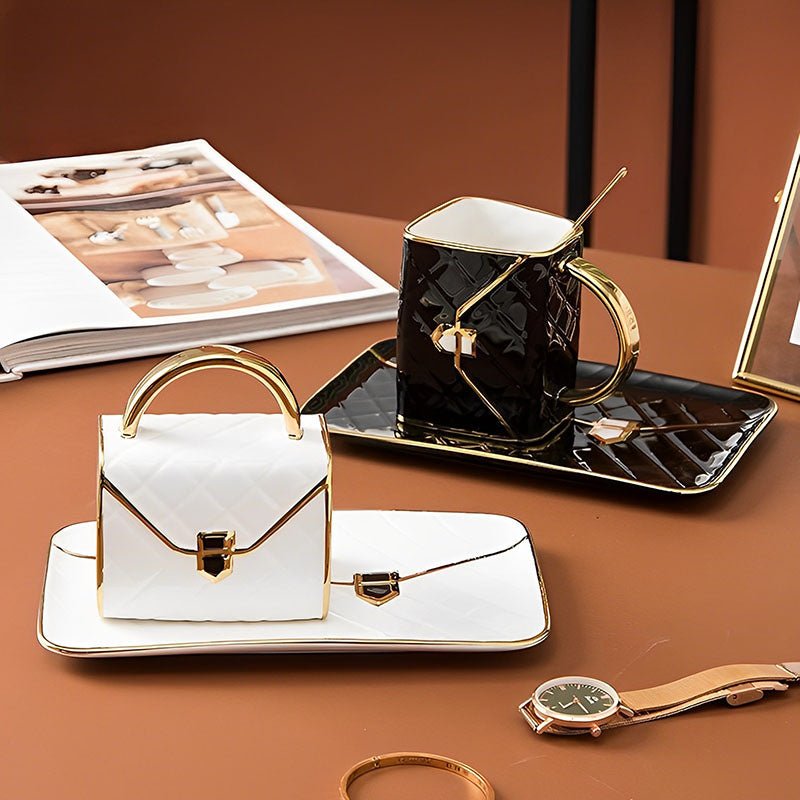
Unique Design Coffee Mugs Storage Fit Guide: Shelf Needs
Compare the visible Handbag, Rhombus, and Crane mug forms against real cabinet depth, shelf height, handle clearance, and storage habits. This guide separates product-page observations from general...
Read more
Leave a comment
This site is protected by hCaptcha and the hCaptcha Privacy Policy and Terms of Service apply.