
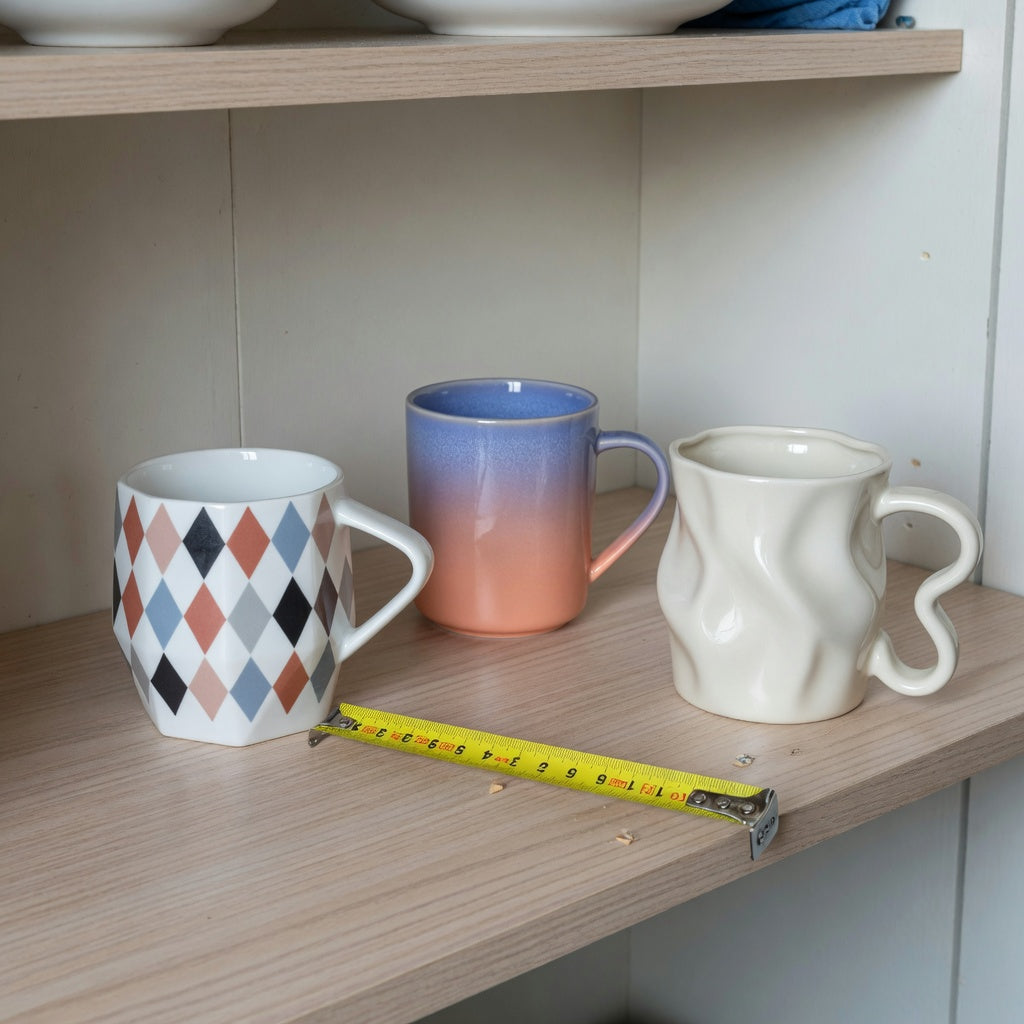
Abstract Coffee Mug Storage Fit Guide: Shapes and Shelf Space
Reading time: about 9 minutes
A cabinet can close neatly on a row of standard mugs and still catch the handle of a more sculptural shape. On an open shelf, the body may sit safely while the handle projects into the path of a hand or nearby appliance. This abstract coffee mug storage fit guide compares Rhombus, Gradient, and The Flow using only verified capacity and visible-form details, then gives you a practical way to check the shelf measurements that are not confirmed here.
In our store, we separate drink volume from exterior fit. Rhombus is listed at 250 ml with a geometric form, Gradient at 400 ml with a color-transition finish, and The Flow at 400 ml with sculptural curves. Those facts support a useful comparison, but they do not prove exact height, width, base size, handle projection, stackability, material, or dishwasher compatibility. We will not turn a capacity number or product photo into a made-up measurement.
How to use this abstract coffee mug storage fit guide before checkout
Start with the place where the mug will live. A successful fit requires room for the mug itself and a clear path for your hand to remove it without striking the shelf above, cabinet door, or neighboring drinkware.
- Serving volume: Decide whether 250 ml or 400 ml suits the coffee or tea you normally pour.
- Usable height: Measure from the shelf surface to the underside of the shelf above, including any front lip.
- Closed-door depth: Measure from the back panel to the nearest door, rail, or hinge obstruction.
- Total width: Account for the widest body point and the full handle projection, not just the rim.
- Retrieval space: Leave room for your fingers and for the slight upward movement needed to clear a shelf lip.
- Storage routine: Decide if the mug will sit alone, in a row, two deep, on a desk, or on a hanging system.
Use current external dimensions from the live product page if they are listed. If a key measurement is absent, ask before ordering rather than estimating from an image. Product photos show silhouette and finish, but they are not scale drawings. That restraint is central to this abstract coffee mug storage fit guide: verified product facts first, your measured space second.
Here, abstract is a shopper-facing style description covering geometry, color transition, and sculptural curves. It is not a claim about a named art movement, creator attribution, or design provenance.
Which current mug matches a compact shelf or display setup?
Rhombus: a 250 ml geometric option
Reader situation: you usually drink a smaller serving and want a clearly geometric profile. The Rhombus 250 ml geometric mug is the first model to investigate because it has the lowest verified capacity of these three. That makes it a serving-size match, not a guaranteed smaller exterior footprint.
Check the live listing for any current dimensions and compare the widest geometric point plus the handle against your shelf. Rhombus is not the right choice if you need a 400 ml pour, and its angular appearance should not be treated as proof that it stacks or slides between neighboring mugs like a straight cylinder.
Gradient: 400 ml with a color-transition finish
Reader situation: you want a 400 ml mug and the visible finish is a major part of the purchase. The Gradient 400 ml color-transition mug makes sense for an open coffee station or office shelf where that transition remains visible. A closed cabinet can still work after the exterior measurements and handle orientation have been checked.
The trade-off is storage density. A distinctive finish does not make a mug easier to pack into a crowded row, and the shared 400 ml capacity does not prove that Gradient occupies the same exterior space as The Flow.
The Flow: 400 ml with sculptural curves
Reader situation: you want a 400 ml serving and prioritize a sculptural silhouette. The The Flow 400 ml sculptural mug is the relevant next step for an open shelf, coffee nook, or desk where the curved form has room to be seen and lifted comfortably.
It is not a sensible blind purchase for a cabinet with almost no spare width or depth. Without a complete exterior measurement set, we cannot honestly rank The Flow as wider or narrower than Gradient. Confirm the widest point and handle clearance before choosing between them for a tight space.
| Product | Verified catalog fact | Main storage question |
|---|---|---|
| Rhombus | 250 ml, geometric form | Do its widest geometric point and handle clear the available space? |
| Gradient | 400 ml, color-transition finish | Can its body and handle fit in your preferred orientation? |
| The Flow | 400 ml, sculptural curves | Is there enough side and lift clearance around the curved outline? |
What cabinet measurements prevent handle and shelf conflicts?
Measure the usable interior rather than the cabinet's advertised exterior size. Our team uses the following sequence because it catches the obstructions shoppers most often overlook.
- Measure vertical clearance. Start at the shelf surface and stop at the lowest obstruction above. Add space for lifting; a mug that barely matches the static height may still be difficult to remove.
- Measure closed-door depth. Include an inset door panel, front rail, or hinge that reduces usable space. Test both handle-forward and handle-sideways orientations.
- Measure total width. The limiting point may be the handle rather than the body. Leave enough room to grip the handle without knocking the next mug.
- Check the retrieval path. A front shelf lip can block a straight pull. Confirm that the mug can move forward and upward while your fingers remain around the handle.
- Test the planned storage pattern. Two-deep storage requires access to the rear mug. For hanging storage, compare the support system's rated load with the mug's actual weight; liquid capacity is not product weight.
If a live product page supplies maximum dimensions, make a simple cardboard envelope using those measurements and place it on the shelf. A rectangular envelope is conservative for an irregular shape and quickly reveals door, hinge, and neighboring-mug conflicts. Do not use another 400 ml mug as an exact proxy because equal-capacity vessels can have different heights, widths, and handle layouts.
Open shelf, closed cabinet, office desk, or gift?
- Open shelf: Gradient and The Flow suit shoppers who want the finish or curves on view. The door constraint disappears, but dust, edge overhang, and accidental contact become more relevant.
- Closed cabinet: Rhombus is a logical first candidate for someone who also prefers a 250 ml serving. It is still necessary to check external size, handle direction, shelf lips, and door closure.
- Office desk: A single 400 ml mug may have more freedom than it would in a packed kitchen cabinet. Check the handle against keyboards, monitors, cables, and the edge of the desk rather than judging the empty desktop alone.
- Gift purchase: A striking unboxing does not solve a cabinet mismatch. Ask the recipient for usable shelf height and depth, or avoid promising that a specific abstract shape will fit an unknown storage setup.
What do stacking and dishwasher routines change about fit?
The verified catalog facts supplied for this comparison do not establish stackability, material, or dishwasher compatibility. Check the current product instructions before building either habit around a new mug.
- Stacking: Do not assume a geometric or sculptural mug nests securely. Stack only if the product guidance permits it and the mugs sit level without loading weight onto a rim, curve, or handle.
- Dishwasher placement: Use a dishwasher only when the care instructions allow it. During a cycle, separate handles and confirm that the spray arm clears the mug; repeated contact can mark or damage vulnerable edges.
- Finish care: A color-transition finish does not reveal which cleaners or scrubbers are suitable. Follow the listed care directions instead of testing an abrasive pad on a visible surface.
- Putting mugs away: Let the mug dry fully before closed-cabinet storage, lift it rather than dragging it across neighboring pieces, and keep handles from striking each other.
When is an abstract mug the wrong storage decision?
A more conventional profile will serve you better if storage density matters more than visible form. These current abstract options are poor candidates for an unmeasured space where every mug must behave exactly like a stackable, straight-sided cup.
- Your cabinet is already packed two or three mugs deep.
- You must stack every mug to reclaim vertical space.
- The door barely closes on your existing handles.
- You cannot confirm missing exterior dimensions before ordering.
- You need every piece to share one uniform footprint.
Choosing a simpler mug in those situations is a practical decision, not a compromise in taste. Rhombus, Gradient, and The Flow make more sense for shoppers who value their visible forms and can give them measured shelf or desk space.
Frequently asked questions
How do I measure cabinet space for an abstract coffee mug?
The abstract coffee mug storage fit guide starts with usable shelf height, closed-door depth, and total width including the handle. Then check the lift path above the rim and the finger space beside neighboring mugs. Measure interior obstructions rather than relying on the cabinet's outside dimensions.
Is Rhombus guaranteed to fit a smaller cabinet because it holds 250 ml?
No. Its 250 ml capacity is lower than the two verified 400 ml options, but capacity measures liquid volume rather than exterior size. Compare any current height, width, depth, and handle measurements on the Rhombus page with your actual shelf.
Do Gradient and The Flow need the same shelf space because both hold 400 ml?
Not necessarily. Gradient and The Flow share a verified 400 ml capacity, but their color-transition and sculptural presentations do not establish identical exterior dimensions. Check each model separately instead of treating one as a storage substitute for the other.
Can I stack these abstract mugs or wash them in a dishwasher?
Those capabilities are not confirmed by the catalog facts used for this guide. Follow the current product care instructions and do not assume stackability from photos. If dishwasher use is permitted, leave room between handles and verify spray-arm clearance.
Five checks to make before adding one to your shelf
- Choose the 250 ml or 400 ml capacity that matches your normal drink.
- Record any current external dimensions listed on the product page.
- Compare the widest body point and handle orientation with your shelf.
- Test door closure, shelf-lip clearance, and the path of your hand.
- Verify care and stacking guidance rather than assuming either.
Once those five answers are clear, compare the current shapes in our unique coffee mugs collection and choose the mug whose capacity, visible form, and measured storage space all agree. If one answer remains unknown and your cabinet is tight, get that measurement before checkout.
More from our blog
Read more
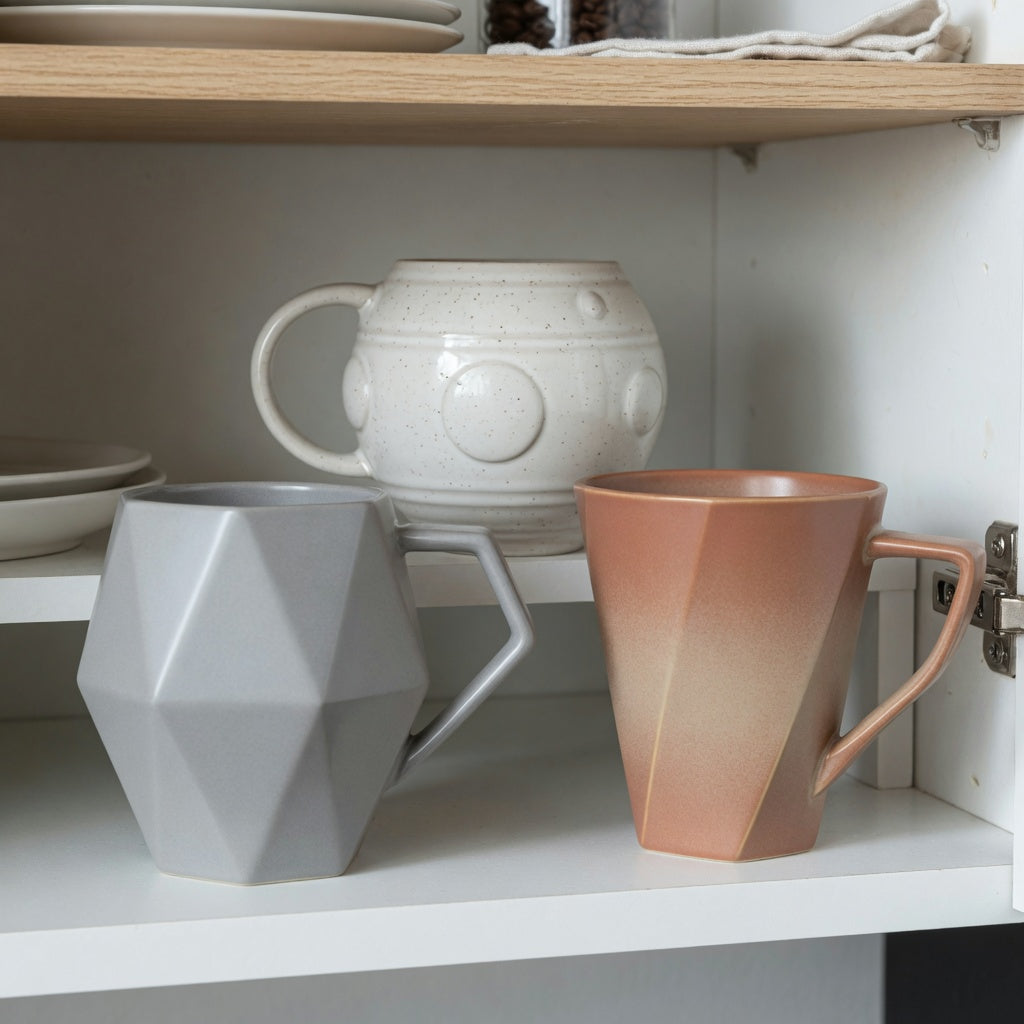
Geometric Coffee Mug Storage Fit Guide: Shelf Fit by Shape
Compare the Rhombus, Planet, and Gradient mug profiles using practical cabinet measurements, handle clearance, base support, capacity checks, and storage scenarios.
Read more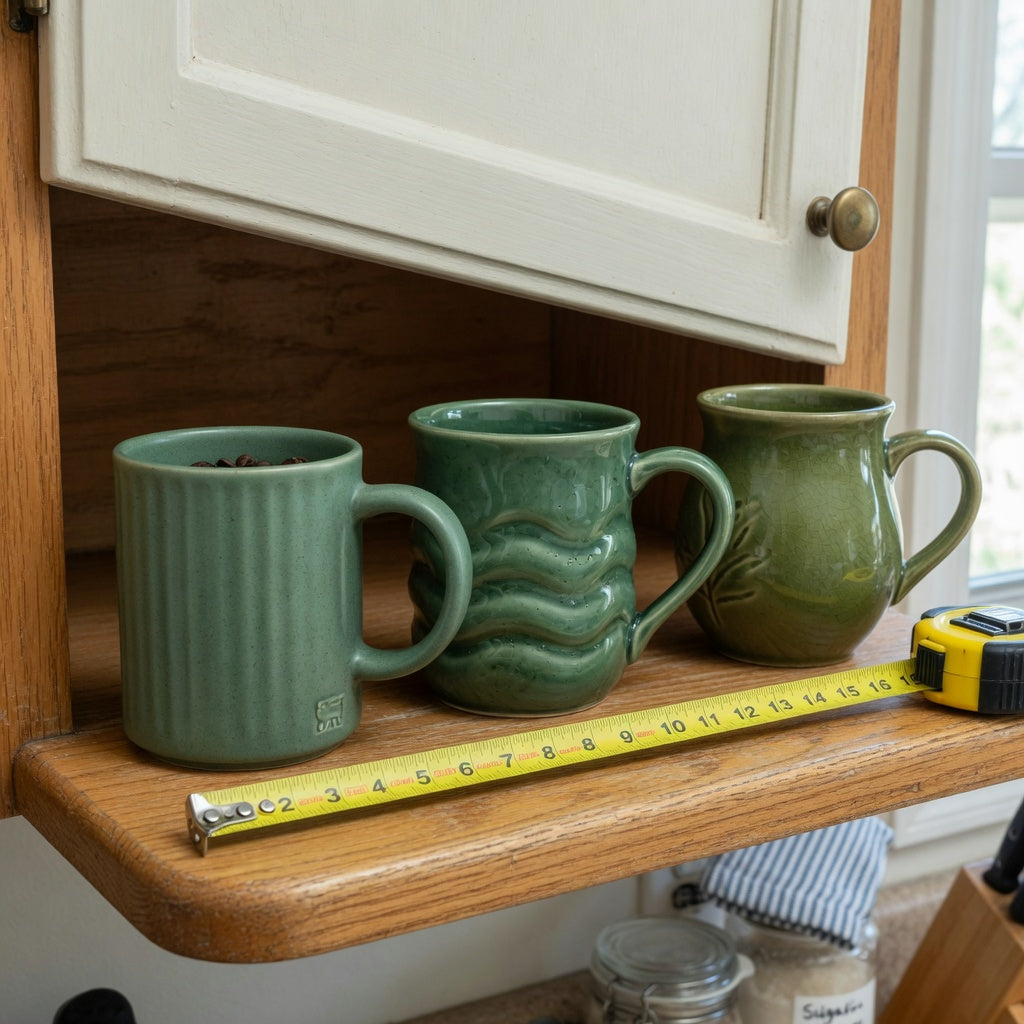
Green Ceramic Coffee Mugs Storage Fit Guide: Compare Shapes
Compare the visible shapes and handle needs of CoffeifyMug's Emerald, Green Waves, and Round ceramic mugs. Learn how to check cabinet depth, shelf height, side clearance, and stacking trade-offs wi...
Read more
Leave a comment
This site is protected by hCaptcha and the hCaptcha Privacy Policy and Terms of Service apply.