
Unique Espresso Cups Size Decision Guide: 170, 200 or 250 ml
Reading time: about 10 minutes
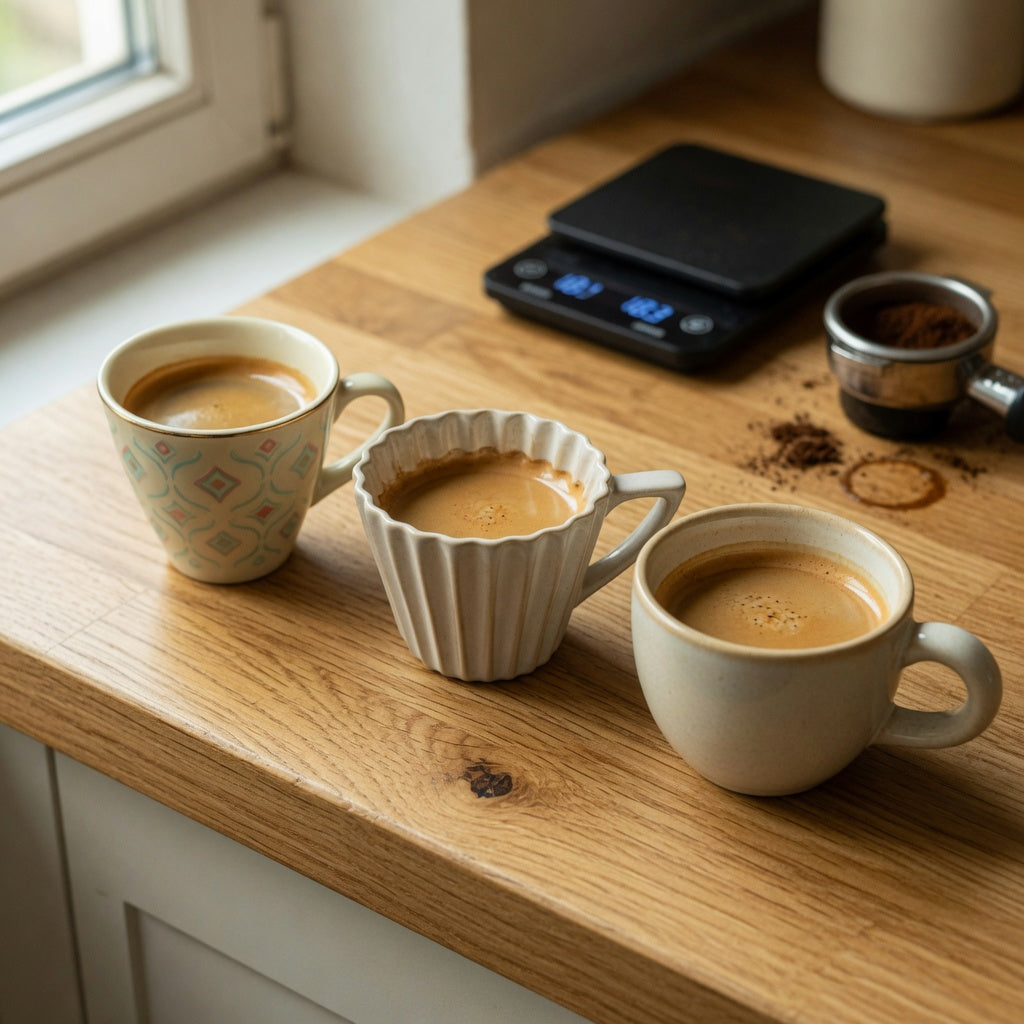
Three cups sit on the counter beside our test machine: the 170 ml Retro, the 200 ml Pleated, and the 250 ml Ball Handle. Same double shot poured into each. In the first cup the shot looks deliberate. In the last it looks like a mistake. Nothing changed but capacity — and that is the decision most shoppers are actually making when they search for a unique espresso cups size decision guide.
So here is the practical version. Which listed capacity fits the way you really pour, where each size stops being the right tool, and what to check on the listing before you add to cart.
Unique espresso cups size decision guide: separate the shot from the cup
Sizing goes sideways because two different numbers get blended together: how much you pour, and how much the cup holds.
Published espresso references put a certified Italian espresso at roughly 25 ml, while the older specialty definition ran about 25–35 ml. The cup it is served in is bigger — commonly cited demitasse capacities sit around 50–100 ml, with many guides settling near 60 ml. That gap is headspace: the empty room that lets you smell the shot and watch the crema settle.
Our three cups are listed at 170 ml, 200 ml and 250 ml. Those are not demitasse volumes, and we will not pretend otherwise. They are compact ceramic vessels sized around a double shot or a short cortado-style pour, with visible glaze and room above the liquid. If what you want is the classic two-sip demitasse, buy a 60 ml cup — ours is the wrong tool for that job. If you want one cup that takes a double shot, a modest milk top-up, and still earns its place on the shelf, this is the range to shop in.
What 170, 200 and 250 ml look like with a shot in them
The spread between the smallest and largest cup here is 80 ml — roughly three shots of extra room. That is the real difference, and it shows up the moment you pour.
| Cup | Listed capacity | Pour it suits | What you give up |
|---|---|---|---|
| Retro Coffee & Tea Cup | 170 ml | A double shot with a short milk pour — the closest to a demitasse feel in our range | Little room left if you like a milkier drink |
| Pleated Coffee & Tea Cup | 200 ml | A double shot with clear headroom — the flexible middle | Less of a statement on the shelf than the other two |
| Ball-Handled Coffee & Tea Mug | 250 ml | A double shot plus a generous milk pour; coffee and tea from one cup | A single shot on its own will look sparse in it |
All three share the same brief: compact ceramic, a visible finish, no lid, built to be drunk from at a table or desk rather than carried through a commute. You can see them side by side in our unique coffee mugs collection.
When the smaller 170 ml option is the practical pick
The Retro Coffee & Tea Cup is our smallest listed capacity, and it is the one we hand to shoppers who describe their routine as "espresso, sometimes with a little milk." It is the right call when:
- Your regular pour is a double shot with at most a splash of milk.
- You want the liquid to occupy a visible share of the cup instead of sitting in the bottom third.
- Counter or shelf space is tight and you want cups that sit close together.
- It is a gift for someone who drinks shots, not lattes.
Where it stops working: if your usual drink is a full latte or an iced coffee, 170 ml means refilling every few minutes, and you will resent it by day three. That is not a defect. It is the wrong capacity for that habit, and no amount of nice glaze fixes it.
When the 250 ml cup earns its counter space
The Ball-Handled Coffee & Tea Mug is the size to buy when:
- You pull a double shot and then top it with a real pour of steamed milk.
- One cup has to cover coffee in the morning and tea in the afternoon.
- You keep a cup at a desk where a refill trip costs you ten minutes.
- Guests use your cups and you would rather not explain which mug is which.
The honest trade-off: a straight single shot in a 250 ml cup looks lonely. If that bothers you — and for plenty of people it does — size down. And if 250 ml reads as small next to what you actually drink, this is the wrong range entirely; you want a full-size mug, and our full ceramic mug selection is the better place to browse.
Who the 200 ml Pleated is actually for
Most shoppers do not pour the same drink every day. They pull a double shot on weekdays and add milk on the weekend, or they swap between espresso and a small cortado depending on the hour. The Pleated Coffee & Tea Cup at 200 ml is the one we recommend for that pattern: enough headroom that a milk-topped drink does not slosh over, tight enough that a plain double shot does not look drowned.
Its limitation is aesthetic rather than functional. The pleated profile is quieter than the Retro's shape and lighter than the Ball Handle, so if you are buying one statement piece for open shelving, it will not be the cup guests pick up first.
Rim, wall and interior color: details that decide daily use
Capacity gets you to the right shortlist. These details decide whether the cup becomes the one you reach for.
- Wall thickness. Thick ceramic holds heat well once warm, but it also pulls heat out of a small shot on first contact. A ten-second hot-water rinse before you pull the shot fixes that.
- Interior color. A light interior makes crema easy to read. Dark glazes and metallic lusters look striking and hide it completely.
- Rim shape. A thin, level rim drinks cleanly. Heavy rounded rims feel softer on the lip. An irregular handmade rim can dribble if the lip is not level all the way around.
- Handle or no handle. Handleless cups stack tighter and look cleaner, but they pass heat straight to your fingers. A handle keeps fingertips off the wall.
- Foot diameter. A wide base can overhang a small drip tray; a narrow foot can wobble on a saucer.
Are handmade or brightly glazed espresso cups safe for hot coffee?
This is the question buyers ask us late at night, after they have already ordered something with a reactive glaze. The FDA is direct about it: lead in ceramic glazes and decorative decals can leach into food and drink when pottery is not properly fired, and washing or boiling cannot remove lead from pottery. The agency also notes that some traditional pottery labelled lead free has still shown extractable lead at or above FDA action levels.
For cups and mugs specifically, the FDA's chemical contaminant listing sets an action level of 0.5 µg/ml in the leaching solution under CPG 545.450. Separately, 21 CFR 109.16 requires ceramicware intended as ornamental to carry a conspicuous "Not for Food Use" label — or a hole through the food-contact surface — if it could otherwise be mistaken for usable dinnerware.
The FDA flags higher-risk pieces as handmade ware with a crude or irregular look, antiques, damaged or worn ware, flea-market finds from unknown makers, and items brightly decorated in orange, red or yellow. The practical move takes five seconds: turn the cup over. If the base reads "Not for Food Use," or the maker cannot tell you anything about the glaze, do not drink from it, however good the photo looked. If you are buying from us and want to know what is printed on the base of a specific piece before it ships, ask and we will check the actual item in stock rather than guess.
Dishwasher, microwave and stacking checks before you commit
- Look for an explicit dishwasher and microwave statement on the product page. If it is not there, hand wash.
- Skip the microwave for anything with metallic decoration — gold rims, lusters, decals.
- Think through stacking: stackable cups need a flat rim and a handle that nests. One-off pottery and double-wall glass usually do not stack at all.
- Check the foot ring. Deep unglazed feet trap water, which leaves rings on the shelf and smells if you store cups upside down while damp.
- Plan where it lives. A cup stored in a cupboard you cannot reach becomes decoration within a month.
We would rather tell you a cup needs hand washing than have you find out on cycle two — so where a care line is missing on a listing, treat the piece as hand wash only.
A two-minute checklist before you add to cart
- Name your biggest regular pour, in millilitres. Double shot? Shot plus milk? Tea?
- Match the capacity: 170 ml for espresso-forward, 200 ml for a flexible middle, 250 ml for milk and tea crossover.
- Measure clearance from drip tray to portafilter spout, then compare it with the cup height on the page.
- Read the care line and check what is printed on the base.
- Remember that oversized is more forgiving than undersized. Extra headspace does not ruin a drink; overflow does.
Frequently asked questions
Is 170 ml too big for a single espresso?
Yes, if you are pouring a roughly 25 ml shot. A 170 ml cup is far larger than a traditional demitasse, and the shot will occupy a small fraction of it. It is sized for a double shot with a short milk pour. If you only ever drink single shots, a 50–100 ml demitasse is the more honest match.
Can I use a unique espresso cup for tea as well?
Yes — capacity is capacity, and a 200 ml or 250 ml cup pours a normal tea without drama. Buy for your biggest regular pour and the tea will take care of itself. Just expect a cup used for both to pick up tannin staining over time if the interior is unglazed or crazed.
Do thick ceramic espresso cups need preheating?
Thick walls hold heat well once they are warm, but they pull heat out of a small shot on first contact. Rinse the cup with hot water, or park it on the machine's warming tray for a minute, before you pull the shot. Thin-walled glass warms faster and cools faster; ceramic evens out.
Will these cups fit under my espresso machine?
This is the part of the unique espresso cups size decision guide we cannot answer remotely. Measure from the drip tray to the portafilter spout, then compare that number with the cup height on the listing — group-head clearance varies a lot between machines. If the gap is tight, a shorter, wider cup usually clears better than a tall one.
Are these cups dishwasher and microwave safe?
Check the care line on the specific product page before you buy, because the decoration drives the answer — metallic rims, lusters and hand-painted details are the first things to suffer in a dishwasher. Where a listing does not state it, treat the cup as hand wash only.
Which cup to add to your cart first
Start with the pour you make most mornings. Espresso-forward, and you want the shot to look intentional? Take the 170 ml Retro. Double shot today, splash of milk tomorrow, one set for both? The 200 ml Pleated is the middle ground. Milk drinks and tea from the same cup? The 250 ml Ball Handle will not leave you refilling.
You can compare all three capacities in one place, check the height against your machine, read the care line, and pick the size that matches your biggest regular pour — not the prettiest photo.
More from our blog
Read more

Big Latte Mug Storage Fit Guide: 400, 440 and 480 ml
We compare our three current big latte mugs by listed capacity — 400 ml, 440 ml and 480 ml — then walk through the clearances that actually decide shelf fit: headroom, cabinet depth, handle project...
Read more
Unique Espresso Cups Storage Fit Guide: Shapes and Shelf Needs
Handle projection, base diameter, and listed capacity decide whether a distinctive cup actually fits your shelf and your machine. Here is how to measure before you buy.
Read more
Leave a comment
This site is protected by hCaptcha and the hCaptcha Privacy Policy and Terms of Service apply.