
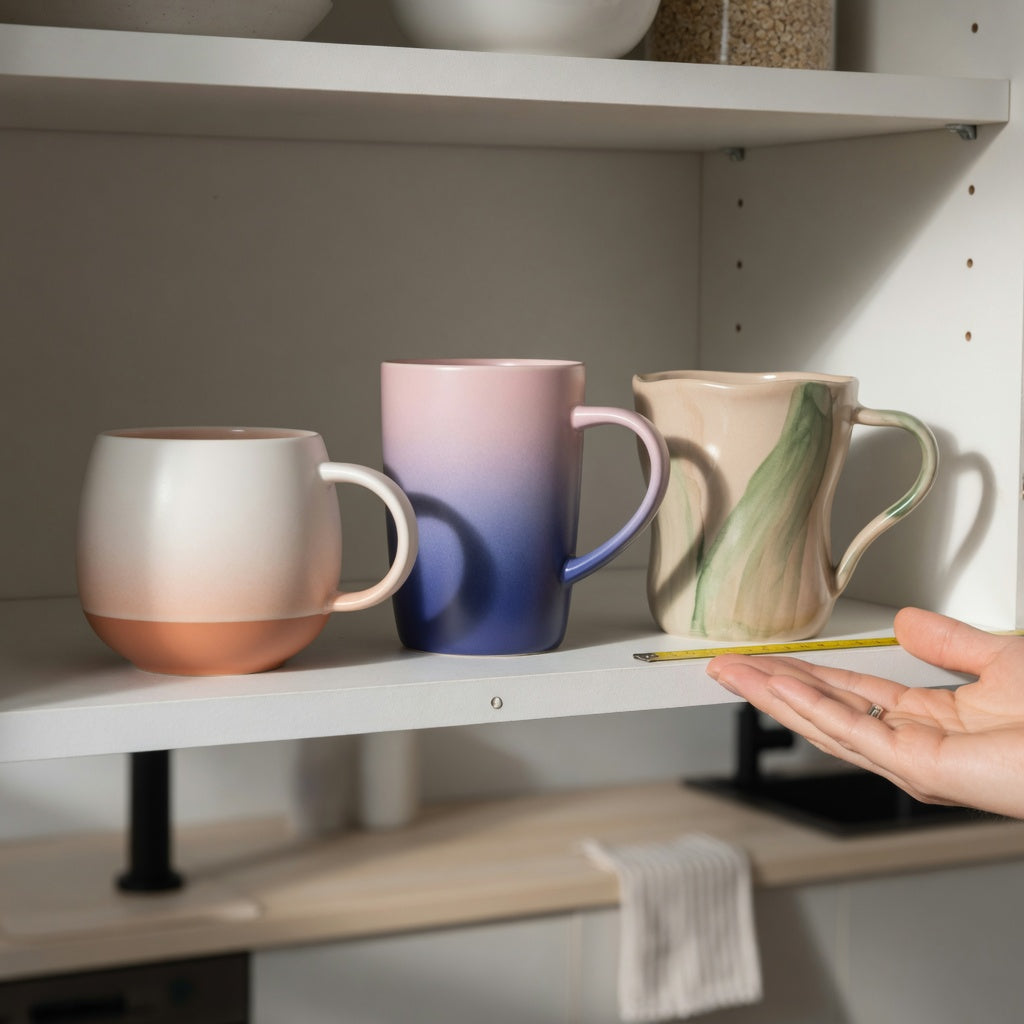
Black tea mug storage fit guide: Compare 3 current shapes
Reading time: about 9 minutes
A mug can sit fully on a cabinet shelf and still stop the door from closing because the handle, not the body, is the outermost point. This black tea mug storage fit guide compares the three current tea-friendly options in our store: Round at 390 ml, Gradient at 400 ml, and The Flow at 400 ml.
We sell and handle this category, so we look beyond the number printed beside capacity. Shelf height, usable cabinet depth, handle projection, neighboring mugs, and the space your hand needs for retrieval all affect everyday fit. We will also be direct about the limit of this comparison: verified exterior height, width, and diameter measurements are not available for these three listings, so capacity cannot be turned into a guaranteed cabinet fit.
Black tea mug storage fit guide: what should you measure first?
The useful measurement is the mug's full storage envelope. That means the space occupied by the body and handle together, plus enough working clearance to lift the mug without knocking the shelf above or the mug beside it.
- Usable shelf height: Measure from the shelf surface to the underside of the shelf above. Do not use the cabinet's total interior height if another shelf divides the space.
- Closed-door depth: Measure from the back wall to the inside face of the closed door. A mug can remain behind the shelf edge and still meet the door.
- Free row width: Include side panels, hinge hardware, glasses, and any plates that share the shelf. The widest point may be the handle rather than the body.
- Retrieval clearance: Leave room for fingers to enter the handle or grip the body. A mug that fits only after being rotated and pushed tightly into place is not a practical daily fit.
Keep those four checks beside the current unique coffee mugs collection as you compare silhouettes. Product images help you identify a rounded body, taper, or extended handle curve, but they are not a reliable scale drawing. Browser zoom, cropping, and image framing can all change apparent size.
Does 390 ml versus 400 ml tell you which mug is smaller?
No. Capacity describes internal liquid volume, not the exterior envelope that occupies a shelf. Round holds 390 ml, while Gradient and The Flow each hold 400 ml. That is a difference of 10 ml, but body geometry, wall construction, base shape, and handle projection can affect outside size independently of capacity.
Use the listed volume to decide how much black tea you want in one serving. Use the visible form and verified exterior dimensions, where supplied, to make a storage decision. For these current listings, the dimensions needed for an exact ranking are not published, so we do not label one model as definitively shortest, narrowest, or smallest overall.
| Current mug | Listed capacity | Visible form to inspect | Main storage check | Claim limit |
|---|---|---|---|---|
| Round | 390 ml | Upright, rounded profile with a conventional-looking handle outline | Find the outermost point of the handle curve | Lower capacity does not prove the smallest exterior size |
| Gradient | 400 ml | A visibly changing body profile rather than a purely straight outline | Check the widest point, not only the base | The product name and capacity do not supply dimensions |
| The Flow | 400 ml | A more sculptural-looking relationship between body and handle | Trace the full side outline where the handle reaches outward | Handle projection is not numerically listed |
Round 390 ml: is it the first shape to check for a tight row?
The Round coffee tea mug is the logical first comparison for a crowded cabinet because it has the lowest listed capacity of the three and a regular, rounded-looking profile in the current imagery. That makes it easier to compare visually with a conventional mug you already own.
This is a starting point, not a size guarantee. If your existing mug clears the cabinet door by only a narrow margin, the 390 ml listing is not enough evidence that Round will fit. It is best suited to shoppers who prefer the Round design and have some spare clearance around their current mugs. It is not a dependable choice for a cabinet with a hard maximum width or height unless exterior measurements are confirmed before purchase.
Gradient 400 ml: where can its profile affect shelf spacing?
The Gradient coffee tea mug is listed at 400 ml. Its visible profile changes across the body, so a base-only comparison can miss the point that determines shelf clearance. Look at the full outline from base to rim and then follow the handle to its outer edge.
Gradient makes practical sense for a standard cabinet, counter, or open shelf where you have visible spare space and want the 400 ml capacity. On an open shelf, the cabinet-door question disappears, although side clearance and retrieval space still matter. It is less suitable for a tightly packed, uniform row if every mug needs to align to the same straight body outline.
The Flow 400 ml: how should you judge handle clearance?
The Flow coffee tea mug also carries a 400 ml listing. Its body-to-handle line appears more design-led in the current product imagery, which makes the full side silhouette the critical storage variable. Do not judge it by the base alone or assume that sharing Gradient's capacity means sharing its exterior footprint.
The Flow is a sensible option for an office desk, open counter, or shelf with lateral breathing room, where its visible design can be appreciated without packing mugs tightly together. It is not the cautious choice for a narrow desk cubby or a closed cabinet that already catches the handles of your existing mugs. Without a published handle-projection measurement, we cannot promise clearance in those hard-limit spaces.
Closed cabinet, open shelf, or office desk: which shape fits the situation?
Storage location changes which trade-off matters most. We map the common situations this way:
- Crowded closed cabinet: Start with Round because its 390 ml capacity and regular-looking outline make it the most straightforward comparison. Choose it only after checking the door path, shelf height, and outer handle edge.
- Open kitchen shelf: Gradient is a useful 400 ml option when you have room around the widest visible part of the profile. The missing door removes one collision point, but the mug still needs a stable footprint and an unobstructed lift path.
- Office desk or open counter: The Flow suits a surface where the handle is not trapped between a wall, monitor stand, or neighboring cup. Its design matters more here because dense cabinet packing is not the main goal.
- Matching row of several mugs: Buy the same shape rather than mixing all three. Repeated bodies and handles create a more predictable row, while mixed silhouettes require different gaps and orientations.
- Gift for someone whose kitchen you have not seen: Treat storage fit as unknown. A lower listed capacity may feel less imposing, but it still does not verify exterior size. The broader collection is the better next step if the recipient prefers another visible silhouette.
None of the verified catalog facts supplied for this comparison establish stackability. We would not recommend Round, Gradient, or The Flow to a shopper whose storage plan depends on nesting one mug securely inside another. A purpose-designed stackable cup or handle-free style would be a better category for that requirement.
How do cabinet contact and dishwasher loading change the fit decision?
A shelf layout has to work while the mug is moving, not only while it is standing still. In our experience, three trouble spots show up quickly: a handle touching the cabinet door, a rim meeting the shelf above during lifting, and neighboring mugs striking each other as one is removed. Repeated hard contact can damage a mug even if the static arrangement technically fits.
Dishwasher geometry is a separate check. A mug that fits comfortably in a cabinet may still have a handle that meets a rack tine or nearby item. Read the current product care instructions before machine washing, then consider how the full handle outline sits in your usual rack. This guide does not infer a dishwasher-safe claim from product appearance.
A five-minute shelf test before placing an order
- Take the best-fitting mug you already own and measure its total width with the handle included, its overall height, and its maximum body depth.
- Place that mug in the intended spot and close the door normally. Check for contact at the handle, rim, hinge area, and door face.
- Lift it out as you would during a busy morning. Notice whether your fingers need extra room above, beside, or inside the handle.
- Compare that known mug with the current product images, paying attention to the widest body point and complete handle outline. Do not calculate dimensions from image pixels because the images may use different scales.
- If your shelf has generous clearance, choose by capacity and visible design. If the space has a strict maximum measurement, do not guess from 390 ml or 400 ml alone.
This process is especially useful for rental kitchens, compact office cupboards, and cabinets shared with plates or glassware. It turns an abstract shape comparison into a reference based on an object that already fits your exact space.
Frequently asked questions
What does this black tea mug storage fit guide compare?
It compares the listed capacities and visible forms of Round 390 ml, Gradient 400 ml, and The Flow 400 ml. It also explains how body shape, handle projection, shelf height, cabinet depth, and retrieval clearance affect everyday storage. It does not invent exterior measurements that are not published.
Is the Round 390 ml mug definitely smaller outside than the 400 ml mugs?
No. Round has the lowest listed liquid capacity, but capacity does not prove exterior height, width, or handle reach. Treat it as the first shape to compare for a tight row, not as a guaranteed smallest option.
Which black tea mug is best for a shallow cabinet?
No model can be guaranteed for a shallow cabinet without verified exterior depth and handle-projection measurements. Round is the most straightforward first comparison because of its regular-looking profile, but you still need clearance for the full handle and the closed door.
Can Round, Gradient, and The Flow be stacked to save space?
The verified facts used for this article do not establish that any of the three is designed for stacking. Do not buy them on the assumption that they will nest securely. Choose a purpose-designed stackable or handle-free style if vertical compression is essential.
Do Gradient and The Flow need the same shelf space because both hold 400 ml?
Not necessarily. Equal liquid capacity does not require equal exterior geometry, and the two mugs have visibly different body-and-handle outlines. Without published exterior dimensions, neither should be treated as an exact dimensional substitute for the other.
Your next step is simple: measure a mug that already fits, include its handle in the total width, test the cabinet door, and decide whether your shelf has generous clearance or a hard limit. Then revisit our current unique mug shapes and choose by verified capacity and visible form rather than capacity alone.
More from our blog
Read more
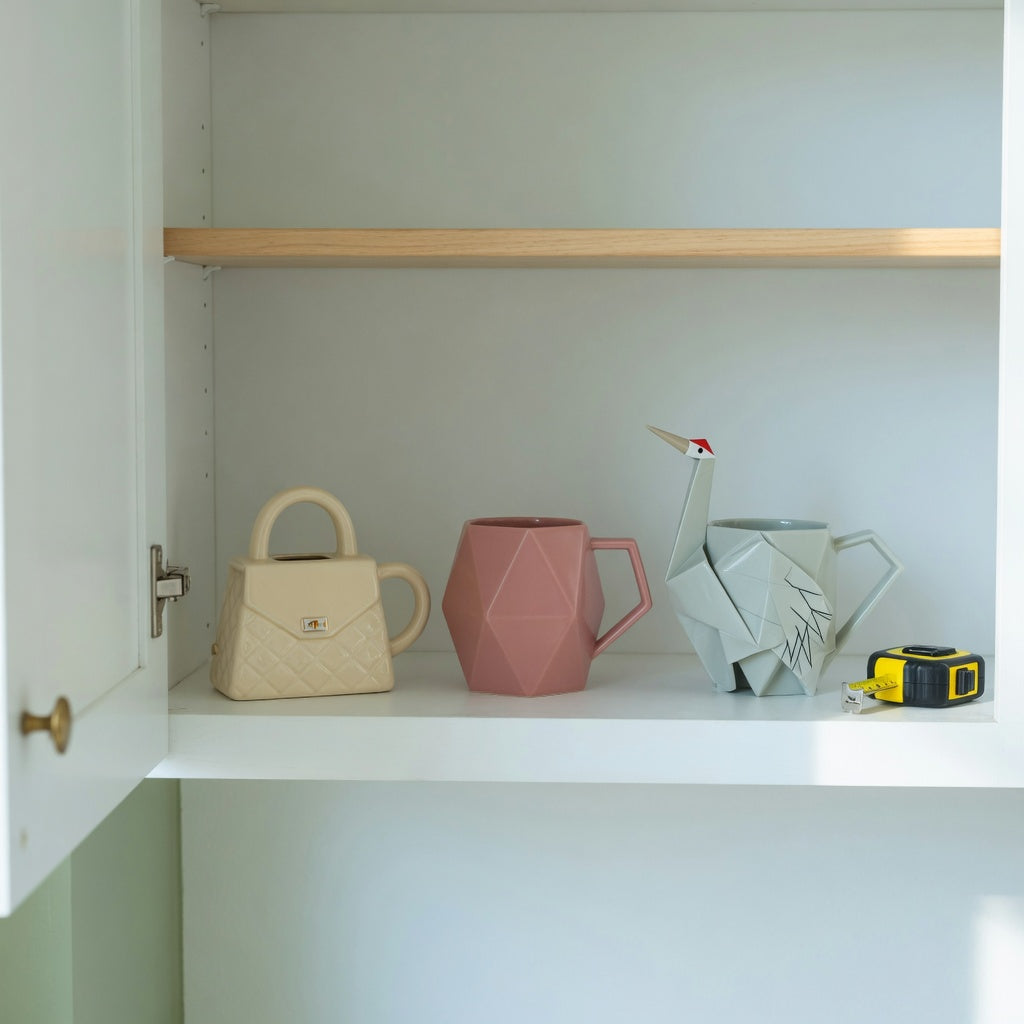
Unique Coffee Mugs for Gifts Storage Fit Guide: Shelf Check
Compare the visible storage demands of the Handbag, Rhombus, and Crane mug shapes. This guide explains how to check shelf height, cabinet depth, handle projection, care needs, and realistic gift fi...
Read more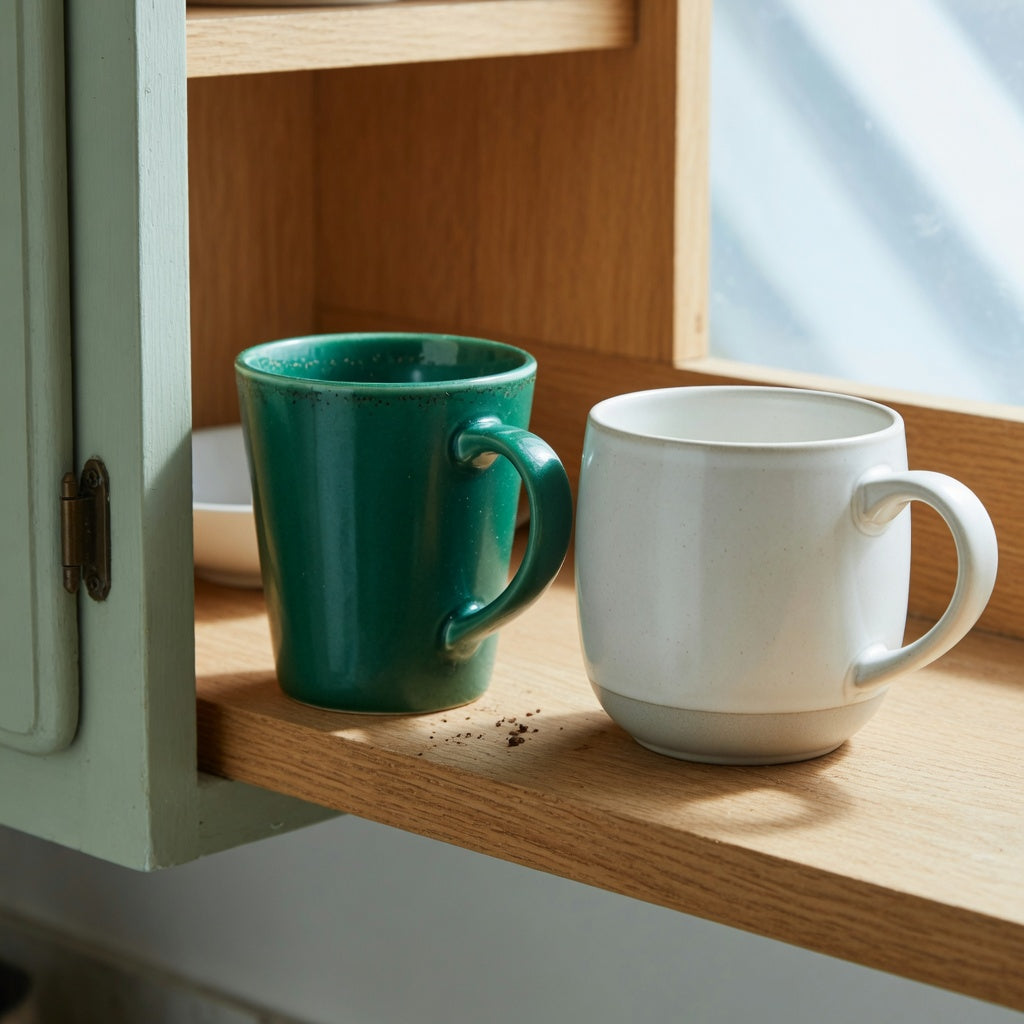
Emerald Green Coffee Mug Storage Fit Guide: Shapes and Shelf Space
Compare the Emerald Coffee Tea Mug and Round Coffee Tea Mug by visible body form, handle footprint, listed capacity, and realistic cabinet or open-shelf needs. Includes a practical measuring checkl...
Read more
Leave a comment
This site is protected by hCaptcha and the hCaptcha Privacy Policy and Terms of Service apply.