
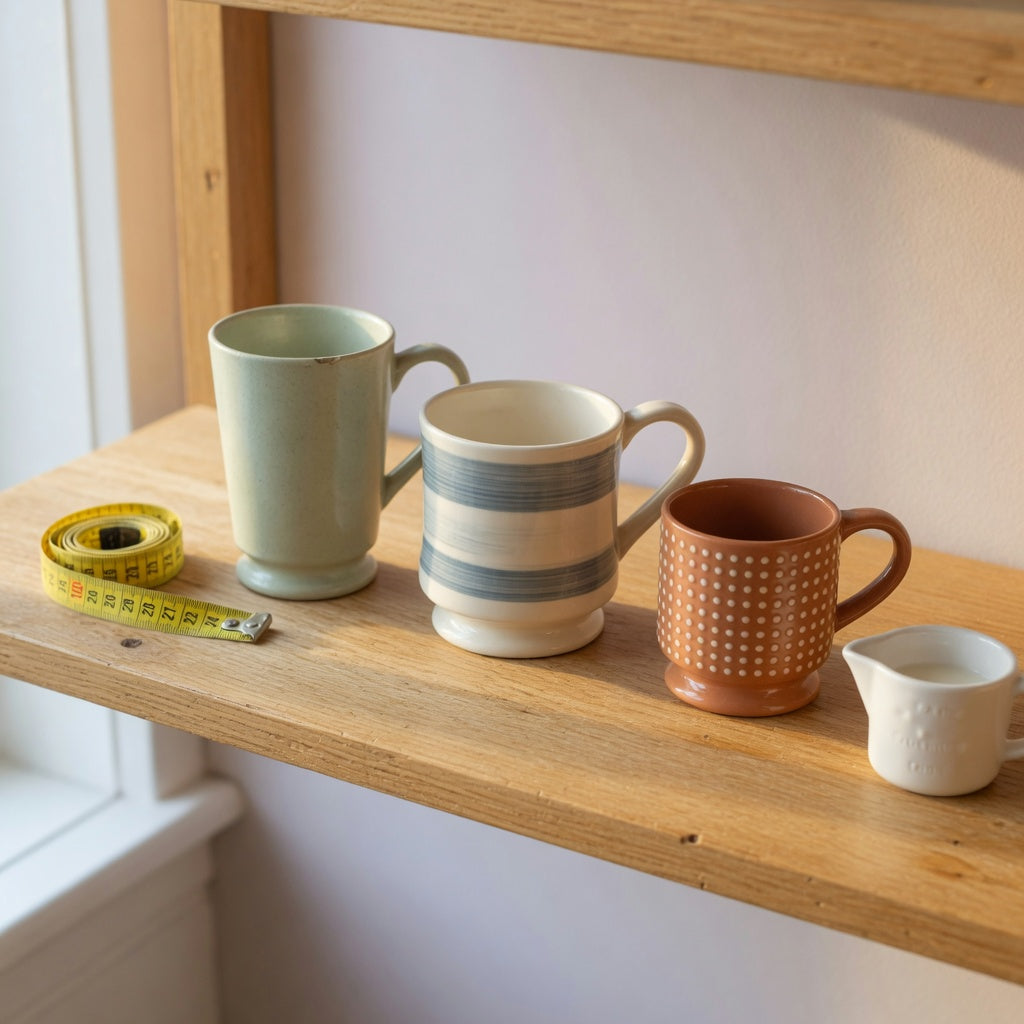
14 Oz Ceramic Coffee Mugs Storage Fit Guide: Shape vs Shelf
Reading time: about 10 minutes
Your cabinet is 30 cm deep, the mug says 14 oz, and the door still will not shut. The number printed in bold was capacity. The number that failed was handle projection. This 14 oz ceramic coffee mugs storage fit guide works through the measurements that actually decide whether a mug earns shelf space — stated millilitres, exterior height, handle depth, stack behaviour — and shows where the three shapes in our unique coffee mugs collection land against them.
Start with one conversion. NIST lists the U.S. fluid ounce as 29.57353 ml, so 14 U.S. fl oz is roughly 414 ml. Hold onto that number. It is more useful than any product photo, and it is the figure most listings quietly round.
What does 14 oz mean once headroom and FDA mug sizing are factored in?
FDA's ceramicware guidance describes cups and mugs as small hollowware normally used for coffee or tea, “normally but not exclusively about 240 mL (8 fl oz),” and usually made with a handle. A 14 oz mug is close to double that example. It still sits far below the 1.1 litre line that separates small hollowware from large hollowware for leach testing — so by the agency's classification it is a small mug, even when it dominates a shelf.
That gap between 8 fl oz and 414 ml has a storage consequence. Cabinet depth, dishwasher basket spacing, and single-serve brewer clearance are all sized around smaller cups. Going bigger is fine. It just means you measure instead of assume.
Then separate brim capacity from drinking capacity. Fill a mug you already own to the rim with water, pour it into a measuring jug, then refill only to the level you would actually carry across a room. The difference is your headroom. If a listing says 14 oz and your comfortable pour is 11, that mug is not a 14 oz drinking vessel for you — it is an 11 oz vessel with a tall wall. Our team measures this on the counter with a jug rather than trusting an angle shot, and it settles more decisions than any spec sheet.
There is a trade-off in sizing up. A wide 14 oz body holding a 6 oz pour has a lot of exposed ceramic surface and a lot of air above the coffee, so the drink cools faster than it would in a smaller cup. Bigger is not automatically better for a short black coffee.
Which measurement breaks shelf fit first: height, diameter, or handle projection?
Handle projection, almost every time. Height decides whether the mug clears the shelf above. Diameter decides how many fit side by side. The handle decides whether the cabinet door shuts and whether you can pull the mug out without knocking its neighbour over.
In our store, the fit question we hear most often starts with the handle, not the capacity. Measure it properly: lay the mug on its side and run a tape from the flat outside wall to the outermost point of the handle. That is the true depth the mug needs, and it is usually the number nobody publishes. Handle opening matters too. A generous opening lets your knuckles clear a hot wall when the mug is full — a comfort issue that becomes a safety issue with 400 g of hot liquid inside.
Weight belongs in the same conversation. A full 400 ml mug carries roughly 400 g of liquid before you count the ceramic. That is a one-handed lift for most people, but the empty weight of the mug is the variable you cannot see in a photo, and it decides whether a full mug feels stable or top-heavy.
Where do our three current shapes land in this 14 oz ceramic coffee mugs storage fit guide?
Capacity is the one specification we can state plainly from our own catalogue. Height, handle opening, and foot diameter belong to the individual piece, so read those off the current product page rather than inferring them from a photo.
| Mug | Stated capacity | Position against a 14 oz search | Confirm on the listing |
|---|---|---|---|
| The Flow | 400 ml (~13.5 fl oz) | Nearest to 414 ml, just under | Exterior height, handle projection, foot diameter |
| Morning and Night | 440 ml (~14.9 fl oz) | Just over 14 oz | Shelf clearance for the taller body, handle opening |
| The Rock | 480 ml (~16.2 fl oz) | A full step above 14 oz | Height and diameter before assuming it shares a shelf |
Match the shape to the situation you are actually in:
- You searched for 14 oz and want headroom. The Flow at 400 ml (~13.5 fl oz) lands just under the 414 ml mark, so by capacity alone it leaves the most headroom of the three. Check its handle projection first if your cabinet is shallow.
- You drink lattes, flat whites, or a 12 oz drip with milk. Morning and Night at 440 ml (~14.9 fl oz) sits just above 14 oz, so a mixed drink lands below the rim instead of at it. Confirm the exterior height against your shelf, since extra volume has to go somewhere.
- You want iced coffee with ice, or you are replacing a 16 oz travel mug. The Rock at 480 ml (~16.2 fl oz) is the biggest of the three. Ice displaces liquid, so the extra capacity earns its keep — but that body is the one most likely to foul a low shelf or a brewer head.
Will it clear the cabinet, the brewer, and the car cup holder?
Three clearances, three separate failures.
- Shelf height. Measure the clear opening between shelves, not the shelf spacing on the spec sheet. Subtract the mug's exterior height, then subtract again for the finger room you need to lift it out from above. A mug that fits with two millimetres to spare is a mug you will pull out by the handle every morning.
- Single-serve brewer clearance. Taller mugs foul the dispenser head or force you to remove the drip tray. If the mug goes under a machine daily, test that before you commit shelf space.
- Cup holder. Handled mugs generally do not sit in car cup holders; tapered bodies sometimes do. A 480 ml ceramic mug with a handle is a desk and kitchen mug, not a commute mug — and that is a legitimate reason to own it anyway.
If sealed, spill-proof travel is the requirement, a handled ceramic body is usually the wrong starting point. Check the individual listing for a lid and for any travel claim before you buy. Our 12 oz ceramic coffee mugs storage fit guide runs the same shelf logic on the smaller format, which is often the better call for a straight black coffee you finish in ten minutes.
Does stacking a taller mug actually buy you shelf space?
Sometimes, but it is not free. Stacking works best when the mug has a foot ring that seats inside the rim of the one below, and even then the glaze on the lower mug takes the wear. Unglazed or roughly finished foot rings can leave dull scuff marks on the glaze beneath them over months of daily use.
Handles complicate it further. Alternating handles left-right stacks tighter than aligning them, but a two-mug stack then needs roughly the footprint of two handles plus a body. With a 480 ml mug you are stacking a genuinely tall object, so the vertical saving may be smaller than the horizontal cost.
Our heavy ceramic coffee mugs storage fit guide goes further into how mass changes the shelf and stacking decision. And if knuckle room is your main complaint rather than shelf space, the guide to ceramic coffee mugs with large handles covers how a wider opening trades against total footprint.
Where do glaze, lead, and dishwasher care change the storage plan?
Care instructions are storage instructions. A mug you cannot put in the dishwasher or microwave ends up on the counter instead of in the cupboard.
Two safety reference points are worth keeping. FDA sets an action level of 0.5 micrograms of lead per millilitre of leaching solution for cups and mugs, judged on any one of six units. The cadmium action level for small hollowware is also 0.5 micrograms per millilitre. A 14 oz mug is far below the 1.1 litre large-hollowware threshold, so the small-hollowware figures are the ones that apply.
Two cautions follow. A “Lead Free” label is not the same as passing a leach test — FDA has documented imported traditional pottery labelled lead free that still contained extractable lead above its action levels. And the California Department of Public Health separates lead-free tableware (no lead present) from lead-safe tableware (may contain some lead but does not leach above Proposition 65 levels). You cannot tell which you have by looking. CDPH notes lead is rarely found in plain white dishes, while damaged or chalky glaze, decoration applied on top of the glaze, and bright colour on the food-contact surface are higher-concern cases. Coffee is acidic, which is why the leach question gets asked about mugs at all.
Practical care rules that hold up:
- If a mug's glaze contains or might contain lead, do not microwave it — CDPH says heating speeds leaching. That is a conditional, not a claim that ceramic mugs leach.
- Dishwashing a suspect piece can damage the glaze and, in some cases, transfer contamination to other dishes in the same load.
- Metallic handles, metallic rims, and overglaze decals frequently disqualify an otherwise identical body from microwave use. Check the individual piece, not the collection.
- Decorative ceramicware sold as ornament is handled differently under 21 CFR 109.16 unless it is marked “Not for Food Use” or physically disabled for food contact. A mug-shaped object is not automatically a mug.
None of this is a verdict on our own glazes. It is the set of questions to put to any listing, ours included. Check the care marks on the exact product page for the exact piece you are buying.
What should you measure before adding another mug?
Run this list once, write the numbers down, and every future mug purchase gets faster:
- Clear shelf opening, in centimetres, at the shelf the mug will actually live on.
- Usable fill volume of your current favourite mug, measured with water and a jug.
- The deepest point of that mug including the handle.
- Whether it goes under a brewer, into a dishwasher basket, or into a car — and the clearance for each.
- Whether you need it microwave-safe, and whether the specific glaze or trim allows that.
Then compare against the stated millilitres and the listing's own dimensions. If a listing does not publish height, handle projection, and weight, treat capacity as the only confirmed figure and buy accordingly.
Frequently asked questions
Is a 14 oz ceramic mug exactly 414 ml?
Close. Using the NIST conversion of 29.57353 ml per U.S. fluid ounce, 14 fl oz works out to about 414 ml. A mug listed at 400 ml is roughly 13.5 fl oz, and one listed at 440 ml is roughly 14.9 fl oz, so both sit within a comfortable margin of a 14 oz search.
How much coffee actually fits in a 14 oz mug?
Less than 14 oz in practice, because you need headroom to carry it without spilling. Capacity figures are usually quoted to the brim. Measure your own comfortable pour with a jug — if it comes out around 11 to 12 oz, you are using the mug the way most people do.
Will a 14 oz mug fit a standard kitchen cabinet?
There is no standard cabinet clearance that guarantees it, so measure the clear opening between your shelves and subtract the mug's exterior height plus finger room. Handle projection is the measurement that most often causes a failure, not height alone.
Can 14 oz ceramic mugs be stacked safely?
Often yes, if the foot ring seats inside the rim below and you accept some glaze wear on the lower mug. Alternate handle directions to save width, and avoid tall stacks of heavier stoneware where a topple would matter. Check that the piece is not hand wash only before stacking it in a cupboard you use daily.
Does the 14 oz ceramic coffee mugs storage fit guide apply to lidded mugs?
Yes, but add two checks. A lid usually reduces usable volume and adds height, and some listings quote capacity with the lid inset rather than to the brim. Confirm how the capacity was measured and allow the lid's extra height in your shelf clearance.
Ready to match a shape to your shelf? Start with The Flow if you want the closest thing to a true 14 oz pour, or browse the full unique coffee mugs collection and check each listing's height and handle projection against the numbers you just wrote down.
Read more
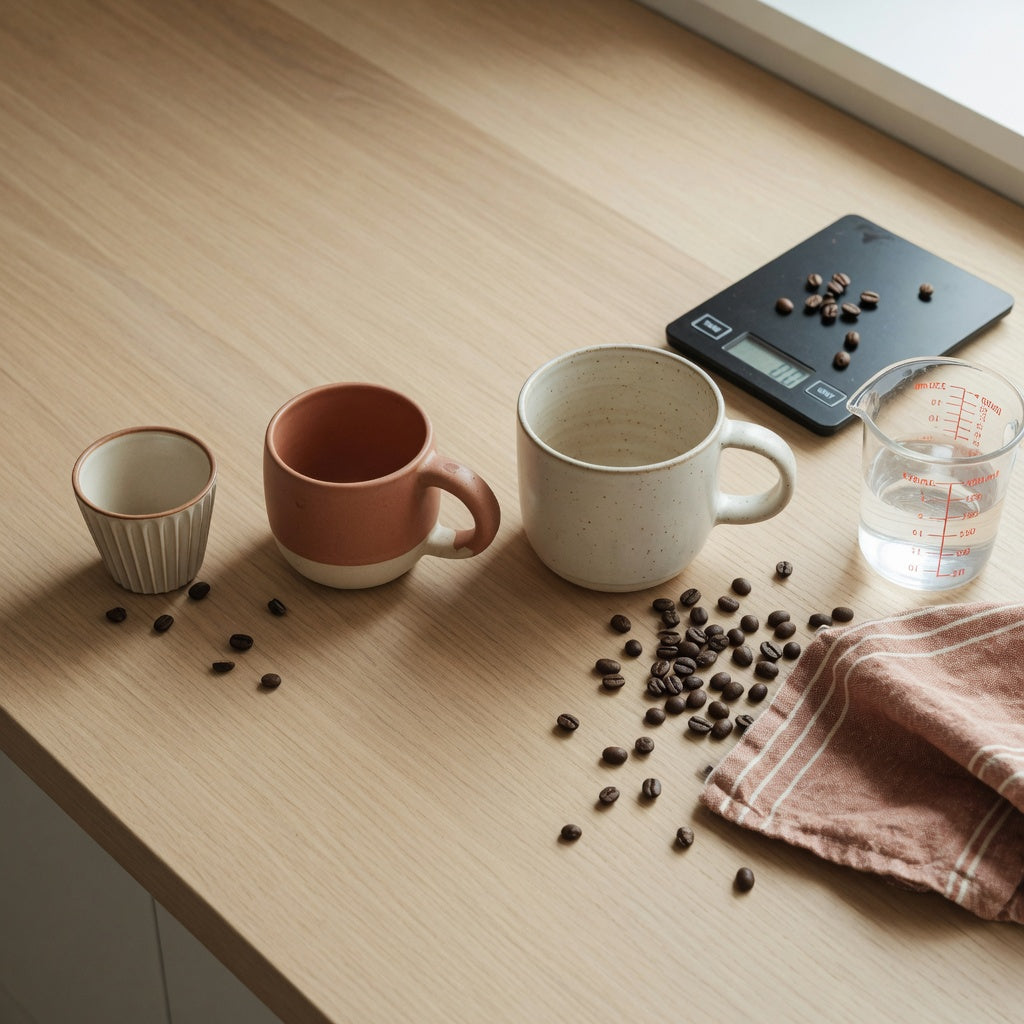
Ceramic Mug Shapes Size Decision Guide: 200, 250 or 400 ml
A 400 ml mug is not automatically the better buy. We compare our 200 ml, 250 ml and 400 ml silhouettes by working volume, rim feel, handle clearance and real shelf fit, so the size call takes five ...
Read more
Big Latte Mug Storage Fit Guide: 400, 440 and 480 ml
We compare our three current big latte mugs by listed capacity — 400 ml, 440 ml and 480 ml — then walk through the clearances that actually decide shelf fit: headroom, cabinet depth, handle project...
Read more
Leave a comment
This site is protected by hCaptcha and the hCaptcha Privacy Policy and Terms of Service apply.