

Big Latte Mug Everyday Mug Rotation Practical Purchase Checklist
Reading time: about 11 minutes
A big latte mug everyday mug rotation practical purchase checklist starts with a truth most product pages skip: the mug you reach for every day is rarely the one that photographed best. It is the one whose handle clears your knuckles at 6:40 a.m., whose base fits the same square of counter as the kettle, and whose rim leaves room for foam without sending the first sip over the side. We sell these mugs at CoffeifyMug, and the exchanges we see are usually fit problems — shelf, hand, machine, or cup holder — not looks.
Here is the version we walk shoppers through when they are holding three sizes and cannot decide.
What counts as a big latte mug when our sizes run 400 to 480 ml?
The phrase does two different jobs. Specialty café latte cups are often listed around 300 to 355 ml, sized for a double shot plus a small pitcher of steamed milk. In home shopping, a big latte mug usually means something noticeably larger. There is no single legal capacity for a latte mug, and no standard anyone enforces. The FDA compliance guide for ceramic hollowware describes cups and mugs as small hollowware that normally, though not exclusively, holds about 240 ml or 8 fl oz, which shows how far the oversized end of the market has drifted from that reference point.
Our store lists three sizes in this range, and the capacity is stated plainly on each product page:
- The Flow at 400 ml, roughly 13.5 fl oz using the NIST conversion of 29.57353 ml per US fluid ounce
- Morning and Night at 440 ml, roughly 14.9 fl oz
- The Rock at 480 ml, roughly 16.2 fl oz
Those numbers sit close together on paper and feel different in a hand. The 80 ml spread between the smallest and largest is only a few tablespoons of milk, but it is also the difference between a mug that clears a low cabinet shelf and one that lives on the counter permanently. If you want to see how these three sit alongside the rest of our range, browse the unique coffee mugs collection before you start measuring.
Brim capacity versus the pour you actually get
Listed capacity is measured to the rim. Drinks are not. NIST packaging conversions put 8.0 fl oz at 236.588 ml and 16.0 fl oz at 473.176 ml, which means a mug sold as 16 oz holds about 473 ml filled flat to the edge with no room for anything else. The Rock at 480 ml sits just past that line.
That headroom matters at three points in the day:
- Hot lattes. A steamed milk pour with a foam cap needs vertical space. Fill a mug to the brim and the first sip goes over the side.
- Iced drinks. Ice displaces volume. A 480 ml mug that looks generous empty can put an iced latte right at the rim once the cubes go in.
- Microwave reheats. Liquids climb as they heat, and a brim-full mug is a spill waiting to happen.
One ratio note. A bigger mug does not give you more coffee unless you pull more shots. If a double shot lands in a 400 ml mug instead of a 240 ml cup, you have not upgraded the coffee, you have upgraded the milk. That is a good outcome for some drinkers and the wrong one for others.
How often will the mug leave the cabinet? Run the frequency test first
Before shape or glaze, do the arithmetic. Two milk drinks a day is roughly 730 uses a year. If you rotate among three mugs, each one takes about 240 trips to the sink or the dishwasher. That number changes the questions you should be asking. A mug used twice a week can be fussy. A mug used twice a day cannot.
Answer three things honestly:
- Hand wash or dishwasher? If it is dishwasher, the mug needs to survive your rack geometry, not just the label.
- Where does it live? Open shelf, deep cabinet, or desk drawer. A tall mug on a shallow shelf will migrate to the counter and stay there.
- Who else reaches for it? A shared office mug gets handled by more hands, more ring sizes, and more gripping styles than a single-person kitchen mug.
Your big latte mug everyday mug rotation practical purchase checklist
Work through these in order. Each one eliminates a mug or confirms it.
- List your drinks for a normal week. Count the shots you actually pull and note which drinks are iced.
- Pick a usable volume, not a brim volume. Take the largest drink you make and add roughly 15 to 20 mm of headroom.
- Measure your shortest shelf clearance. Not the tallest shelf. The shortest.
- Trace your handle grip. Count how many fingers you put through the opening and check the knuckle clearance.
- Lift the mug full, one-handed. If it wobbles at the wrist empty, it is a two-hand mug full.
- Check group-head clearance with your scale in place. The scale is what breaks the fit, not the mug alone.
- Measure your cup holder if the mug travels. Diameter and depth both matter.
- Read the care line on that exact listing. Not on a similar mug, not on ours in general.
Desk footprint and filled weight: the office-survival test
A 480 ml fill is roughly half a kilogram of liquid before you add the mug's own weight, and 400 ml is only modestly lighter. That is a real load at the end of a straight arm over a keyboard. The grip is not the problem. The wrist angle is.
Footprint is the second half. Check the base diameter against your coaster, your mouse mat, and the gap between your monitor stand and the desk edge. A wide base is stable and hard to knock over, but it also claims counter space in a small kitchen. If your only clear surface is a 30 cm sliver beside a laptop, the smallest mug in the range is usually the one that stays at the desk while the others stay home.
Handle comfort: the spec most listings never print
Handle openings are where most real complaints live. Internal opening height and width, the distance between handle and body, and whether the handle sits level with the rim all change how a mug feels. None of those numbers appear on a typical listing, including ours, so treat them as questions to verify before you commit.
Three things worth checking:
- Finger stack. Two fingers plus a thumb is comfortable. Four fingers through a small loop is not, and it is the most common reason a large mug gets returned.
- Knuckle clearance. Wide knuckles, rings, and arthritic joints all need more space than a photo can show.
- The handle junction. Where the handle meets the body is a stress point on any ceramic mug. Look closely at how it is finished in the listing photos, and ask if you are unsure.
A mug you cannot carry comfortably with one hand full of hot liquid is a mug you will stop reaching for. That is the whole test.
Wide bowl or tall wall, and which shape suits your pour?
Shape changes the drinking experience more than capacity does. A wide, bowl-leaning cup spreads the milk thin, gives a barista room to draw, and reads as a café latte cup. Home pourers debate how much the width actually helps latte art, and the honest answer is that technique matters more than geometry, but a wide surface does make a slow pour more forgiving.
A taller, straighter mug suits long drinks, iced lattes with a straw, and hands that prefer a vertical grip. It also takes up less counter diameter for the same volume. We do not publish cooling curves for our mugs, so if drink temperature over twenty minutes matters to you, test it in your own kitchen with your own drink rather than relying on a listing claim.
Three measurements to take before you order
These three failures account for most of the fit complaints we hear about large mugs.
- Group-head clearance. Measure from the drip tray to the group head with your scale already sitting on the tray. Tall mugs fail here first. If yours is borderline, pull the shot into a pitcher and pour it.
- Cabinet or shelf height. Measure the shortest shelf in the cabinet where mugs actually go. Add nothing for optimism.
- Cup-holder diameter and depth. A tapered mug body can clear the diameter and still sit too tall to be stable in a shallow well.
Care labels, microwave claims, and what lead-free really tells you
Dishwasher and microwave labels are manufacturer statements about normal use, not a guarantee that every cycle in every appliance is safe. Two failure modes are worth knowing about whatever mug you buy. Thermal shock, from moving a mug between fridge and microwave or pouring boiling liquid into a cold vessel, can crack ceramic that was perfectly fine a minute earlier. Crazing, the fine web of cracks that develops in some glazes over years of washing, is a wear sign worth watching.
On lead, the FDA sets an action level of 0.5 micrograms per millilitre of leaching solution for ceramic cups and mugs, applied to any one of six units tested under its compliance guide, and the agency notes that some ceramic foodware can leach lead from food-contact surfaces. That is why the phrase lead-free on a product page is weaker evidence than a test result. Ask which test was run and against which limit. We would rather you ask us that question than assume.
Matching each of our three sizes to a rotation slot
Here is how we would map the three, with the trade-offs stated plainly.
- The Flow, 400 ml. Best for a double shot plus a moderate milk pour, and for anyone whose daily rotation happens at a desk or in a small kitchen where the smallest footprint wins. On capacity alone, it is the lightest of the three when full; confirm the handle opening on the listing before relying on one-handed carry. Not the right pick if you routinely pull triples or drink iced lattes with a full glass of ice.
- Morning and Night, 440 ml. The middle slot and the most flexible of the three. Enough capacity for a generous latte with headroom left over, and a sensible choice if the same mug handles coffee in the morning and tea at night. Check the shelf before assuming it stores where your current mugs do.
- The Rock, 480 ml. The largest listed capacity, and the one we would point to for iced drinks where ice eats volume, for soup or cereal, and for anyone who genuinely wants a long, milky drink. Be honest about the trade-off: based on listed capacity alone, it is the heaviest when full and the least likely of the three to clear a low shelf or a car cup holder. Verify those two measurements first.
If none of the three quite matches the drink you make most often, run the same checklist against each listing in the unique coffee mugs collection. The method transfers. The numbers do not.
Frequently asked questions
How do I start a big latte mug everyday mug rotation practical purchase checklist?
Start with your shortest shelf and your most common drink, then compare that usable volume with the listed capacity. Add handle room, filled weight, group-head clearance, and cup-holder depth only after those first two numbers make sense. The checklist above is ordered that way for a reason.
Is a 400 ml mug big enough for a latte?
For a double shot with a moderate steamed milk pour, yes. Specialty café latte cups are often listed around 300 to 355 ml, so 400 ml gives you more room than a café standard and leaves space for a foam cap. If you regularly pull three shots or like a very milky drink, step up to 440 or 480 ml instead.
Is a 480 ml mug too big for a hot latte?
It is too big for a single double shot if you want a balanced milk-to-espresso ratio, because the same amount of coffee is spread across roughly twice the milk of a café cup. It is a good size for iced lattes, for people who genuinely prefer a milky drink, and for soup or cereal. Match the mug to the drink, not to the photo.
Will a big latte mug fit under my espresso machine?
Measure the clearance from the drip tray to the group head with your scale already on the tray, then compare that number to the mug's listed height. Tall mugs fail this test more often than wide ones. If your clearance is tight, pull the shot into a small pitcher and pour it into the mug at the counter.
Are these mugs dishwasher and microwave safe?
Check the care line on the exact product page for the mug you are buying, because we do not publish a blanket yes across the range and we will not guess on your behalf. Whatever the label says, avoid thermal shock by not moving a mug straight from the fridge to the microwave, and retire any mug that develops a cracked or crazed glaze.
What does lead-free mean on a ceramic mug?
It is a marketing phrase unless it is tied to a test. The FDA action level for ceramic cups and mugs is 0.5 micrograms per millilitre of leaching solution under its compliance guide, and the agency acknowledges that some ceramic foodware can leach lead from food-contact surfaces. If lead status matters to you, ask the seller which test was run and against which limit rather than accepting the phrase alone.
Which size should I start with if I want one mug for daily rotation?
Start with Morning and Night at 440 ml if you want one mug to cover both coffee and tea without going to the largest size. Check its care line and shelf height on the product page, then compare it with The Flow at 400 ml if desk space is tight or The Rock at 480 ml if ice and long drinks are your normal.
More from our blog
Read more

Unique Espresso Cups Everyday Mug Rotation Product Shortlist Guide
A three-cup shortlist for shoppers who want unique espresso cups that actually get used: 170 ml, 200 ml and 250 ml ceramics matched to shot volume, milk drinks and shelf space, with an explicit rea...
Read more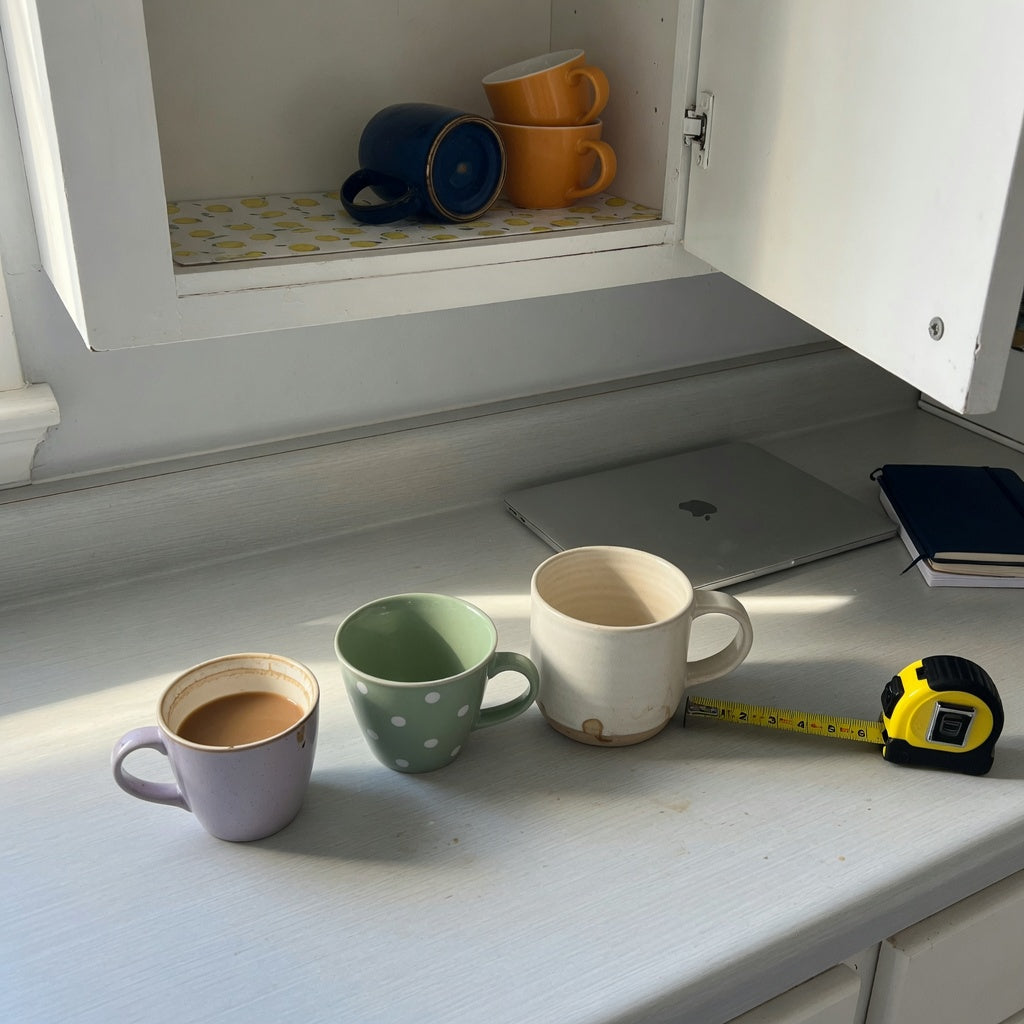
Big Latte Mug Everyday Mug Rotation Product Shortlist Guide
A rotation-first shortlist of three big latte mug sizes — 400 ml, 440 ml and 480 ml — with the exact reason to pick or skip each, plus the fill-line, handle and clearance checks that decide it.
Read more
Leave a comment
This site is protected by hCaptcha and the hCaptcha Privacy Policy and Terms of Service apply.