
Affogato Cup Everyday Mug Rotation Practical Purchase Checklist
Reading time: about 9 minutes
One small cup is beside the sink, another has been left on an office desk, and the decorative favorite is behind two breakfast mugs. That is how a supposedly simple cup purchase turns into a storage problem. Our affogato cup everyday mug rotation practical purchase checklist starts with those ordinary handoffs: where the cup waits, how often it is used, and how much serving room you actually need.
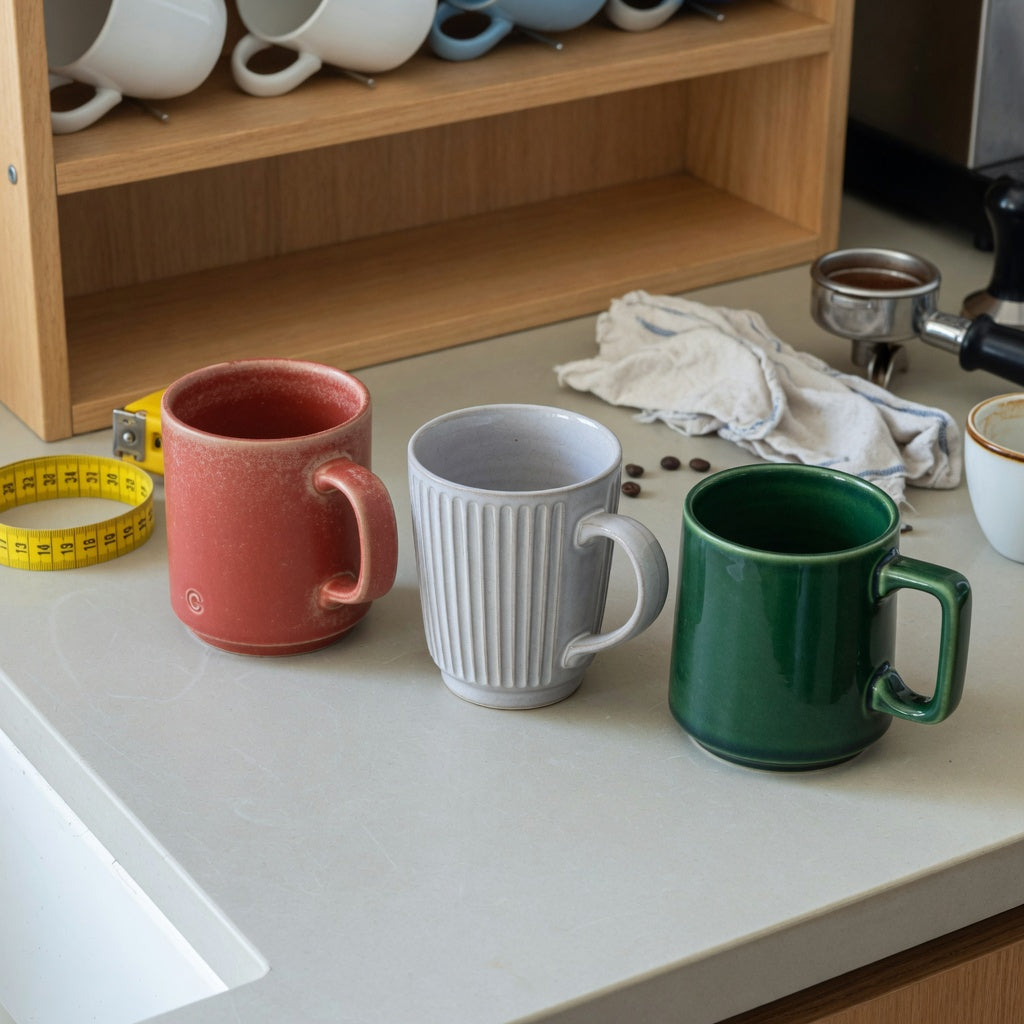
In our store, we keep this comparison within facts we can support. The Retro is 170 ml, the Pleated is 200 ml, and the Emerald is 270 ml. We compare those capacities and the visible shapes shown on the product pages. We do not infer exterior dimensions, material performance, stackability, temperature-change resistance, or care compatibility from appearance alone.
Use this affogato cup everyday mug rotation practical purchase checklist
A useful rotation is built around the full journey from cabinet to counter to washing area. Before selecting an affogato cup or affogato mug, run through these steps with the cup you currently use:
- Record a normal week. Count actual small-coffee and dessert-coffee occasions rather than the number you hope to make.
- Identify the waiting places. Check the cabinet, open shelf, coffee station, desk, sink area, and drying rack. A cup occupies space even when it is not being used.
- Check your current serving. Note the capacity of the vessel that already works. Decide if it feels too roomy, too tight, or about right once the full serving is assembled.
- Choose a capacity band. Compare that reference with 170 ml, 200 ml, and 270 ml. Do not treat cup capacity as an exterior measurement.
- Study the visible profile. Look at the rim, handle area, exterior treatment, base, and side silhouette in the listing images. These details affect how a cup looks in an open rotation.
- Verify every unlisted requirement. If material, dishwasher use, microwave use, exact dimensions, or included accessories could change your decision, confirm them on the current listing or with our store before ordering.
This process prevents a common mismatch: choosing from a close product photo, then discovering that the capacity or storage routine does not suit the household. It also keeps a visually appealing cup from becoming a piece that is used once and moved to the back of the shelf.
170 ml, 200 ml, or 270 ml: which capacity earns a regular place?
The three verified sizes create distinct choices. The middle option is only 30 ml above the smallest, while the largest is 70 ml above the middle and 100 ml above the smallest. Those differences matter when ice cream, espresso, and any additions must share the same vessel, but there is no universal serving size.
| Option | Verified capacity and visible distinction | Reader situation and trade-off |
|---|---|---|
| Retro Coffee Tea Cup | 170 ml, with the retro-style profile shown in its product images. | Consider it when your measured serving is modest and the lowest listed capacity is the priority. It provides the least capacity margin of the three, so it is not the forgiving choice for a portion that already fills a small cup. |
| Pleated Coffee Tea Cup | 200 ml, with a visibly pleated exterior. | Consider it when 170 ml feels restrictive but 270 ml is more room than your usual serving needs. The pleated surface also gives it a more visually textured role in an open-shelf rotation. |
| Emerald Coffee Tea Mug | 270 ml, with the distinct mug profile visible on its listing. | Consider it when serving quantity varies or the same cup needs to cover the largest portions in this comparison. The added capacity does not prove that its exterior footprint, height, or handle reach will fit your storage spot. |
Capacity is the strongest decision point available here. If your usual drink or dessert measures more than 270 ml, none of these three provides enough listed volume. A larger option from the unique coffee mugs collection would be a more sensible next step than forcing a large serving into a compact cup.
The opposite trade-off matters too. If your current vessel is much larger than the serving and you dislike carrying or washing unused volume, 170 ml or 200 ml may make the rotation feel more deliberate. Measure first. We would not recommend a capacity based only on how compact it appears in a photograph.
Shelf, drying rack, or office desk: measure every waiting place
A cup can fit the cabinet and still be awkward everywhere else. We see better buying decisions when shoppers assess the whole route instead of one cleared shelf. Use the vessel already in your rotation as a physical reference.
- Cabinet or shelf: measure usable height, depth, and width. Include the space taken by the handle and neighboring cups.
- Coffee station: check the clear area left after the grinder, machine, kettle, and other daily tools are in place.
- Drying area: identify where a small cup can rest without relying on unsupported assumptions about rack slots or stackability.
- Office desk: measure the coaster or clear desk area and consider where the cup goes during calls, lunch, and the trip back to the kitchen.
Capacity cannot answer those questions. A 170 ml cup is the smallest option by listed volume, but that fact alone does not establish the smallest outer dimensions. If exact shelf clearance is a pass-or-fail requirement and the needed measurements are not shown, ask our store before checkout.
Visible shape becomes more important on an open shelf. The Pleated option offers obvious surface detail, while the Retro and Emerald provide their own distinct profiles in the product images. A mixed rotation can help identify different serving roles at a glance. Matching pieces produce a more uniform row. Neither approach is inherently more practical; the better choice is the one you will return to the same accessible spot.
How many cups does your use-and-wash cycle support?
Frequency should determine quantity. Buying several cups before confirming that the first size works creates cabinet pressure, while buying one for simultaneous household servings creates a different kind of friction.
- Occasional dessert: start with one cup if there is rarely more than one serving at a time.
- Frequent personal use: one may be enough if it returns promptly to service. Two can make sense when one is regularly waiting to be washed or, if permitted by its care instructions, completing a dishwasher cycle.
- Two people serving together: choose the number needed at the same time. Matching capacities make portions easier to compare, while mixed capacities suit different preferences.
- Office use: one dedicated cup avoids filling a shared cabinet, but only if the user has a dependable place to wash and store it.
- Gift purchase: one carefully selected size is usually a clearer first choice than assuming the recipient wants a complete rotation. Confirm their normal serving and available storage if possible.
This is where the affogato cup everyday mug rotation practical purchase checklist becomes commercial rather than decorative. The right quantity is based on overlapping use, washing downtime, and available storage. It is not automatically a set of two, four, or six.
Known facts, open questions, and poor-fit use cases
Our recommendations stop where the verified product information stops. This article establishes three capacities and compares visible shape. It does not establish material, weight, wall thickness, rim thickness, exterior measurements, stackability, microwave suitability, dishwasher suitability, stain performance, or response to sudden temperature changes.
That boundary changes who should buy from this shortlist. These compact capacities are not good fits for someone whose measured everyday drink exceeds 270 ml. They are also a poor basis for a purchase if confirmed stacking, a specific material, or a particular care method is mandatory and has not yet been verified. A commuter who requires a lid or leak-resistant construction should select only a product that explicitly lists those features rather than assume a coffee cup provides them.
Styled photos can show a serving context, but they should not be read as a packing list. Do not assume that food, spoons, saucers, or other serving accessories are included. Check the current contents stated on the relevant product page before placing the order.
Care deserves the same restraint. If daily dishwasher use is essential to your rotation, confirm that the current care guidance permits it. If you routinely move drinkware between sharply different temperatures, verify applicable instructions rather than relying on a general claim about cups or mugs. We do not make either performance promise in this comparison.
Five checks for delivery day and the first wash
Hands-on inspection is most useful before a new cup disappears into a busy kitchen. These checks do not imply that a defect is expected; they are a practical way to identify transit damage or an order mismatch before use.
- Compare the received product and capacity designation with the item ordered.
- Inspect the rim and exterior under clear light for a chip, crack, or unexpected surface damage.
- Check the handle and its attachment areas where a handle is present.
- Place the empty cup on a flat, stable counter and look for unexpected rocking.
- Read the current care information before the first wash. Do not transfer dishwasher, microwave, or temperature guidance from another mug to this one.
For gift unboxing, complete the same visual check before wrapping. The recipient then gets the intended product rather than discovering a shipping issue after the packaging and order details have been put away.
Frequently asked questions
What size affogato cup works best for everyday use?
There is no default size for every serving. In our affogato cup everyday mug rotation practical purchase checklist, 170 ml suits the most modest measured portion, 200 ml is the middle capacity, and 270 ml provides the most room of these three. Compare them with a vessel and portion you already use successfully.
Is a 170 ml cup large enough for affogato?
It can be, but the answer depends on your ice cream portion, espresso quantity, additions, and preferred empty space near the rim. Assemble your normal serving in a known vessel and check its capacity. Move to 200 ml or 270 ml if your serving needs more room than 170 ml provides.
Can I put these affogato cups in the dishwasher every day?
This comparison does not verify dishwasher compatibility or long-term cycle performance for the three products. Check the current product care information before ordering. If dishwasher use is mandatory, obtain confirmation rather than treating it as an assumed feature.
Do the Retro, Pleated, and Emerald cups stack?
Capacity and product photos do not establish secure stackability, and these options should not be treated as a designed stacking set without confirmation. Plan for side-by-side storage unless the current listing or our store verifies otherwise. Buyers with a narrow cabinet should resolve this point before purchasing several pieces.
Do these cups include a spoon, saucer, or food?
Do not treat this article or lifestyle imagery as evidence that any accessory or food is included. Review the contents stated on each current product page before ordering. If a coordinated serving set is essential, choose only a listing that explicitly names every required piece.
For the next step, place your current cup in its real shelf position, record the capacity that works, and choose one verified size: 170 ml Retro, 200 ml Pleated, or 270 ml Emerald. If none fits the measured serving or visual role, compare the wider CoffeifyMug mug collection instead of compromising on a cup that will not enter the daily rotation.
More from our blog
Read more
Thick Ceramic Coffee Mugs: Home Coffee Station Purchase Checklist
Measure dripper clearance, mug footprint, handle room, working capacity, and storage before buying. This checklist explains ceramic trade-offs, care limits, and how to compare The Rock, The Flow, a...
Read more
Ceramic Cortado Cup Everyday Mug Rotation Practical Purchase Checklist
Compare CoffeifyMug's verified 170, 200, and 270 ml ceramic options by repeat pour size, usable headroom, shelf fit, care routine, and rotation frequency. The checklist also explains when a larger ...
Read more
Leave a comment
This site is protected by hCaptcha and the hCaptcha Privacy Policy and Terms of Service apply.