
Big Latte Mug Everyday Mug Rotation Product Shortlist Guide
Reading time: about 9 minutes
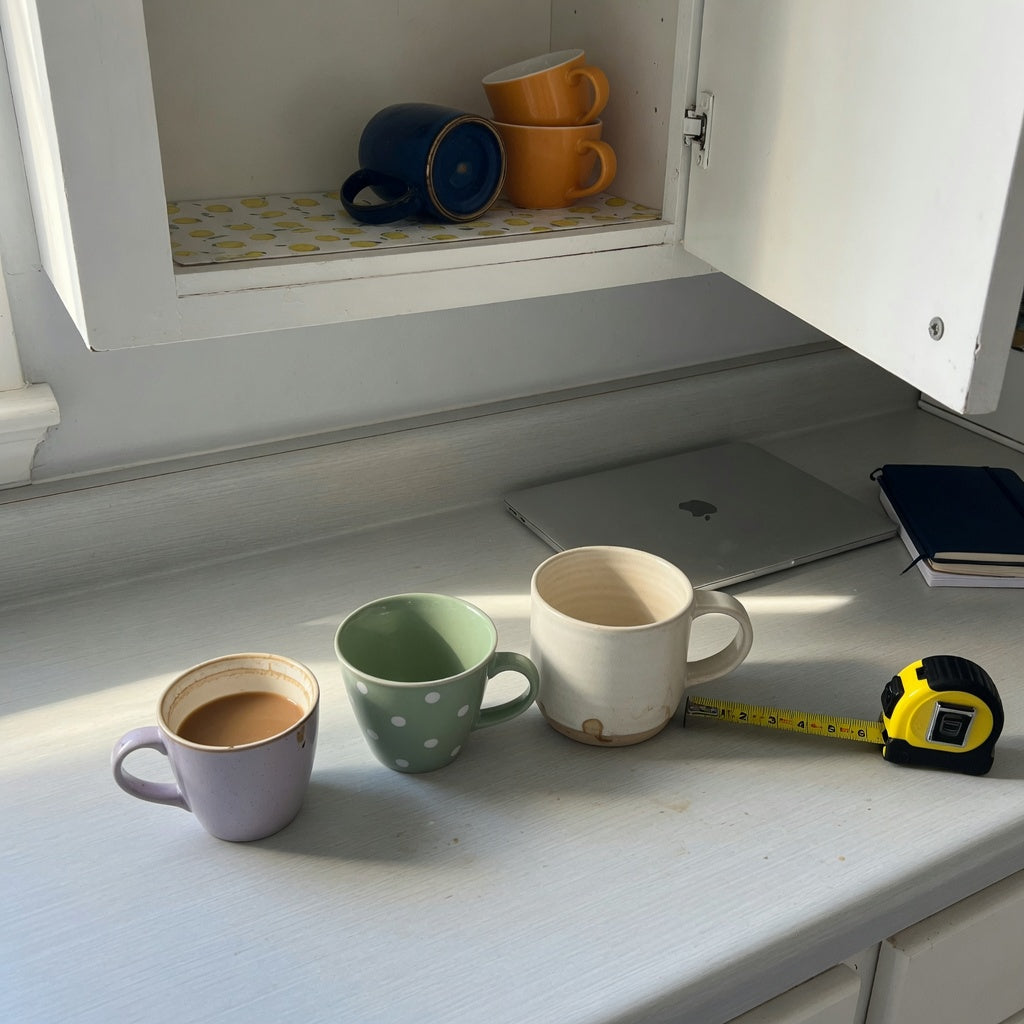
There is a mug on the second shelf of our sample cabinet that nobody reaches for. It is the largest one we stock, the glaze is genuinely nice, and it becomes a two-handed job the moment it is full. We have watched that pattern repeat through months of rotation testing in our store, and it is why this big latte mug everyday mug rotation product shortlist guide starts with how often you will lift the mug rather than how much it holds.
Capacity is the easiest number to shop by and the least useful one. A mug you quietly avoid is a mug that failed, no matter how good it looks on the shelf. So here is a short, scenario-based shortlist drawn from our unique coffee mugs collection: the sizes we carry, the habit each one fits, and the honest reason to skip it.
What does "big" mean in millilitres, and why do the ounce labels mislead?
There is no legal definition of a latte mug. The FDA's Compliance Policy Guide 545.450 (fda.gov) treats cups and mugs as small ceramic hollowware normally — though not exclusively — holding about 240 mL, or 8 fl oz, with a handle. Anything under 1.1 litres counts as small hollowware. "Big" is relative, not a fixed band.
Out in the market the phrase covers two different objects: specialty café latte cups that makers list somewhere around 300–355 mL, and taller retail mugs sold well above that. Both get called a big latte mug online, which is why comparisons between them go sideways so fast.
Convert before you compare. One U.S. fluid ounce is 29.57353 mL under NIST Handbook 44, and NIST Handbook 130 gives 8 fl oz as 236.588 mL and 16 fl oz as 473.176 mL. Rounded, the ladder runs:
- 8 oz ≈ 237 mL — the FDA's typical mug
- 10 oz ≈ 296 mL
- 12 oz ≈ 355 mL — usually the top of the café-cup range
- 14 oz ≈ 414 mL
- 16 oz ≈ 473 mL
Two consequences follow. A mug printed "10 oz / 300 ml" is one vessel with two rounding conventions, not extra capacity. And ounce figures are generally measured to the brim, so a mug filled to a sensible line — leaving headroom for steamed milk and foam — behaves like a smaller mug than its label claims. Our ounce-to-millilitre reference walks through the rest of the conversions if you want them side by side.
How many mornings a week will you actually lift it?
Three questions decide more than any spec sheet, and we ask them before recommending a size to anyone.
- How many drinks a week go into this mug? Five to seven uses a week means hand comfort wins outright. One or two uses means you can justify a heavier, larger mug, because it is a treat rather than a tool.
- Where does it live? Counter mugs get picked up constantly. Cabinet mugs have to clear a shelf and survive stacking. A mug that needs digging out gets used less — that is not a theory, it is what we see.
- Does it leave the kitchen? Desk, studio, car, garden. Leaving the kitchen adds a cup-holder diameter check and a one-hand carry requirement.
That is why this is a shortlist and not a ranking. A 480 ml mug is the right answer for someone making one long iced drink a day and the wrong answer for someone pulling two flat whites before work.
Big latte mug everyday mug rotation product shortlist guide: three sizes, three jobs
We publish capacities plainly because that is the number we can verify. Handle opening, wall thickness, empty weight and base diameter vary by design, so confirm those on the individual product page before you commit — we would rather you measure than assume.
| Mug | Listed capacity | The rotation it suits | Reason to skip it |
|---|---|---|---|
| The Flow | 400 ml | One milk drink a day, poured small enough that you finish it while it is still hot; a good fit for a counter mug you lift every morning | Skip if you routinely pour 16 fl oz (≈473 mL) drinks, or if ice is going to eat a third of the volume |
| Morning and Night | 440 ml | A genuine two-drink day — coffee in the morning, tea or a second milky drink at night, same vessel both times | Skip if you only ever make one drink a day; the 40 ml over The Flow is not something you will notice in the cup |
| The Rock | 480 ml | One substantial drink daily, long desk sessions, or iced drinks where the ice needs room to move | Skip if you drink small flat whites, if your shelf clearance is tight, or if latte art on a modest volume is the point for you |
If none of the three match the way you actually drink, our capacity comparison across current sizes puts the wider range next to each other so you are not guessing from product photos alone.
What does the mug weigh when it is full, and where does the handle give out?
A millilitre of a milk-and-water drink weighs roughly a gram, so a full 400 ml mug carries about 400 g of liquid before the ceramic is counted, and a full 480 ml mug carries close to half a kilo. That is the figure your wrist argues with, not the number printed on the base.
- Handle opening: can you get two knuckles through it while the mug is empty? A grip that is merely possible turns into a grip you avoid once the mug is heavy and the outside is warm.
- Base diameter: measure your coaster, your drip tray, your cupboard shelf depth and your car cup holder. Base size is printed far less often than capacity, yet it is the dimension that decides whether a mug fits at all.
- Group-head clearance: if you pull espresso, set your scale on the drip tray, measure from the scale to the group head, then compare that to the mug height on the listing. A tall mug plus a scale is the clearance failure we hear about most often.
- Stacking: if mugs live two-deep in a cabinet, a wide base eats shelf space that a narrower one leaves free.
This is the point in the shortlist where we tell people to put the phone down and pick up a tape measure.
Wide bowl or tall cylinder: which shape survives your actual drink?
A wide mouth gives you surface area, and surface area is what latte art needs — the milk has somewhere to spread and the foam settles in a visible ring instead of collapsing into the middle. A taller, narrower body stacks more easily in a cabinet and behaves better for long hot drinks or iced drinks where you want depth rather than width.
The trade-off cuts both ways, and we will not pretend otherwise. Wide mugs take more shelf real estate and are harder to store two-deep. Tall mugs that are only partly filled hold a lot of empty ceramic above the drink line, and baristas argue endlessly online about how that changes the temperature over ten minutes — there is no measured consensus we would quote, so treat it as a preference rather than a specification. If your usual drink is milk-forward rather than espresso-forward, the same shape question applies with different priorities.
What do "dishwasher safe" and "lead-free" actually promise?
"Dishwasher safe" and "microwave safe" describe a specific design, not a category standard. Check the care line on the exact listing you are buying — ceramic alone tells you nothing, and hand-washing is the gentlest way to keep a glaze looking new across years of daily cycles. If a mug is going to live in a rotation, assume it will be washed several hundred times.
On lead, the FDA guidance is concrete: for ceramic cups and mugs the lead action level is 0.5 micrograms per millilitre of leaching solution, applied to any one of six units tested under CPG 545.450. The FDA also notes that some ceramic foodware can leach lead from food-contact surfaces. That makes "lead-free" on a product page a marketing phrase unless it is tied to a test result — treat it as a question to ask the seller, not a guarantee to accept at face value.
Which one should you skip, and what should you buy instead?
Be honest about the drink, not the shelf. Skip the 480 ml if you pull a single shot and top it with a modest amount of milk; the same shot spread through that much volume tastes thin and milky and you will drift back to a smaller cup within a fortnight. Skip the 440 ml if you have a one-drink habit and no interest in a second. Skip anything whose handle you cannot hook a finger through when it is empty — that handle will not improve when the mug is full.
Buying for someone else is harder, because you cannot measure their cabinet or watch their morning. When the recipient's habits are unknown, the middle size is the safer gift: it is big enough to feel generous and small enough to survive a normal cupboard. Our large mug gifting comparison covers the rest of what to check before you wrap it.
Frequently asked questions
Is a 16 oz latte mug the same as a 473 ml mug?
Effectively yes. Using the NIST conversion of 29.57353 mL per U.S. fluid ounce, 16 fl oz comes to 473.176 mL, so a mug marked either way is the same vessel. The number that matters more is whether the figure is measured to the brim or to a comfortable fill line that leaves room for foam.
Will a big latte mug fit under my espresso machine?
No product page can answer that for your setup. Put your scale on the drip tray, measure the gap from the scale up to the group head, then compare it with the mug height listed on the product page. Tall mug plus a scale on the tray is the clearance failure we hear about most.
Does a bigger mug make a latte taste weaker?
Yes, if you keep the same number of shots. A single shot spread through 480 ml tastes noticeably milkier than the same shot in a 400 ml mug. Either add a shot or accept that the larger mug is making a different, longer drink.
What is the fastest way to build a big latte mug everyday mug rotation product shortlist guide of my own?
Use this one as a filter. Choose capacity by how many days a week you will use the mug, then confirm handle opening, base diameter and machine clearance with a tape measure. If two mugs pass all three checks, take the smaller one — in our experience it is the one that actually gets picked up.
Is a big latte mug a bad choice for iced coffee?
Not bad, but be careful with the maths. Ice displaces volume, so a 480 ml mug loaded with ice and a double shot holds far less liquid than the label suggests. If iced drinks are most of your rotation, start at 480 ml rather than below it.
One last step before you decide: measure your shelf, your coaster and your machine clearance, then reread the three rows above with those numbers written down. Two of the sizes will usually drop out on clearance alone, and the choice between the survivors gets obvious fast. Start with The Flow if you drink one hot latte a day, Morning and Night if you come back to the same mug at 9pm, and The Rock if the ice cube tray is part of your routine.
Read more
Big Latte Mug Everyday Mug Rotation Practical Purchase Checklist
A big latte mug only earns its cabinet space if it fits your hand, shelf, machine, and cup holder. This big latte mug everyday mug rotation practical purchase checklist walks through 400 ml, 440 ml...
Read more
Ceramic Mug Shapes Everyday Mug Rotation Practical Purchase Checklist
Two mugs can hold the same volume and feel completely different in the hand. Here is the six-step ceramic mug shapes everyday mug rotation practical purchase checklist we actually run in our store,...
Read more
Leave a comment
This site is protected by hCaptcha and the hCaptcha Privacy Policy and Terms of Service apply.