
Abstract Coffee Mug Everyday Mug Rotation Practical Purchase Checklist
Reading time: about 9 minutes
A mug can look right on a product page and still fail its first ordinary morning: the usual drink reaches too close to the rim, the widest part crowds a cabinet neighbor, or the care instructions do not suit a daily dishwasher routine. Our abstract coffee mug everyday mug rotation practical purchase checklist starts with those repeat-use details because a rotation earns its shelf space through fit and frequency, not novelty alone.
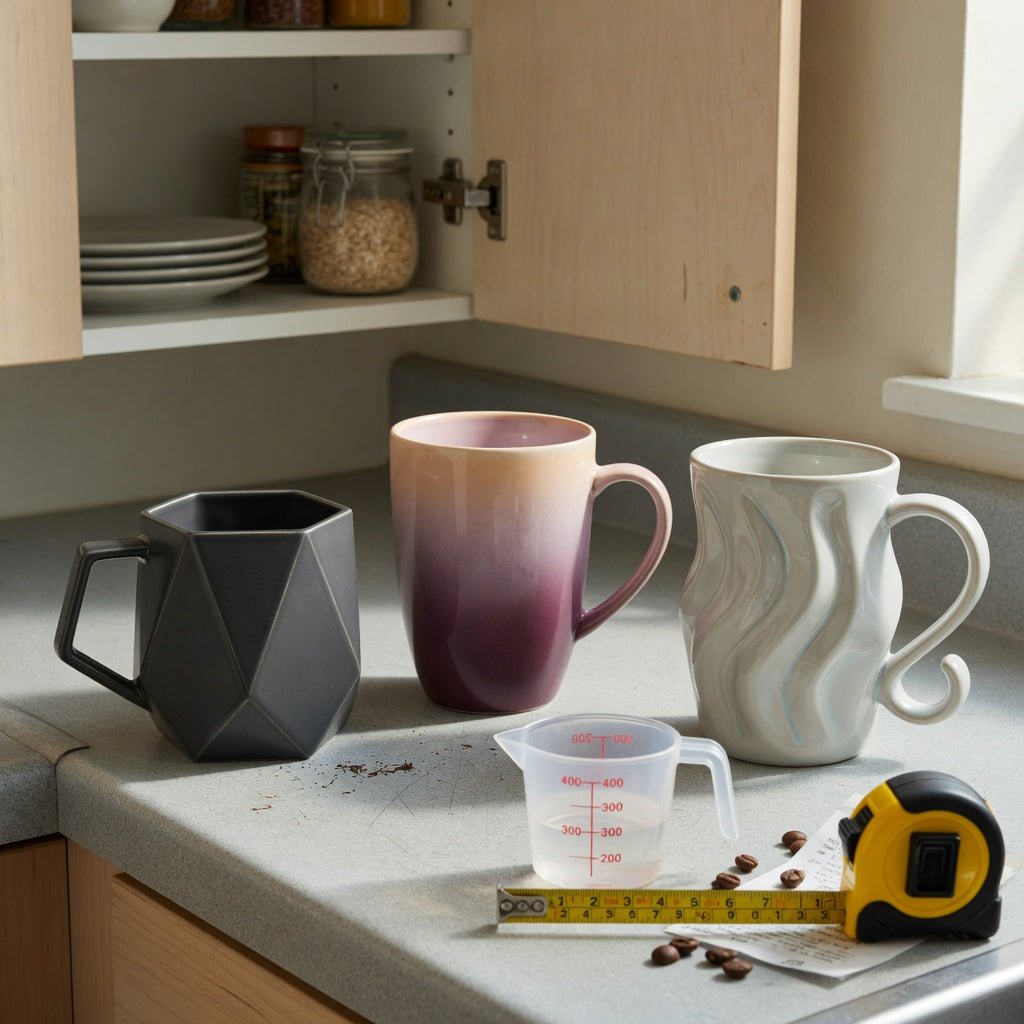
At CoffeifyMug, our team handles drinkware during receiving, product checks, and customer questions. For the three designs discussed here, the catalog facts we can stand behind are specific: Rhombus has a 250 ml capacity and geometric form, Gradient has a 400 ml capacity and color-transition finish, and The Flow has a 400 ml capacity with sculptural curves. We use abstract as a shopper's style description. It does not establish a named art movement, artist attribution, production method, limited-edition status, or design provenance.
Is your repeat pour suited to a 250 ml or 400 ml listed capacity?
Measure the drink you make, not the mug you imagine using. Fill your current mug with cold water to the same level as a normal coffee or tea, then transfer that water to a graduated measuring jug. Include the space taken by milk, foam, or ice. This gives you a more useful number than estimating by eye.
- A serving comfortably below 250 ml: the Rhombus can enter the shortlist because its verified listed capacity is 250 ml.
- A serving above 250 ml but comfortably within 400 ml: compare Gradient and The Flow, both of which have a verified 400 ml listed capacity.
- An iced or foamed drink: measure the finished drink. Ice and foam occupy volume even though they do not represent the same amount of liquid coffee or tea.
Listed capacity and comfortable working volume are not always the same thing. Most people need some headspace for carrying and sipping, so a drink that measures exactly 250 ml should not automatically be matched to a 250 ml mug without checking how the product defines capacity. The 150 ml difference between the listed options is meaningful, but it does not tell us their external dimensions, empty weight, rim shape, or usable fill line.
Cabinet, desk, and dishwasher space: what needs measuring?
Capacity is an internal-volume specification. It is not a substitute for the mug's external size. Before ordering, measure the exact location where the new piece will spend most of its time and record the numbers in one consistent unit.
- Shelf opening height: measure at the narrowest point, including any shelf lip or cabinet frame.
- Usable depth: measure from the back of the shelf to the inside of the closed door, not to the front edge alone.
- Maximum width: allow for the handle, geometric projections, or the widest sculptural curve rather than measuring only the base.
- Side clearance: leave enough room to lift one mug without knocking the mug beside it.
- Dishwasher rack clearance: check this only after confirming that the product is approved for dishwasher use.
Do not infer that the 250 ml Rhombus has a smaller external footprint than either 400 ml option; that dimension is not part of the verified facts supplied for this comparison. Likewise, The Flow's curves may place its widest point above the base, but the style name does not reveal how wide that point is. Gradient's 400 ml capacity also does not establish its height. Exact product measurements should settle those questions before a tight cabinet, office cupboard, or under-shelf coffee station becomes the deciding factor.
Rhombus, Gradient, or The Flow: which rotation role is unfilled?
Once serving volume is known, choose the visual role you actually want to add. This comparison separates verified facts from details that still need confirmation.
| Design | Reader situation | Why it fits the shortlist | Confirm before checkout |
|---|---|---|---|
| Rhombus coffee and tea mug | Your measured serving stays comfortably below 250 ml, and your current rotation lacks a geometric form. | The verified catalog description combines a 250 ml capacity with geometric styling. | External dimensions, material, weight, care guidance, and stackability. |
| Gradient coffee and tea mug | You need a listed 400 ml capacity and want visual change from a color-transition finish. | Its verified points are the 400 ml capacity and color-transition appearance. | External dimensions, material, finish-care instructions, and appliance suitability. |
| The Flow coffee and tea mug | You need a listed 400 ml capacity and prefer sculptural curves over a geometric profile. | Its verified catalog points are the 400 ml capacity and curved sculptural form. | Maximum width, material, care guidance, weight, and storage clearance. |
A frequent short-drink slot points toward Rhombus for capacity and geometric style. A longer coffee or tea slot points toward Gradient or The Flow, with the choice determined by color transition versus sculptural curves. If none clearly fills a missing role, compare the broader unique coffee mugs collection after recording your capacity and storage limits.
Abstract coffee mug everyday mug rotation practical purchase checklist: seven gates
Run each candidate through these seven checks. A failed non-negotiable is a reason to pause, even if the design is visually right.
- Measure the finished drink. Record the volume of a normal coffee or tea, including milk, foam, or ice.
- Name the rotation slot. Decide if this is for weekday desk coffee, a shorter evening tea, weekend iced drinks, or another repeated use.
- Match capacity with headspace. Compare the measured serving against 250 ml and 400 ml without assuming that brim capacity equals a comfortable carry level.
- Measure the storage envelope. Check opening height, usable depth, and maximum allowed width, including handle or curved projections.
- Set the care requirement. Treat dishwasher and microwave suitability as separate specifications that must be confirmed.
- Choose the style contribution. Select geometric form, color transition, or sculptural curves based on what is missing from the current rotation.
- Resolve the unknowns. Confirm material, exact dimensions, care directions, weight, and any required appliance compatibility before paying.
This process also keeps rotation frequency visible. A mug intended for five workdays deserves stricter capacity, storage, and care checks than a piece used occasionally for guests. Do not force an occasional design into the easiest-to-reach cabinet slot while the true daily mug sits behind it.
Care labels and first unboxing: what should stop daily use?
For this comparison, we do not have a verified material specification or confirmed dishwasher and microwave guidance. Geometric and sculptural describe form; neither tells us whether the body is ceramic, porcelain, stoneware, glass, or another material. The phrase color-transition finish also identifies an appearance, not a coating, printing process, glaze type, or level of dishwasher resistance.
- Before checkout: review the current product information and ask our store if a required material or care instruction is not stated clearly.
- At unboxing: check the shipping packaging and compare the received form and finish with the ordered product before use.
- On a dry counter: place the mug on a flat surface and confirm that it sits securely without unexpected rocking.
- Around the rim and body: inspect under good light for chips, hairline cracks, sharp areas, or transit damage. Do not use damaged drinkware.
- At the handle, if present: check for visible separation or movement where it meets the body.
- Before a hot drink: follow the supplied use instructions. Do not assume microwave, dishwasher, freezer, or sudden-temperature-change suitability from a photograph.
Dishwasher-safe and microwave-safe are separate claims. A shopper who relies on a dishwasher after every use should treat missing machine-care guidance as an unresolved purchase requirement, not as implied approval. We also would not promise that one of these forms or finishes lasts longer than another without verified construction and care evidence.
Gift buyers should perform the same visual inspection with enough time to contact us about a problem, while keeping packaging as the applicable store policy directs. A careful check before the gift is wrapped is more useful than discovering rim damage or an unsuitable care requirement during the recipient's first coffee.
Who should leave an abstract mug out of the rotation?
These three designs are not the right answer for every routine. Choose another drinkware style if any of these needs controls the purchase:
- You require a leak-resistant lid for commuting; no lid or travel-vessel specification is verified here.
- You need proven nesting or stackability in a crowded cabinet; capacity and visual form do not establish either feature.
- You need confirmed dishwasher or microwave compatibility and cannot verify it before ordering.
- You need exact external dimensions or a particular material and those details remain unresolved.
- You want documented artist attribution, named art-movement provenance, an edition number, or an institutional connection.
A plain, straight-sided mug with published dimensions and explicit care instructions can be the better everyday choice for dense storage or strict appliance routines. For these CoffeifyMug options, the strongest purchase logic is narrower: select Rhombus for a measured serving that fits comfortably within its listed 250 ml capacity and a geometric look; select Gradient for a 400 ml listing and color transition; or select The Flow for a 400 ml listing and sculptural curves.
Frequently asked questions
What belongs on an abstract coffee mug everyday mug rotation practical purchase checklist?
Record your finished drink volume, required headspace, shelf opening height, usable cabinet depth, maximum allowed width, and care requirements. Then compare the verified capacity and style facts with still-unconfirmed details such as material, external dimensions, weight, stackability, and appliance suitability. A visual preference should make the shortlist, but it should not override a failed daily-use requirement.
Is a 250 ml abstract mug enough for everyday coffee?
It can be if your finished drink measures comfortably below 250 ml and leaves carrying and sipping headspace. Rhombus is the relevant option here because its verified listed capacity is 250 ml. If your normal drink approaches or exceeds that figure after adding milk or foam, compare a 400 ml option instead.
Are Gradient and The Flow the same size because both hold 400 ml?
No. The shared 400 ml listing describes capacity, not identical height, width, base footprint, or empty weight. Gradient is distinguished by its color-transition finish, while The Flow is distinguished by sculptural curves; confirm external measurements separately.
Can these abstract coffee mugs go in a dishwasher or microwave?
That cannot be confirmed from the verified facts used in this checklist. Check the current product information or ask our store for the applicable care directions before machine washing or microwaving any design. Do not infer appliance suitability from capacity, shape, or finish.
Which CoffeifyMug design should I compare first for a larger everyday drink?
Start with Gradient if a 400 ml listed capacity and color-transition finish fill the missing role in your rotation. Start with The Flow if the same listed capacity suits your measured serving and you prefer sculptural curves. Measure the drink and storage space first, resolve care and material questions, then compare both in the CoffeifyMug unique mug collection.
More from our blog
Read more
Matcha Latte Mug Everyday Mug Rotation Practical Purchase Checklist
Compare the 250 ml Ball Handle, 390 ml Round, and 400 ml Spittoon using a real rotation audit: finished drink volume, visible opening shape, sink routine, desk use, and storage. We also flag the de...
Read more
Coffee Mug Wedding Gift: Everyday Mug Rotation Purchase Checklist
Choose a wedding mug by checking shelf clearance, beverage habits, care instructions, surface details, and unboxing condition. We map common household routines to three CoffeifyMug options without ...
Read more
Leave a comment
This site is protected by hCaptcha and the hCaptcha Privacy Policy and Terms of Service apply.