
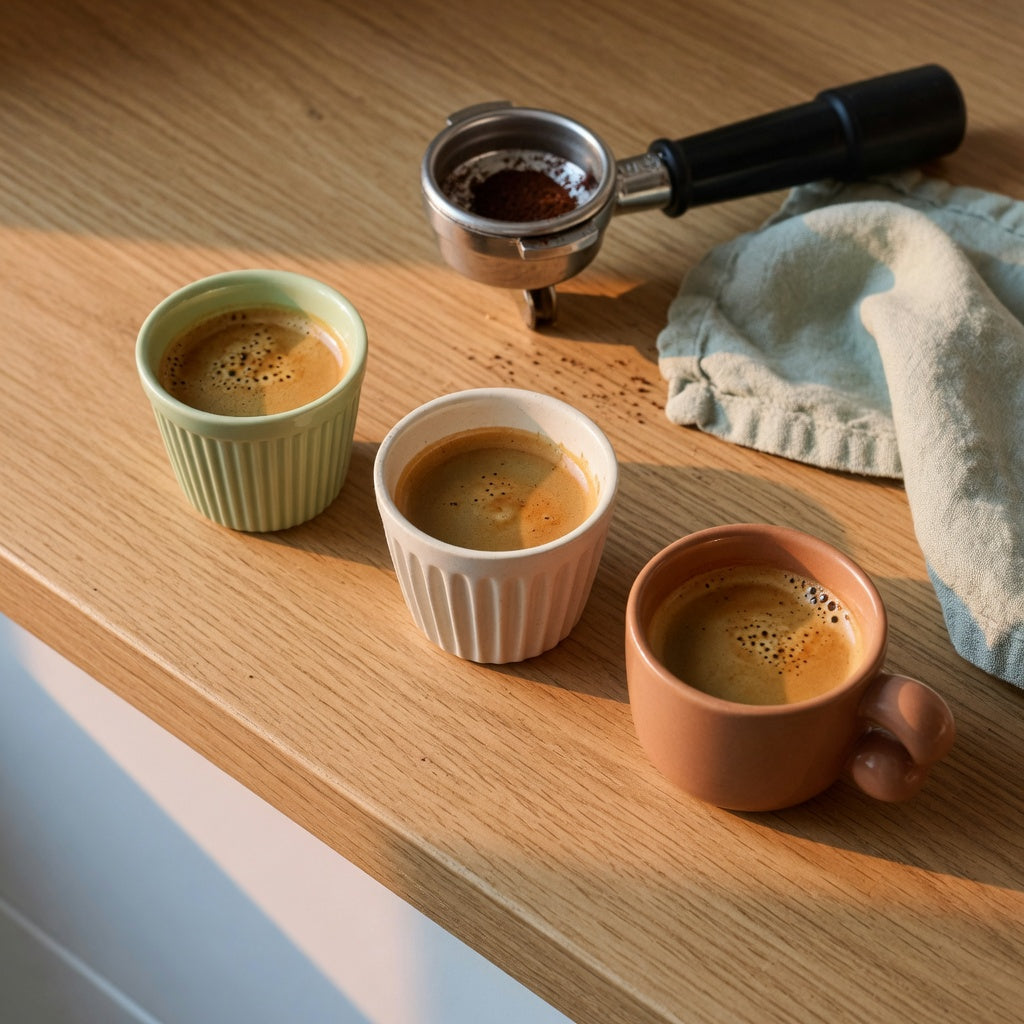
Unique Espresso Cups Everyday Mug Rotation Product Shortlist Guide
Reading time: about 9 minutes
Three cups sit on the shelf above our packing bench, and only one of them gets pulled down every single day. That is the honest test of a rotation: not which cup photographs best, but which one you reach for at 6:40 on a Tuesday when the machine is already warm. If you want a unique espresso cups everyday mug rotation product shortlist guide rather than a gallery of pretty ceramics, start with frequency of use and work backwards to the finish.
We shortlist three compact ceramic vessels at CoffeifyMug, and each one earns its slot by covering a different habit: the Retro coffee and tea cup at 170 ml, the Pleated coffee and tea cup at 200 ml, and the Ball Handle coffee and tea mug at 250 ml. Each one also has a clear reason to be skipped, and we would rather tell you that now than have the cup sit unused by week three.
Why does your weekday shot count beat the cup's looks?
A certified Italian single espresso is roughly 25 ml; the older specialty-coffee definition puts a single at 25–35 ml. Buying advice for the cup itself lands much higher, commonly 50–100 ml, with a demitasse often described as around 60 ml. That gap is crema and headspace. It explains why a 170 ml cup is not absurd for espresso and why a 250 ml vessel is really a small milk-drink or tea mug instead.
Map the three listed capacities onto the pours you actually make:
- 170 ml — Retro. A double shot with generous headroom, or a small cortado. Closest to traditional demitasse proportions.
- 200 ml — Pleated. Cortado and piccolo territory, where milk and coffee stay close to even.
- 250 ml — Ball Handle. A long black, a small latte, or tea. Not a straight-shot cup.
The unique espresso cups everyday mug rotation product shortlist guide, at a glance
This is the table we would hand someone standing at the counter with their phone out. The choose and skip columns are deliberate. A cup that fights your routine stops getting used, no matter how good it looks on open shelving.
| Cup | Listed capacity | Rotation slot | Choose it if | Skip it if |
|---|---|---|---|---|
| Retro coffee and tea cup | 170 ml | Daily double-shot cup | You pull one or two straight doubles most mornings and want something that reads as an espresso cup rather than a mug | You want a true 25–35 ml single-shot demitasse, or you drink 8 oz lattes |
| Pleated coffee and tea cup | 200 ml | Cortado and milk-drink cup | You alternate between straight espresso and cortados, so one cup has to hold both without a second wash cycle | Cabinet space is tight and you only ever drink shots straight |
| Ball Handle coffee and tea mug | 250 ml | Long drink and tea mug | You want a handle on the cup and you drink tea or longer blacks from the same shelf | You want espresso-cup proportions, or your shelf gap is shallow |
What the table deliberately leaves out: dishwasher behaviour, microwave safety, stackability and thermal shock. Those vary by finish and by listing, so they belong in the questions you put to the seller rather than in a blanket promise from us.
Which cup fits a double-shot morning versus a cortado afternoon?
Three shopper situations cover most of what we see at the counter.
- Two straight doubles before work, nothing else. Take the 170 ml Retro cup. It gives you espresso-cup proportions with room for crema, and it will not look like a half-finished latte the way a wider vessel can. Skip the 250 ml here unless you also drink tea from the same shelf.
- Espresso on weekdays, cortados on weekends. The 200 ml Pleated cup is the one-cup compromise — enough volume for a milk drink, still small enough that a double does not look lost. Skip it if you never add milk and your cabinet is already crowded.
- Tea, long blacks, and anyone who wants a handle. The 250 ml Ball Handle mug is the only one of the three designed around a handle. Choose it for tea and longer drinks; skip it if espresso-cup scale is the point of the purchase.
If none of those three matches your habit, shortlist the wider unique coffee mugs collection by capacity first and finish second — it is far easier to fall for a glaze after the size already works than to talk yourself into a size you will not use.
What fit checks retire a cup by week three?
Cups rarely get retired for looks. They get retired because they do not fit, do not stack, or are annoying to wash. Screen for these before you commit:
- Group-head clearance. Measure the vertical gap between your drip tray and the portafilter, then compare it with the cup's outer height. Listings rarely publish that number, so ask.
- Outer base diameter. A base wider than your drip-tray grate rocks while the shot pulls. Ask for the measurement instead of guessing from a photo.
- Handle versus tray and scale. The Ball Handle mug is the one to check here — a protruding handle can foul a narrow drip tray or sit awkwardly on a scale platform.
- Rim shape. A rim that narrows sharply makes it hard to get your nose over the crema, which is why heavily sculpted cups often look better than they drink.
- Preheating habit. Thick ceramic pulls heat out of a small shot quickly. Many baristas park cups on the warming tray; at home a 30-second fill with hot tap water does the same job.
Does a dark or metallic interior cost you the crema read?
Yes, and it is the trade-off we raise most often. A white or clear interior lets you judge crema colour and tiger-striping in the first ten seconds after a shot. A dark, reactive or metallic interior looks striking on open shelving and hides exactly that information. Neither is wrong — but if you are dialling in a new bean, taste from a pale-interior cup and save the statement piece for the second shot.
Rim feel matters too. A thin rim reads hotter and sharper on the lip; a thicker rim feels softer but draws more heat out of the coffee. If you drink fast, thin is usually kinder. If you sip slowly over ten minutes, the difference is mostly academic.
How much cabinet space does a three-cup rotation actually take?
More than people expect, because rotation is a storage decision as much as a drinking one.
Do not assume stackability. Straight-sided cups often nest; flared rims and handles usually do not. Our listings make no stacking claim, so treat all three as non-stacking and plan shelf height around the tallest — the 250 ml Ball Handle.
Saucers roughly double the footprint. Inside a closed cabinet that is fine. On open shelving, a saucer-free rotation of three looks tidier and gets used more, because nobody has to unstack anything before the first coffee of the day.
Which food-safety questions are worth asking about a bright glaze?
Unique ceramics are the category where a two-minute check earns its keep. The FDA notes that lead in ceramic glazes or decorative decals can leach into food and drink if the ware is not properly fired, and that washing or boiling will not remove lead from pottery. It flags higher-risk pieces as handmade ware with a crude or irregular look, antiques, damaged or worn items, flea-market finds from unknown makers, and ware brightly decorated in orange, red or yellow.
Two references are worth quoting when you email a seller. The FDA chemical-contaminants listing sets an action level of 0.5 µg/ml leaching solution for lead in ceramicware cups and mugs. Separately, 21 CFR 109.16 requires ornamental ceramicware that could reasonably be used with food to carry a conspicuous “Not for Food Use” label or a hole through the food-contact surface. Practical translation: if the base says not for food use, believe it; if a seller cannot describe how a reactive or brightly coloured glaze was tested, choose a different cup.
What belongs on a 60-second pre-checkout list?
- Measure the clearance under your portafilter, then compare it to the cup height once you have the number from the listing.
- Name your most common pour — a 25–35 ml single, a double, or a cortado — and pick capacity from that, not from the product photo.
- Confirm the handle clears your drip tray and your scale.
- Decide how much you care about judging crema, then pick interior colour accordingly.
- Ask the seller directly about food-contact testing, dishwasher and microwave limits, and whether the cup stacks.
- Count your shelf. Three cups plus two saucers is more space than most people budget for.
Buy for the weekday, not the weekend. For most shoppers that means starting with the 170 ml Retro for straight doubles and adding the 200 ml Pleated only once milk drinks become routine — buying the largest size first is the most common way a rotation ends up sitting untouched. When you are ready to compare shapes side by side, work through the full unique coffee mug range with your capacity shortlist already written down.
Frequently asked questions
Is a 170 ml cup too big for a double espresso?
No. The drink itself is 25–35 ml for a single, but the cup needs headroom for crema and aroma, which is why buying guidance commonly lands at 50–100 ml. At 170 ml you have a comfortable double or a small cortado without spilling into mug territory.
Do I need to preheat a ceramic espresso cup?
It helps, especially with thicker-walled cups that absorb heat from a small shot. A 30-second fill with hot tap water, or storing cups on the machine's warming tray, keeps the coffee from going lukewarm in the first minute.
Are these cups dishwasher and microwave safe?
Check the current product listing rather than assuming. Hand-painted decoration, metallic lustre and gold rims commonly need hand washing, and anything with metallic trim should stay out of the microwave. If a listing does not state it clearly, ask before you buy.
How can I tell if a handmade espresso cup is safe to drink from?
Ask the seller for food-contact testing information and check the base for a “Not for Food Use” mark. The FDA sets a 0.5 µg/ml lead action level for ceramicware cups and mugs, and it warns that washing or boiling cannot remove lead from improperly fired pottery — so a vague answer is a reason to walk away.
Which cup should I buy first if I only want one?
Build your unique espresso cups everyday mug rotation product shortlist guide around frequency: if straight doubles dominate your week, start with the 170 ml Retro cup and add the 200 ml Pleated only when milk drinks become a habit. Buying the largest size first is the most common reason a rotation goes unused.
More from our blog
Read more
14 oz Ceramic Coffee Mugs Replacement Purchase Product Shortlist Guide
A replacement-focused shortlist method for 14 oz ceramic coffee mugs: convert brim capacity to a real pour, match the old mug's failure to a fix, and compare three concrete capacities with reasons ...
Read more
Big Latte Mug Everyday Mug Rotation Practical Purchase Checklist
A big latte mug only earns its cabinet space if it fits your hand, shelf, machine, and cup holder. This big latte mug everyday mug rotation practical purchase checklist walks through 400 ml, 440 ml...
Read more
Leave a comment
This site is protected by hCaptcha and the hCaptcha Privacy Policy and Terms of Service apply.