
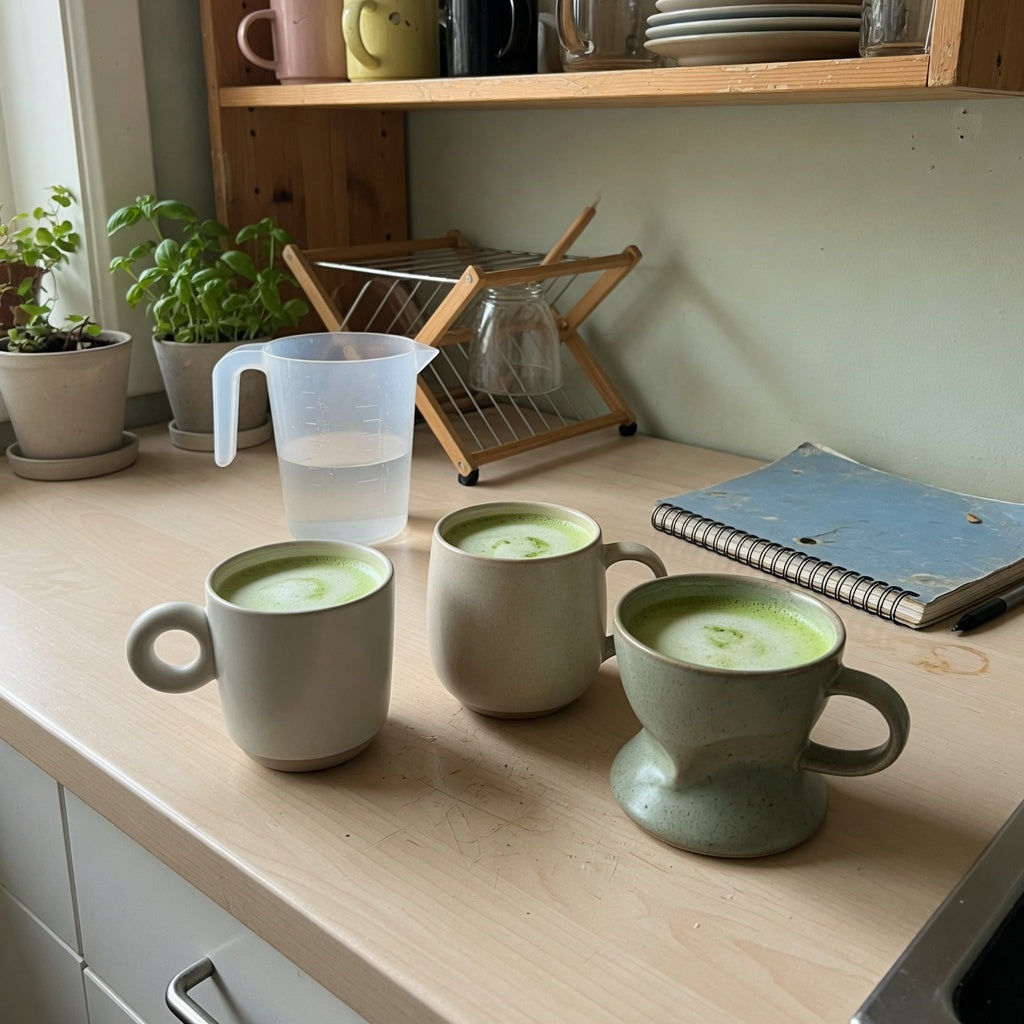
Matcha Latte Mug Everyday Mug Rotation Practical Purchase Checklist
Reading time: about 9 minutes
At 8:40 in the morning, one mug is beside the laptop, another is still damp on the drying rack, and a third is blocked behind dinner plates in the cabinet. That is where mug-buying decisions become practical. Our matcha latte mug everyday mug rotation practical purchase checklist starts with the amount you actually drink, the space you actually have, and the number of times a mug moves from counter to desk to sink.
We sell and handle mugs in this category, and we start comparisons with facts we can verify. For these three CoffeifyMug styles, those facts are the listed capacities, the Ball Handle mug's listed 11.2 cm diameter, and the visible differences in opening shape. We do not turn those details into unsupported claims about durability, whisking, heat retention, care compatibility, or ceremonial use.
How many mug turns does your week create?
An everyday rotation is a small workflow. Before choosing a capacity, follow your current mug for three normal days. Note where it waits after use, whether you rinse it immediately, and how many clean mugs you need before the next wash cycle.
- One drink followed by an immediate rinse: Capacity accuracy matters more than owning several similar mugs. Measure the drink you finish rather than choosing extra volume automatically.
- Kitchen-to-office use: Check the desk space, route from the kitchen, and place where the mug sits after the drink is finished. A larger listed capacity does not tell you the exterior footprint.
- Two or more mugs in active rotation: Shelf and drying-rack space become part of the purchase. Do not assume mugs will stack or nest unless the current listing explicitly confirms it.
- Shared household rotation: Different capacities can reduce mix-ups and suit different serving sizes, but mixed silhouettes require more careful storage planning.
Frequency of use is not evidence of durability. It simply reveals which details create daily friction. A mug can look right in a product photo and still be the wrong choice if its capacity misses your usual pour or its unverified footprint does not suit your cabinet.
250 ml, 390 ml, or 400 ml: which capacity matches your pour?
Use your current drink as the measuring tool. After preparing it normally, recreate the fill line with water and transfer that water to a marked measuring jug. This gives you a useful finished-volume figure without relying on recipe names such as small, regular, or cafe size.
| Option | Verified catalog facts | Reader situation and fit | Trade-off to check |
|---|---|---|---|
| Ball Handle coffee and tea mug | 250 ml; listed 11.2 cm diameter | Your prepared drink fits comfortably within 250 ml, and a listed diameter gives you one concrete number to compare with your storage area. | It is the smallest listed capacity here. The diameter alone does not confirm total width or whether the handle is included in that measurement. |
| Round coffee and tea mug | 390 ml | Your finished drink is above the 250 ml range but still fits within 390 ml, making this the middle listed capacity. | No exterior dimensions are established by the verified facts used for this comparison. Check the current listing before planning a tight shelf space. |
| Spittoon coffee and tea mug | 400 ml | Your measured serving needs close to 400 ml, or you prefer the visible spittoon-style silhouette over the round form. | It holds only 10 ml more than the Round mug. Capacity alone is unlikely to settle the choice between these two styles. |
The 10 ml difference between 390 ml and 400 ml is easy to overvalue while shopping. If both capacities accommodate your normal drink, compare their visible forms and any current dimensions on the product pages. The Ball Handle's 250 ml capacity creates a clearer separation for shoppers who prepare smaller servings.
What does opening shape change at the sink and desk?
Product images can show whether an opening appears more contained, rounded, or flared. They cannot provide an exact rim measurement unless one is listed, and they do not prove whisking performance. We inspect top and side views because the opening is part of both the cleaning routine and the space a mug appears to occupy beside a keyboard, kettle, or dish rack.
- For a quick sink check: Look at how clearly you can see the interior from above and consider how your usual sponge or brush enters the mug. Treat this as a visual comparison, not a cleaning-performance guarantee.
- For a crowded desk: Do not use capacity as a substitute for footprint. Compare current exterior dimensions or measure the available area before ordering.
- For a gift: The visible silhouette may be more useful than the 10 ml capacity difference between the Round and Spittoon options, especially if you do not know the recipient's exact drink volume.
If none of the three silhouettes settles the decision, compare them with other unique coffee mugs in our collection. Keep the same capacity and storage checks in place as you browse; a different shape is useful only if it fits the recipient's real routine.
Will the mug fit the shelf, drying rack, and office cabinet?
Capacity measures internal volume, not the complete exterior footprint. This distinction matters in a small kitchen. The Ball Handle mug's listed 11.2 cm diameter gives you a starting point, but we would not assume that figure includes the handle or every projecting part unless the current product details say so.
- Measure the usable shelf depth, width, and height rather than the cabinet's outside dimensions.
- Measure the open drying-rack area used by mugs, including any space needed around handles.
- For the Ball Handle style, compare the listed 11.2 cm diameter with your available surface, then verify how the measurement is defined if the fit is close.
- For the 390 ml Round and 400 ml Spittoon styles, check the current product pages for any additional dimensions. Do not estimate their footprint from capacity.
- Plan to store each mug upright unless stackability or nesting is explicitly confirmed.
- Count every mug that normally occupies the same shelf. A single mug may fit easily while a three-mug rotation does not.
This measurement step also prevents a common buying mistake: assuming the 250 ml option must have the smallest overall footprint. Its lower capacity is verified, but capacity by itself does not establish complete exterior size.
What should a matcha latte mug everyday mug rotation practical purchase checklist cover?
Use this checklist before opening several product tabs. It separates verified product facts from the personal measurements only you can supply.
- Measure your finished drink: Record the volume in milliliters after recreating your normal fill line.
- Allow for your preferred serving level: Choose a listed capacity that holds your drink without requiring you to fill the mug higher than you find comfortable.
- Treat 390 ml and 400 ml as close capacity options: The difference is 10 ml, so opening shape may be the more useful deciding factor.
- Inspect the visible opening: Compare top and side product images without assuming that shape guarantees whisking or easier cleaning.
- Measure each storage zone: Include the shelf, drying rack, kitchen counter, and office surface used during a normal day.
- Count active mugs: Buy for the number that will be in use or waiting to be washed, not just for the space occupied by one mug.
- Verify material and care requirements: Confirm current listing details if your routine depends on a dishwasher or microwave. Those compatibilities are not established in this comparison.
- Rule out missing functions: Do not assume included tools, a travel lid, heat retention, stackability, or ceremonial features.
Run the matcha latte mug everyday mug rotation practical purchase checklist once for your kitchen and again for any office or gift setting. The same mug can pass the capacity test and fail the storage test, which is why both measurements belong in the decision.
Which CoffeifyMug option fits each rotation pattern?
- Smaller measured serving plus a known diameter: Start with the 250 ml Ball Handle option. It fits a drink that stays comfortably within 250 ml, and its listed 11.2 cm diameter gives you a concrete storage comparison. Choose another style if your usual serving exceeds that capacity.
- Serving that needs more than 250 ml but fits within 390 ml: Review the 390 ml Round mug. It is the middle capacity, but buyers with tight cabinets should verify exterior measurements rather than assuming a middle-sized footprint.
- Serving close to 400 ml or preference for the spittoon silhouette: Consider the 400 ml Spittoon style. Its extra capacity over the Round is only 10 ml, so select it for that small difference or because its visible form suits your setting.
- Gift purchase or mixed household rotation: Use the unique mug collection to compare silhouettes. If you do not know the recipient's drink volume, avoid presenting any capacity as universally best.
None of these mugs is automatically the best everyday choice. The Ball Handle is not suited to a prepared drink that needs more than 250 ml. The Round and Spittoon options are not sensible picks for tightly planned storage until their relevant exterior dimensions are confirmed.
Which deal-breakers still need verification?
A commercial comparison should also state what it cannot establish. The verified details used here do not support claims about the following:
- Dishwasher or microwave safety
- Heat retention or temperature performance
- Whisking performance
- Ceremonial authenticity or suitability
- Included whisks, lids, spoons, or other tools
- Stacking, nesting, or resistance to everyday wear
If one of those features is required, verify the current product details or contact our store before checkout. A different mug with explicitly documented care or accessory information is a better choice than relying on a product photo. This is especially relevant for gifts, where an unverified expectation often appears only after unboxing.
Frequently asked questions
What should I check first in a matcha latte mug everyday mug rotation practical purchase checklist?
Measure the volume of the matcha latte you normally finish. Then compare that figure with 250 ml, 390 ml, and 400 ml before checking opening shape and storage space. Starting with the drink volume quickly rules out options that are too small.
Is a 250 ml Ball Handle mug large enough for a matcha latte?
It is large enough only if your prepared drink fits comfortably within the listed 250 ml capacity. Recreate your normal fill line with water and measure it rather than relying on a recipe label. Choose the 390 ml or 400 ml option if your measured serving exceeds the smaller capacity.
Should I choose the 390 ml Round mug or the 400 ml Spittoon mug?
The capacity difference is only 10 ml. If both hold your normal serving, compare the visible opening shapes and verify any exterior dimensions needed for your shelf or desk. Do not assume one performs better for whisking or retaining heat.
Are these matcha latte mugs dishwasher and microwave safe?
This comparison does not establish dishwasher or microwave compatibility. Check the current product listing or ask our store before buying if either is essential to your routine. Appearance and mug shape are not reliable evidence of care safety.
Can the Ball Handle, Round, and Spittoon mugs be stacked?
Stacking and nesting are not verified facts for these products. Plan upright storage unless the current listing explicitly confirms otherwise. Measure the complete shelf area required for every mug in your active rotation.
Your next step: Recreate your normal fill with water, record the milliliters, and measure the shelf or desk where the mug will live. Then compare those numbers with the three linked products or browse the CoffeifyMug collection for a shape that passes the same checks.
More from our blog
Read more
Lungo Coffee Cup Everyday Mug Rotation Practical Purchase Checklist
Compare CoffeifyMug's listed 170 ml, 200 ml, and 270 ml options by measured pour, nominal headroom, wash frequency, and storage limits. This checklist also flags the product details to verify befor...
Read more
Abstract Coffee Mug Everyday Mug Rotation Practical Purchase Checklist
Use actual pour volume, cabinet measurements, care requirements, and rotation frequency to compare the Rhombus 250 ml, Gradient 400 ml, and The Flow 400 ml without assuming unlisted specifications.
Read more
Leave a comment
This site is protected by hCaptcha and the hCaptcha Privacy Policy and Terms of Service apply.