



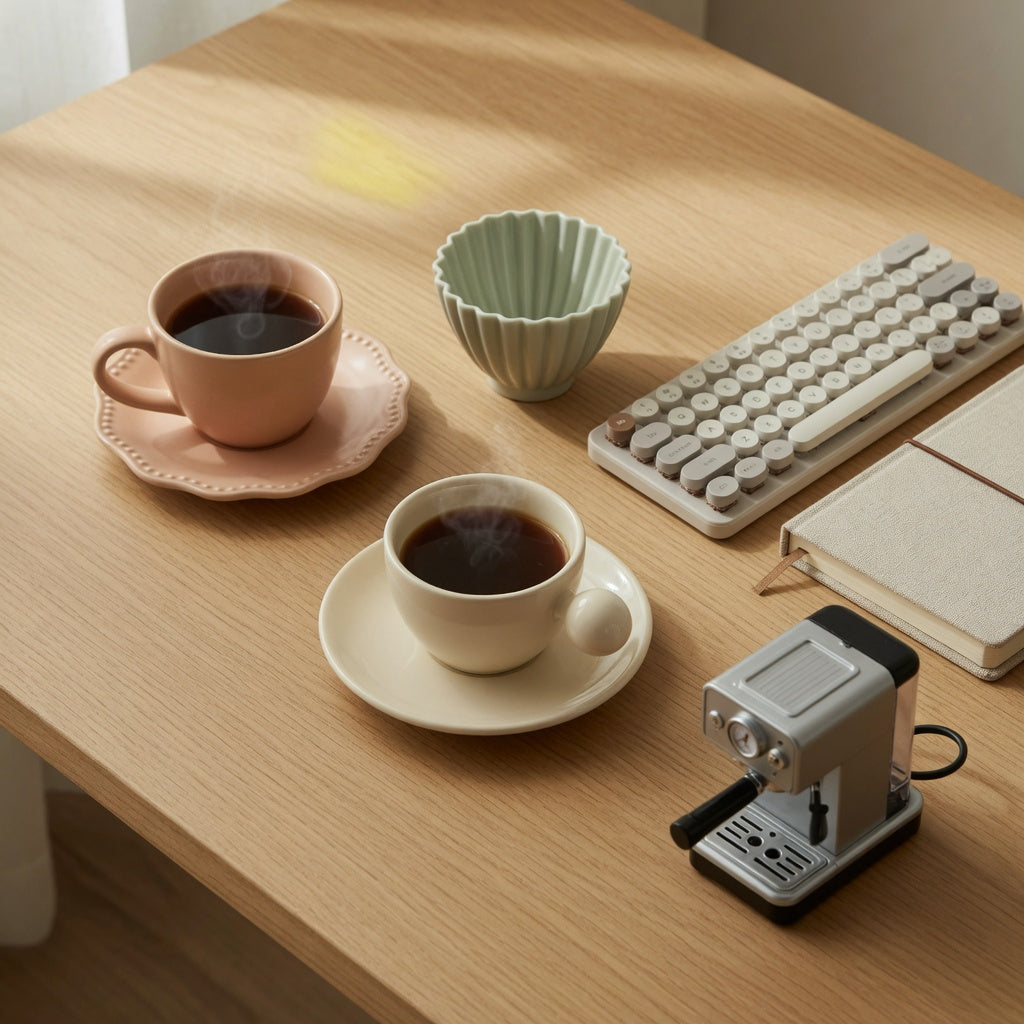
Unique Espresso Cups for Desk Use: Capacity, Footprint, and Fit
Reading time: about 10 minutes
A 250 ml cup looks modest in a product photo and enormous the second it lands next to a keyboard. That gap between how cups are photographed and how they behave on a desk is where most espresso cup orders go wrong — not the glaze, not the colour, but base diameter, handle span, and how many times you have to stand up for a refill. We pack and handle these cups every week, and the questions that come back to us about unique espresso cups for desk use are always the same three: how wide is the foot, will it clear the group head, and will the last sip still be warm.
Here is the short version. Our three ceramic cups are compact, but they are not demitasse-small. They are sized around double-shot and cortado routines, not a 25 ml single. If a strict single shot is what you are after, read the capacity section before you order — it will save you a return.
How much desk space does a unique espresso cup really take up?
The number that decides this is the outer base diameter. Not the rim width, and not the capacity printed at the top of the listing. A 200 ml cup can have a wide foot that fights your mouse sweep, while a narrow cup sitting on a broad saucer can eat more desk than a small mug does.
Three measurements settle it:
- Outer base diameter. This is the only part touching your coaster or desk. A foot ring wider than the coaster leaves a ring of glaze resting on bare wood, which is how you get a faint white bloom on an oak desk.
- Widest point including the handle. A cup is often two or three centimetres wider at the handle than at the body, and that handle is what collides with a monitor stand or the corner of a notebook.
- Height with the saucer underneath. Relevant if the cup lives under a monitor riser or on a shelf above the keyboard.
The saucer is the sneaky one. It adds clearance on every side, which is exactly what a tight corner does not have. If your desk is genuinely narrow, skip the saucer and use a coaster — you lose the visual ceremony and gain two fingers of mouse room.
Our listings lead with capacity and finish because that is what photographs well. Base diameter, height, and handle span are the numbers worth confirming on the current listing before you order. In our store we would rather you message us for a measurement than order twice and return once.
Unique espresso cups for desk use: what 170 ml, 200 ml, and 250 ml actually hold
A certified Italian espresso is roughly 25 ml. The older specialty definition of a double runs about 25–35 ml, and a classic demitasse is usually sized somewhere in the 50–100 ml range so there is headroom for crema. Put those numbers next to 170 ml, 200 ml, and 250 ml and the picture is clear: our cups are not single-shot vessels, and they are not pretending to be.
That is a deliberate choice. A cup that holds only a shot is a lovely object and a poor desk companion — three sips, and the thin wall of coffee has already handed its heat to the ceramic. Our cups are sized so a double shot plus a splash of steamed milk, or a full cortado, lands with room to spare.
| Cup | Listed capacity | What that holds in practice | Refill rhythm at a desk |
|---|---|---|---|
| Retro cup | 170 ml | A double shot with a modest splash of milk, or a small cortado | Most frequent refills of the three |
| Pleated cup | 200 ml | A double shot plus a fuller milk pour | Middle ground |
| Ball Handle cup | 250 ml | Closest to a small mug; a longer milk drink with room to swirl | Fewest trips to the machine |
Here is the trade-off almost nobody mentions: pouring 40 ml of coffee into a 250 ml cup does not keep it warm longer. A large empty vessel holds more air, and the ceramic mass pulls heat out of a small volume of liquid. A bigger cup means a longer drink, not a hotter one. If you pour small and brew rarely, the smallest of the three will hold temperature better than the largest.
And the honest limitation: these are not the right cups for a strict single ristretto or a traditional 25 ml serving. For that, buy a true demitasse with a narrow bowl. Our cups suit people who drink doubles, cortados, or a short milk drink while working.
Will the handle clear your keyboard, mouse, and drip tray?
Product pages everywhere, ours included, lead with capacity and finish because that is what sells in a thumbnail. Two measurements that decide daily usability rarely make it onto the page: height from base to rim, and the horizontal span from the cup body to the outside of the handle. Both are worth checking on the individual listing, since they vary by silhouette.
Why each one matters at a desk:
- Group-head clearance. Measure the gap between your drip tray and the underside of the portafilter before you buy anything. A cup that only fits at an angle gets old fast, especially before the first coffee of the morning.
- Handle versus keyboard. A protruding handle pushes the cup out of a tight corner and into your typing space. A handleless cup saves width but forces you to lift by a hot rim.
- Rim thickness. Thick, rounded rims feel warm against the lip and slow the flow; thin rims feel more precise but pass heat straight through. Neither is wrong — try one before committing to a set.
- Interior colour. A light interior lets you read the crema and spot an uneven extraction. A dark or heavily reactive interior hides both, which is fine for drinking and unhelpful for dialling in a grinder at your desk.
If your setup is genuinely cramped, start with the smallest silhouette rather than the prettiest one, then work upward once you know your real clearance.
Which of our three cups fits your desk and your pour?
Match the cup to how you actually drink, not to how the photo looks:
- Narrow desk, one short coffee a day. Go with the Retro cup at 170 ml. It is the smallest of the three and holds a double shot plus a splash without leaving a puddle of empty ceramic around the coffee.
- A small milk drink most mornings. The Pleated cup at 200 ml gives the milk somewhere to go. The pleated wall also gives your fingers something to grip if you pick it up by the body rather than a handle — check the listing for whether that particular piece carries one.
- Two refills before ten, and you hate standing up. The Ball Handle cup at 250 ml is the closest thing here to a small mug. It is the widest of the three, so confirm your handle span and group-head clearance before ordering.
- You want the finishes side by side. Browse the full unique coffee mugs collection — the three capacities above sit inside it alongside shapes that suit a desk less well, and seeing them at the same scale helps.
All three are ceramic, and the finish you see in the photographs is the finish you handle. That matters twice over: ceramic holds heat once it is warm, and a glazed surface is the part you should ask questions about before pouring hot coffee into it.
Glaze, lead, and the question to ask before you pour
This is not only a cheap-import problem. The FDA explains that lead in ceramic glazes and decorations can leach into food or drink if the ware is not properly fired, that some traditional pottery labelled lead free has still shown extractable lead at or above FDA action levels, and that washing or boiling will not remove lead from pottery once it is there. The agency sets an action level of 0.5 µg/ml leaching solution for ceramicware cups and mugs under CPG 545.450.
The FDA also flags the higher-risk categories: handmade pieces with a crude or irregular look, antiques, damaged or worn ware, items from flea markets or unknown makers, and ware brightly decorated in orange, red, or yellow. Under 21 CFR 109.16, ornamental ceramicware that looks usable must carry conspicuous 'Not for Food Use' labelling or a hole through the food-contact surface — because people do drink out of decorative pieces.
What that means when you are shopping for a distinctive cup:
- Check the base for a 'Not for Food Use' mark. If it is there, it is decor, not drinkware.
- Ask the seller for a food-contact statement rather than trusting the words 'lead free' on their own.
- Retire any cup with a worn, crazed, or chipped glaze instead of reasoning that it is only a small chip.
If you need the current food-contact and care documentation for a specific listing here, ask us before ordering. We will not claim a certification we cannot put in writing.
Preheating, washing, and storing a small ceramic cup
Thick ceramic takes longer to heat up than thin porcelain, but it holds what it has. That cuts both ways on a desk. A cold thick cup will pull heat out of a 30 ml shot almost immediately, so a ten-second rinse with hot water before you pull the shot is not fussiness — it is the difference between a warm first sip and a lukewarm one.
Care specifics worth knowing before you buy:
- Rinse with hot tap or kettle water for roughly half a minute while the machine comes up to temperature. Leave the cup on the warming tray if yours has one.
- Confirm dishwasher and microwave suitability on the individual listing. Decorated rims, metallic lustres, and heavily reactive glazes are usually hand-wash items, and abrasive detergent dulls a glaze over months rather than days.
- Do not stack ceramic cups rim to foot. The foot ring of one cup chips the rim of the one below it, and a chipped rim is a discard, not a story.
- Dry feet that trap water. Standing water in a foot ring is how the glaze at the base starts to craze.
If you want glass instead, accept that double-wall borosilicate is a single-cup purchase — it does not stack, and it does not hide a scratch the way an opaque glaze does.
Frequently asked questions
Do unique espresso cups for desk use need to be a specific size?
They need to match your pour, not a standard. A 25 ml single wants a small demitasse; a double shot plus a splash or a cortado wants something in the 170–200 ml range, which is where two of our cups sit. If you routinely pour small and want the coffee to stay hot, choose the smaller vessel rather than the larger one.
Will a 170 ml cup fit under my espresso machine?
That depends on your machine, not the cup. Measure from the drip tray to the underside of the portafilter and compare it with the cup's listed height, leaving a little slack — a cup wedged in at an angle is awkward to remove while it is hot. If a specific height is not shown on the listing, ask us before ordering.
Do I need to preheat a thick ceramic espresso cup?
Yes, especially with a small volume of coffee. A room-temperature cup absorbs heat from a 30 ml shot within seconds. A short rinse with hot water while your machine finishes warming up is enough for most desks.
How many shots does a 200 ml cup hold?
Physically far more than a double, which is the point — the extra room is for crema, milk, and headspace rather than for more coffee. In practice a 200 ml cup suits a double shot plus a fuller milk pour, or a cortado with space to swirl.
Are these cups dishwasher and microwave safe?
Check the individual product listing rather than the category, since glazes and decoration vary between designs. As a working rule we treat decorated rims and reactive glazes as hand-wash items to protect the finish over time.
Start with the capacity you will actually drink: a double plus a splash points to the 170 ml, a regular milk drink points to the 200 ml, and a long desk session points to the 250 ml. Then measure three things — drip tray to portafilter, the desk corner including handle swing, and your usual pour volume — and browse the CoffeifyMug collection with those numbers in hand. If the measurements still do not line up, message us with your machine model and we will tell you honestly whether a cup fits.
More from our blog
Ready to pick your mug? Two ways to save on today's order:
Ordering 1–3 mugs? Get an extra 10% off your 1st order with code 10_OFF Apply 10% Off & Shop Wooden-Handle Mugs →
Gifting 4+ mugs? Buy 3, Get the 4th Free applies automatically at checkout (no code needed; offers do not stack) · Free standard shipping (Nov pre-Christmas delivery: 15–20 calendar days US) · Free replacement if chipped in transit.
Popular mug buying guides: Ceramic Tea Cups & Infuser Mugs · Ceramic Mugs with Lids Compared · Wooden-Handle Tea Infuser Mugs Compared · Christmas & Secret Santa Mugs 2026 · Espresso & Cortado Cups Guide · Cup & Saucer Gift Sets · All 25 Mugs Spec Table · Mug Size Guide · Shipping & Promo FAQ
FIRST ORDER 10% OFF (CODE: 10_OFF) · OR BUY 3, GET THE 4TH FREE


Read more
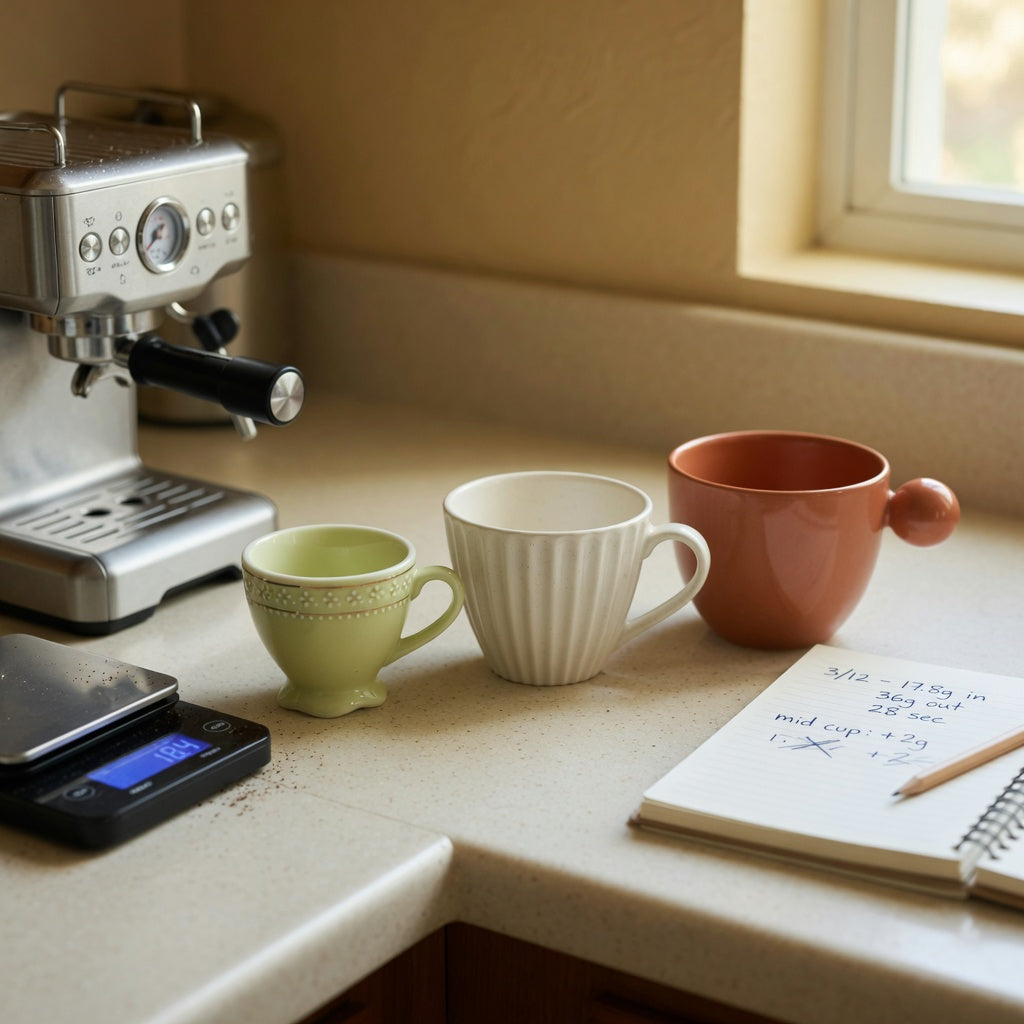
Cute Espresso Cups Size Decision Guide: 170 vs 200 vs 250 ml
A practical size breakdown of our 170 ml, 200 ml, and 250 ml ceramic cups: when the smaller Retro is the better daily choice, when the 250 ml Ball Handle earns its space, and which fit questions to...
Read more
Abstract Office Desk Coffee Mug: What to Compare Before Buying
A practical comparison of abstract office desk coffee mugs: how the decoration method decides dishwasher life, where microwave claims break down, 250 ml versus 400 ml capacity, and what a lead-free...
Read more
Leave a comment
This site is protected by hCaptcha and the hCaptcha Privacy Policy and Terms of Service apply.