



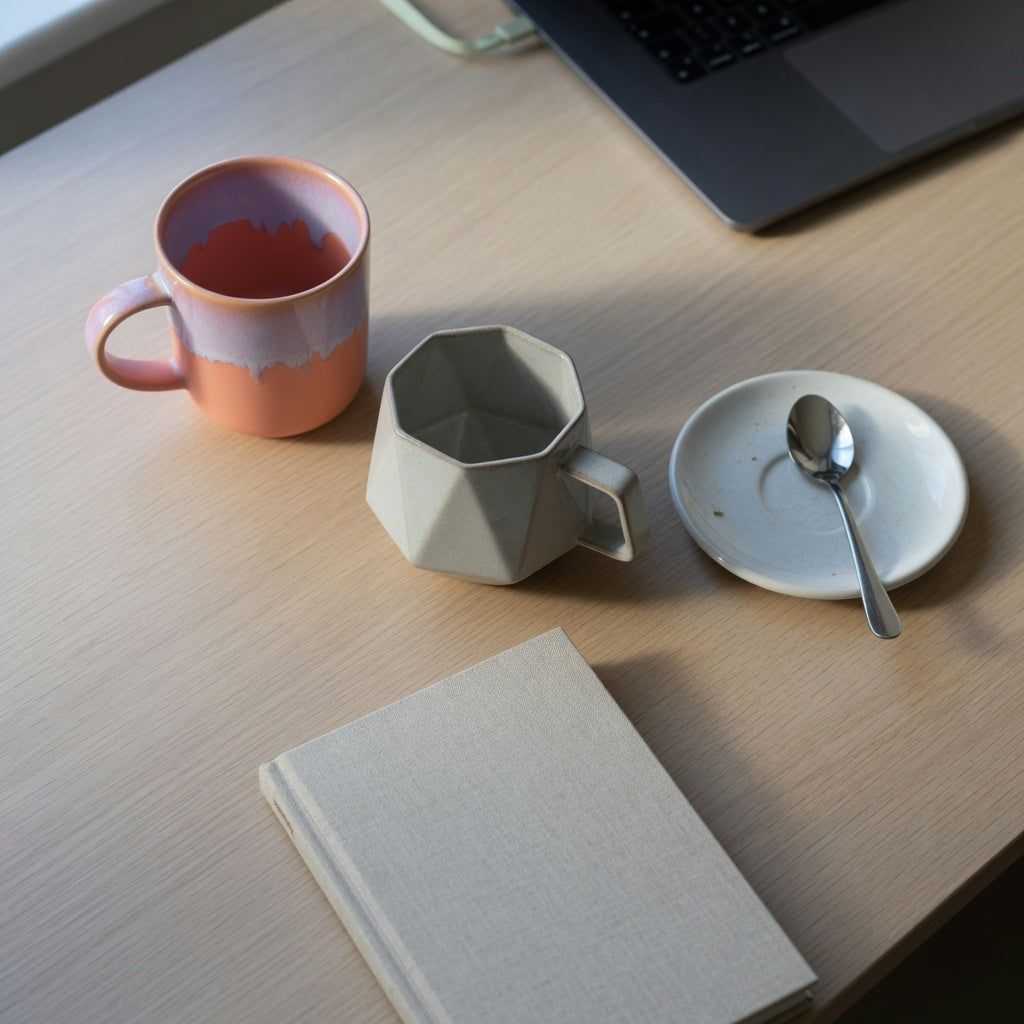
Abstract Office Desk Coffee Mug: What to Compare Before Buying
Reading time: about 10 minutes
Six weeks of a shared break-room dishwasher and the pattern comes back chalky, half erased at the rim. The listing said dishwasher safe. We hear that version of the story regularly enough — usually from someone shopping for a replacement — that it has changed how we describe an abstract office desk coffee mug to customers. You buy it for the pattern. You keep it, or you return it, because of the finish and the care line.
What follows is the comparison we walk people through before checkout: how the decoration is applied, what a microwave claim actually covers, how capacity and footprint change desk life, and which safety statements deserve a close read. Some of these details can only be confirmed on the specific listing, and we flag those rather than guess.
What separates an abstract office desk coffee mug from a slogan mug?
Abstract, in shopping terms, is a style label: non-literal artwork — geometric blocks, colour gradients, flowing curves — instead of a photo, a cartoon, or a joke. It says nothing about who designed the piece or where it came from, and we treat it that way.
The look does three practical things at work:
- It does not age out. A joke has a shelf life and a meeting where it lands badly. Geometry does not.
- It marks ownership quietly. A distinctive pattern is easier to spot in a shared kitchen than plain white, without printing a warning to coworkers on it.
- It survives mixed company. The same mug is fine in a client call and in a lunchroom.
What the label will not tell you: how the design was applied, whether the piece can go in a microwave, or what a hot wash does to it. Those are listing facts, and they differ mug to mug — most sharply between a standard printed body and a heat-changing finish.
Does an abstract office desk coffee mug survive a shared dishwasher?
Two mugs can carry the same abstract pattern and behave nothing alike, because the application method matters more than the badge on the box. Three builds show up most often in this category:
- Decoration fired under the glaze. Detergent and hot water reach glass, not ink. Done properly, this is the most forgiving construction and the least likely to fade.
- A decal applied over the glaze. Fine for daily hand washing; more exposed to heat, detergent, and abrasion over hundreds of cycles. A faint line circling the artwork — a seam where a transfer wrapped — is the usual tell.
- A heat-sensitive or colour-transition coating. The changing appearance comes from a coating, and that coating is the most delicate part of the mug. Listings for this type often rule out dishwashers, microwaves, ovens, and hard scrubbing in the same paragraph that markets it for office use.
So the useful question is not 'is this mug dishwasher safe' but 'is this exact finish dishwasher safe.' If hand washing appears anywhere in the care block, believe it over the headline. If a product photo shows a seam running through the pattern, treat the top rack as an occasional favour rather than a routine.
One variable buyers underestimate: office dishwashers are often commercial units running hotter and longer than the machine at home. A mug that survives an apartment cycle can still dull in a break-room cycle. That is not a defect. It is a mismatch between the finish and the wash cycle it lives in — and it is the single most common reason we see abstract prints come back looking tired.
Where microwave claims break down: metallic detail and colour-transition coatings
USDA's Food Safety and Inspection Service advises using only cookware specially made for microwave use, notes that microwave-safe glass and ceramic are usually labelled as such, and lists china with metallic paint or trim as not safe. The agency also defines arcing — sparks thrown when microwaves react to metallic materials such as gold paint — and warns that prolonged arcing can damage the oven or the dish.
A 2016 CPSC recall shows why that matters. Roughly 14,000 white ceramic coffee mugs with gold-painted monograms and accent rims were sold as microwave and dishwasher safe when they were not; the agency said the metallic accents could spark and pose a fire hazard. The company received one report of sparking and no reported injuries.
Abstract designs lean on exactly the details that cause this: thin metallic lines, luster washes, flecks of gold or copper worked into a gradient. A blanket microwave-safe claim does not automatically extend to metallic decoration layered on afterwards. If you can see metal anywhere in the pattern — including a rim band you only notice from the side — reheat in a plain mug or pour the coffee out first.
Colour-transition finishes are the second grey zone. Some are built for microwave use, some are expressly excluded, and the difference is invisible in a product photo. Read the care block for the specific piece. If it is silent, treat it as hand wash and no microwave until the seller says otherwise — that is the assumption we suggest to anyone buying a heat-changing mug for a desk they do not control.
250 ml or 400 ml: sizing the mug to your actual pour
Our own abstract range splits cleanly — a 250 ml geometric form and two 400 ml shapes — and that is a real fork in the road, not a cosmetic one.
- 250 ml is a short-drink mug. Espresso, cortado, a small filter coffee, repeated tea top-ups. Less desk real estate, lighter in the hand, and it cools quickly: ideal if you finish a drink in five minutes, frustrating if you like one to last through a call.
- 400 ml is a session mug. One fill covers a long meeting or a slow morning. The trade-offs are weight when full and a wider exposed surface, so it cools faster than the volume suggests unless you sip steadily.
Four measurements decide whether a mug actually works at a desk, and none of them is the capacity number:
- Base diameter. A wide base resists knocks; a narrow one fits a crowded coaster zone but catches an elbow more easily.
- Overall height. Measure clearance under your single-serve brewer or dispenser spout before you commit.
- Handle opening. Wide enough for two fingers plus a thumb, or it becomes a two-handed mug.
- Full weight. A 400 ml mug plus coffee is noticeably heavier to lift from a keyboard-side position, especially on the fifth refill.
If your desk is really a laptop on the kitchen table, the same variables apply with more room around them — but the sizing logic does not change.
Which way does the pattern face when the mug is sitting still?
A one-sided print forces a decision. Does the artwork face you while you work, or face the room? Facing you means the design is visible for hours and the blank side greets visitors. Facing outward turns the mug into a small desk object and leaves you looking at bare glaze all day. Wraparound patterns remove the question at the cost of artwork that gets interrupted at the handle.
Most listings photograph a single angle and never state which way the primary image runs. It is a two-line email to ask, and it saves a return.
Lead and cadmium: reading past a lead-free label
This is the section most buying guides skip, and it matters most for a vessel you refill every day. FDA's compliance guidance sets an action level of 0.5 micrograms per millilitre for lead leaching from cups and mugs, measured across six units tested. The cadmium action level for small hollowware under 1.1 litres is also 0.5 micrograms per millilitre.
Two practical consequences follow.
- Lead-free is a narrow claim. FDA has stated that ceramicware with extractable lead should not carry the label, and the agency has reported imported pottery marked lead free that still released extractable lead. A label is a starting point, not a lab report.
- You cannot see it. California's Department of Public Health is direct that appearance does not tell you whether a dish contains lead. The same guidance flags decoration applied on top of the glaze, bright colour on interior food-contact surfaces including the upper rim, and handmade pieces whose glaze chemistry is unknown.
The drink itself matters too. Coffee and tea are acidic, and CDPH notes that acidic beverages increase the chance of leaching from lead-bearing tableware — as does microwaving in it. For a desk mug, the microwave question and the food-contact question are really the same question.
What we look for on a listing: an explicit statement about the food-contact surface and the decoration, plus a care block that matches how you will actually use the mug. If both are missing, ask before buying. Any seller should be able to answer.
Matching form to desk habits: Rhombus, The Gradient, The Flow
Three shapes, three different jobs:
| Mug | Stated capacity | Form | Desk fit | Confirm on the listing |
|---|---|---|---|---|
| Rhombus | 250 ml | Geometric | Short coffees, tea top-ups, small desks | Base width, handle opening, brewer clearance |
| The Gradient | 400 ml | Colour-transition finish | Long morning coffee, slow sipping | Care instructions for the transition finish |
| The Flow | 400 ml | Sculptural curves | Desk object plus session-sized pours | Care line, base stability, full weight |
The Rhombus at 250 ml suits anyone who drinks short and often, or works at a desk where coaster space is contested. Its geometric form reads as pattern from across the room, which is the useful trick of an abstract design in a shared office: recognisable without being a statement.
The Gradient at 400 ml is the long-morning option, and its colour-transition finish is the detail that needs the most verification. Confirm the care instructions for that specific finish before you commit to a daily dishwasher habit, because the coating is the part that decides.
The Flow at 400 ml trades printed pattern for sculptural curves. It is the pick for someone who wants an abstract object on the desk rather than an abstract image, and it holds the same session-sized pour as the Gradient.
To see the three alongside the rest of the range, start with the unique coffee mugs collection.
What changes when the mug is a gift for a coworker?
Abstract patterns are the safest gift category in an office context precisely because they are not saying anything. A joke mug can land wrong with a new hire or a manager. A geometric form cannot.
Two checks before it gets wrapped. First, whether the care instructions fit the recipient's real routine — a hand-wash-only colour-transition mug is a poor gift for someone who runs the dishwasher nightly. Second, whether a company logo is involved. Logo mugs read as swag; a personal abstract piece reads as a gift, and if you are buying for a colleague rather than yourself, say so when you ask the seller about care.
Frequently asked questions
Will an abstract office desk coffee mug fade after a few dishwasher cycles?
It depends on the decoration method, not the brand or the capacity. Fired-under-glaze prints usually hold up; surface decals and heat-sensitive coatings are more vulnerable, especially in a hot commercial cycle. Follow the care line for that exact mug, and hand wash if you can see a seam running through the artwork.
Can I microwave an abstract mug that has a gold rim or metallic flecks?
Don't. USDA's FSIS lists china with metallic paint or trim as unsafe for microwaves, and a 2016 CPSC recall involved mugs with gold-painted accents that were mislabelled microwave safe and could spark. A general microwave-safe claim does not cover metallic decoration added afterwards.
Is 250 ml enough for office coffee?
For espresso, cortado, or repeated small pours, yes. If you want one fill to last through a long meeting, 400 ml is the more realistic size — just expect a heavier mug and faster cooling across the larger surface.
Does a lead-free label mean the mug is safe?
Not on its own. FDA has reported imported pottery labelled lead free that still released extractable lead, and California's public health department notes you cannot judge by appearance. Look for an explicit statement about the food-contact surface and the decoration, and ask the seller when it is missing.
Which way should one-sided artwork face on a desk?
Toward you if you want to see the design while you work; outward if the mug is desk decor for visitors. Wraparound patterns skip the decision but get interrupted at the handle.
Start with the care paragraph, not the photo. If the finish fits how you actually wash and reheat, pick the shape that fits how you drink — short and frequent, or one long pour — then confirm the food-contact details before checkout. The three abstract forms in our unique coffee mugs collection are a reasonable place to begin that comparison.
More from our blog
Ready to pick your mug? Two ways to save on today's order:
Ordering 1–3 mugs? Get an extra 10% off your 1st order with code 10_OFF Apply 10% Off & Shop Wooden-Handle Mugs →
Gifting 4+ mugs? Buy 3, Get the 4th Free applies automatically at checkout (no code needed; offers do not stack) · Free standard shipping (Nov pre-Christmas delivery: 15–20 calendar days US) · Free replacement if chipped in transit.
Popular mug buying guides: Ceramic Tea Cups & Infuser Mugs · Ceramic Mugs with Lids Compared · Wooden-Handle Tea Infuser Mugs Compared · Christmas & Secret Santa Mugs 2026 · Espresso & Cortado Cups Guide · Cup & Saucer Gift Sets · All 25 Mugs Spec Table · Mug Size Guide · Shipping & Promo FAQ
FIRST ORDER 10% OFF (CODE: 10_OFF) · OR BUY 3, GET THE 4TH FREE


Read more
Unique Espresso Cups for Desk Use: Capacity, Footprint, and Fit
Our three ceramic cups hold 170 ml, 200 ml, and 250 ml — well past a 25 ml shot. Here is how each one sits on a desk, clears a group head, and changes how often you get up for a refill.
Read more
Elk Coffee Mug vs Tea Cup: What Actually Changes at Checkout
The label says mug; the shape in your hand may say tea cup. Here's how wall profile, stated ounces, heat loss, and dishwasher care really decide an elk coffee mug vs tea cup purchase — and when nei...
Read more
Leave a comment
This site is protected by hCaptcha and the hCaptcha Privacy Policy and Terms of Service apply.