
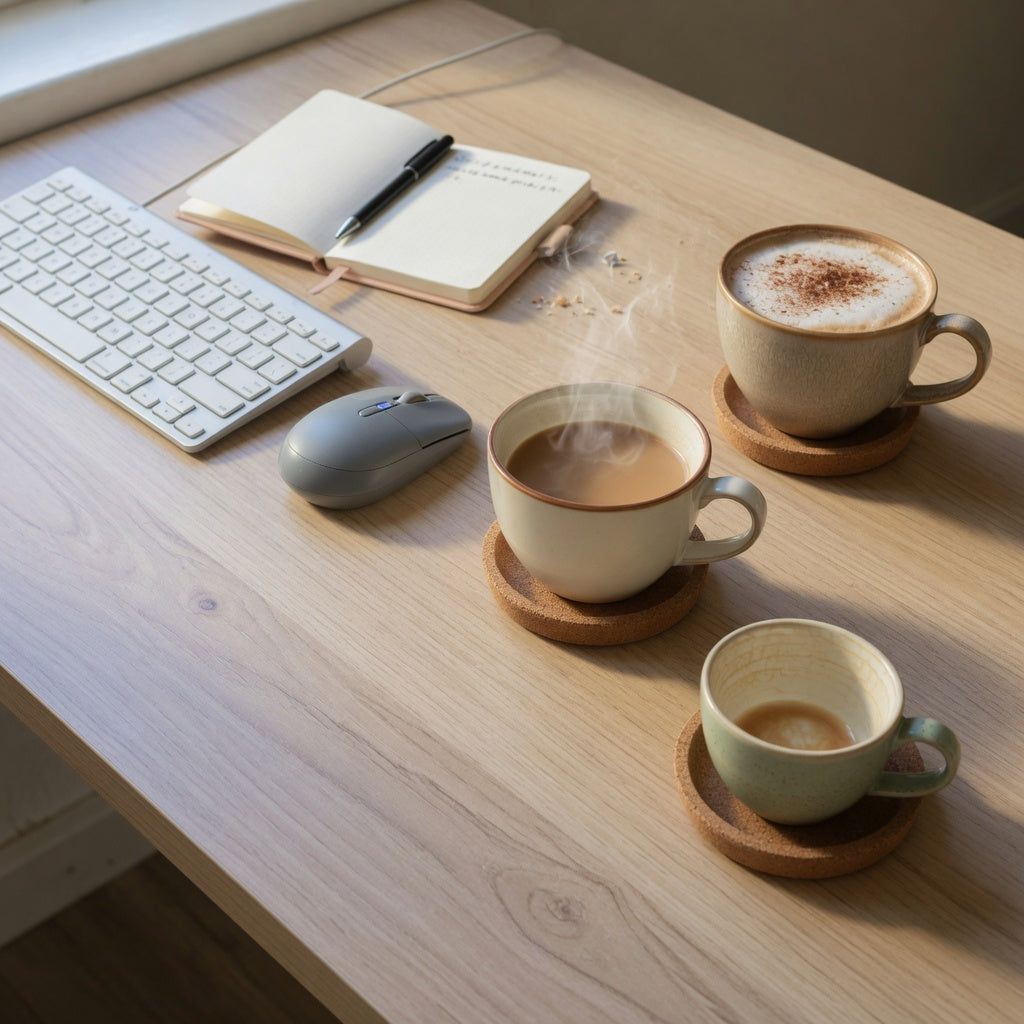
Ceramic Latte Cups for Desk Use: Capacity, Handle, Footprint
Reading time: about 11 minutes
Watch someone at a desk pick up a full latte. If the handle only clears one finger, they tilt the cup toward their body, brace the base against the desk edge, and sip looking down. That small fumble is the whole desk-fit problem in miniature, and none of it shows up in a product photo.
We field questions about ceramic latte cups for desk use every week in our store, and the returns we process almost never involve the glaze or the colour. They involve a cup that was wider than the gap beside the keyboard, or a handle that knocked the mouse on every lift. So this is not a ranking of the best latte cup in the abstract. It is a way to check whether one specific cup survives a full working day next to your keyboard.
Three variables decide that: listed capacity, total width once the handle is counted, and where the handle attaches relative to the rim. For scale, the FDA describes a ceramic cup or mug as small hollowware that normally, though not exclusively, holds about 240 ml (8 fl oz). That is a regulatory category description, not a shopping target — plenty of latte cups run well past it.
Why does a desk punish cups that a café counter forgives?
Café cups are chosen for how the drink looks in the hand for ninety seconds. Desk cups are chosen for what happens forty minutes later, when the cup is half full and you are typing around it. The priorities flip. A wide, bowl-like cup that photographs beautifully becomes the most irritating object on the desk if it sits inside your mouse arc.
Height matters as much as width. A tall cup that rises above your monitor's lower bezel catches your eye every time you glance at the screen, and it will sit in the corner of every video call. A shorter, wider cup drops out of peripheral vision. If you take calls at your desk all day, that is a real consideration, not a fussy one. We hear it from customers who bought for looks first and ergonomics second.
What do 250 ml, 400 ml, and 440 ml actually change?
Our range lists three capacities plainly: 250 ml for the Ball Handle, 400 ml for The Flow, and 440 ml for Morning and Night. Those are the stated volumes of the vessels, nothing more.
Treat them as guidance rather than a pour line. Listings in this category rarely say whether the number is brim-full or a comfortable fill well below the lip, and buyer reviews complain about that gap constantly — a cup sold as 10 oz that takes closer to 8 oz once a foam head and a safety margin are counted. If the exact espresso-to-milk ratio matters to you, ask before ordering whether the listed figure is brim-full capacity.
| Cup | Listed capacity | Drink it suits | Desk situation it fits |
|---|---|---|---|
| Ball Handle | 250 ml | Cortado, flat white, small latte | Keyboard trays, shared benches, tight mouse arcs |
| The Flow | 400 ml | Standard latte | Most desks with room for a coaster beside the keyboard |
| Morning and Night | 440 ml | Large latte, milk-forward drinks | Deep desks, long sessions, fewer refills |
Where do ceramic latte cups for desk use fail on handle clearance?
The handle is the part that breaks the fit. A cup can have a modest base and still claim 12 cm of horizontal space once you count the loop plus the room your knuckles need to get through it. On a desk, that extra centimetre is the difference between a cup that lives beside your keyboard and one that ends up on the floor.
- Measure the loop opening, not the handle length. A loop that fits one finger is technically a handle and genuinely miserable with a full cup.
- Note where the handle attaches. A handle set high near the rim gives you more clearance over the desk surface; a low-set handle puts your knuckles close to the coaster.
- Check which side it sits on when you set the cup down. If you are left-handed and the handle faces right, you will rotate the cup every single time.
- Weigh the cup full, if you can. A heavier cup with a small loop is the combination buyers regret most, because the grip has to do more work.
Handle shape also changes how a cup reads on a desk. A rounded, ball-style handle and a flat strap handle occupy space differently even at the same capacity. Our listings show the shapes in photographs rather than in a dimension table, so study the profile shots and confirm any published measurements on the current product page for the exact cup before committing. That is a question to ask us, not something to assume from a similar-looking cup elsewhere.
How much desk space does a cup and handle really occupy?
Run this five-minute audit before you order. It catches the failures photographs hide.
- Keyboard width. A full-size board can run 44 cm or more, which leaves you whatever desk length remains on each side.
- Mouse arc. Plan on roughly 20 cm of clear travel on your dominant side. A cup placed inside that arc gets hit, not lifted.
- Monitor stand or riser. Anything under about 8 cm of vertical gap will not accept a tall cup, and you will not be able to slide it back out of the way.
- Coaster diameter. A coaster wider than the cup base adds footprint you never budgeted for.
- Paper and notebooks. If you still work from a notepad, the cup goes on the non-dominant side. Plan for that, not around it.
A 440 ml cup is a completely different proposition on a 120 cm desk than on a shallow standing-desk top. If your workspace is genuinely cramped, start at the smallest listed capacity and work upward only once you have measured. You can see all three side by side in our unique coffee mugs collection.
Refill rhythm is a capacity decision, not a heat-retention claim
Here is an honest limitation: we do not publish tested heat-retention times for our cups, and we would be sceptical of any store that does without naming a method and a starting temperature. Wall thickness and mass affect how quickly a drink cools, but so does whether you preheated the cup, the room temperature, and how much foam sits on the surface. Those variables swamp most material differences in ordinary use.
What we can talk about is refill rhythm, which is purely a capacity question. A 250 ml cup means more trips to the kettle, and that is not automatically bad — you drink the last third while it is still hot instead of finding it tepid at 3 pm. A 440 ml cup means fewer interruptions but more liquid sitting unattended. If you routinely forget your coffee exists, a bigger cup does not fix that. It just gives you more cold coffee to pour out.
The practical middle path is a 400 ml cup plus a thirty-second preheat with hot tap water before you pull the shot. That is a habit, not a product claim.
Is the glaze on a daily latte cup something you should actually check?
This is the part of the decision that matters most and gets discussed least. The FDA sets an action level for leachable lead in ceramic cups and mugs of 0.5 micrograms per millilitre of leaching solution, applied to any one of six units tested. For cadmium, the action level is 0.5 micrograms per millilitre for small hollowware and 0.25 for large hollowware. The test method, ASTM C738, uses an acetic-acid extraction the agency itself describes as severe — harsher than ordinary use.
Why that belongs in a desk-cup decision:
- A "lead free" badge is a claim, not a test report. The FDA has reported traditional pottery labelled lead free that still leached at or above its action levels, and states that such labelling can be treated as misleading.
- Firing quality drives the risk. If a glaze is not fired properly, lead in it may not fuse into the surface and can transfer into your drink.
- Some categories carry more risk. The FDA flags handmade, antique, damaged, flea-market, and brightly orange-, red-, or yellow-decorated pieces as higher concern, while describing everyday commercial factory pottery as much less likely to have lead problems.
- You cannot wash it away. Boiling or scrubbing does not remove lead from a problematic piece. Neither does a long dishwasher cycle.
In practice: buy from sellers who can describe their supply chain, retire any cup with a cracked or crazed glaze, and never treat a purely decorative vessel as a daily mug just because it looks food-safe. Every time you finish a drink at your desk, that cup has been in contact with an acidic, hot liquid for twenty minutes or more — the exact conditions the FDA test is designed to probe.
Microwave and dishwasher: the piece decides, not the category
The FDA explains that microwaves are reflected by metal and pass through ceramic, glass, paper, and plastic, which is why ceramic vessels work in a microwave at all. That general fact does not cover every ceramic object. Metallic trim, gold lustre, and applied decals can arc or scorch, and a cracked glaze changes the equation entirely.
Dishwasher tolerance is equally piece-specific. High-temperature cycles and harsh detergents are unforgiving on unglazed foot rings and hand-applied decoration, and the first sign is usually a dulled rim rather than a break. If a listing does not state microwave or dishwasher suitability explicitly for that exact cup, assume neither and hand wash. That is the conservative call, and we would rather say it plainly than let you find out at the sink.
Which of our three cups matches your desk?
Small desk, keyboard tray, or a shared bench: the Ball Handle at 250 ml. It is the smallest listed volume we carry, which makes it the natural starting point when your mouse arc is already tight. It suits cortados, flat whites, and small lattes. It is not the right cup if you want one large drink to last an hour — you will refill twice, and on a busy morning that gets old.
Standard office desk, one latte a day: the Flow at 400 ml. This is the middle of our range and the easiest to place beside a full-size keyboard with a coaster. Confirm the handle orientation in the photos if you work left-handed, and check the listed dimensions against your monitor stand gap before you buy.
Deep desk, long sessions, fewer interruptions: Morning and Night at 440 ml. The largest capacity we list, and the one that rewards a desk with real depth. Expect more weight in hand when it is full, and skip it entirely if your desk is a shallow standing top or you type with your elbows close to the edge.
Before you order, run this list:
- Desk length minus keyboard width — is there at least 12 cm left on your non-dominant side?
- Vertical gap under your monitor stand — 8 cm or more?
- Do you want one large drink, or two hot ones?
- Does the listing for that exact cup state microwave and dishwasher suitability?
- Have you confirmed whether the listed capacity is brim-full or a comfortable fill?
Start with the CoffeifyMug collection and compare the three capacities against your own measurements. If two cups are close, choose the smaller one. A cup you can reach comfortably beats a cup that holds more.
Frequently asked questions
How do I measure my desk for ceramic latte cups for desk use before ordering?
Measure the clear length left on your non-dominant side after your keyboard, then subtract roughly 20 cm for your mouse arc. You want at least 12 cm of clear space for the cup plus handle, and about 8 cm of vertical gap if the cup will sit near a monitor riser. Write both numbers down and compare them to the listing.
Will a cup listed at 400 ml hold a full 400 ml latte?
Usually not to the rim. Foam headspace and a safe margin below the lip take up volume, which is the single most common complaint in this category. Ask the seller whether the listed number is brim-full before you build a recipe around it.
Are CoffeifyMug ceramic latte cups microwave safe?
Microwave suitability depends on the specific piece, particularly if there is metallic trim or lustre on the handle or rim. Check the care notes on the current product page for the exact cup you are buying, and hand wash anything that is not explicitly rated for the dishwasher.
Can I pour latte art in a 250 ml cup?
Yes, though the canvas is smaller, so patterns compress and a tulip or heart is more forgiving than a multi-layer rosetta. A rounded interior helps the milk fold rather than hit a hard corner — check the interior profile in the listing photos, since shape is not always described in the text.
Does a larger cup keep coffee hot longer at a desk?
More volume generally holds heat longer in practice, simply because there is more thermal mass. We do not publish tested hold times, and anyone quoting them without a method is guessing. Preheating the cup with hot water makes a bigger difference than a few millimetres of wall thickness.
More from our blog
Read more

Ceramic Mugs Ideas for Desks and Shelves: A Practical Guide
Explore ceramic mugs ideas tailored for busy workstations and display shelving. Compare verified 170 ml, 400 ml, and 480 ml capacities to match your daily routine.
Read more
Cute Espresso Cups Morning Routine Practical Purchase Checklist
A cup that looks right on the shelf can still be wrong at 6:45 a.m. This is the checklist our team runs before recommending a cute espresso cup — pour volume, refill tolerance, spout clearance, han...
Read more
Leave a comment
This site is protected by hCaptcha and the hCaptcha Privacy Policy and Terms of Service apply.