

Cute Espresso Cups for Desk Use: Capacity, Footprint, Handle Fit
Reading time: about 10 minutes
The cup is usually the first thing to go wrong on a desk espresso setup. Not the grinder. Not the beans. Someone pulls a double into a pretty little demitasse, and the shot sits at the rim, the handle is too hot to hold, and the crema ends up on a keyboard. The overcorrection is just as common: a 350 ml mug that swallows the shot and goes lukewarm before the first meeting ends. Cute espresso cups for desk use sit in the narrow band between those two mistakes, and that band is wider than most shoppers expect.
We sell compact ceramic cups, so we handle this question often. The catalog facts we can stand behind are simple: the Retro coffee tea cup is listed at 170 ml, the Pleated coffee tea cup at 200 ml, and the Ball handled coffee tea mug at 250 ml. All three are ceramic. All three are larger than a traditional single-shot cup. We describe them by listed capacity and visible form rather than by espresso labels, because capacity is the number a desk shopper can plan around.
That planning has three parts: how much desk room the cup takes, how often you will refill it, and whether your hand can lift it cleanly over a keyboard. Get those right, and the cup stops being a problem.
How much desk room do 170 ml, 200 ml and 250 ml cups really take up?
A cup's footprint is more than its base. Add the handle swing, the coaster or saucer, and the clearance your knuckles need when you lift it. On a desk, the tightest spot is usually between the keyboard and the monitor base, or between the machine and the nearest notebook. We cannot give you one universal clearance number, because the catalog facts we can verify are capacity, ceramic body, and visible form; check the current listing for height, rim diameter, and handle opening before you order.
| Cup | Listed capacity | Desk-drink fit | What to verify on the listing |
|---|---|---|---|
| Retro coffee tea cup | 170 ml | Double espresso with headroom, cortado, small flat white | Height under the spout, rim width, handle opening |
| Pleated coffee tea cup | 200 ml | Double plus a splash, macchiato, tea for one | Height, rim width, care note for the textured exterior |
| Ball handled coffee tea mug | 250 ml | Long black, americano-scale drink, standard tea | Height, handle gap, base stability on a coaster |
Use the table as a rough desk map, not a millimeter drawing. The 170 ml cup is the one most likely to tuck into a tight corner. The 250 ml cup is the one most likely to need a dedicated spot, because a fuller cup is heavier in the hand and easier to clip with a mouse cable or a notebook edge.
Refill frequency: is a smaller cup worth the extra pulls?
A traditional single-shot cup is a small, single-purpose object. That is fine in a café where the cup goes back to the bar. At a desk, every refill is a full cycle: stand up, grind, dose, tamp, lock, brew, knock out, wipe. If you drink two shots before a morning call, a tiny demitasse means you are doing that cycle twice. A 170 ml cup takes a double with headroom in one pass. A 250 ml cup is closer to a one-drink-per-meeting vessel.
There is a trade inside that convenience. Crema spreads thinner across a wider surface, and a fuller cup holds heat differently from a small preheated one. If straight shots and crema are the point, go smaller. If you drink a double with a splash at 8 a.m. and again at 2 p.m., go larger and save yourself the standing up.
Material matters less at this size than wall thickness and interior color. Thick ceramic walls hold heat differently from thin walls, and a plain interior makes crema easier to read than a dark or busy pattern. Double-wall glass is a different tool: it insulates well, but it is more fragile in a shared office sink. Match the tool to the desk, not to the photo.
Which of our three ceramic cups matches your desk routine?
We map these by routine, not by abstract drink categories. You can see them together in our unique coffee mugs collection.
Retro coffee tea cup, 170 ml — for the tight corner and the straight-shot drinker
This is the smallest of the three and the natural starting point if your desk drink is a double with a little headroom, or a cortado. The retro ceramic form is decorative without looking fragile. If your priority is keeping the cup tucked between the machine and the monitor base, start here — but confirm the cup height against your spout clearance on the current listing before you commit.
Pleated coffee tea cup, 200 ml — for the double-plus-splash desk
At 200 ml this covers a double plus a splash of milk, or a macchiato, without pushing the drink to the rim. The pleated exterior gives the body visible texture. One honest trade-off: textured surfaces in general can hold dried milk in a way smooth walls do not, so rinse it before the residue sets rather than after. That is a 20-second habit, not a defect.
Ball handled coffee tea mug, 250 ml — for the long-call drink
The largest listed capacity of the three, sized for long blacks, americano-scale drinks, and standard tea. The ball handle is the defining visual feature, so look at listing photos in profile if handle feel matters to you. It also needs the most stable spot on the desk: a fuller cup is heavier and easier to knock. If your routine is one drink that lasts an entire call, this is the shape to pick.
Handle clearance and desk footprint: what should you measure first?
The handle is the first thing you touch and the last thing most shoppers check. At a desk you are lifting the cup over a keyboard, a notebook, and possibly a laptop worth more than the coffee machine. Run these four checks before you order:
- Spout-to-tray height. Measure from the underside of the portafilter spout to the drip tray, then subtract room for a scale if you brew on one.
- Rim outer diameter. Dual spouts pour two streams; a rim much narrower than the spout spacing sends espresso down the outside of the cup and onto the tray.
- Handle opening. This is a hand-size question, not a capacity question. If you wear rings or have large hands, look for a clearly visible opening in the listing photos rather than a snug one.
- Base stability. Check whether the base sits flat on a coaster. A cup that rocks on a wooden desk is a spill waiting for a deadline.
Add roughly 2 cm if you brew on a scale, and check that the cup can sit slightly off-center. Most desks have the machine pushed to one side, not dead ahead.
Do cute espresso cups for desk use fit under a machine?
Maybe. Machine fit is a product-by-product measurement, not a capacity question. A 170 ml cup can be too tall for one machine and fine under another. Measure from the spout to the drip tray, subtract the height of a scale if you use one, then compare that figure with the cup height shown on the current listing.
Also check the rim against your spout spacing. If your machine has two spouts, a narrow rim can catch one stream and miss the other. If you use a mug warmer or a monitor arm, confirm that the cup can sit slightly off-center without touching either. There is no published standard for spout-to-tray clearance, so this is a measurement rather than an assumption.
Glaze safety, dishwasher cycles, and the shared office sink
Ceramic glaze safety deserves two minutes of attention when you buy decorated drinkware online. The U.S. FDA notes that lead in a ceramic glaze is bound when pottery is fired correctly, but an improperly fired glaze may not fuse and can contaminate food. The agency also warns that some pottery labeled lead free has still shown extractable lead, and that ceramicware intended only as decoration must be identified so it is not used with food. The practical translation for a desk shopper: buy pieces sold as drinkware, and keep ornamental ceramics out of the coffee. Plush or purely decorative espresso-cup objects are not drinkware, however cute they look in a search grid.
Cleaning is the other long-term variable. We do not make blanket dishwasher claims across every listing, because decorated and hand-finished glazes vary. The care note on the specific product page is the one that governs that piece. From handling these shapes day to day: rinse milk drinks promptly instead of leaving them until 5 p.m., avoid stacking cups inside each other in a shared sink, and dry the rim rather than letting the cup sit face-down on a wet counter. Chips almost always start at the rim, and a rim chip on a drinking vessel ends its useful life.
When these cute espresso cups for desk use are the wrong buy
Three situations where we would point you elsewhere:
- You drink 350–450 ml in one go. A 170 ml cup means two rounds. Step up to a larger mug rather than nursing a small cup through a long meeting.
- You need insulation, not charm. Ceramic walls transfer heat. A double-wall tumbler holds temperature longer; these cups are for drinking now.
- You need an unbreakable desk cup. Ceramic chips and can shatter on a tile floor. That is the material, not a manufacturing fault.
If you want a true single-shot demitasse for tasting, these are also larger than that use case. They are desk cups that happen to look like espresso cups, not competition-grade tasting cups.
Frequently asked questions
Is 170 ml too big for a single espresso?
For a strict single-shot demitasse, yes — it is larger than a traditional single-shot cup. At a desk, that extra room is usually the point: a double with headroom, a cortado, or a small milk drink fits without reaching the rim. If you want a tiny tasting cup, choose a smaller demitasse.
Will cute espresso cups for desk use fit under my espresso machine?
That depends on your machine. Measure spout-to-tray height, subtract a scale if you use one, and compare that with the cup height on the current listing. Also check rim width against your dual spouts. No single capacity number answers machine fit.
Are the cups dishwasher safe?
Check the care note on each product page — that is the statement that applies to that specific piece. We do not extend one listing's care instructions to another. Hand washing is the safer default for a painted or textured exterior.
Can the 250 ml cup handle tea as well as espresso?
Yes. It is sold as a coffee and tea mug, and 250 ml is a comfortable single-serving tea volume. It is also the roomiest of the three, so it suits a drink you want to last through a call.
Do I need a saucer?
Whether a saucer is included is stated on the product page rather than something to assume. On a desk, a small coaster does most of the work: it catches drips and keeps the base off the wood. If you use a saucer, add its diameter to your footprint.
Before you order, run one quick check: measure your spout-to-tray clearance, judge how much lifting room sits between your keyboard and monitor base, then decide whether you are a one-double person or a nurse-it-through-a-meeting person. Match the capacity to that answer first. The 170 ml Retro cup, the 200 ml Pleated cup, and the 250 ml Ball handled mug are all in the store — pick the size, then let the shape decide.
More from our blog
Read more
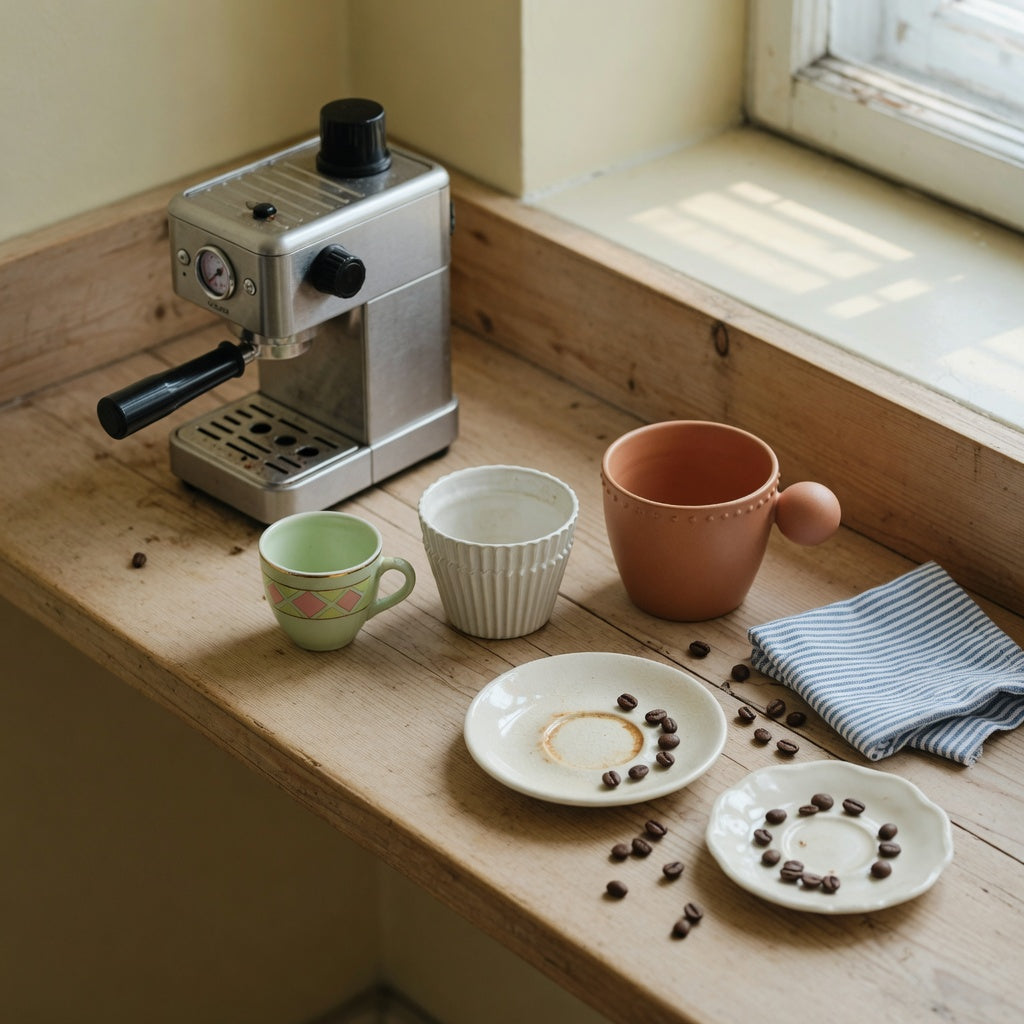
Cute Espresso Cups for Small Coffee Setup: 3 Sizes Compared
Cute espresso cups for small coffee setup counters are a capacity decision before a style decision. We compare our 170 ml, 200 ml, and 250 ml ceramic cups on spout clearance, saucer footprint, and ...
Read more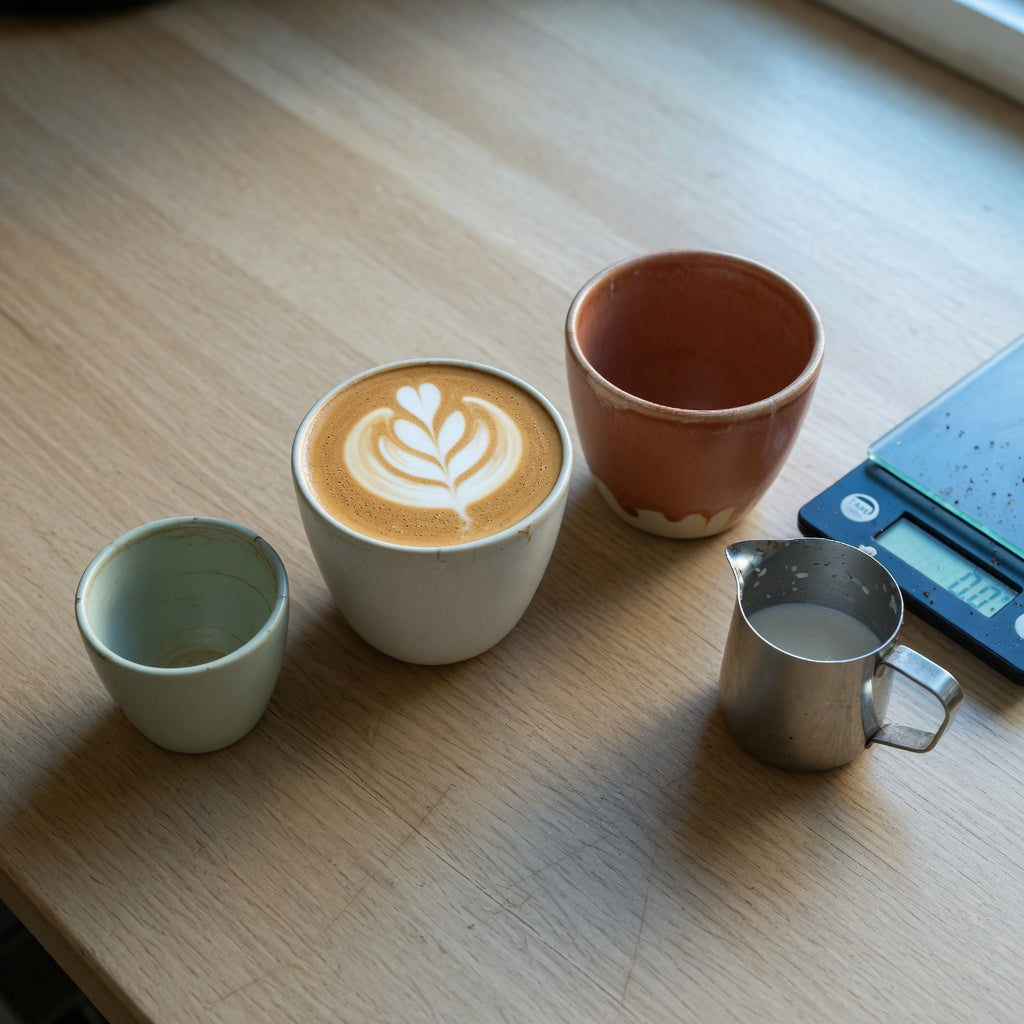
Ceramic Latte Cups Daily Use Guide: 250, 400 or 440 ml?
Listed capacity, foam headspace and handle fit decide whether a ceramic latte cup survives daily use. We compare our 250 ml, 400 ml and 440 ml cups, plus the glaze and care checks worth doing befor...
Read more
Leave a comment
This site is protected by hCaptcha and the hCaptcha Privacy Policy and Terms of Service apply.