
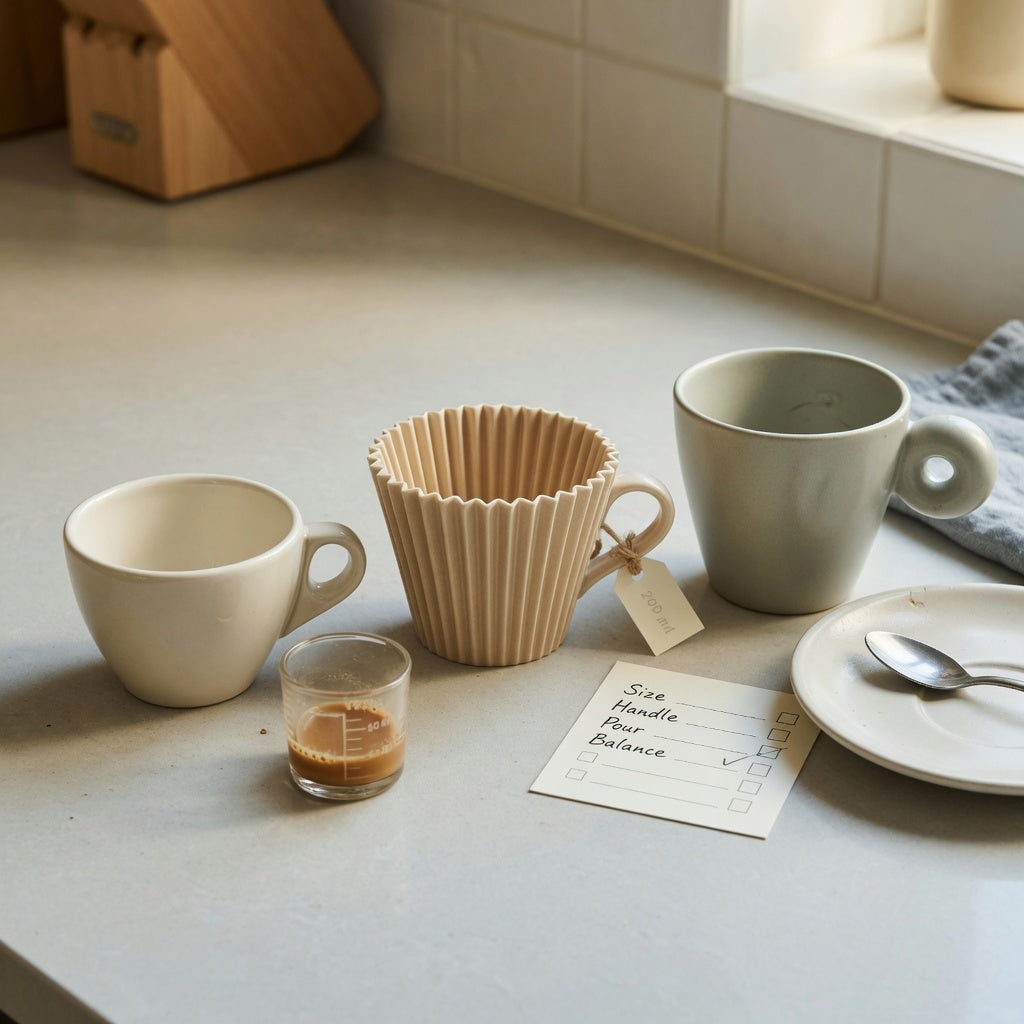
Macchiato Cup First Time Buyer Product Shortlist Guide: 3 Compact Picks
Reading time: about 10 minutes
At our packing table, the same decision appears again and again: three cups look compact in photos, but which one leaves enough room for the drink you actually make? This macchiato cup first time buyer product shortlist guide starts with that kitchen-counter problem. A macchiato-style drink may be espresso with a small amount of milk or foam, but home proportions vary, so capacity is a headroom choice rather than a universal recipe.
In our store, we handle these pieces while checking product listings, packing orders, and preparing gift shipments. The verified catalog facts for this shortlist are simple: Retro is listed at 170 ml, Pleated at 200 ml, and Ball Handle at 250 ml. We can compare those capacities and their visible forms. We will not fill in an unstated material, diameter, height, weight, saucer, or dishwasher/microwave rating. Those blanks matter, especially when a cup is headed for a crowded office desk or a first-time gift.
How does this macchiato cup first time buyer product shortlist guide narrow the choice?
A shortlist should answer one practical question: which listed option matches your routine with the fewest assumptions? We use four checks before putting a cup on a first-purchase list:
- Capacity in milliliters: record the exact number, not a description such as small or espresso-friendly. The verified comparison is 170 ml, 200 ml, or 250 ml.
- Visible form: compare the rounded retro profile, pleated exterior, and ball handle. These are style and handling preferences, not proof of comfort, insulation, stackability, or durability.
- Available space: measure the shelf, counter, or desk area where the cup will sit. Capacity does not tell you the outside footprint, base diameter, handle clearance, or saucer fit.
- Unstated details: mark missing material, dimensions, and care information as unknown. Do not turn a silent product page into a positive claim.
That is the working rule behind this macchiato cup first time buyer product shortlist guide: capacity sets the boundary, visible form sets the style preference, and missing listing data stays marked as unknown.
Pick the smallest listed capacity that gives your usual drink room to sit below the rim, then verify the details that capacity cannot answer.
Which capacity leaves enough headroom for an espresso-and-foam routine?
The three verified sizes form a useful progression rather than three interchangeable choices. 170 ml is the tightest fit for a small espresso-forward pour. 200 ml adds a middle amount of breathing room. 250 ml gives the most flexibility for a little extra milk or foam. These are comparison points, not serving commandments.
Do one honest test before shopping: pour your usual drink into a measuring cup once and note the liquid amount before adding ice, if you use it. That check is more useful than guessing from the word macchiato. If your normal drink already needs more than 250 ml before ice, this compact cluster is the wrong starting point.
- 170 ml: choose for a small pour that should look relatively full; skip if you routinely add generous milk or foam.
- 200 ml: choose for a little visual and practical headroom; skip if your drink is either very small or routinely larger than this.
- 250 ml: choose for the most capacity flexibility in this shortlist; skip if you want a deliberately tiny, near-full serving.
Remember that listed capacity does not reveal the outside footprint. A 170 ml cup could still need a particular amount of shelf or handle clearance, and a 250 ml cup could have a different shape than you expect. Check dimensions on the live listing when space is a deciding factor.
Is Retro 170 ml the right first pick for a tight desk or small kitchen?
If your espresso machine makes a short drink and your home-office desk is already crowded with a keyboard, notebook, and saucer, start with the Retro coffee tea cup. Its verified catalog capacity is 170 ml, the smallest of the three, and the visible retro form gives it a traditional-looking profile.
Choose it when: you want the least spare room in the shortlist and prefer an espresso-forward presentation. The smaller listed volume creates a clear boundary against adding enough milk to turn the serving into a larger cafe-style drink. Measure the available surface anyway: we do not have verified outside dimensions here, so smaller capacity should not be treated as a guaranteed smaller footprint.
Skip it when: your normal pour approaches 170 ml, you like a high foam cap, or you need room for ice. It is not a general-purpose breakfast mug or a good match for a recipient who usually drinks a larger milk beverage. In that situation, open the Pleated or Ball Handle listing and compare the next capacity rather than forcing the Retro to cover it.
Does Pleated 200 ml give a first-time buyer enough room for foam?
Buyers who want a compact cup but do not want to fill to the rim should compare the Pleated coffee tea cup. At a verified 200 ml, it sits between Retro and Ball Handle. Its visible pleated exterior is the main form distinction, so it suits someone who wants texture and a less plain silhouette alongside moderate headroom.
Choose it when: your espresso-and-foam pour varies slightly, you serve small tea portions as well, or you are choosing a first gift without wanting the largest option. In our store, we use the 200 ml size as the middle checkpoint: it makes the capacity trade-off easy to see without pretending there is one correct recipe. The pleats are a style and surface preference; we do not claim they improve grip, insulation, or cleaning.
Skip it when: your priority is the smallest vessel, a completely smooth exterior, or enough room for a drink larger than 200 ml. If the grooves raise care questions, inspect the listing care notes and ask before ordering; a photograph cannot tell you how the material should be washed.
Should a flexible office-to-kitchen routine move up to Ball Handle 250 ml?
If one routine includes a small macchiato-style pour on some mornings, more milk on others, and a short tea serving later, the Ball handled coffee tea mug is the flexible end of this shortlist. Its verified catalog capacity is 250 ml, the largest listed size here, and the ball handle is its defining visible form.
Choose it when: practical headroom matters more than a nearly full small-cup look, or you are buying for someone whose exact serving size is not yet clear. The larger listed capacity gives more room for variation within the compact range. Before an office or narrow-shelf purchase, verify the outside dimensions and handle clearance; the visible ball shape does not tell us either measurement.
Skip it when: you want a strict espresso-forward presentation, prefer a conventional ear-style handle, or routinely need more than 250 ml. It is also a poor match for ice-heavy iced coffee, where the ice itself consumes the available volume. For those situations, a larger or differently shaped cup is a better next step.
What should you verify about material, dimensions, and care before paying?
Capacity is the verified comparison. Material, dimensions, and care need their own check on each live product page because a product photograph and a name such as cup or mug cannot establish them.
- Material: copy the exact material term from the listing. Do not infer ceramic, porcelain, stoneware, glass, or another material from a glossy finish or a warm product photo. For this shortlist, an unstated material remains unknown.
- Dimensions: look for overall height, widest outside diameter, base diameter, handle opening, and stated weight. These details determine shelf, saucer, and hand-clearance questions; milliliters alone do not.
- Capacity basis: check whether the number describes a brim fill, a measured serving, or simply a catalog capacity. If the page does not explain it, use 170, 200, and 250 ml as relative comparisons and leave a little room below the rim.
- Care: look for explicit dishwasher, microwave, hand-wash, and thermal-shock guidance. We do not use an unverified first dishwasher cycle as a test. Until the care note is clear, gentle hand-washing with mild detergent and a non-abrasive sponge is the conservative routine.
- Arrival condition: when unboxing a gift or your own delivery, inspect the rim and base for chips, hairline cracks, rough edges, or a handle join that moves. If the listing identifies a glazed material, also check for pinholes or uneven glaze. These are receiving checks, not claims that a listed product has a defect; photograph any concern before washing and follow the seller's stated process.
These checks take less time than debating three nearly similar photos, and they prevent a familiar first-purchase mistake: filling in missing information with assumptions.
Which compact macchiato cup belongs on your shortlist?
Use this table as a decision filter, not a ranking. The recommendation is conditional on your routine.
| Option | Listed capacity | Choose when | Skip when | Still verify |
|---|---|---|---|---|
| Retro | 170 ml | Small espresso-forward drink and a tight capacity preference | Extra foam, milk, ice, or larger servings | Material, outside dimensions, and care |
| Pleated | 200 ml | Some headroom and a textured visible form | Near-full tiny pour or a smooth exterior is essential | Material, outside dimensions, and care |
| Ball Handle | 250 ml | Variable short drinks and the most compact-range headroom | Strict small-cup proportions or more than 250 ml | Material, outside dimensions, and care |
One option is enough for a first purchase. If two scenarios sound equally true, use Pleated 200 ml as the middle checkpoint, then let visible form and clearly stated listing information break the tie. If the page is silent about a detail that matters to you, keep that uncertainty in the decision rather than calling one cup a safer choice.
When should a first-time buyer skip the compact macchiato range?
Skip all three when your normal drink needs more than 250 ml before ice, a travel lid, or a large breakfast-mug serving. These are compact cups; they are not travel tumblers, large-volume tea vessels, or ice-heavy iced-coffee cups. They may also be the wrong gift for someone who values one large refill-free mug more than a short espresso presentation.
In that case, browse the unique coffee mugs collection for a different form factor, then apply the same checklist to any replacement: exact listed capacity, named material, external dimensions, and written care guidance. A collection link is a starting point, not proof that every item fits your drink; verify the individual listing.
Frequently asked questions
How does a macchiato cup first time buyer product shortlist guide help when dimensions are missing?
Use listed capacity and visible form to rank the options, then record external dimensions as unknown. Measure the available desk or shelf space and contact the seller before buying if clearance matters. Do not assume that 170 ml, 200 ml, or 250 ml implies a particular height, diameter, or handle opening.
Is 170 ml too small for a first-time macchiato cup buyer?
Not necessarily. It suits a small espresso-forward pour with modest milk or foam, but it can feel cramped once your usual drink approaches the listed capacity or includes ice. Choose Pleated or Ball Handle if you need more headroom.
Should I choose 200 ml or 250 ml for extra foam?
Choose Pleated 200 ml when you want a middle amount of room without choosing the largest option. Choose Ball Handle 250 ml when your pour varies more or you want the most headroom in this shortlist. Neither capacity is a universal recipe standard, so compare with your measured routine.
Can I put these cups in the dishwasher or microwave?
Only the individual product listing can answer that. The verified facts for this guide do not establish dishwasher or microwave suitability, and a photograph cannot establish it either. Follow the stated care instructions; if they are missing, use gentle hand-washing and avoid a dishwasher cycle until you have clarification.
Which macchiato cup is best for a first-time gift?
Ask what the recipient usually drinks before choosing. Retro 170 ml suits a compact espresso-forward routine, Pleated 200 ml is the midpoint, and Ball Handle 250 ml leaves the most room; the visible handle or pleated form then becomes a style preference. For larger milk drinks or ice-heavy iced coffee, choose a different capacity from the unique coffee mugs collection.
Before adding a cup to your cart, measure your usual pour once, note the available counter or desk space, and open the listing to confirm material, dimensions, capacity basis, and care. Then choose the smallest of Retro 170 ml, Pleated 200 ml, and Ball Handle 250 ml that leaves practical headroom. If your drink needs more than 250 ml, a lid, or substantial ice, start with the unique coffee mugs collection and repeat the same checks.
More from our blog
Read more
Ceramic Glazed Coffee Mugs Weekend Coffee Practical Purchase Checklist
Use a weekend-specific filter for ceramic glazed coffee mugs: compare the listed capacity, dimensions, handle, rim, finish, and care instructions, then match CoffeifyMug designs to your table, desk...
Read more
Thick ceramic coffee mugs first time buyer product shortlist guide
Use a real desk, kitchen, or gifting scenario to narrow three CoffeifyMug ceramic mug pages. This guide shows which listing details to verify, what remains unknown, and why each option may be a fit...
Read more
Leave a comment
This site is protected by hCaptcha and the hCaptcha Privacy Policy and Terms of Service apply.