
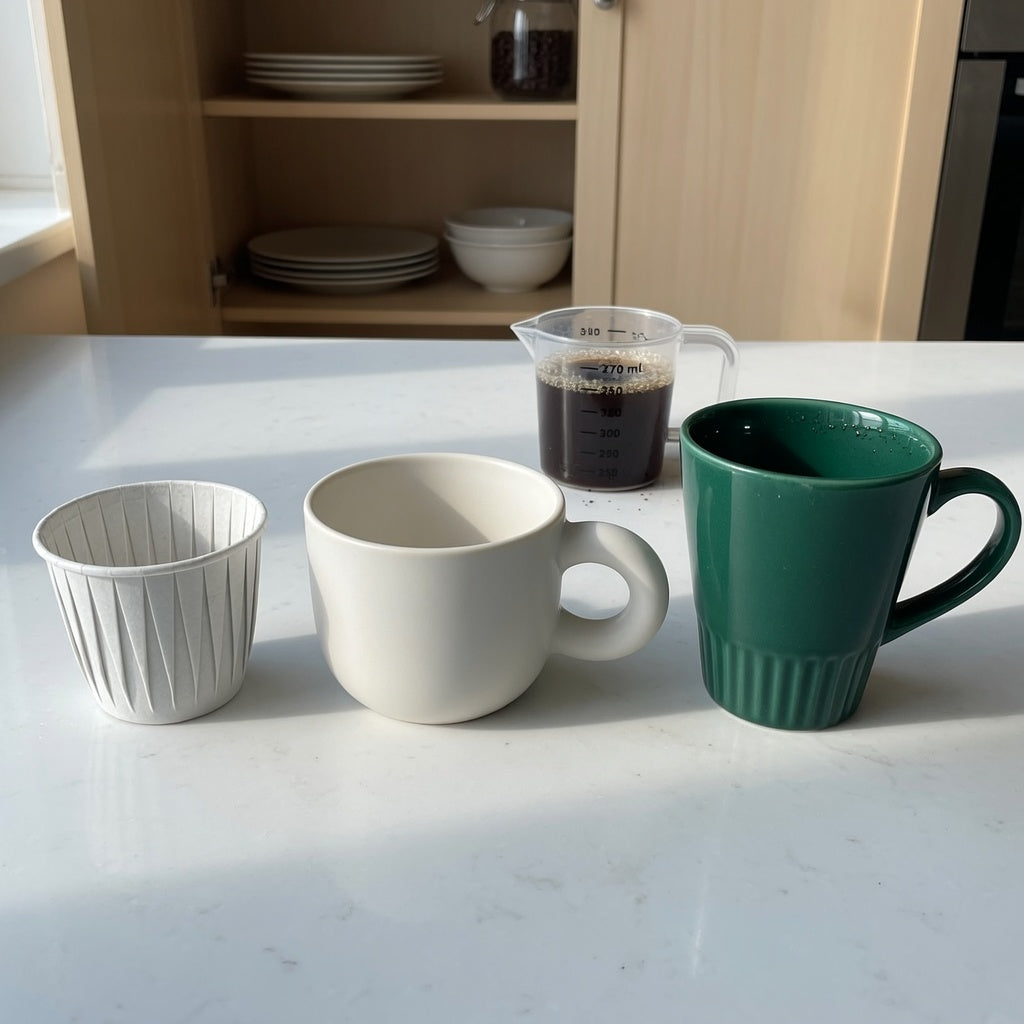
Flat White Cup First Time Buyer Product Shortlist Guide: 3 Options
Reading time: about 10 minutes
A product photo can make a cup look roomy until your usual coffee and milk reach the rim. On a crowded kitchen counter or beside a laptop, that missing margin matters more than the styling that first caught your eye. In our store, we start first-purchase comparisons with the details we can verify, then label everything else as an unknown. This flat white cup first time buyer product shortlist guide compares the Pleated at 200 ml, the Ball Handle at 250 ml, and the Emerald at 270 ml.
We do not call one capacity a barista standard, assign a required drink ratio, or claim that any shape is purpose-built for flat white coffee. Listed capacity tells you the nominal volume. It does not confirm a comfortable fill line, exterior dimensions, empty weight, material, handle clearance, or care method. The best first choice is the one whose known facts fit your routine and whose unanswered questions are not deal-breakers.
Your flat white cup first time buyer product shortlist guide starts with a measured pour
Before comparing cups, measure the volume you actually use. Photo scale is unreliable, and a familiar cup described as small or regular gives you no dependable milliliter figure. You can make this check without handling hot liquid.
- Fill your current cup with cool water to the level where your finished drink normally sits, not to the brim.
- Transfer the water to a marked measuring jug and record the volume in milliliters.
- Consider the empty rim space you prefer for carrying the cup, adding milk, or topping off.
- Compare that measurement with 200 ml, 250 ml, and 270 ml, remembering that a listed capacity may describe total rather than comfortable working volume.
If your copied fill level is already close to 200 ml, the Pleated option leaves little nominal margin. The 250 ml and 270 ml choices deserve more attention. If your fill is comfortably below 200 ml and you want a smaller serving, extra capacity may add no practical value. Ask how capacity is defined if a precise fill margin is essential to your decision.
How much difference do 200 ml, 250 ml, and 270 ml make?
| Option | Verified capacity | Reason to choose | Reason to skip or verify |
|---|---|---|---|
| Pleated coffee and tea cup | 200 ml | Your measured pour stays comfortably below 200 ml, and you prefer the lowest listed capacity of the three. | Skip it if you top off frequently or your normal fill is already close to its stated capacity. Verify exterior dimensions and care separately. |
| Ball Handle coffee and tea mug | 250 ml | You want a middle capacity with 50 ml more listed volume than the Pleated and only 20 ml less than the Emerald. | Skip it if the distinctive handle does not suit your grip or storage setup. Use listing photos and any available measurements rather than assuming hand fit. |
| Emerald coffee and tea mug | 270 ml | You want the largest listed capacity and the greatest nominal buffer for the same measured pour. | Skip it if a compact footprint or low filled weight is essential and those details are not confirmed on the listing. |
The differences are meaningful but should stay in context. For a hypothetical 180 ml home pour, the gaps between the drink volume and the listed capacities are 20 ml, 70 ml, and 90 ml. Those figures are arithmetic, not promised usable headroom. Cup shape, measurement method, and the practical fill line can all change how much empty space you actually see above the drink.
Which option fits a small kitchen, an office desk, or a flexible home pour?
A useful shortlist connects a real setting to a reason for buying or passing. These are the three situations we would use to separate the options before checkout.
Small kitchen with one consistent morning serving
Choose the Pleated 200 ml cup if your measured serving stays below its listed capacity and you do not want unused volume. It is the lowest-capacity option, which makes it the logical starting point for a compact serving. Do not assume that lower capacity guarantees the smallest exterior footprint; height, rim diameter, base diameter, and handle projection still need checking. Skip it if you often add more milk after the first pour or carry the cup while it is filled close to the rim.
Office desk where a middle capacity and handle choice both matter
Choose the Ball Handle 250 ml mug if the 200 ml option feels restrictive but 270 ml adds volume you are unlikely to use. Its named handle design is a major selection variable, so inspect close-up photos and any listed clearance before deciding. A handle that looks distinctive on screen is not automatically comfortable for every hand. Skip this option if your office routine depends on confirmed dishwasher care and that information is absent, or if the handle would crowd a narrow desk shelf.
Home use with changing pour sizes or regular top-offs
Choose the Emerald 270 ml mug if you want the largest nominal capacity in this three-cup shortlist. Assuming the capacities are measured consistently, it offers the most potential margin for a changing home pour. That flexibility can be useful when one person pours a smaller drink and another uses more milk. Skip it if you know you prefer a short serving, or if cupboard clearance and filled weight matter but remain unlisted.
Which missing listing details should pause the purchase?
Capacity is only one line of a proper product check. We would rather identify a missing specification plainly than turn a product name or photo into a claim it cannot support. Before buying, verify the details that could change daily use.
- Material: Confirm whether the body is ceramic, stoneware, porcelain, glass, metal, or another material. Do not infer composition from color or surface shine.
- Exterior measurements: Look for overall height, rim diameter, base diameter, and widest point including the handle. Capacity does not establish cupboard or dishwasher-rack fit.
- Handle clearance: Check the opening width, depth, and projection where measurements are supplied. The Ball Handle name identifies a design feature, but it does not guarantee comfort for a particular hand size.
- Empty weight: A 270 ml cup does not necessarily feel heavy, but capacity alone cannot tell you how it will feel when full.
- Care instructions: Look for explicit dishwasher and microwave guidance. If either is missing, treat compatibility as unknown rather than assumed.
- Capacity convention: Check whether the stated number is a brim capacity, recommended fill, or another measurement. Ask our team if the distinction affects your decision.
When our team handles a cup during an order check, the rim, base, body, and handle attachments deserve attention before decorative details. At unboxing, place the empty cup on a clean, level counter to check that it sits steadily. Inspect the rim and handle joins under good light for chips, rough edges, or hairline cracks. If the listing confirms a glazed material, compare any visible finish variation with the product description and photos. A damaged cup should not be put into use.
How do dishwasher habits, grip, and storage change the shortlist?
A flat white coffee cup can have the right capacity and still be wrong for the way your household operates. Someone who hand-washes one cup after breakfast has different requirements from a shared office kitchen that runs full dishwasher cycles. Care compatibility needs to be stated on the current product page; a glossy product image proves nothing about repeated washing or microwave use.
- For a shared dishwasher: Keep only options with care guidance that matches the appliance routine. If dishwasher suitability is not stated, pause and confirm it.
- For a narrow cupboard or mug rack: Measure the available height, shelf depth, and hook or rail clearance. Pay attention to handle projection, not only cup diameter.
- For a laptop desk: Prioritize a grip you can control without crowding your fingers, plus a base that fits the available surface. No handle style eliminates spill risk.
- For a gift: Confirm material, care, dimensions, and what is included in the package. Missing instructions become the recipient's problem after the unboxing.
Do not choose the Ball Handle solely because it appears easier to hold, and do not choose the Pleated or Emerald solely because their silhouettes look familiar. Grip comfort depends on hand size and holding style. If handle measurements are missing and grip is a non-negotiable requirement, contact us before ordering.
When should you skip all three compact options?
These cups are not sensible purchases based only on the assumption that they will handle a large iced drink, include a travel lid, provide double-wall insulation, stack neatly, or meet a specific appliance-care requirement. None of those features follows from a 200-270 ml capacity label. If you need one of them, choose only a listing that states it directly.
The best cup for flat white use at home may also sit outside this capacity group if your measured serving is larger, you prefer a different handle, or you are shopping primarily for a decorative gift. In that case, browse our unique coffee mugs collection and apply the same volume, dimensions, grip, and care checks to a wider set. A larger catalog is useful only after you know which variables can eliminate an option.
A five-minute final filter before checkout
Keep the shortlist small. Three open product tabs are useful at the start, but the goal is to finish with one supported choice or two options that need a final specification confirmed.
- Write down your measured pour in milliliters and your preferred empty rim gap.
- Remove any cup whose listed capacity is too close to that pour for your comfort.
- Remove any cup missing a non-negotiable detail such as material, care method, dimensions, or handle clearance.
- Compare the remaining options by the setting where the cup will spend most of its time: kitchen shelf, office desk, shared counter, or gift box.
Frequently asked questions
What cup size should a first-time flat white buyer choose?
There is no required capacity. Measure your normal finished pour and compare it with the verified 200 ml, 250 ml, and 270 ml options, leaving whatever rim space you find comfortable. Choose 200 ml for a clearly smaller serving, 250 ml for the middle capacity, or 270 ml for the largest nominal buffer.
How do I use a flat white cup first time buyer product shortlist guide?
Start by measuring your normal pour, then eliminate cups that do not provide the capacity margin you want. Check material, exterior dimensions, handle clearance, and care instructions before comparing style. Any missing must-have specification should remain an open question until the store confirms it.
Is the Ball Handle 250 ml automatically the easiest first choice?
No. Its capacity falls between the 200 ml Pleated and 270 ml Emerald, but that does not make its handle, dimensions, or care requirements suitable for every buyer. Choose it only if both the middle capacity and the listed handle details fit your routine.
Does 270 ml mean the Emerald will be physically much larger?
Not necessarily. The Emerald has the largest verified capacity of these three, but capacity does not establish exterior height, width, wall thickness, or empty weight. Check the product page or ask for measurements if shelf space is limited.
Can I assume these cups are dishwasher and microwave safe?
No. Appliance compatibility depends on the stated material, finish, decoration, and manufacturer care guidance. Check the current product listing, and if the guidance is absent, treat dishwasher and microwave use as unconfirmed.
Your next step: recreate your usual fill with cool water, record the milliliters, and write down one detail you will not compromise on. Compare that note with the three linked product pages. If none clears both checks, move to the wider coffee mug collection rather than forcing a first purchase that does not fit your routine.
More from our blog
Read more
Americano Coffee Cup First Time Buyer Product Shortlist Guide
Build a practical first-cup shortlist by measuring your usual pour, comparing the verified 200 ml, 270 ml, and 350 ml capacities, and identifying material, care, and dimension details that still ne...
Read more
Ceramic Sculptural Mug Shared Household Product Shortlist Guide
Compare three sculptural ceramic mug forms for a shared kitchen: The Flow 400 ml, Ball Handle 250 ml, and Handbag 310 ml. This scenario-led shortlist covers pour size, grip, storage, care checks, a...
Read more
Leave a comment
This site is protected by hCaptcha and the hCaptcha Privacy Policy and Terms of Service apply.