




Ceramic Sculptural Mug Shared Household Product Shortlist Guide
Reading time: about 11 minutes
A shared shelf exposes a poor mug decision quickly. One person pours a large coffee, another makes a short tea, and a third chooses whichever shape looks most interesting. By evening, one mug is blocking the bowls while another has been refilled twice. Our ceramic sculptural mug shared household product shortlist guide starts with those daily conflicts, not with the idea that everyone needs matching drinkware.
We handle sculptural mugs in our store, and the details that matter after purchase are often different from the details that first catch a shopper's eye. A curved body claims shelf space differently from a straight cylinder. A pronounced handle needs clearance beside other mugs. A distinctive silhouette can be satisfying on a desk but inconvenient in a crowded drying rack. The comparison below stays within verified product facts: ceramic construction, three-dimensional form, and listed capacity. These are individual options, not a proposed set, and we do not attach unlisted production methods, provenance, or special-edition claims to them.
Which capacity matches each person's actual serving?
Start by measuring a normal serving rather than asking each housemate if they prefer a small, medium, or large mug. Those labels are too vague. Pour a person's usual coffee or tea into a measuring jug, including the milk or other additions they normally use, and record the result. Repeat it on two ordinary days if their serving changes with the routine.
The three verified capacities create meaningful separation. The Ball Handle holds 250 ml, the Handbag holds 310 ml, and The Flow holds 400 ml. The difference between 250 ml and 310 ml is 60 ml. The difference between 310 ml and 400 ml is 90 ml, while the two endpoints are separated by 150 ml.
| Household serving pattern | Capacity to compare | Relevant form |
|---|---|---|
| One larger coffee or tea with fewer refills | 400 ml | The Flow with sculptural curves |
| Short coffee, compact tea serving, or frequent fresh pours | 250 ml | Ball Handle with a rounded sculptural handle |
| Mid-sized serving between those two habits | 310 ml | Handbag with a purse-shaped silhouette |
Treat capacity as a comparison point, not as a guaranteed comfortable fill line. A person who wants a full 300 ml drink may find that a 310 ml mug leaves little room for carrying, milk, or foam. In that situation, the 400 ml option may be more practical even if the drink itself is not 400 ml. Conversely, someone who usually pours 220 ml gains little from storing a higher-capacity mug unless they strongly prefer its form.
How much shelf and dishwasher clearance can the household spare?
Capacity does not tell you the external width, height, base size, or handle projection of a sculptural mug. We do not call one option the most space-efficient without verified external dimensions. Instead, measure the space where the mug will actually live and check the individual product page for any available measurements before ordering.
- Cabinet: Measure usable shelf height and the horizontal space available for one mug that may not stack or nest.
- Drying rack: Identify a position where a curved body or projecting handle will not knock against plates, cutlery, or another mug.
- Dishwasher: Verify the listed care instructions first. Ceramic material alone does not establish dishwasher compatibility.
- Desk or counter: Check the intended landing space rather than assuming a normal coaster or narrow desk corner will suit every base and silhouette.
If the care instructions permit dishwasher use, load the mug only where rack tines and neighboring dishes do not press against its sculptural details. A household that routinely packs the dishwasher tightly may find hand-washing a distinctive mug more practical. If nobody wants that extra step, a conventional straight-sided mug is the more honest choice.
Ceramic sculptural mug shared household product shortlist guide: three matches
This shortlist maps each household situation to one verified form and capacity. Each recommendation also includes a reason to skip it, because an attractive shape is not automatically a practical daily mug.
The Flow, 400 ml: for the person who dislikes frequent refills
Situation: One housemate normally prepares the largest single serving and has enough shelf space for a form that is not a plain cylinder.
Why it fits: The Flow coffee and tea mug has a listed 400 ml capacity and sculptural curves. It is the strongest match here for someone whose measured serving needs more room than the 250 ml and 310 ml options provide. The three-dimensional body also suits a buyer who wants form itself to create the visual interest rather than relying on surface artwork.
Why to skip it: Do not choose The Flow merely because that person drinks several cups across the day. Choose it only if they prefer a larger amount in one serving. It is also a weaker fit for a stack-only cabinet, a tightly packed drying rack, or someone who consistently pours closer to 200 or 250 ml.
Ball Handle, 250 ml: for short pours and a handle-led design
Situation: A housemate prefers a smaller serving and wants the handle to be the main sculptural feature.
Why it fits: The Ball Handled coffee and tea mug has a listed 250 ml capacity and a rounded sculptural handle. It makes sense for short coffee servings, tea that is refreshed frequently, or a person who deliberately wants a grip that differs from a standard loop handle.
Why to skip it: A regular 300 ml or larger drink will mean repeated refills or an undersized serving. We also would not describe this mug as lighter without a verified product weight; lower liquid capacity does not prove lower empty-mug weight. Skip it if the intended user strongly prefers a familiar loop handle and does not want to adapt their grip.
Handbag, 310 ml: for a mid-sized pour and statement silhouette
Situation: One person wants more capacity than 250 ml but does not need the full 400 ml option. The mug may also be chosen for a guest shelf or gift because its shape is meant to be noticed.
Why it fits: The Handbag coffee and tea mug combines a listed 310 ml capacity with a purse-shaped silhouette. It gives the middle-volume drinker a clearly three-dimensional option without moving straight to the largest capacity in this comparison.
Why to skip it: The purse-shaped profile will not suit someone who wants every mug to look and store like a conventional cylinder. We also do not claim that its shape is more or less stable than the others without verified base dimensions. If counter stability is a deciding factor, confirm the measurements rather than drawing a conclusion from product photos alone.
These products do not need to be purchased together. One household may need only the 400 ml option, while another may assign different forms to two or three people. After removing any capacity or storage mismatches, compare the remaining shapes in our unique coffee mugs collection.
Which grip and desk habits can rule out a sculptural form?
Watch how each person uses their current mug for a day or two. Some drinkers lift exclusively by the handle. Others cradle the body, especially while sitting on a sofa or working at a desk. A rounded sculptural handle is a deliberate change for the first group, while body curves may matter more to the second.
- Record whether the person holds the handle, the body, or both.
- Note if they carry the mug between rooms, up stairs, or beside a laptop.
- Check whether they require space for two or more fingers inside a conventional loop; do not assume a ball handle provides the same grip.
- Measure the desk, side table, or counter area where the mug is normally placed.
- Ask if the distinctive shape still appeals after storage and washing needs are explained.
Liquid load also affects the choice. At their listed capacities, the 400 ml option can contain 150 ml more liquid than the 250 ml option before the empty mug weight is considered. That does not make either one better, but it is relevant for someone who carries a full mug through the house. Capacity, empty product weight, and grip design are separate variables and should not be collapsed into a single idea of comfort.
What should you inspect after unboxing and during washing?
Sculptural ceramic forms create more visual and tactile contact points than a plain cylinder. Before the first wash, we recommend inspecting the mug on a clear, well-lit counter. This is also how our team approaches a shape that has pronounced curves or a handle that carries much of the visual design.
- Run your eyes around the rim and check for chips, cracks, or an unexpectedly sharp point.
- Inspect the handle connection and pronounced sculptural areas for visible damage from transit.
- Place the empty mug on a level, dry surface and check for pronounced, unexpected rocking.
- Confirm the care instructions before using a dishwasher or microwave; do not infer compatibility from the word ceramic.
- Keep the mug from knocking against heavy cookware, sink edges, or other ceramics during washing and drying.
Impact chips at the rim, cracks around high-contact areas, and damage to projecting details are practical risks with ceramic drinkware in general, not claims that these three products are defective. If a new mug arrives with a visible crack or chip, photograph it and contact our store before using it for a hot drink. During ownership, stop using any ceramic mug that develops significant cracking or a sharp damaged edge.
Follow the product's stated care directions and avoid abrupt temperature changes unless the instructions specifically allow them. A shared household should agree on the care routine before ordering. The person who loves the shape may not be the person willing to wash it separately.
Who should keep a plain mug in the rotation?
Not every member of the household needs a sculptural mug. A straight-sided, easily stored ceramic mug may be the better daily tool for someone who values interchangeability, quick dishwasher loading, or a low-profile desk setup. Keeping one or two plain mugs also helps on days when the distinctive pieces are drying or already in use.
A different style is likely to work better if any of these conditions apply:
- The cabinet only works when mugs stack or fit into identical spaces.
- Everyone expects to grab any mug without considering capacity or grip.
- The user needs a fitted travel lid or another accessory with exact dimensional requirements.
- The buyer mainly wants printed surface artwork rather than a three-dimensional ceramic form.
- No one in the household wants to provide extra clearance during washing and storage.
Do not assume a standard lid, coaster, rack position, or storage hook will fit a sculptural silhouette without measurements. The practical answer may be one personal sculptural mug for the interested drinker and conventional mugs for everyone else.
A five-minute decision card for the shared kitchen
Use this ceramic sculptural mug shared household product shortlist guide as a household decision sheet. Write down the answers before opening multiple product tabs:
- Put each person's initials beside their measured one-serving volume.
- Match 250 ml, 310 ml, or 400 ml to that serving, allowing room for additions and carrying.
- Record whether each person prefers a standard grip, rounded sculptural handle, body hold, or no strong preference.
- Cross out any form that cannot fit the available shelf, drying area, or permitted care routine.
- Give every remaining option one specific reason to choose it and one specific reason to skip it.
- Keep a plain mug available for anyone whose routine does not suit a statement form.
A shortlist is ready only when each mug has a likely owner and a realistic storage position. That is more useful than choosing three similar-looking pieces and discovering that everyone reaches for the same one.
Frequently asked questions
How should three housemates use a ceramic sculptural mug shared household product shortlist guide?
Measure each person's normal single serving, record how they hold a mug, and check the available shelf and drying space. Then compare the 250 ml Ball Handle, 310 ml Handbag, and 400 ml Flow against those individual habits. The result may be three different mugs, one shared sculptural mug, or no sculptural mug for a person who needs a stackable shape.
Is a 250 ml sculptural mug too small for daily coffee?
It is too small if the person's normal serving is substantially above 250 ml or needs extra room for milk and carrying. It can be a practical size for short coffee, tea, or someone who prefers frequent fresh pours. Measure the actual serving instead of relying on the words small or regular.
Which option makes sense for someone who drinks about 300 ml?
The 310 ml Handbag is closest by listed capacity, but a 300 ml beverage could leave very little headroom. If that person adds milk, foam, or needs space to carry the mug comfortably, the 400 ml Flow may be the more practical shortlist candidate. Capacity should be tested against the complete prepared drink.
Can these ceramic sculptural mugs go in the dishwasher?
Check the care instructions on the individual product page or packaging before using a dishwasher. Ceramic construction by itself does not confirm dishwasher or microwave compatibility. If dishwasher use is permitted, prevent the sculptural form and handle from contacting rack tines or neighboring dishes during the cycle.
Are The Flow, Ball Handle, and Handbag mugs a matching set?
This guide compares three individual product pages with different capacities and forms; it does not present them as a set. Choose only the option or options that match the household's actual serving and storage needs. Different people can use different forms without creating a coordinated collection.
For the next step, place each person's initials beside 250 ml, 310 ml, or 400 ml, remove any shape that fails the grip, shelf, or care checks, and compare only the remaining candidates in the sculptural and unique mug collection. One clear owner and one clear skip reason per mug will keep the final order practical.
More from our blog
Ready to pick your mug? Two ways to save on today's order:
Ordering 1–3 mugs? Get an extra 10% off your 1st order with code 10_OFF Apply 10% Off & Shop Wooden-Handle Mugs →
Gifting 4+ mugs? Buy 3, Get the 4th Free applies automatically at checkout (no code needed; offers do not stack) · Free standard shipping (Nov pre-Christmas delivery: 15–20 calendar days US) · Free replacement if chipped in transit.
Popular mug buying guides: Ceramic Tea Cups & Infuser Mugs · Ceramic Mugs with Lids Compared · Wooden-Handle Tea Infuser Mugs Compared · Christmas & Secret Santa Mugs 2026 · Espresso & Cortado Cups Guide · Cup & Saucer Gift Sets · All 25 Mugs Spec Table · Mug Size Guide · Shipping & Promo FAQ
FIRST ORDER 10% OFF (CODE: 10_OFF) · OR BUY 3, GET THE 4TH FREE


Read more
Flat White Cup First Time Buyer Product Shortlist Guide: 3 Options
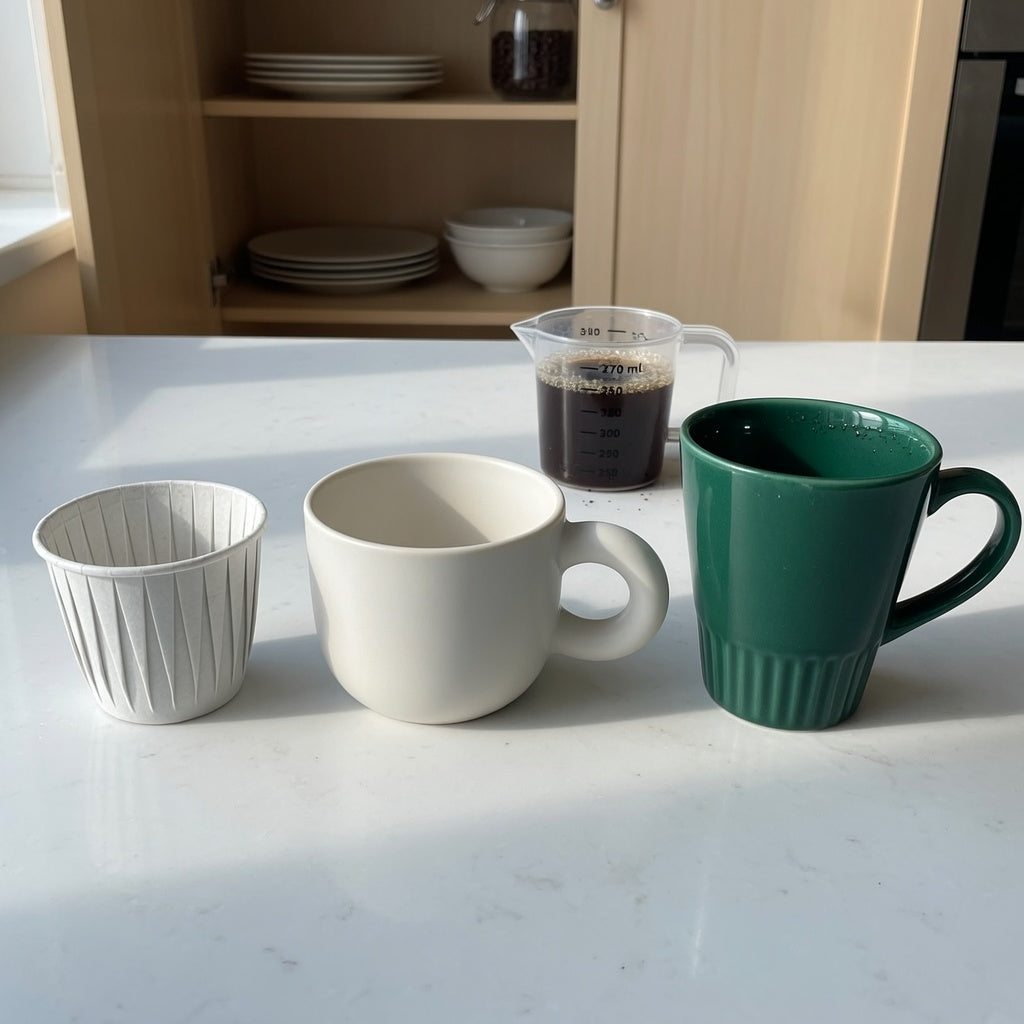
Compare the verified Pleated 200 ml, Ball Handle 250 ml, and Emerald 270 ml options by pour size, headroom, grip, storage, and care unknowns. Each pick includes a clear reason to choose it or leave...
Read more
Thick Ceramic Coffee Mugs First Time Buyer Practical Purchase Checklist
Compare ceramic material, wall evidence, practical capacity, handle clearance, base size, care instructions, and common defects. Then match The Rock, The Flow, Spittoon, or the wider collection to ...
Read more
Leave a comment
This site is protected by hCaptcha and the hCaptcha Privacy Policy and Terms of Service apply.