



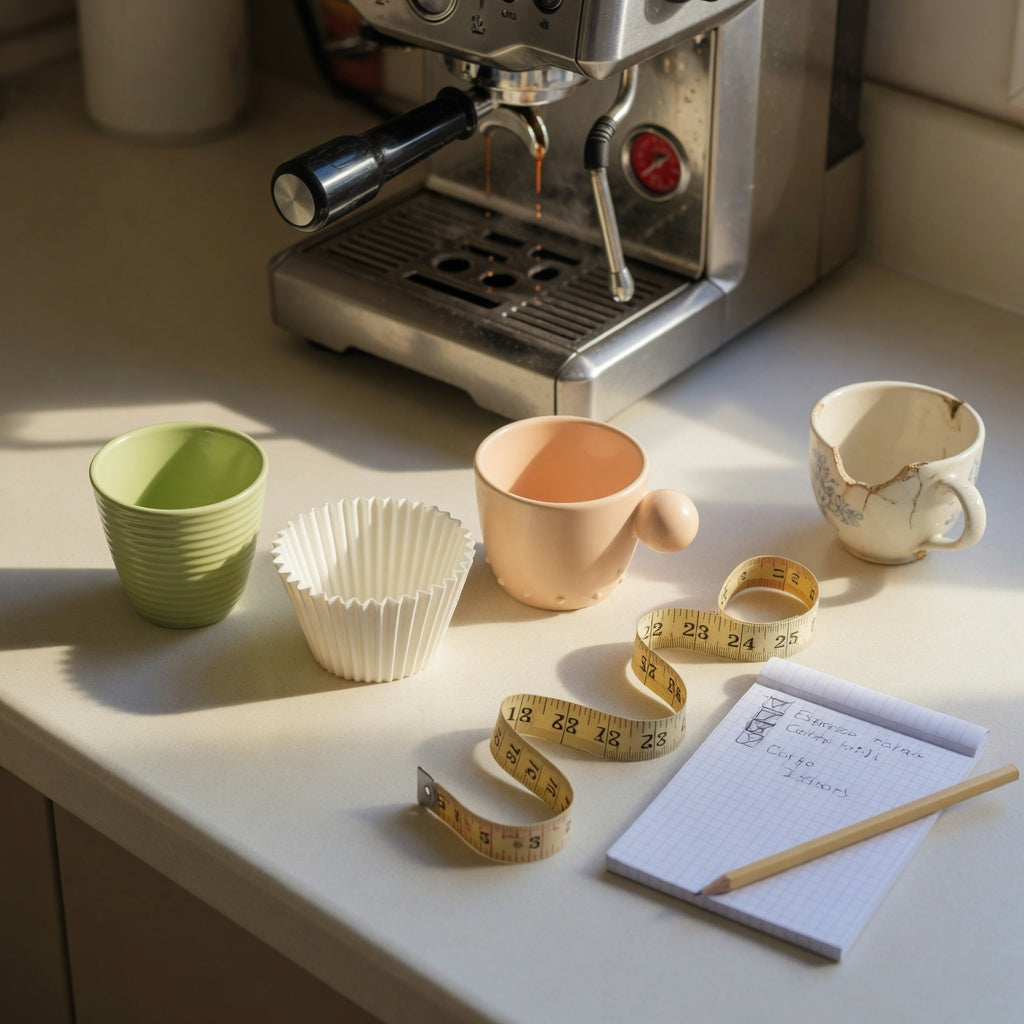
Cute Espresso Cups Replacement Purchase Practical Purchase Checklist
Reading time: about 9 minutes
The chip usually appears on the rim just above the handle, and you find it on a Tuesday when you are already running late. Two years of stacking, spoon-stirring and hot dishwasher cycles later, the cup you bought because it was charming is the one you push to the back of the shelf.
We sell compact ceramic cups, and we hear what happens after the sale. Almost nobody replaces a cup because it stopped being cute. They replace it because it holds the wrong volume, will not sit under the spout, or the glaze has gone chalky and grey. That is why this cute espresso cups replacement purchase practical purchase checklist starts with the failure and works backwards, and why we will say plainly where a small decorative cup is the wrong tool for the job.
What did the cup you are replacing actually fail at?
Name the failure before you open a single product page. A replacement only works if it fixes the specific reason the old cup stopped getting used. In our experience the complaints cluster into six buckets:
- Volume. Too small for a double, so crema creeps over the rim — or so wide that a single shot looks like a stain at the bottom.
- Clearance. It cleared the group head at home but not the office machine, or it fit the machine but not under the cupboard shelf.
- Rim width. A narrow opening means the two streams from a double spout land on the outside of the cup instead of in it.
- Handle. The loop only takes a fingertip, so a hot cup becomes a two-handed job.
- Wear. A chipped rim, a crazed glaze, or a pattern that faded inside a season.
- Footprint. Too tall for the shelf, too wide for the tray, or too unstable next to everything else you own.
Write down which of those apply. If three or more do, you are probably not shopping for a replacement — you are shopping for a different category of vessel, and a dainty patterned cup may be the wrong answer entirely.
Capacity first: where 170 ml, 200 ml and 250 ml land against a real shot
Volume decides everything downstream. A traditional Italian espresso is commonly described as roughly 25 ml, and a modern double pulled at about a 1:2 ratio typically lands near 36 g of liquid. That is why the classic demitasse sits around 50 ml: a short shot in a small vessel keeps the crema thick and the heat in.
The three ceramic cups we point people to for this kind of replacement are listed at 170 ml, 200 ml and 250 ml. We would rather be blunt than flattering: all three are compact ceramic vessels by everyday mug standards, and all three are considerably larger than a traditional single-shot cup. The verified figures are:
- 170 ml (about 5.7 fl oz) — the Retro coffee tea cup. The tightest of the three, and the closest to a generous espresso volume.
- 200 ml (about 6.8 fl oz) — the Pleated coffee tea cup. Enough headspace for a double with a little room, or an espresso with a splash of steamed milk.
- 250 ml (about 8.5 fl oz) — the Ball Handle coffee tea mug. Closer to a small milk drink than to a demitasse.
What that means at the counter: if you drink ristretto or a strict 25–35 ml single, all three are oversized and a true demitasse is the better tool. If you pull doubles, drink macchiatos, or like a lungo, the 170 ml and 200 ml versions are the more sensible compromise. A 30 ml shot sitting in a 250 ml cup spreads crema thin and sheds heat quickly — that is the honest trade-off of buying a cup roomy enough to double as a tea cup.
Will the new cup clear your machine's spout and catch both streams?
No published standard governs spout-to-drip-tray clearance, so this is a measuring job, not a spec-sheet job. Do it once and you stop guessing:
- Set your current cup on the drip tray under the group head and measure the free gap above its rim.
- Measure the cup's outer height. Your replacement should not exceed that total unless your tray has an adjustable or removable section.
- Measure the inner rim diameter. Two streams from a double spout land a couple of centimetres apart, so a narrow rim catches one and misses the other.
- Check the base. A wide flared foot can overhang a small tray or rock on a slatted one.
Our listings state capacity and show the visible form of each cup. They are not a fit guarantee — geometry depends entirely on your group head and tray. If clearance is the reason you are replacing, measure first, then confirm the stated height on the product page against your number, and ask us if the height is not shown. That single step prevents most of the exchanges we see.
Handle, rim and glaze: what fails first, and how you wash decides it
Cute is a finish, not a construction. The parts that fail are the same on a cheap cup and an expensive one.
Rim finish. A thin, sharply rolled rim chips first, especially where it meets a saucer or a spoon. Look at the edge in the product photos: a slightly rounded, thicker rim survives cupboard stacking far better than a knife-edge one.
Handle geometry. Finger clearance is the whole test. Can your index finger pass through comfortably while the cup is full? A loop that only takes a fingertip turns the handle into a hook, and you end up gripping the hot body instead.
Glaze and crazing. Fine cracks in the glaze trap coffee oils and stain, usually at the bottom where you notice it last. Hand-painted and novelty finishes are the ones most often reported to fade or chip, though we have never seen a standards body test confirming that — it is anecdotal, and we will not dress it up as data.
Dishwasher reality. Heat, detergent and cups knocking together are what dull a glaze. If the pattern matters to you, hand wash and skip the heated dry cycle. If the cup must go in the machine, choose a plainer finish and accept that the colour will soften.
Food-contact labeling. The U.S. FDA notes that lead in ceramic glaze is bound when pottery is fired correctly, but that improperly fired glaze can leave extractable lead, and that ceramicware intended only as decoration must be identified so it is not used with food (FDA guidance on lead-glazed pottery). Buy drinkware from a seller who states the intended use. If a listing cannot tell you, ask before you drink from it.
One more detail worth knowing: tasting guidance generally favours a plain white interior because it shows crema colour and texture clearly. A dark or heavily patterned interior hides both, which matters if you are dialling in a new grinder and judging the shot by eye.
Which cup for which drinker: doubles, macchiatos, desks and gifts
Same shelf, four different shoppers. Match the situation, not the photograph:
- You pull doubles and drink them black. The Pleated at 200 ml gives crema room without drowning the shot; the Retro at 170 ml keeps things tighter and fits smaller shelves. Both are ceramic, both are oversized for a single — that is the trade for a cup you can also use for tea.
- You add milk. The Ball Handle at 250 ml leaves room to stir a macchiato without overflow, though for a true cortado ratio it is generous rather than precise.
- You are outfitting a desk or a narrow counter. Footprint beats volume. Tall, narrow-footed cups are the ones that topple on a crowded shelf or a wobbling desk, so check the base before the pattern.
- You are buying a gift. Handle it before you call it giftable: rim smooth, handle sitting square to the body, box sturdy enough to ship. A pretty cup with no saucer suits a coffee-curious friend and feels incomplete to someone who already owns matched china.
If you are choosing between silhouettes rather than replacing one specific cup, compare shapes side by side in our unique coffee mugs collection before committing.
The cute espresso cups replacement purchase practical purchase checklist, line by line
Six lines. If a candidate fails two or more, walk away — another shape will pass.
- Does it fix the failure? Hold it against the problem you named in the first section, not against the photo.
- Does the capacity match your pour? Pull one real shot into a measuring jug once, write the number down, then compare it to 170, 200 or 250 ml.
- Does it clear the machine? Height and inner rim width measured, not assumed.
- Can you hold it full? Finger through the handle, no contact with the hot body.
- Does the care routine fit your habits? Hand wash or dishwasher — and does the finish survive your honest answer?
- Is food use stated? The listing should describe drinkware, not decoration.
Start with the Retro cup if you want the smallest step up from what you had, and work upward only if your pour genuinely needs the space. And if you drink strict singles, buy a true demitasse instead — our cups are built for doubles, milk drinks and tea, and pretending otherwise would just send you back to this checklist in six months.
Frequently asked questions
Are 170 ml cups too big for a single espresso?
By traditional standards, yes. A classic single is often described as roughly 25–35 ml, so 170 ml is several times the shot volume. It suits doubles, lungos and espresso with a splash of milk, but a small shot served in it will cool faster and show thinner crema than it would in a 50 ml demitasse — which is exactly why this cute espresso cups replacement purchase practical purchase checklist starts with volume rather than colour.
Will these cups fit under my espresso machine?
We cannot promise a universal fit, because clearance depends on your group head, spout and drip tray. Measure the free space above your current cup plus its outer height, then compare that to the height stated on the product page. If the height is not shown, ask us before ordering rather than guessing from a photo.
Can these ceramic cups go in the dishwasher?
Check what the individual listing states rather than assuming, because finishes vary. Broadly, heat and detergent dull painted and hand-applied glazes faster than hand washing does. If you want the pattern to stay sharp, wash by hand and skip the drying cycle.
Do I need a saucer with a cute espresso cup?
No, but saucers earn their place: they catch drips from the spout, protect a wooden desk and give you somewhere to rest a spoon. If counter space is tight, a saucer-less cup with a narrow foot stacks more easily in a cupboard.
How is a 250 ml cup different from a demitasse?
Mainly volume and intent. A demitasse is built around a short shot, usually near 50 ml, while the Ball Handle is listed at 250 ml — five times the capacity. It is still a compact ceramic vessel, but treat it as a small milk-drink or tea cup, not a single-shot cup.
More from our blog
Ready to pick your mug? Two ways to save on today's order:
Ordering 1–3 mugs? Get an extra 10% off your 1st order with code 10_OFF Apply 10% Off & Shop Wooden-Handle Mugs →
Gifting 4+ mugs? Buy 3, Get the 4th Free applies automatically at checkout (no code needed; offers do not stack) · Free standard shipping (Nov pre-Christmas delivery: 15–20 calendar days US) · Free replacement if chipped in transit.
Popular mug buying guides: Ceramic Mugs with Lids Compared · Wooden-Handle Tea Infuser Mugs Compared · Christmas & Secret Santa Mugs 2026 · Espresso & Cortado Cups Guide · Cup & Saucer Gift Sets · All 25 Mugs Spec Table · Mug Size Guide · Shipping & Promo FAQ
FIRST ORDER 10% OFF (CODE: 10_OFF) · OR BUY 3, GET THE 4TH FREE


Read more
Ceramic Latte Cups: Weekend Coffee Practical Purchase Checklist
A decision-ready checklist for buying ceramic latte cups for weekend coffee: how listed capacity differs from what you actually pour, why handle geometry matters more as capacity grows, what FDA le...
Read more
Cute Espresso Cups Gift Choice Practical Purchase Checklist
A gifted espresso cup fails when the pour is lost in too much volume, the rim splashes two streams, or the handle is only decorative. Use this checklist to match capacity, machine clearance, and ca...
Read more
Leave a comment
This site is protected by hCaptcha and the hCaptcha Privacy Policy and Terms of Service apply.