



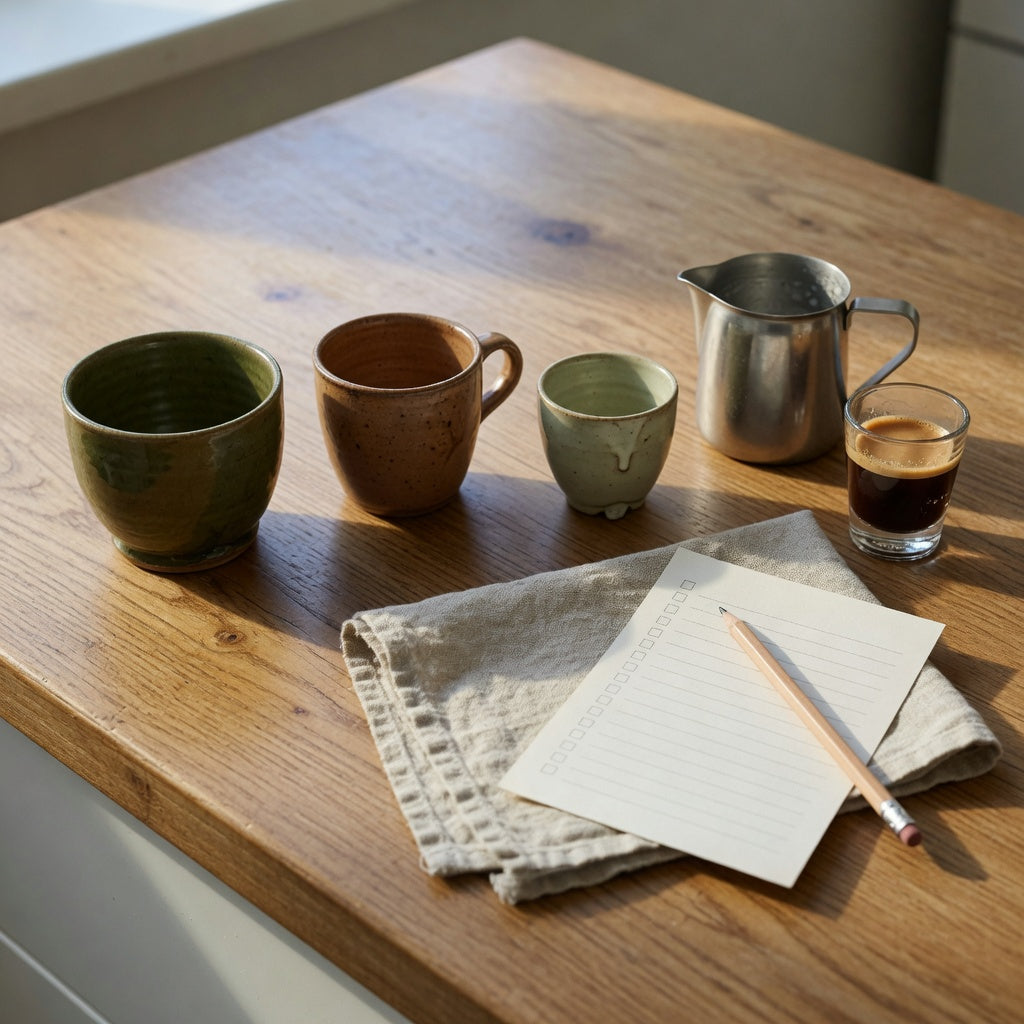
Ceramic Latte Cups: Weekend Coffee Practical Purchase Checklist
Reading time: about 11 minutes
Saturday, 8:40 a.m. The shot is pulled, the milk is steamed, and the foam crests over the rim before the pour is halfway finished. The cup was listed as 12 oz and it told the truth — it just measured something different from what you were about to drink. That gap between listed capacity and comfortable fill is where most weekend latte purchases go sideways, and it is the first line of our ceramic latte cups weekend coffee practical purchase checklist.
We sell ceramic drinkware, and the same handful of questions lands in our inbox every Saturday: why does this cup feel smaller than the number, will the handle still work when it is full, and is that glaze something I want to drink from for years. Here is how we walk customers through it, plus the places where a different piece of drinkware is the smarter buy.
Why a cup listed at 12 oz pours like a 10 oz drink
Three variables sit between the number on a product page and the liquid in the cup.
- Headspace for foam. A latte-art pour needs roughly a centimetre of clearance at the rim. Pour flush to the lip and the pattern collapses the moment you set the cup down.
- Interior geometry. A rounded or bowl-like bottom gathers the espresso and gives the milk somewhere to fold as it rises. Straight sides push the same volume into a taller column with a narrower surface to pour onto.
- Where the fill line sits. A cup filled to a comfortable drinking line holds less than a cup filled flush to the lip. Most listings quote the second figure.
For calibration: FDA describes a ceramic cup or mug as small hollowware for hot drinks that normally — though not exclusively — holds about 240 ml (8 fl oz) and is made with a handle. Cups typically have a base and curved sides, while mugs run cylindrical. That is a regulatory description rather than a menu spec, but it is a useful reality check against modern retail listings.
No government or standards body publishes an ideal retail latte-cup volume, and the buyer guides and cafe menus we have read scatter anywhere from roughly 6 oz to 16 oz. Treat the listed number as the start of the decision, not the answer to it.
Matching our 250 ml, 400 ml and 440 ml cups to the pour you actually make
We list our latte-friendly shapes in millilitres, which removes one layer of the 8/10/12 oz confusion at the shelf. Here is how the three sit relative to each other.
| Mug | Listed capacity | Where it lands in a slower weekend routine |
|---|---|---|
| Ball Handle | 250 ml (about 8.5 fl oz) | The smallest capacity we list. Suits a single shot with a small milk pour, where the espresso stays forward. |
| The Flow | 400 ml (about 13.5 fl oz) | The middle of the range: a double shot with a full milk pour and room left for a foam head. |
| Morning and Night | 440 ml (about 15 fl oz) | The largest we list. Built for the long, milk-heavy cup you sip across twenty minutes. |
Read all three as listed capacities, not fill lines. The 40 ml between The Flow and the Morning and Night is roughly one espresso's worth of milk, so the practical difference between them is less about how much you drink and more about how the shape sits in your hand.
Capacity also tells you nothing about base diameter. If your counter or desk is tight, check the footprint shown on the current listing rather than assuming a larger capacity means a wider base. And if a saucer matters to you, confirm whether the specific listing includes one instead of reading it out of the lifestyle photos.
Handle geometry and desk footprint: the two things product photos hide
A handle is easy to judge on an empty shelf sample and much harder to judge when the cup is full and warm. Two measurements decide it: the opening between handle and body — does your index finger pass through without pressing against glaze — and where the handle sits relative to the cup's centre of mass. A narrow handle set high on a wide body tips forward as the cup fills.
Mass scales with capacity, which is why the handle question gets more important as you move up our range. At 250 ml the load is light; a full 440 ml cup is not. In our experience, buyers who end up disliking a mug almost always dislike it at the larger end of the range rather than the smaller. Rim thickness is the other half of the feel, and a thin rim drinks differently from a rolled one — neither is objectively better.
Rim diameter changes the pour as well. A wider mouth gives you more surface for a pattern and a shorter drop from pitcher to crema. A narrower mouth concentrates the pour and is more forgiving if your milk texture is inconsistent. If you are still building the skill, favour the wider-mouthed of the shapes you are comparing and check the listing photos for that.
Then weigh how you actually carry the cup: one hand at the counter, two hands to the sofa, or wedged beside a laptop on a desk. The awkward shapes are the ones nobody plans for.
Glaze, lead and cadmium: what you can and cannot verify before checkout
Fired clay is not automatically food-safe. If a glaze is not fired properly, lead used in that glaze may not fuse into the surface and can migrate into food or drink. That is why regulators publish action levels instead of trusting a sticker.
- Lead: FDA's action level for leachable lead in ceramic cups and mugs is 0.5 micrograms per millilitre of leaching solution, applied to any one of six units tested.
- Cadmium: 0.5 micrograms per millilitre for flatware (averaged over six units) and small hollowware (any one of six), and 0.25 micrograms per millilitre for large hollowware (any one of six).
- The test behind those numbers: an acetic-acid extraction method, ASTM C738, which FDA's compliance guide describes as a severe test unlikely to be matched in ordinary use. Useful context — not a reason to relax.
Two labelling details are worth knowing. FDA guidance states that ceramicware releasing extractable lead under that test method should not be labelled lead free, and the agency has reported traditional pottery labelled lead free that still contained extractable lead at or above the action level. Separately, under 21 CFR 109.16, decorative ceramicware that looks suitable for food use is treated as food-use ware unless it carries both a conspicuous warning and a permanent version on the base, or has a hole bored through the food-contact surface.
Here is the honest limitation. Batch leach-test results rarely appear on a product page anywhere, so a lead-free claim is only as good as the method behind it. The reasonable question to send any seller — us included — is which test backs the claim for this exact piece. FDA also flags handmade, antique, damaged, flea-market, and brightly orange-, red- or yellow-decorated ware as higher-concern categories, while describing everyday commercial factory pottery as much less likely to have a lead problem. Washing or boiling a suspect piece does not remove lead; there is no home fix.
Glaze condition matters for daily wear too. Crazing — the fine web of cracks across a glaze — starts as a cosmetic complaint and becomes a food-contact question once the surface opens. Retire a cup whose glaze has crazed, chipped or cracked.
Microwave and dishwasher answers are piece-by-piece, not category-wide
FDA states that microwaves are reflected by metal and pass through glass, paper, ceramic and plastic. That is why ceramic belongs in a microwave, and also why metal trim does not: reflected microwaves cook unevenly and can damage the oven.
This matters for latte cups, because metallic lusters, gold bands and painted rims are common on decorative ceramic. A plain glazed body and a body with a metallic band are different products in the microwave even when they came off the same shelf. We will not tell you a mug is microwave safe unless the care line on that exact listing says so, so read it before the first use rather than after. Dishwasher guidance works the same way — heat, detergent and mechanical abrasion are harder on decoration than on a plain fired glaze, and a piece that survives the top rack for a year can still lose a painted band in year three.
The ceramic latte cups weekend coffee practical purchase checklist
- Start from the pour, not the photo. Single shot with a small milk pour points to 250 ml. A double shot with a full pour points to 400 ml. A long, milk-heavy weekend drink points to 440 ml.
- Subtract headspace. If you pour art, plan for about a centimetre of clearance and treat the listed figure as the brim-full number.
- Check interior shape. Rounded or bowl-like bottoms suit a latte pour. Straighter sides stack more predictably and take less shelf room.
- Judge the handle on a full cup. Finger clearance, handle position against the centre of mass, and how it feels once the ceramic is warm.
- Check the footprint. Capacity says nothing about base diameter. On a narrow desk or small counter, confirm dimensions on the listing before ordering.
- Confirm what is in the box. If you want a saucer or a second cup, verify it is included in that specific listing.
- Read the care line for that exact piece. Microwave, dishwasher and metallic trim are three separate answers, not one category-wide rule.
- Ask how a lead-free claim was verified if one appears, and treat handmade, antique, damaged and brightly red-, orange- or yellow-decorated ware as higher concern.
- Buy the pair if weekends are shared. Two identical cups keep your milk volume consistent; a second shape means re-learning the pour.
Where a ceramic latte cup is the wrong buy
- Commuting. No lid, no insulation. A travel tumbler is the right tool for a train or a car.
- Iced drinks in volume. A 440 ml cup loses most of its usable room once ice goes in. Taller glassware handles iced coffee better.
- Very large lattes. If your weekend drink starts at 16 oz of milk before the espresso, none of our three listed capacities is the match.
- Stack-and-dishwasher households that do not care about shape. Ceramic handles both, but you would be paying for pour geometry that stacking does not reward.
- Anyone shopping for a heat-retention ranking. We do not publish heat-retention claims for our mugs, and we would be sceptical of a listing that ranks stoneware against porcelain without a test behind it. Wall thickness and mass are things you feel in the hand; a ranking is something someone has to measure.
If you specifically want double-wall ceramic, we do not stock it. The questions buyers usually raise about that construction — whether the sealed cavity leaks over time, and whether a cup that stays cool outside tells you anything about the drink inside — are worth weighing as trade-offs rather than assuming double-wall is an upgrade.
Frequently asked questions
What belongs on a ceramic latte cups weekend coffee practical purchase checklist?
Listed capacity versus comfortable fill, interior shape, handle geometry judged on a full cup, base footprint, what is actually included in the box, glaze safety, and the care line for that exact piece. Start with capacity, because it drives every other item on the list.
Why does a 10 oz cup only hold about 8 oz?
Because listed capacity usually measures the cup filled flush to the lip. Leave headspace for foam and pour to a comfortable drinking line, and a nominal 10 oz cup behaves closer to 8 oz. FDA's description of a standard ceramic cup or mug — about 240 ml, or 8 fl oz — is often nearer real drinking volume than a modern listing is.
Can I microwave a ceramic latte cup with a gold or metallic handle?
FDA notes that microwaves reflect off metal, which is why foil and metal pans should not go into a microwave. Treat any metallic trim, luster or painted band as not microwave safe unless the listing for that exact piece states otherwise.
Is a lead-free label enough on its own?
Not by itself. FDA guidance says ceramicware that releases extractable lead under its test method should not be labelled lead free, and the agency has found traditional pottery labelled lead free that still exceeded the lead action level. Everyday commercial factory pottery is far less likely to be a concern than handmade, antique, damaged or brightly decorated pieces.
Is one cup enough, or do I need four?
One cup is enough for a solo weekend routine. Add a second identical cup when someone else drinks from the same pitcher, because matching shapes keep your milk volume consistent. If you want four, the practical move is to order the same listing four times — check availability and any quantity limits on the listing itself.
If your weekend pour is a double shot with a full milk pour, start with The Flow at 400 ml. If you sip slowly over a longer cup, the Morning and Night at 440 ml is the largest we list. If you pour small and quick, the Ball Handle at 250 ml keeps the ratio tight. All three sit together in our unique coffee mugs collection — open the listing that matches your pour, read the capacity and care line as they appear today, and check the dimensions before it ships.
More from our blog
Ready to pick your mug? Two ways to save on today's order:
Ordering 1–3 mugs? Get an extra 10% off your 1st order with code 10_OFF Apply 10% Off & Shop Wooden-Handle Mugs →
Gifting 4+ mugs? Buy 3, Get the 4th Free applies automatically at checkout (no code needed; offers do not stack) · Free standard shipping (Nov pre-Christmas delivery: 15–20 calendar days US) · Free replacement if chipped in transit.
Popular mug buying guides: Ceramic Mugs with Lids Compared · Wooden-Handle Tea Infuser Mugs Compared · Christmas & Secret Santa Mugs 2026 · Espresso & Cortado Cups Guide · Cup & Saucer Gift Sets · All 25 Mugs Spec Table · Mug Size Guide · Shipping & Promo FAQ
FIRST ORDER 10% OFF (CODE: 10_OFF) · OR BUY 3, GET THE 4TH FREE


Read more

Ceramic Latte Cups Shared Household Product Shortlist Guide: 3 Sizes
A scenario-based shortlist for shared households: Ball Handle 250 ml for small milk drinks, The Flow 400 ml for daily lattes and latte-art practice, Morning and Night 440 ml for long coffee-and-tea...
Read more
Cute Espresso Cups Replacement Purchase Practical Purchase Checklist
A replacement cup should fix one specific failure — capacity, spout clearance, handle grip, or glaze wear. Here is the six-line check we run before pointing anyone at another cute cup, including wh...
Read more
Leave a comment
This site is protected by hCaptcha and the hCaptcha Privacy Policy and Terms of Service apply.