
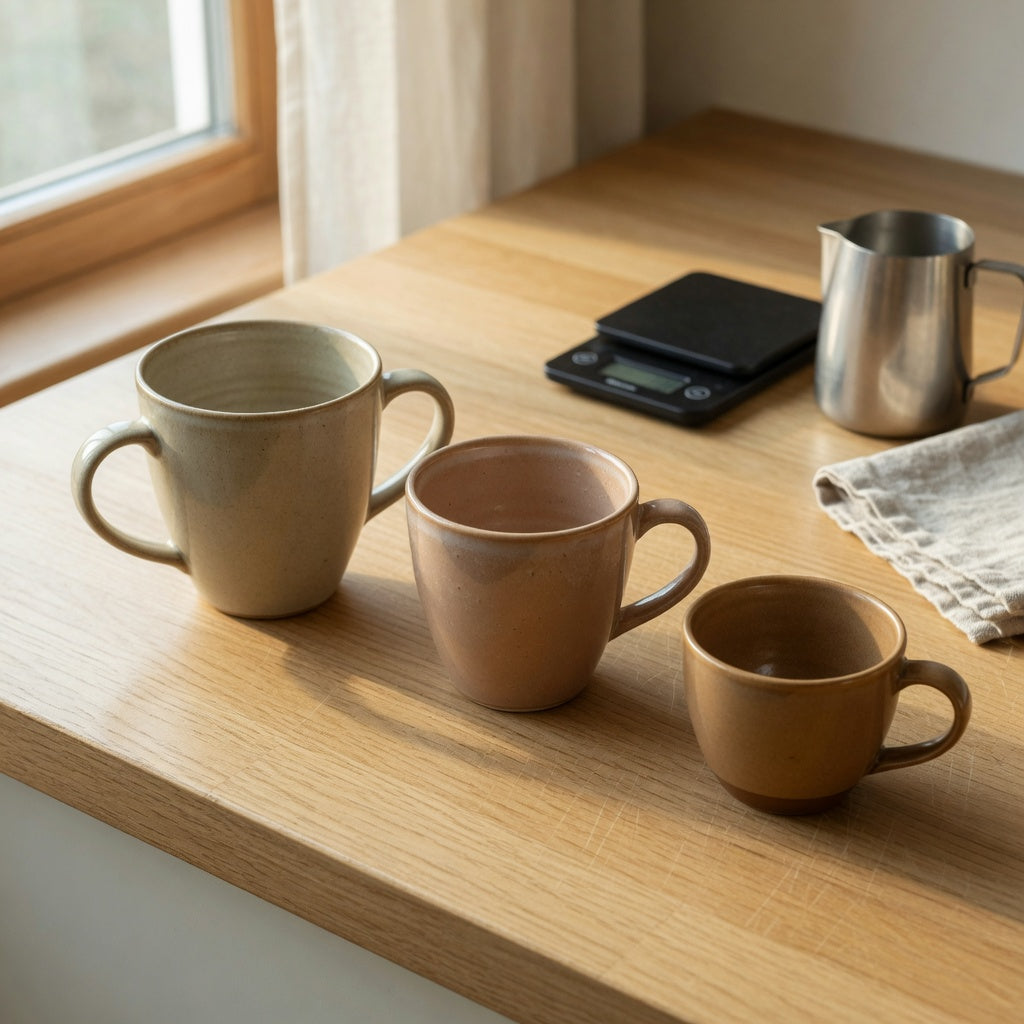
Ceramic Latte Cups: 250, 400, and 440 ml Capacity and Shape Guide
Reading time: about 10 minutes
Ten ounces is 296 ml. So why does a cup sold as a 10 oz mug leave you with roughly 8 oz of latte and a ring on the saucer? Because that printed number is almost always brim-full capacity, and nobody drinks from a brim-full cup. Ceramic latte cups expose that gap in a way black-coffee mugs never did: milk and foam take up volume, and a drink poured to the lip has nowhere to go the moment you set it down.
In our store, we keep the Ball Handle, The Flow, and Morning and Night on the same shelf, and the questions we get are rarely about glaze color. They are about which listed capacity matches a daily habit, whether a rounded bottom earns its keep, and how to confirm a cup is safe to drink from twice a day for years. Here is how we walk a customer through it at the counter.
Why does a cup labeled 10 oz pour like an 8 oz cup?
Three different numbers get used interchangeably on listings, and they are not the same measurement:
- Brim-full capacity — the volume to the absolute lip, usually measured with the cup dead level. This is the number that ends up in the title.
- Fill-line capacity — the volume to a molded or printed line inside the wall, which is what a cafe actually uses.
- Working capacity — brim-full minus the headspace you need for foam, a swirl of the cup, and the walk from the kitchen to the desk.
For reference, the FDA describes a ceramic cup or mug as small hollowware for hot beverages that normally, though not exclusively, holds about 240 ml (8 fl oz) and is made with a handle. That is the regulatory framing, not a design rule — and it tells you the 8 oz mug has been the default for a very long time.
In practice, a cup billed at 300 ml might give you 260 ml of usable drink once you leave room for a foam head. If exact volume matters to you, ask the seller which convention their number uses. Most listings never say.
Which capacity fits your daily drink: 250, 400, and 440 ml ceramic latte cups
Our current lineup runs three sizes. Stated plainly: Ball Handle at 250 ml, The Flow at 400 ml, and Morning and Night at 440 ml. Those are the listed figures, and we would treat them the way you should treat any manufacturer number — confirm the fill convention on the live listing before you commit.
| Cup | Listed capacity | Drink it lines up with | What to verify before buying |
|---|---|---|---|
| Ball Handle | 250 ml | Cortado, piccolo, small flat white, single-shot latte | Handle opening and rim width — small cups live or die on grip |
| The Flow | 400 ml | A standard cafe-sized latte with room to spare for a foam head | Interior bottom shape and how wide the rim sits |
| Morning and Night | 440 ml | A long morning drink, iced lattes, anyone who wants one cup to carry them to lunch | Base diameter against your coaster and cupboard shelf |
There is no official standard that says a latte must be served in a particular volume. Cafe practice spreads across a wide range, and buyer guides disagree with each other. So pick from your habit, not from a rule: measure the drink you make now, once, with a measuring jug. Whatever that number is, add 30 to 50 ml of headspace and buy the closest size up.
In our experience, most people overbuy capacity by one size. A 400 ml cup is not a small latte cup; it is a full cafe latte with room for foam. We would rather you measure once than guess and end up with a cup that overflows every morning.
One honest limitation. If you routinely drink 16 oz lattes, none of these three is your cup — the 440 ml will feel like a compromise, and a larger straight-sided mug is the better answer. Same the other way: if you drink a 4 oz cortado, the 250 ml Ball Handle is generous rather than exact.
Does a rounded or bowl-shaped interior earn its keep for latte art?
The argument you will hear from baristas is that a bowl-like or rounded bottom lets the milk roll into the espresso instead of hitting a flat floor and bouncing, and that a wider rim gives the pattern somewhere to spread out. A straight-sided cylinder, by contrast, channels the pour into a narrow column.
We think that is directionally right, with a caveat: pour technique and milk texture matter far more than the vessel. A skilled hand makes decent art in a plain cylinder. A wobbly pitcher ruins a perfect bowl. Where shape reliably earns its keep is cleanup and drinking — a curved bottom is easier to sweep with a spoon and leaves less residue in the corner where wall meets floor.
Straight sides have their own case. They stack more predictably in a cupboard, they hold more liquid for the same rim diameter, and they behave better with ice. If your ceramic latte cups will live on an open shelf or get stacked four high, favor straighter walls. If you are chasing tulips and rosettas, favor the curve — but confirm the interior shape on the listing, because a product name alone will not tell you how pronounced that curve is.
Handle geometry and desk footprint: what product photos hide
A 440 ml cup filled to a sensible line is carrying close to 440 g of liquid before you add the weight of the ceramic itself. That changes how a handle feels. A handle that sits comfortably in the hand when the cup is empty can feel pinched and hot-knuckled when the cup is full, and no product photo shows this.
Two things to look at. First, the shape of the grip. A ball or knob-style handle sits differently in the fingers than a standard loop, and the question to ask is simply whether your fingers clear it — if you have larger hands, a slender loop on a 250 ml cup is the classic misfit. Second, how far the handle projects. A handle that sticks out far makes a wide cup wider on the desk and pushes the center of gravity further from your hand.
- Ball Handle (250 ml) — the compact option; check the handle span before buying if grip comfort is your main concern.
- The Flow (400 ml) — the middle size, and the one most people land on for a daily latte.
- Morning and Night (440 ml) — the largest, so measure the base against your coaster and your cupboard clearance first.
Desk footprint is the spec nobody publishes. Before ordering, measure three things: the width of your coaster, the clearance under your kitchen cabinet if you brew there, and the shelf height where the cup will live. A wide-based mug that clears a coaster can still foul a low cabinet. In our store, we have watched customers wrap a hand around a handle before they look at the glaze. That instinct is right — start with fit, then choose the finish.
Stoneware, porcelain, or bone china — and how to read a lead-free claim
Material names get used loosely. What a buyer can actually verify is narrower: the manufacturer's care marking, the glaze finish, and the stated weight. A glaze should look uniform, with no pinholes, crawling, or rough patches at the rim — those are the defects that show up first in a dishwasher cycle.
Safety is the part worth slowing down for. The FDA sets an action level for leachable lead in ceramic cups and mugs of 0.5 micrograms per milliliter of leaching solution, applied to any one of six units tested, with a cadmium action level of 0.5 micrograms per milliliter for small hollowware. Those limits exist because glaze chemistry is a real risk when a piece is under-fired: lead used in a glaze may not fuse properly and can migrate into the drink.
Which means a lead-free label is only as good as the testing behind it. The FDA has stated that ceramicware containing extractable lead at or above its action levels should not be labeled Lead Free, and that washing or boiling cannot remove lead from pottery. It also flags handmade, antique, damaged, and brightly orange-, red-, or yellow-decorated pieces as higher concern, while describing everyday commercial factory pottery as much less likely to have a problem.
So ask the seller what was tested and by what method. The FDA's compliance guides cite ASTM C738, an acetic-acid extraction test the agency itself describes as severe and unlikely to be matched in ordinary use. If a listing cannot tell you the method or the result, that is your answer. One more rule worth knowing: decorative ceramicware that looks suitable for food is treated as food-use ware unless it carries a permanent Not for Food Use warning on the base or has a hole through the food-contact surface.
Can you microwave or dishwasher a ceramic latte cup with metallic trim?
Plain, fully glazed ceramic is the easy case — the FDA notes that microwaves pass through ceramic, glass, paper, and plastic, which is exactly why those materials are used for microwave containers. Metal is the opposite: microwaves reflect off it, which can cook unevenly and damage the oven.
That single fact settles most of the question. Any cup with metallic trim, a gold or platinum luster, or a metallic-looking handle glaze should stay out of the microwave, regardless of what the ceramic body itself is made of. The same trim is usually the first thing to dull in a dishwasher, where high heat and detergent are unforgiving.
Two more rules we would give anyone buying ceramic latte cups:
- Check the care marking on the specific piece, not on the set. Care instructions frequently vary between finishes within one product line.
- Retire any cup with a cracked, chipped, or crazed glaze. A compromised surface is the one place where the safety discussion stops being theoretical.
And a caution on general claims: a page that says ceramic is microwave safe is making a statement about ceramic as a material family, not a promise about the cup in your hand.
A four-step check before you add to cart
- Measure tonight's drink in a jug, then add 30–50 ml of headspace. That is your target capacity.
- Measure your space — coaster width, cabinet clearance, shelf height. Wide bases fail here, not in the cup.
- Ask about the fill convention and the care marking on the exact finish you are choosing.
- Ask about glaze testing if food safety is your priority, and expect an actual answer.
Start with the size you already know you drink, then choose the shape. Browse the full unique coffee mugs collection to see all three capacities side by side, and if you are still torn between the 400 ml The Flow and the 440 ml Morning and Night, take the larger one — extra headspace is easier to live with than a cup that runs over.
Frequently asked questions
Are 250 ml ceramic latte cups too small for a daily latte?
For a full-size cafe latte, yes — 250 ml leaves little room once you add a double shot and steamed milk. It suits a cortado, piccolo, or single-shot latte. If your usual drink is a 12 oz latte, go to the 400 ml The Flow instead.
Why does my 400 ml cup overflow when I make a 400 ml drink?
Because 400 ml is the capacity to the lip, and a latte needs headspace for foam and for the liquid to move when you walk. Fill a 400 ml cup to roughly 350–370 ml and you will have a drink that survives the trip from kitchen to desk.
Do ceramic latte cups keep coffee hotter than glass?
Wall thickness and the mass of the cup affect how quickly a drink loses heat, but independent side-by-side tests at realistic volumes are scarce and we do not publish heat-retention figures for our cups. If temperature matters most to you, pre-warming the cup does more than the material choice.
How do I check whether a ceramic latte cup is genuinely food-safe?
Ask the seller what lead and cadmium testing was done and by which method — the FDA's compliance guides reference ASTM C738. The FDA action level for leachable lead in cups and mugs is 0.5 micrograms per milliliter on any one of six units tested. A label alone is not evidence; a test method and result are.
Are double-wall ceramic latte cups worth it?
We do not list a double-wall model in this lineup, so we cannot vouch for a specific one. If you are comparing one elsewhere, ask whether the seam is sealed, whether the maker backs it for dishwasher use, and whether the microwave claim covers the whole piece. A double wall can change the weight and the feel in the hand, and those are the trade-offs to check before you buy.
More from our blog
Read more
Cute Espresso Cups Morning Routine Practical Purchase Checklist
A cup that looks right on the shelf can still be wrong at 6:45 a.m. This is the checklist our team runs before recommending a cute espresso cup — pour volume, refill tolerance, spout clearance, han...
Read more
Ceramic Latte Cups Morning Routine Product Shortlist Guide
A short, scenario-based shortlist of ceramic latte cups built around your real morning: how many minutes you have, how much you actually pour, and whether you go back for a refill. Each cup gets an...
Read more
Leave a comment
This site is protected by hCaptcha and the hCaptcha Privacy Policy and Terms of Service apply.