
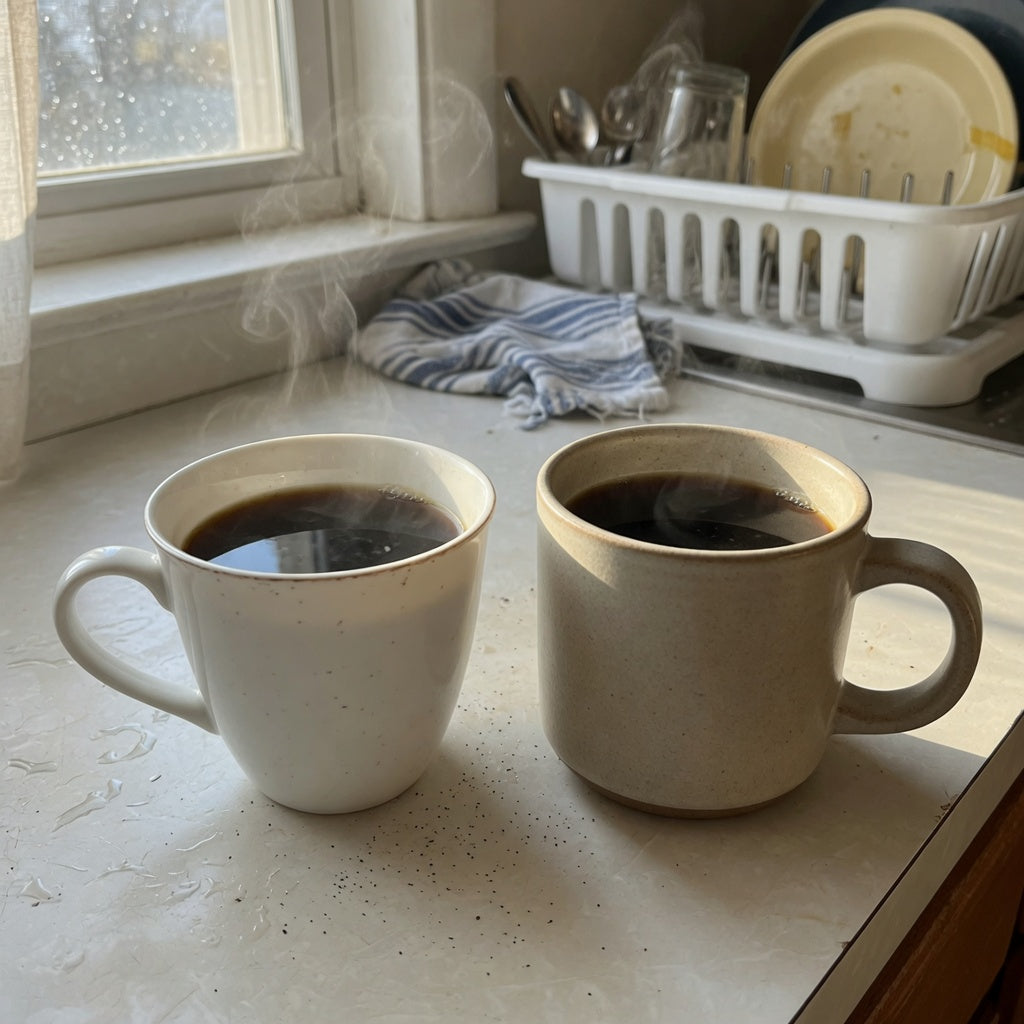
Ceramic vs Porcelain Mug Difference: Which Should You Buy?
Reading time: about 9 minutes
A thin white cup can feel precise at the lip, then seem less practical after it chips against an office sink. A heavier opaque mug may handle that routine better but feel cumbersome during a long tea session. That everyday contrast is where the ceramic vs porcelain mug difference matters: the label alone does not decide which mug is better.
In our store, we look first at the rim, glazed interior, handle joint, wall thickness, and foot. Those details tell us more about daily fit than broad claims such as premium ceramic. The right choice depends on how long your drink sits, how the mug is washed, and how carefully it will be handled.
What does the ceramic vs porcelain mug difference mean?
Porcelain is not a competing material outside the ceramic family. It is a specific type of ceramic. Ceramic is the umbrella term for fired-clay objects, including earthenware, stoneware, and porcelain. Clay composition, firing temperature, vitrification, and porosity separate those categories.
| Ceramic body | Typical construction | Practical mug implications |
|---|---|---|
| Earthenware | Usually fired at about 600-1100 °C and often above 15% porosity | The body remains porous and relies on a sound glaze to hold liquids. Glaze condition and product origin deserve close attention. |
| Stoneware | Usually fired at about 1200-1300 °C, producing a hard, vitrified body that is often below 3% porosity | Commonly opaque and durable. Many everyday products described simply as ceramic mugs fall into this category. |
| Porcelain | Typically contains kaolin, feldspar, and quartz or flint and is fired above roughly 1260-1300 °C; some hard-paste porcelain is fired around 1400 °C | Vitreous, non-porous, usually white, and sometimes translucent where the walls are thin. |
These are category ranges, not guaranteed specifications for every commercial mug. The classification follows the distinctions used in museum ceramics references, but retailers do not always identify the exact clay body on a product page.
A glowing rim held near a lamp or a clear ring from a gentle fingernail tap can suggest porcelain. Neither test is conclusive because wall thickness, glaze, and shape affect the result. A clear material statement from the maker is more dependable.
Heat retention: does porcelain cool coffee faster?
Sometimes, but thin construction is usually the more useful clue. Many porcelain cups are made with fine walls, while stoneware mugs are often heavier and thicker. A thin wall warms quickly and has less ceramic mass. A thicker mug may make temperature changes feel more gradual once the mug itself is warm.
There is a trade-off at the start. A cold, heavy mug can draw noticeable heat from a fresh pour. We preheat either style by filling it with hot water while the coffee brews, then emptying it immediately before pouring. Opening width also matters: a broad cup exposes more liquid to the air than a narrower mug of similar capacity.
For a useful home comparison:
- Preheat both mugs in the same way.
- Pour equal amounts from the same batch of coffee or tea.
- Place them together, away from a vent, fan, or sunny window.
- Compare them at the times that match your routine, such as after a short call and again after a longer meeting.
We have not found authoritative, controlled cooling data that proves all porcelain mugs outperform or underperform all stoneware mugs of comparable capacity. Be cautious with any seller promising a precise heat-retention advantage from the material name alone.
Rim chips, handle cracks, and shared-office durability
Porcelain is hard and non-absorbent, but hardness does not make a finished mug drop-proof. Porcelain drinkware is frequently made thin for a lighter, refined feel, and a fine rim can be vulnerable when it hits a faucet, granite counter, or another mug. Stoneware is also hard and durable, yet it can still chip if the wall or handle is poorly formed.
The common failure points we inspect while handling mugs are specific:
- Rim chips: These create an uncomfortable drinking edge and expose the clay body beneath the glaze.
- Handle-joint cracks: Look where the upper and lower ends of the handle meet the mug. A fine line there can worsen as the filled mug is lifted.
- Glaze crazing: A network of hairline lines in the glaze can collect discoloration and make the interior harder to clean.
- Uneven feet: A mug that rocks on a flat counter is easier to knock during a busy morning.
A very thin porcelain cup is not our first choice for a crowded office kitchen, a child learning to handle hot drinks, or any sink where mugs are routinely stacked. A thick ceramic mug is not ideal for someone who wants minimal weight or has limited grip strength. Construction and use matter more than declaring one material universally tougher.
Does porcelain make coffee taste cleaner?
A material label is not a reliable flavor upgrade. An intact, food-contact glaze over a vitrified body should provide a smooth surface that is easy to rinse clean. Porcelain naturally has a non-porous body, while properly vitrified stoneware also has low porosity.
Perceived off-flavors more often point to coffee oil, scented detergent, glaze damage, or residue caught in fine cracks. We check a dry mug for odor, inspect the interior under side light, then wash it with a soft sponge and rinse until no detergent scent remains. If the glazed interior stays stained, rough, or cracked, changing mugs makes more sense than changing coffee.
Shape affects the drinking experience too. A wider mouth exposes more surface and releases aroma quickly, while a narrower opening limits that exposed area. A fine porcelain lip can feel delicate; a rounded stoneware rim feels more substantial. That is mouthfeel and geometry, not proof that one clay body produces better-tasting coffee.
Food-safe glaze matters more than a porcelain label
The clay body is only part of the food-contact surface. Glaze formulation, decoration, and firing also matter. The FDA guidance on lead-glazed pottery explains that improperly formulated or fired ceramic glazes can leach lead. The agency regulates extractable lead from ceramic foodware, including mugs and cups.
A high-fired, vitrified body reduces absorption, but it does not automatically verify every glaze or decorative layer. Use these checks before putting a mug into daily rotation:
- Confirm that the item is intended for food and drink, rather than decoration only.
- Follow the current product listing for microwave and dishwasher compatibility. Do not infer either from the words ceramic or porcelain.
- Treat metallic rims, luster, and painted details cautiously. Metallic decoration requires explicit microwave guidance.
- Avoid drinking from antique, damaged, or brightly decorated pieces of unknown origin.
- Retire a mug if the food-contact surface develops a deep chip, spreading crack, or loose glaze.
Handmade appearance does not automatically mean unsafe, just as a white porcelain body does not guarantee suitable decoration. Reputable labeling and an intact food-contact surface are the practical standards. Avoid sudden temperature shocks as well, such as moving a cold mug directly from a refrigerator or freezer to boiling liquid unless the maker specifically allows it.
Which CoffeifyMug style fits a desk, gift, or tea setup?
The material guidance above applies to ceramic categories in general. For any CoffeifyMug item, use the current product page as the source of truth for material, dimensions, capacity, included pieces, and care. We do not assign microwave or dishwasher compatibility from appearance alone.
- For a familiar rounded coffee-and-tea format: Start with the round coffee tea mug. It is the relevant style comparison if a rounded profile is your priority. Check its current listing details against your preferred capacity and cleaning routine.
- For a gift where surface detail drives the first impression: Review the pleated coffee tea cup. Compare its listed measurements and care information with the recipient's usual mug before ordering.
- For a decorative desk or kitchen shelf: The landscape coffee tea mug is the more relevant next step if the visible design is central to the purchase. Confirm from the listing that its format and care suit daily drinks rather than display alone.
- For shoppers still comparing silhouettes: Open our unique coffee mugs collection and compare the current listings side by side. Focus on rim shape, handle clearance, overall dimensions, stated material, and care rather than choosing from the main photo alone.
Your checkout checklist: body, rim, handle, and care
- Identify the actual body. Look for porcelain, stoneware, earthenware, or a more specific description than ceramic.
- Read the measurements. Capacity alone does not reveal height, opening width, or how much cabinet space the mug needs.
- Inspect the rim and wall. Thin construction favors a lighter drinking feel; thicker construction usually favors everyday heft.
- Check the handle opening. Make sure it suits the number of fingers you normally use and leaves comfortable clearance from the hot wall.
- Read the care statement. Microwave and dishwasher suitability are product-specific.
- Match the mug to the likely abuse. Office sinks, deep stacking, frequent reheating, careful tea service, and gift display call for different construction.
Treat the ceramic vs porcelain mug difference as a useful filter, not a verdict. Choose the finished mug whose wall, rim, handle, glaze, and stated care match what will happen after the unboxing.
Frequently asked questions
What is the ceramic vs porcelain mug difference for everyday coffee?
Porcelain is a high-fired, vitrified type of ceramic that is usually white, non-porous, and sometimes translucent. Products sold simply as ceramic mugs are often stoneware or earthenware. For everyday coffee, wall thickness, shape, glaze condition, and care instructions can matter more than the broad material label.
Do porcelain mugs keep coffee hotter than ceramic mugs?
Not automatically. A thin porcelain cup may cool differently from a thick stoneware mug, but opening width, mug mass, starting temperature, and room conditions also affect heat loss. Preheating the mug is a practical step for either material.
Is porcelain more durable and stain-resistant than regular ceramic?
Vitrified porcelain is hard and non-porous, so its body resists absorption. A thin porcelain rim can still chip more easily than a thicker stoneware rim during an impact. Staining is most likely where glaze is damaged, crazed, rough, or difficult to clean.
Does a porcelain mug change how coffee tastes?
A sound food-contact surface should not be chosen on the promise that it will improve flavor by itself. Coffee oil, detergent residue, interior damage, rim thickness, and cup shape can all change the perceived drinking experience. A clean porcelain cup may feel smoother, but well-glazed stoneware can also provide a neutral surface.
Are ceramic and porcelain mugs microwave and dishwasher safe?
Either type may be suitable, but material alone does not guarantee it. Follow the current maker or product-page instructions and do not microwave metallic decoration without explicit approval. After confirming care requirements, compare the available shapes in our collection of unique coffee mugs against your daily routine.
More from our blog
Read more
Geometric Abstract Coffee Mug: Compare Size, Form, and Care
Compare a geometric abstract coffee mug by 250 ml versus 400 ml capacity, surface finish versus sculptural form, food-use details, grip, heat retention, and care. See which routine fits Rhombus, Gr...
Read more
Ceramic Breakfast Mug: Compare Capacity, Glaze, and Fit
Compare CoffeifyMug's listed 170, 200, and 350 ml capacities against your usual pour, table space, and refill habits. We also explain glaze documentation, ceramic body terms, handle checks, microwa...
Read more
Leave a comment
This site is protected by hCaptcha and the hCaptcha Privacy Policy and Terms of Service apply.