
Ceramic Breakfast Mug: Compare Capacity, Glaze, and Fit
Reading time: about 9 minutes
A ceramic breakfast mug can look generous in a close-cropped photo, then arrive and hold less than your usual morning pour. The mismatch becomes obvious at a crowded table: the plate is down, the coffee is poured, and the cup needs a refill before the toast is finished.
At CoffeifyMug, we start with the listed milliliters, not the styling language. Capacity determines your refill pattern, while height, base width, handle projection, and glaze care determine whether the mug works on your table every day. The word breakfast does not standardize any of those details.
Ceramic breakfast mug capacity: 170, 200, or 350 ml?
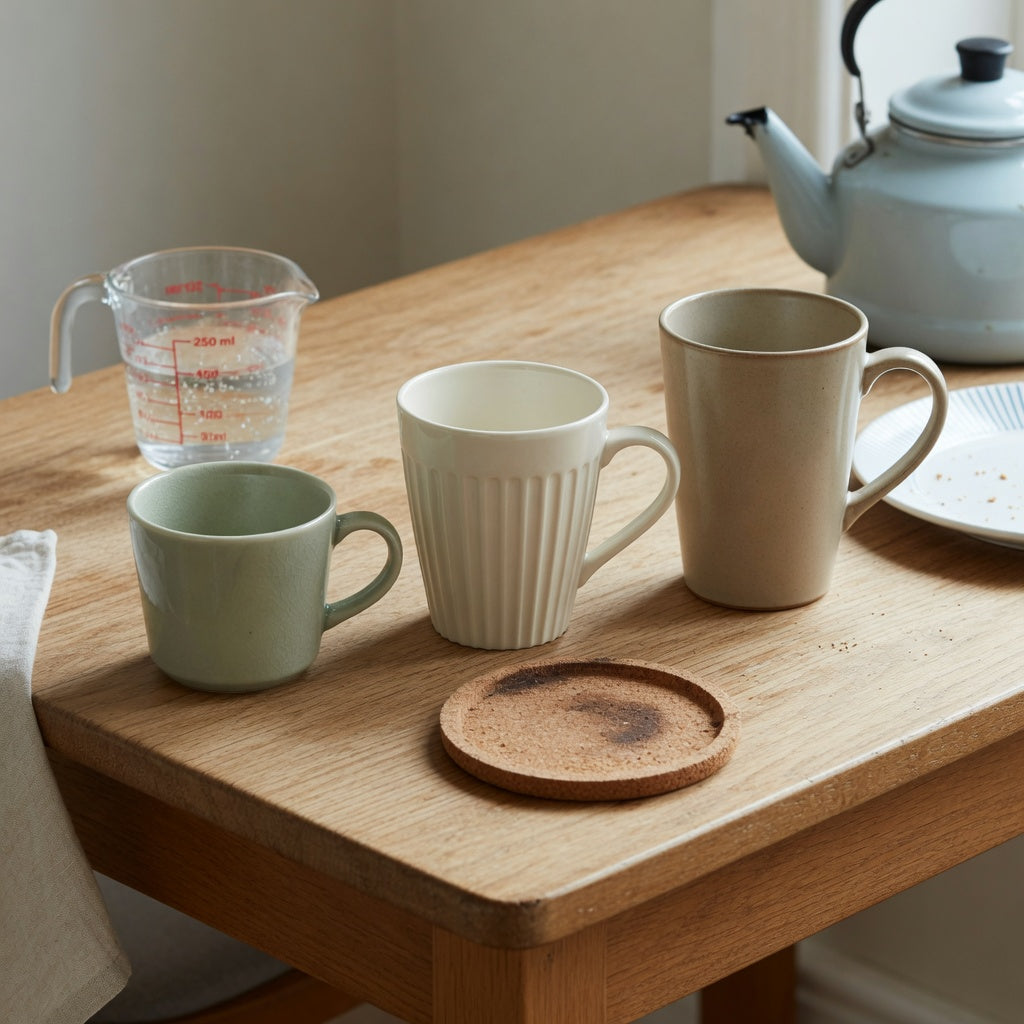
Our three relevant listings cover compact sipping cups through a fuller coffee mug. These are the verified capacities we use for comparison:
| Product | Listed capacity | Approximate US volume | Best starting point for | Main trade-off |
|---|---|---|---|---|
| Retro Coffee Tea Cup | 170 ml | 5.7 US fl oz | A deliberate small pour | Most frequent refills |
| Pleated Coffee Tea Cup | 200 ml | 6.8 US fl oz | A little more drink without choosing the largest option | Still well below a large home pour |
| Landscape Tall Coffee Tea Mug | 350 ml | 11.8 US fl oz | The highest listed capacity of the three | Tall clearance and filled weight need checking |
A listed capacity is not the same as a comfortable serving. Coffee, milk, and foam need headroom if you want to carry the mug without spilling. A 12 US fl oz drink is about 355 ml, so it already exceeds 350 ml before any space is left below the rim. Measure the drink you normally make rather than relying on labels such as regular or large.
- Choose 170 ml if you enjoy a short coffee or tea and do not mind returning to the pot.
- Choose 200 ml if 30 ml more than the smallest option matters but you still prefer a modest serving.
- Choose 350 ml if reducing refills is the priority and your usual pour fits with adequate headroom.
None of these capacities should be assumed to replace an oatmeal or soup bowl. If you need room for a spoon, toppings, and stirring, shop for a vessel specifically listed for that food use and verify its usable capacity.
Footprint, height, and refill habits at a crowded table
Capacity alone does not reveal footprint. A low, wide 200 ml cup can occupy more placemat space than a narrow, tall mug. Product photos can also hide scale, so check measurements whenever the current listing provides them.
- Overall height: Compare it with shelf space, an espresso machine outlet, and dishwasher rack clearance.
- Rim and base diameter: Check the coaster, placemat, and space beside your breakfast plate.
- Handle projection: Include the handle when measuring beside a laptop, wall, or neighboring place setting.
- Filled weight: A 350 ml portion of a water-like drink adds about 350 g before the mug itself is counted.
We recommend setting out your usual plate, coaster, phone, and anything else that lives on the table. Mark the available mug area with a folded napkin or tape measure. The name Landscape Tall signals that height deserves attention, but a product name is not a substitute for exact dimensions.
If shape is still the deciding variable, compare the current silhouettes in our unique ceramic coffee mug collection. Use capacity as the first filter, then verify the dimensions and care details shown on the individual listing.
Stoneware, porcelain, or earthenware: what changes in daily use?
Ceramic is the broad category. Stoneware, porcelain, and earthenware are different ceramic bodies, and the label can affect weight, porosity, rim thickness, and how dependent the piece is on an intact glaze.
- Stoneware is typically fired to a dense body and often feels substantial. That heft can feel stable on a table, but a large stoneware mug may be tiring to hold when full.
- Porcelain is also dense and can be made with a thinner wall. It may feel lighter for its capacity, although a fine rim still needs protection from knocks.
- Earthenware is generally more porous beneath the glaze. It can work as drinkware when properly made, but chips and unglazed areas deserve close inspection.
Clay type does not settle the heat-retention question by itself. Wall thickness, total mass, opening width, starting temperature, and the presence of a lid all matter. We also do not assign a stoneware, porcelain, microwave, or dishwasher claim to a CoffeifyMug product unless that fact appears on its current listing.
Glaze safety: documentation matters more than shine
A fired ceramic glaze is a glass-like surface fused to the clay body, not a removable nonstick coating. A glossy appearance cannot prove food-contact compliance, however, and visual inspection cannot detect extractable metals.
The FDA lead guidance for cups and mugs identifies 0.5 micrograms per milliliter as its action level for extractable lead in any one of six units tested using the specified method. The FDA's cadmium guidance for small hollowware uses the same action level for pieces with capacity below 1.1 liters. These are regulatory action levels, not a certification badge and not proof that a particular mug has been tested.
Before buying an unfamiliar ceramic piece, ask concrete questions:
- Is the interior glaze intended for food and drink contact?
- Does any compliance or test documentation apply to the exact item and decoration?
- Is there metallic trim, overglaze decoration, or a care warning?
- Are microwave and dishwasher claims stated separately?
On arrival, inspect the rim and well under direct light. Chips, exposed clay, pinholes, and crazing need attention. Crazing appears as a network of fine lines in the glaze and can collect stains. Because heat and acidic drinks can facilitate leaching from damaged ceramic surfaces, we would remove a mug with a chipped or heavily crazed interior from food and drink use.
Microwave reheating and dishwasher cycles: check each claim
The FDA's microwave guidance explains that microwaves pass through ceramic while recommending cookware specifically made for microwave use. That distinction matters. Ceramic material alone does not establish that every glaze, decal, or metallic decoration is microwave-safe.
- Confirm the microwave-safe and dishwasher-safe wording for the exact mug; one claim does not establish the other.
- Keep any piece with metallic trim or decoration out of the microwave.
- Avoid sudden temperature changes, such as moving a refrigerated mug directly to a very hot fill.
- Load the dishwasher so the rim and handle cannot strike another piece during the cycle.
- Inspect the handle joins, rim, and interior glaze after a hard knock or a visible change.
Common failure modes we see in ceramic drinkware include rim chips, hairline cracks near a handle join, worn surface decoration, and crazing caused by glaze-body fit or revealed by repeated stress. Dishwasher-safe does not mean chip-proof, and hand washing cannot make an unsuitable mug microwave-safe.
Handle comfort and heat retention on a desk or breakfast table
Handle openings are easy to overlook online. From handling mugs in this category, we find that finger clearance, thumb angle, and balance matter more than an ornate loop. A handle that fits one finger may suit a 170 ml cup but feel less secure as capacity and filled weight increase.
- At unboxing, fill the mug with cool water before using a hot drink.
- Lift it over the counter with your normal one-handed grip.
- Check whether your knuckles touch the mug wall and whether the cup twists forward.
For warmer coffee, preheat the cup with hot water, empty it, and then pour. An open ceramic mug still loses heat from its exposed surface. If you need a drink to stay hot through a long commute or meeting, a sealed insulated mug is a better tool than a larger open cup.
Three morning routines and the most sensible starting point
- Short tea or coffee with easy refills: The 170 ml Retro cup fits the smallest serving preference in this comparison. It is not a fit for someone expecting one large pour.
- Modest serving with slightly more room: The 200 ml Pleated cup adds 30 ml over the Retro. Choose it because that capacity matches your drink, not because the texture changes how much it holds.
- Fewer trips to the kettle: The 350 ml Landscape Tall mug has the largest verified capacity here. Confirm tall clearance and leave enough space below the rim for carrying.
Treat food, drinks, plates, kettles, saucers, lids, and other objects in lifestyle scenes as context. Only the contents stated on the current product page should be assumed to come with an order.
A 60-second check before adding a mug to your cart
- Measure your normal pour in milliliters and allow room below the rim.
- Decide how many breakfast refills you will genuinely tolerate.
- Verify height, base width, handle projection, and empty weight when listed.
- Confirm the ceramic body, food-contact information, and care claims instead of inferring them from appearance.
- Check that the listed contents match what you expect to receive.
Frequently asked questions
What size ceramic breakfast mug works for a 12 oz coffee?
Twelve US fluid ounces is about 355 ml, so a 350 ml mug is slightly smaller even before allowing headroom. If 12 oz is your fixed serving and you do not want spills or refills, choose a capacity above 350 ml rather than filling a smaller cup to the rim.
Is a ceramic mug safe to microwave with hot tea?
Use it only when the exact mug is labeled microwave-safe and has no metallic trim or decoration. Ceramic generally allows microwave energy to pass through, but the glaze, decoration, and construction still determine whether a specific piece is suitable.
How can I tell if a ceramic mug glaze will hold up?
Look for a smooth interior without chips, exposed clay, or networks of fine craze lines, then follow the stated care instructions. Appearance cannot verify lead or cadmium compliance, so ask for product-specific documentation if the seller makes a safety or testing claim.
Is a 350 ml mug large enough for oatmeal?
It may physically hold a small portion, but capacity alone does not make a coffee mug suitable as a breakfast bowl. Oatmeal needs stirring room and space for toppings, so select a vessel specifically listed for food use rather than assuming the 350 ml Landscape Tall mug fills that role.
How do I keep coffee warmer in a ceramic breakfast mug?
Warm the mug with hot water before pouring, use a serving size you can finish promptly, and keep it away from cold drafts. Wall thickness and shape affect cooling, but an open ceramic mug will not retain heat like a sealed insulated vessel.
Your next step: Measure your usual drink once, compare it with 170, 200, and 350 ml, and verify dimensions and care details on the live product page. If none is an obvious match, return to the unique coffee mugs collection and filter by the routine you actually have, not the breakfast setup shown in a photo.
More from our blog
Read more
Ceramic vs Porcelain Mug Difference: Which Should You Buy?
Porcelain is a type of ceramic, but construction changes how a mug feels and performs. Compare wall thickness, heat retention, chip risk, staining, glaze safety, care, and everyday fit before buying.
Read more
Ceramic Abstract Coffee Mug: Compare Size, Glaze and Care
Compare a ceramic abstract coffee mug by capacity, form, food-use labeling, microwave and dishwasher guidance, storage, and finish care. See how the 250 ml Rhombus and 400 ml Gradient and Flow desi...
Read more
Leave a comment
This site is protected by hCaptcha and the hCaptcha Privacy Policy and Terms of Service apply.