
Geometric Abstract Coffee Mug: Compare Size, Form, and Care
Reading time: about 10 minutes
A dramatic mug can look standard-sized in a close product photo. The mismatch appears after delivery: a 250 ml cup is too small for a milk-heavy morning coffee, a sculptural profile may not stack in a crowded cabinet, or the care details do not confirm dishwasher use. From the store side, we see the same lesson repeatedly: a geometric abstract coffee mug should be compared by capacity, design type, food-use information, handling, and care before color decides the sale.
Is the geometric abstract coffee mug patterned or sculptural?
Shoppers often use abstract as a style description for color fields, angles, repeated shapes, and unconventional silhouettes. It is not proof of a named art movement, creator attribution, production method, or design provenance. For buying purposes, the useful distinction is where the visual interest comes from.
- Surface-led design: The finish, pattern, or color transition creates the effect. This suits a buyer who wants a strong visual accent on a kitchen counter or office desk.
- Form-led design: Facets, angles, or curves are built into the silhouette. The shape remains the main feature even from across the room.
- Combined design: Both the finish and the physical form demand attention. This can be striking, but it also makes storage, grip, and care more important.
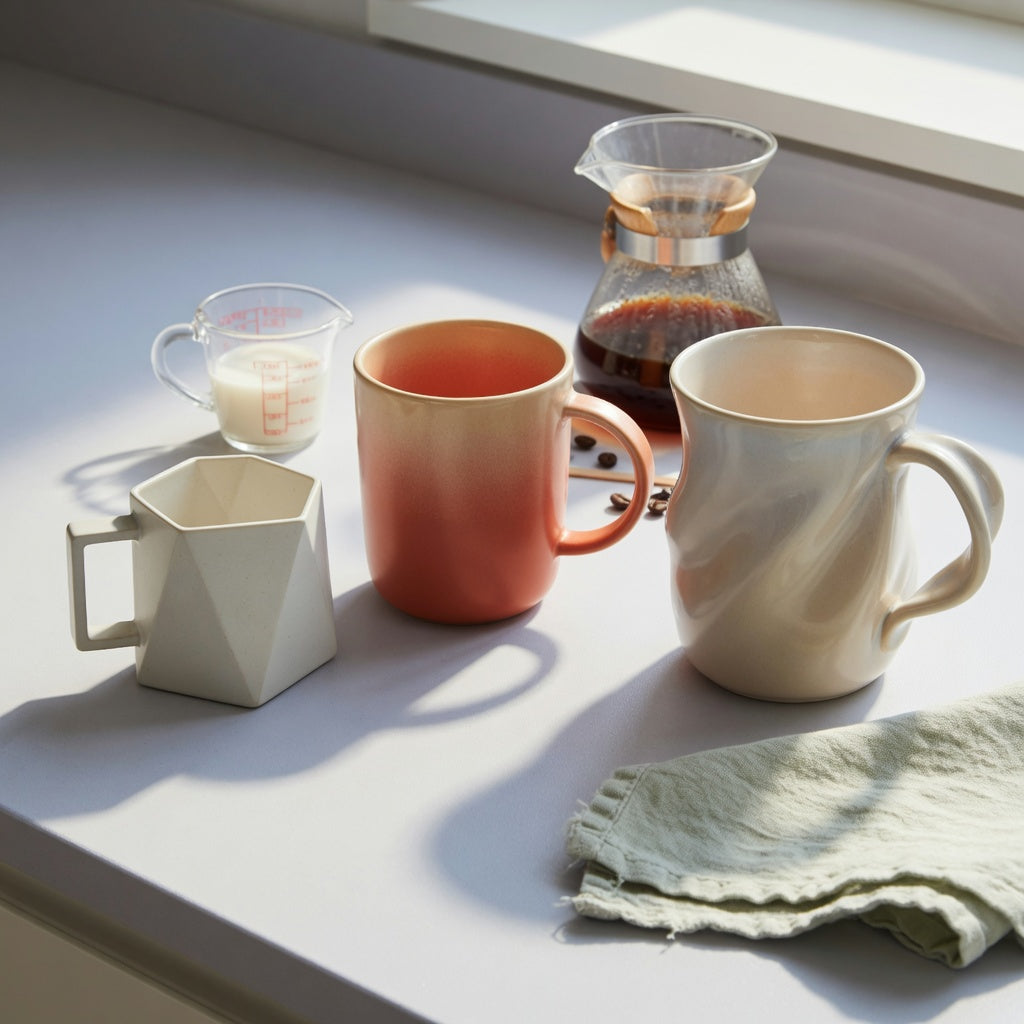
That distinction gives you a better starting point than searching by color alone. Our unique coffee mugs collection includes different visual directions, but the confirmed facts for the three options discussed here are deliberately specific: Rhombus has a 250 ml capacity and geometric form, Gradient has a 400 ml capacity and color-transition finish, and Flow has a 400 ml capacity with sculptural curves.
250 ml or 400 ml: which capacity matches your usual pour?
Capacity is the first practical filter because it cannot be fixed after the mug arrives. A 250 ml vessel holds about 8.5 US fluid ounces, while 400 ml is about 13.5 US fluid ounces. The larger options provide 150 ml more listed capacity, but every drink still needs some headroom below the rim.
| Current option | Verified capacity | Verified design detail | Best situation to investigate |
|---|---|---|---|
| Rhombus coffee and tea mug | 250 ml | Geometric form | Short coffee, tea, or a buyer who prefers a smaller serving and is comfortable refilling |
| The Gradient coffee and tea mug | 400 ml | Color-transition finish | A fuller home or office pour where the changing color is the main visual reason to buy |
| The Flow coffee and tea mug | 400 ml | Sculptural curves | A fuller pour for someone who prefers a shape-led object over a conventional straight-sided mug |
We recommend measuring the drink rather than guessing from an old mug's label. Make your normal coffee or tea, pour it into a measuring jug, and include the milk, cream, or extra water you usually add. If the finished drink approaches 12 US fluid ounces, 250 ml is clearly too small; 400 ml is the closer comparison, although the listing should still be checked for how capacity is measured.
The smaller Rhombus is not an inferior version of the larger designs. It serves a different routine. A tea drinker who makes repeated fresh pours may prefer 250 ml, while someone carrying one coffee from the kitchen to a desk will usually appreciate the additional capacity of Gradient or Flow.
What should food-use and material details actually confirm?
A decorative shape does not make a mug unsafe, but visual style is not evidence of food-contact suitability either. Before ordering any geometric mug, check that the current listing identifies it as drinkware, names the material, and provides relevant care or safety information. Do not infer glaze chemistry, firing temperature, or testing from a polished product photograph.
The FDA compliance guide for pottery sets an action level of 0.5 micrograms per milliliter of extractable lead for cups and mugs, based on any one of six units tested using ASTM C738 or an equivalent method. That is a regulatory action level. It is not a certification for every mug on the market, and it does not establish that any specific CoffeifyMug product underwent that exact test.
Use this sequence when reviewing a listing:
- Confirm intended use. The item should be presented as a coffee or tea mug, not merely as a decorative vessel.
- Read the material description. If it is ceramic, look for food-use information relevant to the complete mug and its decorative finish.
- Separate safety claims. A BPA-free statement does not replace lead-related information for ceramic drinkware. BPA language is more directly relevant when plastic parts, lids, or coatings are present.
- Treat vintage pieces differently. An older geometric mug with an unknown glaze history may be better kept as a collectible than used for daily hot drinks.
The verified catalog details available for this comparison cover capacity and design direction. They do not establish production methods, glaze composition, edition status, or independent laboratory results, so we do not assign those claims to Rhombus, Gradient, or Flow.
Will the handle, rim, and base suit a real workday?
A mug earns daily status through small repeated actions: lifting it beside a laptop, taking a sip without drips, and setting it down without wobble. In our experience, shoppers often evaluate the artwork carefully but spend too little time checking the contact points.
- Handle clearance: Decide whether you normally use two or three fingers. Compare any listed handle dimensions with a mug you already find comfortable, especially if the body is faceted or curved.
- Balance: A large body paired with a compact handle can feel different when full. Look for product photos that show the handle in proportion to the complete mug rather than relying on a tightly cropped image.
- Rim profile: Some buyers prefer a fine rim for tea, while others like a more substantial edge. Check close photos for the drinking edge and inspect it regularly for sharp chips.
- Base contact: A stable foot matters on wood desks, glass tables, and uneven office surfaces. Product imagery should show enough of the base to evaluate its stance.
- Cabinet fit: Treat a sculptural mug as non-stackable unless the listing shows or states otherwise. Measure shelf height and available width if your cabinet is already crowded.
Material and shape also affect temperature. Consumer Reports notes that ceramic mugs with greater mass and thicker walls can retain heat longer than comparable glass or metal vessels because the body absorbs and holds thermal energy. A narrower opening can also reduce evaporative cooling. We do not have direct heat-retention testing for these three models, so capacity or appearance alone cannot establish which one keeps coffee warm longest.
What can you assume about dishwasher and microwave care?
Very little without the current care line. Dishwasher-safe and microwave-safe are separate claims, and a base material does not automatically determine how a decorative finish will behave. If either type of use matters to your routine, confirm it on the exact product page rather than applying a general ceramic rule.
- Check both claims separately. A mug may be suitable for one appliance but not the other.
- Do not microwave unknown metallic decoration. If a finish appears metallic and the listing does not explicitly approve microwave use, choose a different heating method.
- Hand-wash when preservation is the priority. Use a soft sponge and non-abrasive cleaning surface if care information is absent or you want to reduce wear on a decorative finish.
- Prevent contact damage. Even a dishwasher-approved mug can chip if its rim, handle, or raised edge strikes another item in a crowded rack.
Common warning signs include a sharp rim chip, a crack extending from the handle joint, flaking decoration, or a rough patch that was not present when new. A structural crack or sharp drinking edge is a reason to stop using the mug for hot beverages.
There is no independent long-term evidence here showing how these particular products look after hundreds of dishwasher or microwave cycles. That limitation matters most for The Gradient, because its verified color-transition finish is central to the design. Rhombus and Flow are form-led choices, but a geometric or sculptural silhouette does not make either one impact-resistant.
Which CoffeifyMug design fits each drinking routine?
The right recommendation should connect a real situation to a verified product detail. Based on the current catalog facts, the selection logic is straightforward:
- Choose Rhombus for a smaller serving and form-led geometry. Its listed 250 ml capacity suits tea, short coffee, and buyers who prefer a fresh refill over one large drink. Review the 250 ml Rhombus mug if capacity is already a match.
- Choose Gradient for a fuller pour and finish-led color. Its listed 400 ml capacity gives more room, while the color-transition finish provides the main visual feature. Compare the current care details on The Gradient 400 ml mug before assigning it regular dishwasher duty.
- Choose Flow for a fuller pour and sculptural shape. It also has a listed 400 ml capacity, but its defining catalog detail is the curved form. Open The Flow 400 ml mug if silhouette matters more to you than a surface color transition.
For a gift, ask what the recipient actually drinks. A person who makes small cups of tea may get more use from Rhombus than from a larger statement mug. Someone who takes one full coffee to a home-office desk has a stronger capacity match with Gradient or Flow; the remaining choice is finish versus sculptural form.
Who should skip a decorative geometric mug?
This category is strongest on a kitchen counter, dining table, or settled office desk. A different format is more practical if you need:
- A sealed lid, cup-holder fit, or insulation for commuting.
- A 15 or 16 US fluid ounce single-fill drink; even 400 ml is only about 13.5 US fluid ounces.
- A uniform, stackable set for a busy shared kitchen.
- Impact-resistant drinkware for camping, workshops, or frequent outdoor use.
- Guaranteed appliance care when the current product listing does not confirm it.
A plain straight-sided mug or insulated travel cup may be less visually distinctive, but it can be the better tool for those jobs. The geometric abstract coffee mug makes sense when its capacity and handling fit first, and its appearance adds value without creating daily friction.
Can you make the decision in 60 seconds?
Use this order before adding a mug to your cart:
- Measure your normal finished drink, including milk or added water.
- Choose 250 ml for a smaller serving or 400 ml for more listed capacity.
- Decide between geometric form, color-transition finish, and sculptural curves.
- Check material, intended use, and food-contact information on the current listing.
- Confirm dishwasher and microwave claims separately.
- Review handle proportion, rim, base, cabinet space, and likely stacking needs.
- Reject the option if you really need a travel lid, impact resistance, or more than 400 ml.
Frequently asked questions
Is a geometric abstract coffee mug dishwasher and microwave safe?
Only if the current listing confirms each type of use. Dishwasher-safe and microwave-safe are separate claims, and decorative finishes can have different restrictions from the underlying mug material. If the information is absent, hand-wash the mug and avoid microwave use until the seller or manufacturer confirms it.
Should I choose a 250 ml or 400 ml geometric mug?
Choose 250 ml, about 8.5 US fluid ounces, for tea, short coffee, or smaller servings with regular refills. Choose 400 ml, about 13.5 US fluid ounces, for a fuller home or office drink. Measure your usual prepared beverage before ordering because milk and extra water count toward the required capacity.
How can I verify that a geometric ceramic mug is food-safe?
Check that the listing presents it as drinkware, names the material, and provides relevant food-use or safety information. The FDA action level for extractable lead in cups and mugs is 0.5 micrograms per milliliter under its pottery compliance method, but that standard does not prove a specific product was tested. Ask the seller if the listing leaves a material or safety question unresolved.
Will a color-transition or geometric finish fade?
Finish durability depends on materials and application methods that cannot be established from appearance alone. We do not have independent long-term cycle testing for these specific products, so a no-fade promise would not be supportable. Follow the exact care line and use gentle hand-washing if preserving the finish is your priority.
Which geometric mug makes the most practical gift?
Match the gift to serving size before choosing the visual style. Rhombus fits a smaller 250 ml routine, Gradient fits a 400 ml drinker who values a color-transition finish, and Flow fits a 400 ml drinker who prefers sculptural curves. For a recipient who only uses lidded commuter cups, choose a travel format instead.
For the clearest next step, open Rhombus, Gradient, and Flow side by side. Eliminate any option that misses your serving volume or care requirement, then choose between geometric form, color transition, and sculptural curves; for a wider comparison, return to the CoffeifyMug unique mug collection.
More from our blog
Read more

Unique Christmas Mug Gifts: Compare Fit, Care, and Style
Compare a mug the way its recipient will use it: handle clearance, practical capacity, ceramic type, care instructions, food-use wording, and cabinet fit. Then match seasonal, artistic, or handbag-...
Read more
Ceramic vs Porcelain Mug Difference: Which Should You Buy?
Porcelain is a type of ceramic, but construction changes how a mug feels and performs. Compare wall thickness, heat retention, chip risk, staining, glaze safety, care, and everyday fit before buying.
Read more
Leave a comment
This site is protected by hCaptcha and the hCaptcha Privacy Policy and Terms of Service apply.