
Ceramic Mug Shapes Home Coffee Station Practical Purchase Checklist
Reading time: about 9 minutes
The mug that ends up at the back of the cabinet rarely lost on looks. It lost on fit: the handle pinched two fingers, the base was too wide for the warming plate, or a 400 ml body fouled the spout on the drip brewer. We sell ceramic drinkware, so we see this before the return label does. This ceramic mug shapes home coffee station practical purchase checklist is the counter version we walk buyers through: capacity first, then rim, handle, clearance, cleaning and glaze.
What do cup and mug mean on a ceramic spec sheet?
The wording matters, but not as much as shoppers expect. FDA guidance for ceramic hollowware describes cups and mugs as small vessels for hot drinks, normally holding about 240 mL (8 fl oz) and normally made with a handle. In that guidance, a cup normally has a base and curved sides, while a mug has cylindrical sides.
That is a labeling distinction, not a quality ranking. Everything else — belly, barrel, tulip, diner, tapered latte, faceted — is trade language, and sellers use those names loosely. Two listings can both say barrel and be shaped nothing alike. Judge the photo silhouette and the listed capacity, not the label.
One conversion belongs on your phone while you shop: NIST puts 1 US fluid ounce at about 29.57 mL, and its kitchen table treats a cup as roughly 240 mL. A 12 oz mug works out to about 355 mL; a 10 oz mug is about 296 mL. Do that math before you compare a metric listing with an imperial one.
Which capacity band matches the drink you actually pour?
Specialty-coffee guidance commonly places espresso in a small cup and cappuccino, flat white and latte in the 150–240 mL band, with lattes often pushed larger. Treat those as starting ranges, not laws. Your brew ratio and milk volume decide more than the drink name on a menu board.
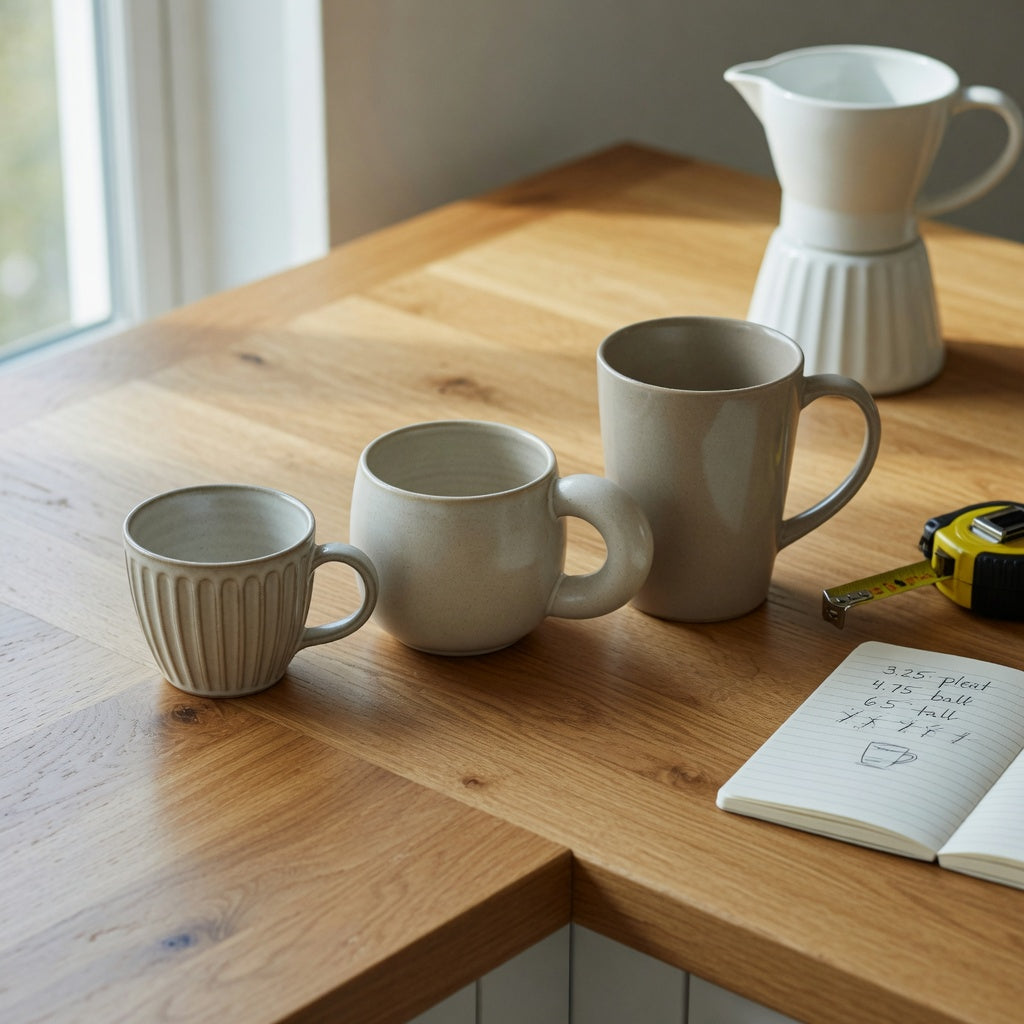
| Piece and listed capacity | Visible shape cue | Best fit on a home station | Check before buying |
|---|---|---|---|
| Pleated coffee and tea cup, 200 ml | Pleated body | Cappuccino, flat white, a short filter pour or tea | Rim feel, interior pleats for cleaning, and whether 200 ml is brim-full or a usable fill line |
| Ball Handle coffee and tea mug, 250 ml | Ball-shaped handle | Cappuccino or flat white where handle feel is the deciding factor | Finger room, balance when full, and whether 250 ml is brim-full or a fill line |
| The Flow coffee and tea mug, 400 ml | Large listed capacity | Long milk drinks, iced coffee and larger filter brews | Height under the spout, full weight, and handle clearance |
What the table cannot tell you: wall thickness, clay body, glaze and food-use status. Verify those on the current listing rather than inferring them from the silhouette. If a listing does not say whether capacity is brim-full or a fill line, assume brim-full and size up if you drink long. A 250 ml mug filled to the rim is tight for a 240 mL latte with foam.
Do fat-bellied mugs keep coffee hotter than straight ones?
Not reliably, and we would rather not sell on that claim. Heat leaves a mug three ways: through the wall, off the open surface, and into the ceramic mass itself. A wide bowl exposes more liquid to air, so it loses heat faster by evaporation. A thick diner-style wall carries more thermal mass, which cuts both ways: an unheated thick mug pulls heat out of the first minute of coffee, then gives a little back.
What helps in practice:
- Preheat. Thirty seconds of hot tap water in the mug before the pour does more for a thick wall than any silhouette choice.
- Match the opening to drinking speed. A wide mouth gives aroma and suits people who finish in five minutes; a narrower mouth suits slow sippers and most tea.
- Accept that the top is open. Evaporation is a major heat leak, and only a lid closes it. No ceramic shape changes that.
Claims that a specific silhouette makes coffee sweeter, more acidic or more floral get repeated widely by sellers. We have not seen evidence we would stand behind, so we do not make them.
How much finger room and balance should you test before buying?
Handle comfort is measurable before checkout. Measure the opening gap, not the outer length of the handle. Two fingers is the minimum for most adults; three is the comfort target for larger hands. We cannot publish a universal ergonomic range for every hand size, which is why a counter test beats a shelf stare.
Balance matters just as much. A full 400 ml mug shifts the center of gravity outward. If the handle sits low on the body, the mug tips toward you as you lift it. Fill a mug with water at the counter before you commit.
The Ball Handle coffee and tea mug, 250 ml is the piece in our catalog where handle geometry is the design argument. The ball-shaped grip is what to inspect: slide your fingers through at the widest point, then imagine 250 ml of liquid. We cannot tell you whether it fits your hand. If you prefer a flat C-handle, this may not be the one for you.
Will the shape clear your shelf, machine spout and dishwasher rack?
In our experience, fit fails more often than aesthetics do. Three measurements catch almost everything:
- Cabinet clearance. Measure the gap between the shelf and the shelf above, then allow mug height plus a finger's width for lifting.
- Spout clearance. On a drip machine or single-serve brewer, measure from the drip tray up to the spout. A tall mug with a high handle can foul the housing even when the body itself clears.
- Stack height. Straight-sided bodies stack; bellies and flared rims do not. If you store mugs upside down, the handle limits how closely they sit together.
Dishwasher reality: interiors with tight corners, deep facets or a pronounced foot ring trap residue and dry poorly, while smooth rounded interiors rinse cleaner. Faceted and pleated bodies also give you more edges to chip against the tap. Our unique coffee mugs collection is where sculptural and faceted silhouettes live. They are genuinely good on an open shelf, more work at the sink, and we say so plainly.
If handle style is the sticking point, our ceramic coffee mug with handle buying checklist compares C, D and loop handles side by side. For narrower tea shapes and handleless forms, see the ceramic tea mug checklist.
What does the clay body and glaze add that the silhouette cannot?
Shape is geometry; the material underneath governs how the mug behaves. Broadly, vitrified stoneware is dense and chip-resistant, porcelain is vitrified and lighter for its size, and earthenware stays porous unless the glaze is sound. That is why earthenware leans on its glaze for liquid-tightness, not just for looks. We do not infer a linked mug's clay body from its silhouette; check the listing or ask.
Food-contact safety is a separate question. FDA Compliance Policy Guide Sec. 545.450 sets a lead guideline of 0.5 micrograms per millilitre of leaching solution in any one of six units, and it cites ASTM C738 among the examination methods. ASTM C738 covers lead and cadmium extracted from glazed ceramic surfaces by acetic acid and describes that extraction as a severe test unlikely to be matched in ordinary use. The FDA guideline is about glaze chemistry and firing, not the outline of the mug. If a listing is decorative rather than food-use, treat it as decorative only. If you want test documentation, ask before you buy.
Ceramic mug shapes home coffee station practical purchase checklist: what to measure before checkout
- Capacity in mL, converted to the drink you make most (1 fl oz is about 29.57 mL).
- Whether that capacity is brim-full or a usable fill line.
- Rim profile — thick rolled versus thin tapered — plus a pour lip.
- Handle opening wide enough for two fingers, ideally three.
- Balance tested with the mug filled, not empty.
- Height plus handle clearance under the spout, and the shelf gap above.
- Interior geometry: smooth and rounded, or faceted and pleated with corners to scrub.
- Food-use statement and, where offered, lead and cadmium test documentation.
Match the reader situation to the piece: a 200 ml pleated cup for cappuccino, flat white or tea; the 250 ml Ball Handle for a handle-first buyer who wants a mid-size mug; the 400 ml Flow for long milk drinks and iced coffee. If you want the sculptural or faceted shapes, start with the unique coffee mugs collection and apply the same measurements. The shape that photographs best is not always the shape that earns counter space.
Frequently asked questions
Is 250 ml too small for a latte?
For a 240 mL latte with a normal layer of foam, a 250 ml mug is a near-brim fill — workable, but tight to carry. If lattes are your default drink, look at the 350–400 mL range instead. A 250 ml mug is a better fit for a flat white or cappuccino.
Do I need a wide bowl-shaped cup to pour latte art?
A wide, shallow, rounded interior gives the milk room to spread and form a pattern, so it is easier. A tall narrow cylinder compresses the surface and makes clean shapes harder, though not impossible. If art matters more than heat retention, favor the bowl; if you sip slowly, favor the narrower body.
How many ceramic mug shapes do I actually need on one station?
Two usually covers a home setup: one small cup for espresso or tea, one larger mug for milk drinks and long pours. The ceramic mug shapes home coffee station practical purchase checklist above is really a filter for the third and fourth mug — the ones bought on looks that end up at the back of the cabinet.
Are handleless ceramic cups safe with very hot coffee?
There is no handle to protect your fingers, so heat goes straight into the wall you are holding. They work well for tea or coffee already at drinking temperature, and poorly for a just-boiled pour into a thin-walled cup. Thicker walls and a smaller body make the grip more forgiving.
Does a thick diner mug chip less than a thin one?
Thicker walls generally resist rim chips better, but they weigh more, feel bottom-heavy when full, and need preheating to avoid dragging heat out of the coffee. Treat thickness as a trade-off, not an upgrade.
More from our blog
Read more
Big Latte Mug Home Coffee Station Product Shortlist Guide: 3 Picks
A big latte mug is not one product. We map three listed capacities — 400, 440 and 480 ml — to the drink you make, the clearance you actually have, and how the mug feels in one hand, with reasons to...
Read more
Big Latte Mug Replacement Purchase Product Shortlist Guide: 3 Sizes
A failure-first shortlist for replacing a big latte mug: convert the printed millilitres, measure the fit you actually live with, and match The Flow 400 ml, Morning and Night 440 ml or The Rock 480...
Read more
Leave a comment
This site is protected by hCaptcha and the hCaptcha Privacy Policy and Terms of Service apply.