
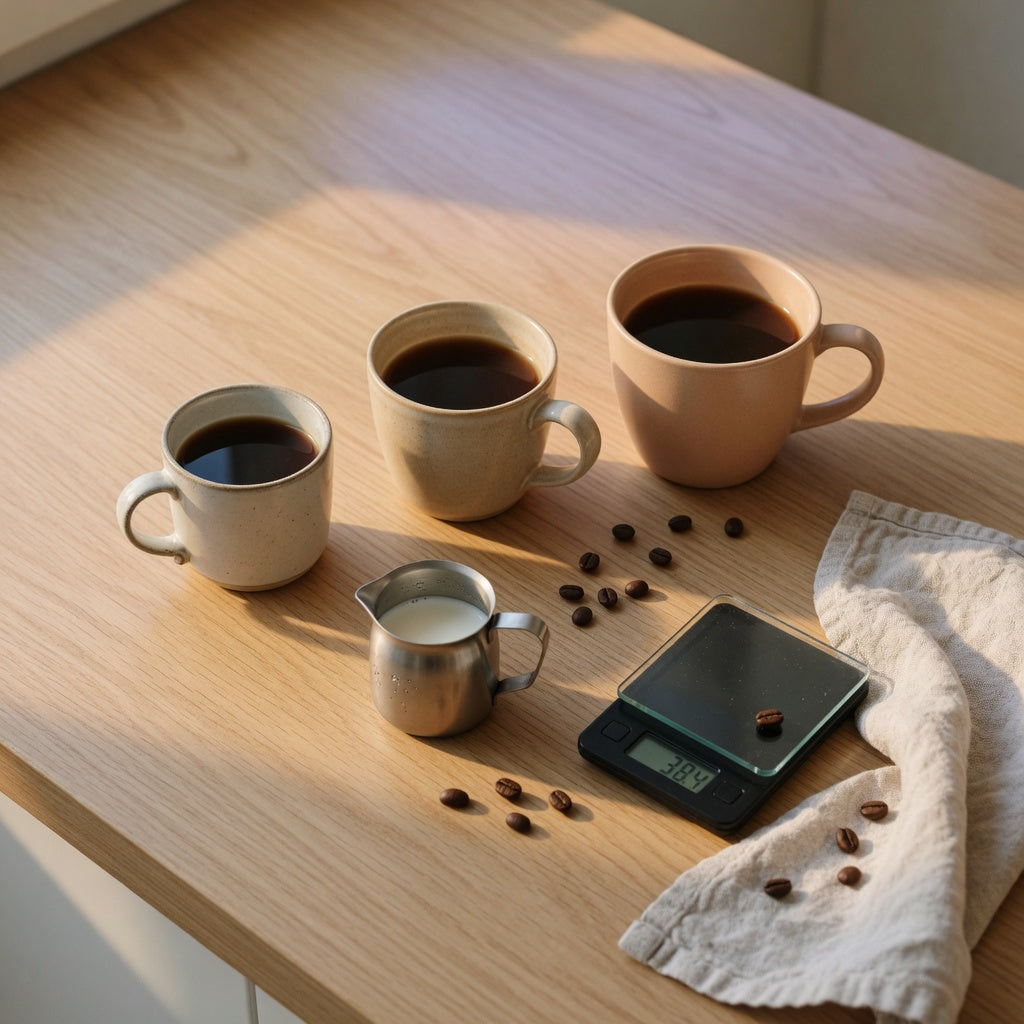
Big Latte Mug Home Coffee Station Product Shortlist Guide: 3 Picks
Reading time: about 10 minutes
A customer once carried a 600 ml mug up to our counter and asked whether it would make her latte taste better. It made it taste colder. The drink was fine — the vessel was simply too large for the milk she was steaming, and the extra surface gave the heat somewhere to go. That is the trap this big latte mug home coffee station product shortlist guide is built to avoid, because capacity is the easiest spec to compare and the least useful on its own.
What actually decides whether a mug earns its counter space is narrower: the drink you make most often, the clearance above and beside the mug, and how it feels in one hand on the walk back to your desk. Below are three capacities from our own lineup, each mapped to a real station setup, with the reasons to pick it and the reasons to leave it on the shelf.
What does “big” mean when a listing says latte mug?
Two different objects share the name. A café-style latte cup is typically listed around 300–355 ml and is built to sit on a saucer holding a double shot plus steamed milk. A retail big latte mug usually starts near 400 ml and climbs well past 600 ml. Both are legitimate products. They are not interchangeable, and confusing the two is the mistake we see most often.
Regulation does not settle it either. FDA guidance describes cups and mugs as small ceramic hollowware — normally, though not exclusively, around 240 ml (8 fl oz) and made with a handle — and puts the small-to-large hollowware line at 1.1 liters. That is useful for food-contact rules and useless for choosing a breakfast mug.
Arithmetic helps more. NIST lists 1 U.S. fluid ounce as 29.57353 ml and converts 16.0 fl oz to 473.176 ml. Keep these anchors in mind:
- 8 oz = 236.6 ml — small milk drinks.
- 12 oz = 354.9 ml — the classic café latte cup.
- 400 ml ≈ 13.5 fl oz.
- 440 ml ≈ 14.9 fl oz.
- 480 ml ≈ 16.2 fl oz.
That rounding gap explains why a 400 ml mug arrives looking like a 14 oz cup, and why the same 480 ml body gets sold as 16 oz on one page and 17 oz on the next. If you want the longer version of the arithmetic, our breakdown of how many ounces are in a mug of coffee walks through the conversions in more detail.
The big latte mug home coffee station product shortlist guide: three capacities, three jobs
Our lineup sits at three listed capacities, and in our experience each one wins a different argument. The losing arguments are just as worth knowing, so we have put them in the table rather than buried at the bottom.
| Mug | Listed capacity | Strongest use | Skip it if |
|---|---|---|---|
| The Flow | 400 ml | Single or double shot latte, tight stations, tea | You routinely drink 16 oz milk drinks |
| Morning and Night | 440 ml | Everyday hot latte, desk refills, one-mug households | You want a wide bowl primarily for latte art |
| The Rock | 480 ml | Iced lattes, long drinks, big morning pours | Counter or cabinet clearance is tight |
The Flow, 400 ml — the tight-counter pick
400 ml suits a single double shot with roughly 150–200 ml of steamed milk, leaving a little headroom for a foam cap without asking you to fill a bowl. It also carries the smallest listed capacity of the three, which is the closest thing we can offer to a footprint guide without you measuring your own counter. On a cramped apartment counter, that matters more than volume. Skip it if you build 16 oz drinks or pour iced lattes over a full glass of ice — you will reach the rim before the drink is finished.
Morning and Night, 440 ml — the everyday hot-latte middle
440 ml lands near 14.9 fl oz, roughly where most home latte drinkers settle once they stop copying café takeaway sizes. A 12 oz latte plus foam fits with room to spare, and the mug still reads as a mug rather than a mixing bowl. We recommend this size most often when someone tells us they want one vessel for mornings and evenings both. The limit is pour surface: if latte art is the goal, rim diameter matters far more than capacity, so check that measurement on the current listing before you commit.
The Rock, 480 ml — the iced and long-pour pick
Ice displaces volume before the milk ever goes in, which is why the mug you use for a hot 12 oz drink is too small for the same drink served cold. At about 16.2 fl oz, The Rock is the size that makes iced lattes and long weekend pours work. It is also the one we flag hardest on fit. A 480 ml body still has to sit steadily on a drip tray and clear a shelf, and both of those outcomes depend on base diameter and overall height — two numbers worth confirming on the product page or by asking us directly before you order.
If none of the three matches how you actually drink coffee, browse the full unique coffee mugs collection instead. There is no reason to force a three-item shortlist.
Will a 480 ml mug clear your group head, shelf and cup holder?
Three measurements cause more returns than anything else we handle, and none of them appear on a typical product page.
- Group head clearance. Measure from the drip tray to the underside of the group head with the portafilter locked in. If you brew onto a scale, subtract the scale height first — a mug that fits bare may not fit with a scale underneath. A bottomless portafilter usually buys a little extra room over a spouted one.
- Cabinet height. Include the saucer if you use one, and leave a finger's width above the rim so you are not scraping knuckles at 7 a.m.
- Cup holder diameter. Measure the base, not the rim. Tapered mugs that look slim at the top often wedge in a holder at the bottom.
We would rather answer those three questions before you buy than process the return afterwards.
Handle comfort and filled weight: the specs nobody lists
A 480 ml drink adds roughly half a kilogram of liquid before the ceramic itself is counted. That is fine on a desk. It is less fine carried one-handed across a kitchen, and it is why handle geometry matters more on the largest size than on the smallest.
- Handle opening. Knuckle room, not handle length. A long, thin handle can be harder to grip than a shorter, thicker one because it concentrates the load on a narrow contact area.
- Empty weight. Heavier ceramic feels better in the hand and worse after ten minutes of holding it.
- Balance point. A full mug carried by the handle tips toward the rim. The taller the wall, the more noticeable that becomes.
Our honest read across the three: 400 ml is the safest one-handed carry for most adults, 440 ml is the comfortable middle, and 480 ml is a mug people set down between sips rather than hold through a meeting.
Brim capacity versus pour capacity: where iced lattes go wrong
Printed ounces are almost always measured to the brim. Your drink is not. A hot latte needs room for a foam cap; an iced latte loses close to a third of its volume to ice before the milk goes in. The rule we give customers at the counter: choose one step above your target drink volume. A 12 oz hot latte sits comfortably in 400 ml. The same 12 oz served iced wants 480 ml.
Milk ratio shifts at the same time. A much larger mug does not hold more espresso — it holds more milk, which is why the same double shot tastes flatter in a 480 ml vessel than in a 300 ml cup unless you pull a second shot. Our capacity guide to oversized ceramic coffee mugs sets the sizes out side by side if you want the full spread.
Dishwasher, microwave and what “lead-free” actually promises
Two labels get read more generously than they deserve.
Microwave safe is a statement about the body and glaze surviving thermal shock, not a blanket guarantee for every decorative finish. Anything with metallic detailing should be treated as hand-wash only unless the current listing says otherwise — and that covers a lot of novelty mugs. Large volumes of liquid also heat unevenly in most domestic microwaves, so the rim often stays cool while the centre is already hot. Stir and test before you carry it.
Lead-free is marketing until it is a test result. FDA notes that some ceramic foodware can leach lead from food-contact surfaces, and its action level for ceramic cups and mugs is 0.5 micrograms per milliliter of leaching solution across six units tested. That is a specific, testable threshold — a far stronger claim than a phrase on a hang tag. When a brand publishes a test rather than a slogan, that is worth trusting.
Dishwasher cycles rarely break a mug outright; they age it. Hot cycles plus abrasive detergent dull the glaze surface, and decals fade long before the ceramic fails. Crazing — the web of fine cracks that appears in an older glaze — is usually cosmetic rather than structural, but it does make a mug harder to get truly clean. If the finish matters to you, hand washing is the cheaper habit.
Who should skip a big latte mug entirely
- Flat white and cortado drinkers. A 5–6 oz drink in a 480 ml mug goes cold before you finish it, and the ratio reads thin.
- Latte art practice. A wide, shallow bowl gives a steadier pour than a tall 480 ml vessel. Capacity is not pour surface.
- Very small counters. If the mug lives between a grinder and a kettle, the 400 ml size earns its footprint and the larger ones do not.
- Car commuters. Base diameter decides cup-holder fit, and large mugs lose that fight more often than not.
- Anyone buying for looks alone. A wide, decorative mug is harder to store, harder to hand-wash and easier to knock over than a plain cylinder of the same volume.
None of that makes a large mug a bad purchase. It makes it a specific one, which is exactly how we would rather you buy it. Run the three checks once — group head clearance with your scale in place, base diameter against cabinet and cup holder, and whether your usual drink is hot or iced — then pick the capacity that leaves headroom rather than the one that looks most impressive on the shelf. Shopping for someone else? Our guide to large unique coffee mugs for gifts covers what actually travels and survives a move.
Frequently asked questions
Is a 16 oz mug big enough for a latte at home?
Sixteen U.S. fluid ounces is 473.176 ml to the brim, which is why both the 440 ml and 480 ml mugs get marketed near that figure. A 12 oz latte with a foam cap fits comfortably. A full 16 oz milk drink does not, because brim capacity is not drink capacity — size up if 16 oz is your actual drink volume.
How much does a full big latte mug weigh?
Milk is close to one gram per milliliter, so a 480 ml drink adds roughly half a kilogram of liquid before the ceramic is counted at all. That is why handle opening matters more on the largest size than on a 400 ml mug, and why we suggest carrying a full mug with a hand under the base until you know how it balances.
Can I pour latte art into a 480 ml mug?
Yes, if the rim is wide enough — pour surface comes from rim diameter and bowl shape rather than capacity. A wide 400 ml cup is often easier to pour into than a tall 480 ml one. Check the rim diameter on the listing or ask us before ordering, because it is not a spec every page publishes.
Are the mugs in this shortlist dishwasher and microwave safe?
Check the care section on the current product page for the specific mug rather than assuming across the range, since finishes differ between designs. As a general habit, hand washing keeps glaze and decals looking newer for longer, and metallic trim should stay out of the microwave.
If this big latte mug home coffee station product shortlist guide allows only one pick, which size should I start with?
Start with 440 ml if you drink hot milk drinks daily and want one mug that does most jobs well. Go to 400 ml if counter space is tight or your drinks are 8–12 oz, and to 480 ml only if iced lattes or long pours are your normal. Still torn? Browse the unique coffee mugs collection and compare shapes as well as sizes before you commit.
Read more
Big Latte Mug Home Coffee Station Practical Purchase Checklist
Most mug disappointments start with a number nobody checked — the clearance under the group head, not the capacity on the box. Here is the order we use in our own store to match a big latte mug to ...
Read more
Ceramic Mug Shapes Home Coffee Station Practical Purchase Checklist
The mug that ends up at the back of the cabinet usually failed a measurement, not a beauty contest. This checklist covers capacity, rim comfort, handle room, spout clearance, stacking and glaze so ...
Read more
Leave a comment
This site is protected by hCaptcha and the hCaptcha Privacy Policy and Terms of Service apply.